


 Call Us



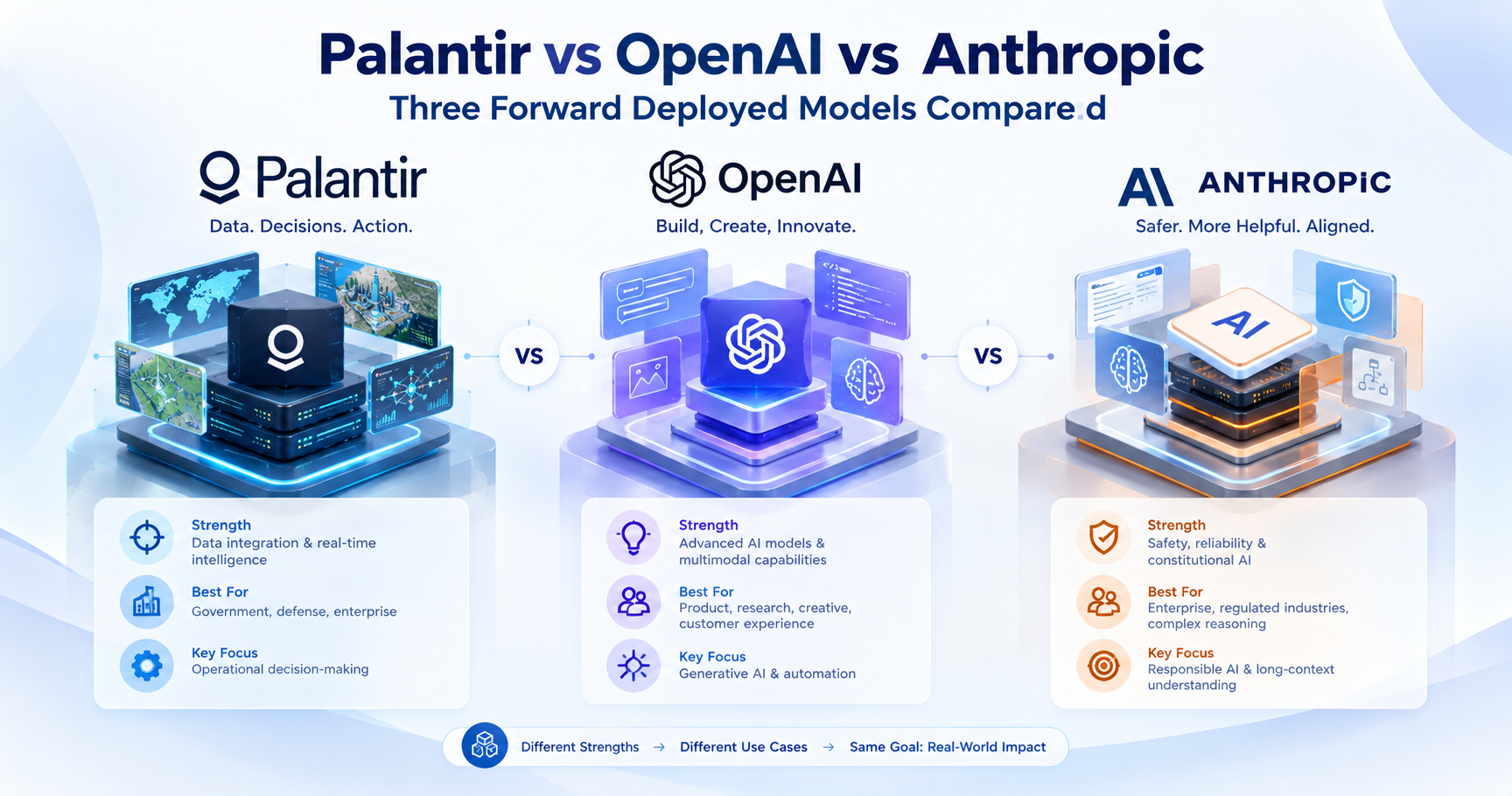
The three most prestigious places to be a forward deployed engineer are Palantir, OpenAI, and Anthropic, and candidates choosing between them deserve to know how the role actually differs across the three, because it differs more than the shared title suggests. Palantir originated the model and runs the reference implementation. OpenAI and Anthropic have adopted and adapted it, each in its own way, as they race to get frontier AI into enterprises. This piece compares the three forward deployed models directly, so anyone weighing where to apply can choose based on the real character of the work rather than the logo.
The comparison matters because the day-to-day work, the skills emphasised, and the interview loops differ meaningfully across the three, and the right fit depends on which version suits you. Whichever you target, the underlying capability is what gets you in, and building it through the Forward Deployed Engineering Program prepares you for all three rather than just one.
Key Highlights
- Palantir originated the forward deployed model and runs the most rigorous version, grounded in ontology, high-stakes domains, and outcome-based delivery.
- OpenAI built its forward deployed team from early 2025, blending customer deployment with contributing back to the product, and weighting production LLM systems.
- Anthropic runs its version under the title Applied AI Engineer, focused on production AI systems like retrieval, evaluation, and agents.
- The interview loops differ: Palantir weights data engineering and problem decomposition, while OpenAI and Anthropic weight production LLM systems and customer judgement.
- The shared insight across all three is that capable models fail without customer-specific grounding, which is engineering rather than prompting.
Palantir: the original and most rigorous
Palantir is where the forward deployed engineer model was born, and it remains the most demanding and reference-defining version of the role. The company developed the model to work with customers, originally intelligence agencies, who could not fully specify their needs through normal product discovery, so Palantir embedded its best engineers directly inside the customer to find the highest-value problems and build against them. That approach became the company's signature and the template everyone else later copied.
The Palantir version of the role has a distinctive character. Its engineers build against a defined outcome rather than a specification, working directly alongside analysts, traders, and domain experts in high-stakes fields like government intelligence, financial trading, and healthcare. A central concept is the ontology, the customer-specific model of the organisation's real nouns and verbs, because Palantir learned early that generic software gives generic results and enterprise value requires grounding in the customer's actual reality. The work is rigorous, deeply embedded, and often in sensitive, demanding environments. For engineers who want the most established and intense version of the role, grounded in the original model, Palantir is the reference, and its standards are correspondingly high.
OpenAI: deployment plus product
OpenAI built its forward deployed engineering function comparatively recently, establishing a dedicated team in early 2025 under experienced leadership, and moved quickly to scale it, reportedly acquiring a specialist forward deployed firm to accelerate. The OpenAI version reflects the company's position at the frontier of model capability, and it has a distinctive dual character that sets it apart from the others.
OpenAI's forward deployed engineers do two things at once. They work inside customer environments, writing code and customising OpenAI's models against the organisation's data and workflow context to make them deliver real value. But they also contribute back to the product, feeding what they learn in the field into OpenAI's broader offering. This dual role, deploying for customers and improving the product, is a defining feature of the OpenAI version, and it appeals to engineers who want their customer work to shape the frontier rather than only serve one client. The emphasis is heavily on production LLM systems, retrieval, evaluation, agents, and fine-tuning trade-offs, which reflects working with the latest models. For engineers who want to be at the absolute frontier of applied AI while also influencing a leading product, OpenAI offers a distinctive proposition, at a correspondingly high bar.
Anthropic: applied AI at production scale
Anthropic runs its forward deployed function under a different name, Applied AI Engineer, and backs it with substantial investment, reflecting how central getting its models into real enterprise use is to the company's strategy. The naming is itself informative: Anthropic frames the role explicitly around applying AI, which signals the emphasis on making capable models deliver in production rather than on the sales or advisory dimensions that dilute the role elsewhere.
The Anthropic version centres on production LLM systems, the retrieval, evaluation, agent, and fine-tuning work that turns a capable model into a reliable enterprise system. Anthropic's applied engineers embed with customers to build these systems against real data and constraints, making Anthropic's models deliver value inside organisations that struggle to do it themselves. Like OpenAI, Anthropic sits at the frontier of model capability, so the work involves the latest models on the hardest deployment problems, and the bar is high. For engineers who want the applied-AI, production-systems flavour of the role at a leading model lab, framed explicitly around application rather than sales, Anthropic offers a clear and appealing version, closely related to OpenAI's but with its own emphasis and culture.
How the three interview loops differ
One of the most practical differences for a candidate is that the interview loops at the three companies differ, and preparing for the wrong one is a common mistake. All three share a general forward deployed shape, a process running several weeks through recruiter screen, technical rounds, a signature ambiguous case study, and behavioural evaluation, and all three weight customer-facing judgement and reasoning through ambiguity heavily. But the technical emphasis differs by company in ways worth preparing for specifically.
Palantir's forward deployed software engineer loop weights data engineering, ontology modelling, and the ability to decompose a vague, ambiguous problem into a workable plan, reflecting its outcome-based, ontology-driven model. OpenAI's and Anthropic's loops weight production LLM systems more heavily, retrieval, evaluations, agents, and fine-tuning trade-offs, reflecting their frontier-model focus, with OpenAI's loop tending to be faster and heavily weighting customer empathy and business judgement. The behavioural and case-study fundamentals overlap across all three, so preparation there transfers, but the technical preparation should be tailored to the company. Understanding these differences is part of the broader forward deployed interview preparation that these rigorous loops demand, and it is one reason targeting a specific company rather than applying broadly pays off.
The insight all three share
Beneath the differences, the three companies share a single insight that explains why they all invested in the forward deployed model, and understanding it clarifies what the role is really for. The insight is that capable but complex systems, and especially large language models, fail to deliver inside organisations unless someone grounds them in the specific customer's reality. Generic models give generic answers. Enterprise value requires grounding the model in the customer's actual nouns and verbs, their real data, workflows, and constraints, and that grounding is engineering work, not prompting.
Palantir productised this insight first, with its ontology-driven, embedded model, and OpenAI and Anthropic lifted the same principle as they discovered that their powerful models did not deliver enterprise value on their own. This is why all three run forward deployed functions despite their differences: each faces the same fundamental problem, that a capable system needs someone to make it work inside a specific, messy organisation. The shared insight is also why the skills transfer across the three, and why the role is so valuable everywhere, because the problem it solves, the gap between capable AI and real deployment, is universal. Whichever company you target, you are solving the same core problem, which is what makes the underlying capability so portable.
What the culture is like at each
Beyond the mechanics of the role, the culture of each company shapes the experience of doing forward deployed work there, and it is worth weighing because you will live inside that culture daily. Palantir has a famously intense, mission-driven culture, particularly around its work in defence and government, and its forward deployed engineers operate in a demanding environment that prizes ownership, rigour, and comfort with high-stakes, sometimes controversial work. Engineers drawn to intensity and consequential missions often thrive there, while those who prefer a gentler pace may find it taxing.
OpenAI and Anthropic, as frontier AI labs, carry the culture of organisations at the centre of a technological revolution, fast-moving, ambitious, and intensely focused on the frontier of what AI can do. Both attract people who want to be where the most advanced work is happening, though the two labs have their own distinct characters and philosophies, with Anthropic in particular emphasising a careful, safety-conscious approach to building AI. The cultural fit matters because forward deployed work is demanding wherever you do it, and doing it inside a culture that energises you rather than drains you makes a real difference to whether you thrive or burn out. Weighing the culture, alongside the role mechanics, is part of choosing well, and it is worth researching each company's culture specifically rather than assuming the prestige of the name tells you what daily life there is like. This cultural dimension interacts with the risk of burnout that the demanding nature of the role carries everywhere.
How to decide between three offers
Suppose you are fortunate enough to have offers from more than one of these companies, which is a genuine possibility for a strong candidate given how aggressively all three hire. The decision then comes down to weighing the factors that differ, and doing so deliberately rather than by prestige alone. Consider the character of the work, whether you want Palantir's ontology-driven, high-stakes rigour, OpenAI's deployment-plus-product blend, or Anthropic's applied-AI focus. Consider the domains, since Palantir's government and finance work differs greatly from the broad enterprise focus of the labs.
Consider the culture and whether it energises you, the compensation and equity across the offers, and the specific team and manager, which often matters more than the company name. Consider too your own longer-term goals, since time at each of these companies opens somewhat different doors, with Palantir's rigour, OpenAI's frontier-and-product exposure, and Anthropic's applied-AI depth each building a distinct profile. The temptation with three prestigious offers is to choose on brand, but the better decision weighs fit across all these dimensions, because all three are elite and the real question is which one suits you specifically. Whichever you choose, the underlying capability is what earned the offers, and continuing to build it through the Forward Deployed Engineering Program keeps you strong wherever you land. There is no wrong choice among three elite employers, only the choice that best fits who you are and where you want to go.
The three models side by side
To help you choose, here is how the three forward deployed models compare across the dimensions that matter for the decision.
| Dimension | Palantir | OpenAI | Anthropic |
| Role in the model | Originator, reference implementation | Recent, fast-scaling adopter | Recent adopter, applied focus |
| Title | Forward Deployed Software Engineer | Forward Deployed Engineer | Applied AI Engineer |
| Distinctive character | Ontology, outcome-based, high-stakes | Deployment plus product contribution | Applied AI, production systems |
| Technical emphasis | Data engineering, ontology, decomposition | Production LLM systems, customer empathy | Production LLM systems, retrieval, agents |
| Typical domains | Government, finance, healthcare | Broad enterprise, frontier customers | Broad enterprise, frontier customers |
| Interview weighting | Decomposition and data engineering | Fast loop, business judgement | Production AI systems |
| Best fit for | Rigour and high-stakes embedding | Frontier plus product influence | Applied AI at a model lab |
Read the table to match your preference to a company. If you want the most rigorous, established, high-stakes version, Palantir fits. If you want the frontier plus a hand in the product, OpenAI fits. If you want applied AI at a leading lab, framed around application, Anthropic fits. All three are elite, and the choice is about character rather than quality.
Which one should you target
The choice among these three prestigious employers comes down to the character of the work you want and the environment you want to do it in, since all three are elite and demanding. If you are drawn to the most rigorous, established version of the role, to high-stakes domains, and to the intellectual depth of ontology-driven, outcome-based work, Palantir is the reference and its rigour will suit you. If you want to work at the absolute frontier of model capability while also shaping a leading product, OpenAI's dual deployment-and-product role is distinctive and appealing.
If you want the applied-AI, production-systems flavour at a leading model lab, with the role framed explicitly around application rather than diluted toward sales, Anthropic offers exactly that. There is no wrong choice among the three in terms of prestige or opportunity, they are three of the best places to do this work, so the decision should be about fit: the domains, the culture, the balance of customer work and product influence, and the specific emphasis of the role. Because the underlying capability is shared, preparing well positions you for all three, and building that capability through the Forward Deployed Engineering Program, grounded in agentic AI engineering, is how you make yourself a credible candidate wherever you aim.
For a candidate, the healthiest way to approach these three is to prepare for the shared core and then tailor at the margin, rather than betting everything on one company's specific emphasis. The fundamentals of decomposing an ambiguous problem, building reliable production AI, and exercising customer judgement carry across all three loops, and the company-specific weighting is a refinement on top of that shared base. Build the core capability first, and the choice among three elite employers becomes a question of fit rather than a gamble on guessing one company's particular emphasis.
It is also worth remembering that the specific details of each company's programme evolve, since all three are actively building and refining their forward deployed functions, so the fixed points to rely on are the enduring differences in character and emphasis rather than any particular current detail. The rigour-versus-frontier-versus-applied distinction is durable even as the specifics shift.
The bottom line
Palantir, OpenAI, and Anthropic run the three most prestigious forward deployed programmes, and they differ more than the shared title suggests. Palantir originated the model and runs the most rigorous, ontology-driven version in high-stakes domains. OpenAI built its team from early 2025 and blends customer deployment with contributing back to the product. Anthropic runs its version as the Applied AI Engineer role, focused on production AI systems at a leading lab. Their interview loops differ too, with Palantir weighting data engineering and decomposition and the labs weighting production LLM systems.
Beneath the differences, all three share the insight that capable models fail without customer-specific grounding, which is engineering rather than prompting, and that shared problem is why the skills transfer across all three. The choice is about fit, the domains, the culture, and the specific emphasis, rather than quality, since all three are elite. Because the underlying capability is portable, preparing well through the Forward Deployed Engineering Program positions you for whichever of the three fits you best.
Preparing for all three
Because the underlying capability transfers across all three companies, the smartest preparation is to build genuine skill across the full span of the role rather than optimising for one employer. Grounding yourself in agentic AI foundations and the applied work that takes a developer into shipping AI features prepares you for Palantir's rigour, OpenAI's frontier-and-product blend, and Anthropic's applied focus alike. The three loops differ in emphasis, but the core of building and deploying AI inside real customers is shared, so real capability is what opens doors at whichever of the three fits you best.







 Lowest-Price Challenge











 Personalized Path


.webp)


 USA
USA  Canada
 India
India UK
UK Australia
 Singapore


