


 Call Us




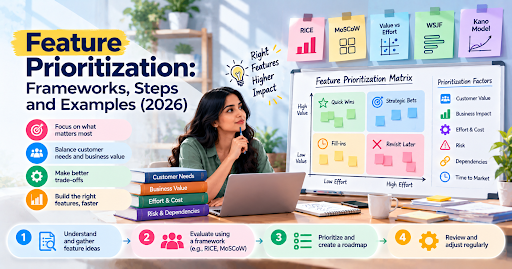
Key Highlights of Feature Prioritization
- Feature prioritization helps teams decide what to build first.
- RICE, MoSCoW, Kano, and WSJF support different product decisions.
- A feature prioritization matrix makes trade-offs easier to see.
- Customer needs, business value, effort, risk, and dependencies matter.
- Prioritization should be reviewed as product goals and evidence change.
- SAFe teams can use WSJF during Program Increment planning.
Introduction
Ideas are in plentiful supply for product teams. The difficult part is knowing which ideas to pay attention to first.
The backlog can also contain customer requests, business needs, technical improvements, new product ideas, compliance work, and fixes. The team can usually not build everything at the same time. That's where feature prioritization comes into play.
Feature prioritization provides product teams with a tangible way to evaluate features and determine what to work on next. It helps teams allocate their time, avoid waste, and keep product work aligned with business and customer needs.
There’s no one-size-fits-all for every product. A small team might apply a simple value vs effort matrix, whilst a larger team may require a more structured scoring like RICE or WSJF.
In this guide, we’ll look over the main feature prioritization frameworks, the steps, common mistakes, and practical feature prioritization examples.
What Is Feature Prioritization?
Feature Prioritization Definition
Feature prioritization is the process of deciding which product features to develop first based on considerations such as customer value, business value, effort, risk, urgency, and dependencies.
The aim is not simply to create a list from top to bottom. Good prioritization helps us to answer a more useful question: Which work should we do now, and why?
A clear feature prioritization process also simplifies product discussions. Teams can use consensus criteria and evidence rather than opinion.
Feature vs Capability vs Epic vs User Story
In product planning, features are not the only things you see. Product teams could also work with capabilities, epics, and user stories.
A feature is generally a function of a product that has some value to users or customers. So an epic is a larger body of work. It may have a few features or stories. A user story is a small piece of user work.
A capability is often larger than a feature and may include several related features.
For a detailed comparison, please refer to What Is The Difference Between A Capability And A Feature In SAFe and Epic Vs Feature Vs User Story.
Understanding these differences is important as teams need to prioritize work at the right level.
Feature Prioritization vs Backlog and Roadmap Prioritization
Feature prioritization is about deciding which features to focus on and in what order.
Backlog prioritization focuses on the larger set of work items in a backlog. It can be user stories, technical work, bugs, or features.
Roadmap prioritization is even more common. It looks at how a particular piece of work fits into a product roadmap over time.
These activities are related, but not the same. A feature might be valuable, but it might need to wait because of dependencies, capacity, timing, or some other business priority.
Why Feature Prioritization Matters
Maximizing Value Per Unit of Engineering Effort
Time for engineering is limited. When you have features that take three months to work on, you should treat them differently than features you can do in a few days.
Good feature prioritization helps teams weigh the expected value against the work it takes to deliver it. This does not mean to only pick the easiest features. That is to say, the trade-off is transparent.
For instance, a feature with high customer value and moderate effort may be considered earlier than a feature with similar value but much higher effort.
Aligning Delivery to Product Strategy and OKRs
Features should connect to larger product goals, usually expressed as OKRs and tracked with KPIs. (See OKR vs KPI for the difference.)
If the goal is to increase customer retention, then we should focus on customer retention features. But if the goal now is to reduce operational cost, internal efficiency features might become more important.
That link prevents teams from filling the product roadmap with features simply because they were requested.
Reducing Waste, Scope Creep, and Stakeholder Conflict
If there is no clear way to prioritize, then each stakeholder might have a different idea about what needs to be addressed first.
A common feature prioritization framework gives the team a common language for discussing those requests. It doesn’t remove disagreement, but it can help make the reasons behind each decision more understandable.
It can also help to limit scope creep, as new requests can be measured against the same criteria as the existing work.
Inputs You Need Before You Prioritize
Product Vision, Strategy, and Current Objectives
First, understand what the product is trying to do.
Review product vision, strategy, current goals, OKRs, customer segments, and business goals. They give the context for the decisions that follow.
Usage Data and Customer Evidence
Feedback from clients is helpful, but it shouldn’t be the only input.
Teams can also look at product usage, support requests, customer interviews, conversion data, retention data, surveys and other relevant evidence.
The goal is to know whether a feature solves a real and meaningful problem, which is the job of product discovery.
Effort, Dependency, and Risk Estimation
The value of a feature cannot be considered apart from the work required to deliver it.
Teams should consider development effort, testing, design work, technical complexity, dependencies, risks, and capacity.
Such inputs are important for reliable feature prioritization scoring.
Business Value and Compliance Drivers
Some work may be important for revenue, cost savings, contracts, security, regulations, or other business requirements.
Not all features need to be used by a lot of customers to be important. There may be a different type of priority arising from compliance or operational requirements.
Popular Feature Prioritization Frameworks
There are many feature prioritization methods, and each of them takes into account product decisions in a different way.
RICE scoring (Reach, Impact, Confidence, and Effort)
The RICE prioritization framework has four factors:
- Reach
- Impact
- Confidence
- Effort
A standard RICE formula is:
RICE Score = Reach x Impact x Confidence / Effort
Reach estimates the number of users/customers who are impacted. Impact estimates the effect on each user/customer. Confidence measures how confident the team is in its estimates. Effort is the work to be done.
RICE can be useful when teams have enough data to make reasonable guesses.
You can also go through the complete guide on the RICE Prioritization Framework.
MoSCoW Prioritization Method
Moscow prioritization divides requirements into four groups:
- Must have
- Should have
- Could have
- Won’t have this time
The approach can be useful when a group needs to make explicit decisions about what’s important in a finite scope or time period.
For example, a payment product might have secure payment processing as a Must have, but a cosmetic interface change might be a Could have.
Learn more about MoSCoW prioritization.
Effort vs. Value Matrix
The value vs effort matrix is a way of comparing the expected value of a feature with the effort involved in building it.
It generally makes four wide groups:
- High value, low effort
- High value, high effort
- Low value, low effort
- Low value, high effort
High-value, low-effort items are often worthy of close attention. Low-value, high-effort items may take more discussion.
A feature prioritization matrix based on value and effort is simple enough for workshops and early product conversations.
Kano Model
Kano Model explains the correlation between various product features and customer satisfaction.
Features can be categorized into such things as basic needs, performance needs and attractive features.
When a basic need is there customers might not be impressed but if it is absent they might get dissatisfied. A nice feature might add to satisfaction but is not anticipated.
This is why the Kano Model is helpful when customer satisfaction is a big part of the decision.
Weighted Scoring and Opportunity Scoring
Weighted scoring assigns different values or amounts of importance to different criteria.
For example, a team might score each feature on customer value, revenue impact, strategic fit, effort, and risk. The team then assigns weights to those criteria.
Opportunity scoring is driven by the difference between the importance of an outcome to a customer and the satisfaction with the current solution.
These methods can be useful when teams need a more tailored feature prioritization framework.
How to Choose the Right Framework for Your Context
Simple feature prioritization matrix: When the team needs a quick visual comparison. When you have good data on reach and impact, use RICE.
Use MoSCoW When Scope Boundaries Matter. If customer satisfaction is your main consideration, use Kano.
It needs to be customized to the team’s needs, not create unnecessary work.
WSJF: How SAFe POPMs Prioritize Features
Weighted Shortest Job First Explained
Weighted Shortest Job First (WSJF) is a prioritization model used in SAFe to sequence work based on economic value.
The basic idea is to consider the cost of delaying work and to compare it to the job size.
The WSJF is particularly relevant for Product Owners and Product Managers in SAFe environments.
SAFe POPM Certification Training is designed for those professionals who want to learn about the Product Owner/Product Manager role in SAFe.
Elements of the Cost of Delay
WSJF uses Cost of Delay which is based on three factors:
- Value to Business
- Time criticality
- Opportunity facilitation and risk mitigation
These factors help teams consider what might happen if work is delayed.
PI Planning: Dividing Cost of Delay by Job Size
The basic WSJF calculation is:
WSJF = Cost of Delay / Job Size
The result helps teams compare work based on the size of the work versus the economic impact of the delay.
Teams in SAFe can use this approach to prepare and sequence work during Program Increment planning.
How to Prioritize Features Step by Step
Step 1: Define Objectives and Criteria for Prioritization Scoring
Begin with what's important.
The criteria can include customer value, business value, revenue impact, strategic fit, urgency, effort, risk, and dependencies.
Don’t have too many criteria. Teams are more likely to use a simple model consistently.
Step 2: Collect, De-duplicate, and Merge Requests
Collect feature requests from customers, sales, support, leadership, research, analytics, and internal teams.
Delete duplicate requests Combine requests that solve the same problem.
This results in a cleaner list to start feature prioritization.
Step 3: Score Features with a Selected Framework
Pick a framework and stick with it.
This could be RICE scores, MoSCoW categories, a value versus effort matrix, Kano categories, or WSJF scores.
Document the assumptions underlying the scores. This documentation makes subsequent reviews easier.
Step 4: Roadmap or Program Increment to Sequence
Score then consider capacity, dependencies, timing, technical constraints and other commitments.
Then identify which features can be deferred to the next delivery time.
The output should be fed into the product roadmap, backlog, or Program Increment Plan.
Step 5: Communicate Decisions & Re-Prioritize
Prioritisation decisions should be shared with the people who are affected by them.
Here is what was picked, what was put off, and why.
Feature prioritization should be a continuous activity as new evidence might change priorities.
See Agile Prioritization Techniques for additional ideas.
Feature Prioritization Example (Worked Walkthrough)
Think about a mobile shopping product with 4 possible features:
- Speedy checkout
- Dark mode
- Compare Products
- Personalized Recommendations
The team begins by reviewing customer data and business goals.
Faster checkout directly correlates to reduced checkout abandonment. Compare products and let the buyer decide.Personalized recommendations could help keep people engaged, and dark mode could improve the experience for some users.
Next, the team estimates effort.
Let’s say that faster checkout takes a moderate amount of engineering work. Product comparison takes a moderate amount of work. Personalized recommendations take a significant amount of data and engineering work. Dark mode takes relatively little.
The team can then score these features on a feature prioritization matrix using value and effort.
It might also use RICE to think about reach, impact, confidence, and effort.
The important point is the final order. The value of the exercise is to surface the reasoning and to test the assumptions that underlie each decision.
This is one of the simplest feature prioritization examples, as it shows how the same features can be viewed differently depending on the criteria.
Common Feature Prioritization Mistakes
Letting the Loudest Voice (HiPPO) Override Evidence
A senior stakeholder may have a forceful opinion about a feature. Their input can be valuable, but authority should never preempt customer evidence, product strategy, or delivery information.
The structured feature prioritization process provides the team with a way to consider all important inputs.
Ignoring Effort and Technical Debt and Dependencies
A feature might seem like a promising idea until the team learns what it takes to build it.
Not accounting for dependencies and technical debt can result in unrealistic plans and delivery issues.
Treating Prioritization as a One-Time Event
The markets are shifting. Customer needs evolve. Product data is changing.
A feature that was important six months ago may not be as important today. Teams should review priorities when new relevant information becomes available.
Prioritising Outputs, Not Outcomes
An output is a feature. The result is the change that the product team wants to make.
Outputs: For example, adding a new search filter. So customers are finding products faster.
Good feature prioritization techniques keep the desired outcome in mind.
Best Practices for Effective Feature Prioritization
Here are some simple practices to help you prioritize features:
- Start with product goal.
- Use customer evidence where possible.
- Explain the scoring criteria.
- Put engineering effort into the mix.
- Think about dependencies when you commit.
- Save reasons for major decisions.
- Do not change the criteria for individual features.
- As evidence changes, re-examine priorities.
- Separate the urgent work from the really valuable work.
- Link the selected features to measurable results.
Also, teams should not adopt a framework just because it is popular. The best feature prioritization methods are ones the team can understand, apply, and review consistently.
Tools and Templates for Feature Prioritization
Prioritization can be managed using spreadsheets, product management tools, whiteboards, or simple documents.
A basic feature prioritization template can include:
- Feature name
- Customer problem
- Target users
- Business value
- Customer value
- Strategic alignment
- Estimated effort
- Dependencies
- Risk
- Priority score
- Decision
- Reason for decision
Your feature prioritization template may also have assumptions and evidence fields. That allows teams to go back and look at scores if they get new information.
For smaller teams, a simple feature prioritization matrix may be enough. Larger teams may need a more detailed scoring system.
Conclusion
When the ideas are more than the time and resources to execute them, feature prioritization helps product teams make pragmatic decisions.
RICE, Moscow, value vs effort matrix, Kano, weighted scoring, WSJF all show different ways of comparing product work. The best way will depend on the product, the team, the data you have and the goal at stake.
A good feature prioritization framework should make decision making easier, not harder. The goal of the product. Collect the evidence that counts. Balance risk against effort. Rate features uniformly. Re-prioritize as conditions change.
When feature prioritization is done right, teams can spend their limited time working on things that can make a material difference for their customers and the business.








 Lowest-Price Challenge












 Personalized Path



.webp)


 USA
 Canada
 India
 UK
 Australia
 Singapore


