


 Call Us



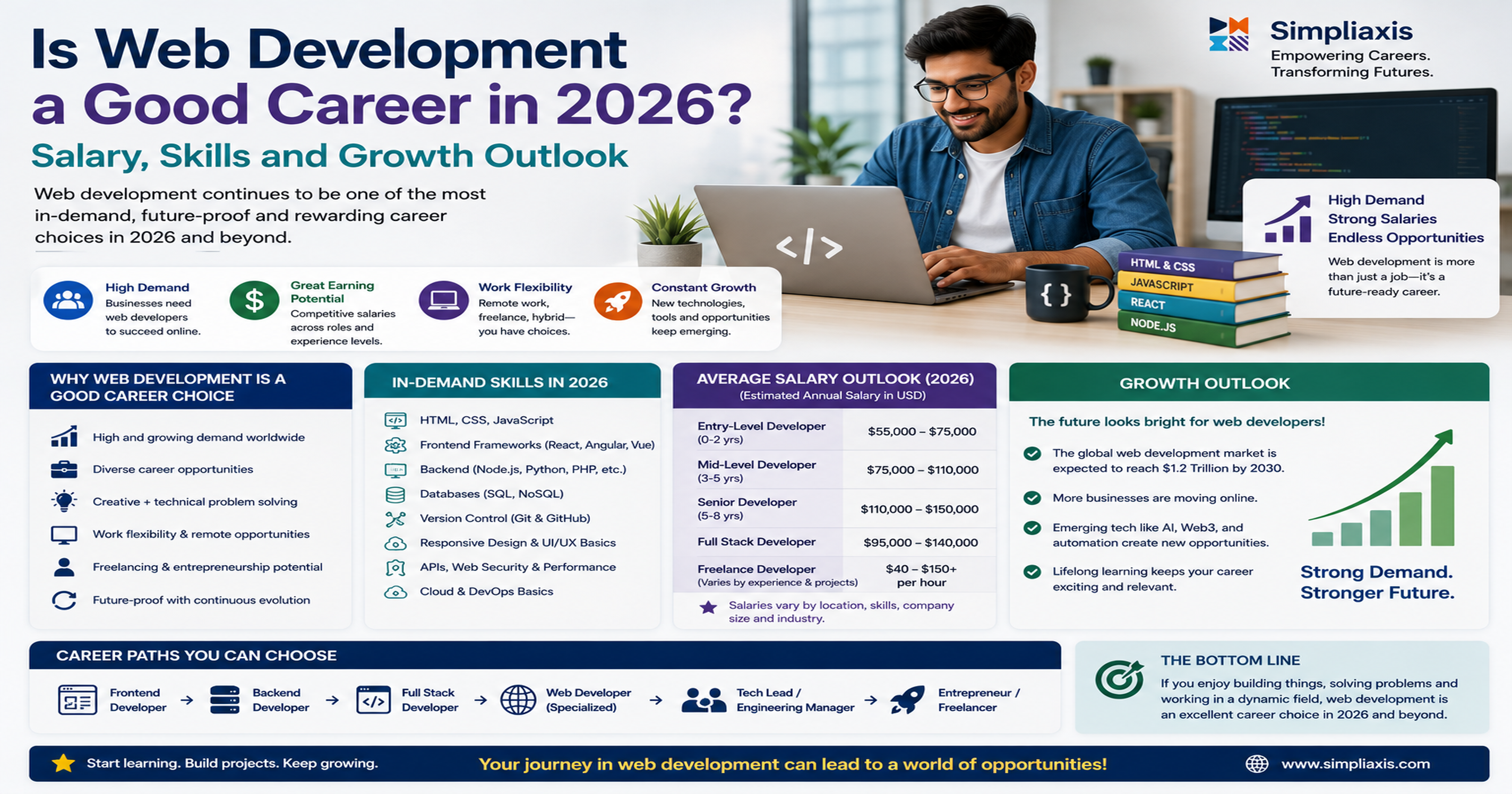
Yes, web development remains a good career in 2026 for most people willing to learn continuously. Global demand for websites, e-commerce platforms and web applications keeps rising, entry is possible without a traditional four-year degree, and experienced developers in specialized stacks (React, Node.js, cloud-native architecture) continue to command strong salaries. The main caveat is that generative AI is automating routine coding tasks, so the developers who thrive are the ones who move up the stack into system design, architecture, security and AI-assisted engineering rather than staying purely at the "write basic HTML/CSS" level.
Key Highlights of Is Web Development a Good Career
- The U.S. Bureau of Labor Statistics groups web developers with digital designers and projects faster-than-average employment growth through the early 2030s, with tens of thousands of job openings expected across the decade.
- Salary ranges are wide: entry-level developers in the U.S. typically start in the $55,000 to $70,000 range, while experienced full-stack and specialized developers can earn well over $120,000; in India, salaries range from roughly ₹3 to ₹7 LPA for early-career roles up to ₹20+ LPA for senior and product-company roles.
- JavaScript remains the most-used language for the 13th consecutive year in the Stack Overflow Developer Survey, with React the dominant front-end framework and Node.js the leading back-end runtime.
- AI coding assistants are changing the job, not eliminating it: they automate boilerplate and repetitive code, while human developers are increasingly valued for architecture decisions, debugging complex systems, security and product judgment.
- You can realistically break into web development without a computer science degree through self-study, bootcamps, and a strong project portfolio, though structured certifications and formal training measurably shorten the learning curve for career switchers.
- Career paths branch into front end, back end, full stack, and increasingly AI-augmented development, DevOps, and cloud-native engineering, each with different skill stacks and long-term earning trajectories.
What Does a Web Developer Actually Do
Web development is the work of building, testing and maintaining websites and web applications, everything from a small business landing page to a large-scale e-commerce platform or SaaS product. The discipline is usually split into three areas of focus:
- Front-end development, which builds everything a user sees and interacts with in the browser: layout, styling, interactivity, accessibility and performance.
- Back-end development, which builds the server, database, APIs and business logic that power the application behind the scenes.
- Full-stack development, which combines both, and is increasingly the default expectation at startups and mid-sized companies that cannot afford separate specialized teams.
Day-to-day work typically includes writing and reviewing code, fixing bugs, integrating third-party APIs and payment systems, optimizing page speed and Core Web Vitals, and collaborating with designers, product managers and QA engineers. Increasingly, it also includes working alongside AI coding assistants to generate boilerplate, then reviewing, refactoring and securing that output.
Web Developer Job Outlook and Demand in 2026
The U.S. Bureau of Labor Statistics' Occupational Outlook Handbook tracks "Web Developers and Digital Designers" as a combined occupational category. Reporting drawn from that data indicates a median annual wage in the neighborhood of $90,000 and an employment base of roughly 86,000 workers as of the most recent survey year, with projected growth described as significantly faster than the average for all occupations over the coming decade. Growth-rate figures cited across secondary sources vary (numbers between roughly 8% and 16% appear depending on the exact time window and whether digital designers are included), so treat any single percentage as directional rather than exact, and check the BLS Occupational Outlook Handbook directly for the current published figure before quoting it in a resume or business case.
What is consistent across sources is the underlying demand driver: virtually every business, from local retailers to global enterprises, now depends on a website, e-commerce storefront, or web-based application to reach customers, which keeps demand for developers structurally high even as the tools used to build those products evolve. Remote and hybrid work options also remain unusually common in this field compared to many other professions, widening the addressable job market for developers who are not located near major tech hubs.
How Much Do Web Developers Earn
Compensation varies enormously by country, specialization, company size and experience level. Based on aggregated salary-tracking data from sources like Payscale and Indeed:
| Experience Level | Typical U.S. Salary Range | Typical India Salary Range |
| Entry-level (0-2 years) | $55,000 to $70,000 | ₹3,00,000 to ₹6,00,000 |
| Mid-career (3-6 years) | $70,000 to $95,000 | ₹6,00,000 to ₹12,00,000 |
| Senior / Specialized (7+ years) | $100,000 to $140,000+ | ₹15,00,000 to ₹25,00,000+ |
These ranges are directional estimates built from multiple third-party salary aggregators rather than a single authoritative census, and actual pay depends heavily on the specific stack (a developer with strong cloud and DevOps skills, for example, typically out-earns a generalist), the hiring company's size and sector, and the city or country's cost of living. Product and fintech companies in major hubs like Bangalore, San Francisco or London generally pay well above these medians, while smaller agencies and services companies tend to pay closer to the lower end.
Is AI Going to Replace Web Developers
This is the single biggest question anyone researching this career should ask in 2026, and the honest answer is nuanced. AI coding assistants are genuinely capable of generating boilerplate components, simple CRUD interfaces, basic styling and even entire prototype pages from a text prompt. Low-code and no-code AI-powered builders are also letting non-technical users assemble simple sites and internal tools without writing code at all.
What AI still struggles with is contextual judgment: understanding how a small change cascades through a large, interconnected system, making architecture decisions that balance performance, security, and long-term maintainability, and translating ambiguous business requirements into a coherent technical plan. The realistic near-term outcome is not mass replacement of developers but a shift in what developers are paid to do: less time typing repetitive syntax, more time on system design, code review, security hardening, performance tuning and directing AI tools effectively. Developers who treat AI as a productivity multiplier and invest in the judgment-heavy parts of the job (architecture, debugging, security, product thinking) are best positioned; those who only ever learned to copy-paste basic templates face the most pressure.
Front End vs Back End vs Full Stack: Which Path Fits You
Choosing a specialization early can make your learning path far more efficient.
- Front-end developers focus on HTML, CSS, JavaScript, responsive design, accessibility and performance, and typically work with a framework such as React. This path suits people who enjoy visual design, user experience and rapid, visible feedback on their work.
- Back-end developers focus on server logic, databases, APIs, authentication and scalability, typically using languages like Python, Java, PHP, or Node.js-based JavaScript, plus SQL or NoSQL databases. This path suits people who enjoy systems thinking, data modeling and solving performance or security problems.
- Full-stack developers work across both layers. Full-stack roles are increasingly the default at startups and mid-sized product companies because a single hire can own a feature end to end, and this generalist skill set tends to translate well into technical leadership and architecture roles over time.
According to the Stack Overflow Developer Survey, JavaScript has remained the most-used language among professional developers for over a decade, React leads front-end framework adoption, and Node.js is the most widely used back-end runtime, which is why most full-stack bootcamps and roadmaps in 2026 center on a JavaScript/TypeScript, React, and Node.js combination as the fastest path to a shippable, hireable skill set.
Skills and Technologies You Need in 2026
A realistic, current skill stack for a hireable web developer includes:
- Core fundamentals: HTML5, CSS3 (including responsive design and Flexbox/Grid), and JavaScript (ES6+), with TypeScript increasingly expected rather than optional.
- A modern front-end framework: React remains dominant, with Vue and Angular still widely used in enterprise environments.
- Back-end fundamentals: at least one server-side language or runtime (Node.js/Express, Python/Django or Flask, or Java/Spring), plus REST or GraphQL API design.
- Databases: working knowledge of at least one relational database (PostgreSQL, MySQL) and one NoSQL option (MongoDB).
- Version control and workflow: Git and GitHub, plus basic CI/CD concepts.
- Cloud and deployment basics: familiarity with a major cloud provider (AWS, Azure, or Google Cloud) and containerization concepts like Docker are increasingly expected even for mid-level roles, not just DevOps specialists.
- AI-assisted development: fluency with AI coding assistants and prompt-based code generation, paired with the judgment to review, test and secure whatever they output.
- Soft skills: the ability to translate business or design requirements into technical decisions, communicate trade-offs, and collaborate across design, product and QA functions.
Developers aiming for senior or architect-track roles often add structured cloud or DevOps credentials to formalize these skills. For example, Simpliaxis's Generative AI for Software Developers course is aimed specifically at developers who want to integrate AI tools into their daily workflow, while its Python Programming Certification covers the back-end language most commonly paired with data-heavy and AI-integrated web applications.
Pros and Cons of a Web Development Career
| Pros | Cons |
| Strong, broad-based demand across nearly every industry, not just tech companies | The field evolves quickly; frameworks and best practices that were standard five years ago are often outdated today |
| Multiple entry paths: self-study, bootcamps, degrees, or certifications all lead to real jobs | Entry-level roles are increasingly competitive as more people enter the field through bootcamps and online courses |
| High remote and freelance flexibility compared to many other careers | AI tools are compressing the value of purely repetitive, boilerplate-level coding skills |
| Clear progression into higher-paying specializations like cloud architecture, DevOps and technical leadership | Continuous learning is mandatory; developers who stop upskilling can become less competitive within a few years |
| Tangible, portfolio-based hiring means results can matter more than pedigree | Debugging and deadline pressure can be mentally demanding, especially early in a career |
How to Become a Web Developer: A Step by Step Path
- Learn the fundamentals. Start with HTML, CSS and JavaScript through free resources, structured online courses, or a paid bootcamp, depending on how much guidance and accountability you need.
- Pick a specialization track. Decide whether to lean front end, back end, or full stack based on what you enjoy building, then choose one framework and one back-end language to go deep on rather than spreading thin across many.
- Build real projects, not just tutorials. Recreate a small e-commerce flow, a dashboard with a real API, or a full CRUD application with authentication. Employers consistently weigh a working portfolio more heavily than a list of completed courses.
- Learn Git and deploy your work publicly. Host projects on GitHub and deploy live versions so hiring managers can interact with them directly, not just read about them.
- Get comfortable with AI-assisted coding tools. Practice using them to speed up boilerplate work while still being able to explain, debug and refactor every line they produce; interviewers increasingly test for this judgment specifically.
- Gain real-world experience. Freelance projects, open-source contributions, or internships all provide the kind of applied experience that a home project alone cannot fully replicate.
- Network and apply strategically. Use LinkedIn, developer communities, and referrals; a strong portfolio combined with a warm introduction consistently outperforms cold applications.
Do You Need a Certification or Degree
A four-year computer science degree is not strictly required to become a working web developer, and many hiring managers, particularly at startups and agencies, prioritize a demonstrable portfolio and practical skills over formal credentials. That said, certifications and structured training programs still carry real value in two specific ways: they compress the self-study timeline for career switchers who don't already have a technical background, and they provide third-party validation of specific, in-demand skills (a particular cloud platform, a specific framework, or an AI-integration skill set) that a generalist portfolio may not clearly demonstrate.
For developers moving toward cloud-native or DevOps-adjacent web roles, credential-backed training such as Simpliaxis's AWS Certified DevOps Engineer Professional course or its Microsoft Azure Developer Associate (AZ-204) certification can help formalize the deployment, infrastructure and automation skills that increasingly separate mid-level developers from senior, architecture-track engineers.
Career Growth: From Junior Developer to Architect
A typical long-term trajectory looks like: Junior Developer, to Mid-level or Senior Developer, to either a Technical Lead/Engineering Manager track or a Solutions/Software Architect track, with parallel branches into specialized roles like DevOps Engineer, Cloud Engineer, or AI Integration Engineer becoming increasingly common and well-compensated as of 2026. Developers who deliberately build skills adjacent to their core specialty, cloud infrastructure, security, or AI tooling, tend to reach senior compensation bands faster than those who remain purely focused on writing application code. Because so much of the field now overlaps with cloud deployment and automation, many experienced web developers eventually pursue adjacent credentials in project delivery or IT service management to move into technical leadership, a path covered in more depth in Simpliaxis's guide to the best industries for project managers for developers considering a move into technical program management.
Who Should Think Twice About This Career
Web development is not equally suited to everyone. It may be a poor fit if you dislike frequent, ongoing learning, since frameworks, tooling and best practices genuinely change every few years and stagnating technically has real career consequences. It can also be frustrating for people who need highly predictable, repetitive daily work, since debugging and requirement changes are a constant. Finally, if your only motivation is that "coding pays well" without any underlying interest in building or problem-solving, the entry-level job search in an increasingly competitive, AI-augmented market may prove discouraging; the developers who report the most career satisfaction tend to genuinely enjoy the process of building and improving software, not just the paycheck at the end of it.
Key Takeaways
- Web development remains a strong, broadly in-demand career in 2026, driven by the fact that virtually every business now depends on a web presence or web application.
- Salary potential is real but wide-ranging, and is shaped heavily by specialization, geography, and company type rather than the "web developer" title alone.
- AI is changing the job, automating repetitive coding tasks, not eliminating it, and developers who build judgment-heavy skills (architecture, security, debugging, AI-tool fluency) are best positioned.
- A four-year degree is not mandatory; a strong project portfolio, demonstrable skills, and increasingly, targeted certifications, can open real job opportunities.
- Choosing a specialization (front end, back end, or full stack) early, and pairing it with cloud or AI-integration skills, tends to accelerate long-term earning potential.
- Continuous learning is not optional in this field; developers who stop upskilling for even a few years risk falling behind on tooling and best practices.
Frequently Asked Questions
1. Is web development still a good career in 2026?
Yes. Demand remains broad-based across industries, remote flexibility is high, and multiple entry paths exist, though developers now need to actively incorporate AI tools and keep skills current to stay competitive.
2. Is web development a dying career because of AI?
No. AI is automating repetitive, boilerplate coding tasks, but it still cannot reliably handle system architecture, complex debugging, security decisions, or translating ambiguous business needs into working software, all of which remain human-led tasks.
3. Can I become a web developer without a degree?
Yes. Many working developers are self-taught or bootcamp-trained; a strong project portfolio and demonstrable skills often matter more to hiring managers than a specific degree.
4. How long does it take to become job-ready as a web developer?
Timelines vary widely, but many career switchers report reaching an entry-level, job-ready skill level in roughly six months to a year of consistent, focused study and project-building, faster with a structured bootcamp or course and slower with unstructured self-study.
5. Should I learn front end, back end, or full stack first?
Most beginners start with front-end fundamentals (HTML, CSS, JavaScript) since the feedback is immediate and visual, then branch into back-end or full-stack work once those fundamentals feel solid.
6. What is the average web developer salary?
It varies significantly by country and experience. In the United States, entry-level roles commonly start around $55,000 to $70,000, while senior and specialized developers can exceed $120,000. In India, ranges typically run from roughly ₹3 to ₹7 LPA at entry level up to ₹20+ LPA for senior or product-company roles.
7. Do I need to learn AI tools as a web developer?
Increasingly, yes. Fluency with AI coding assistants is becoming a baseline expectation, similar to how Git and version control became non-negotiable a decade ago; the differentiator now is knowing how to review, test and secure AI-generated code rather than avoiding the tools entirely.
8. What is the difference between a web developer and a software developer?
Web developers specialize specifically in browser-based websites and web applications, while software developers is a broader term covering desktop applications, mobile apps, embedded systems and more; many skills overlap, and many professionals move between the two categories over a career.






 Lowest-Price Challenge











 Personalized Path


.webp)


 USA
USA  Canada
  India
India  UK
UK  Australia
  Singapore


