


 Call Us



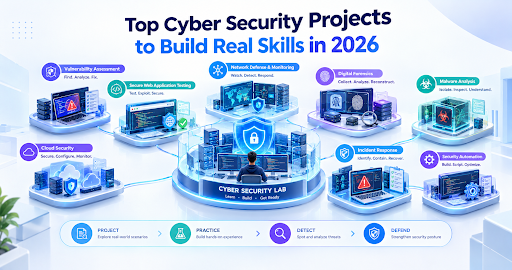
The best cyber security projects to build are the ones that combine a real tool, a documented process, and a measurable outcome, starting with a home lab, packet analysis, and a password security tool as a beginner, moving into vulnerable web app testing, SIEM log analysis, and network segmentation at the intermediate stage, and finishing with full penetration test reports, digital forensics investigations, and detection engineering at an advanced level. Each project should be built using industry-standard tools such as Wireshark,Kali Linux, andMetasploit, then documented and published so recruiters and hiring managers can see the work rather than just a list of topics. The goal of any project is to prove a specific, job-relevant skill, not to accumulate a long list of half-finished ideas.
Key Highlights of Top Cyber Security Projects
- Projects are organised into three levels: beginner, intermediate, and advanced, so learners at any stage know exactly what to build next.
- Every project recommendation names the specific tool or platform used in the real world, including Wireshark, Nmap, Kali Linux, Metasploit, Security Onion, and Autopsy.
- Each project is mapped to the on-the-job skill it demonstrates, such as network defence, vulnerability assessment, incident response, or digital forensics.
- There is a dedicated section that connects projects to industry-recognized certifications, such as CEH, CompTIA Security+, CISSP, CISM, CISA, and AZ-500, to keep learning on track with a credential path.
- Practical guidance is included for turning projects into a portfolio that survives recruiter screening, from GitHub documentation to write-up structure.
- A summary table lets readers compare projects by level, tools used, and skills demonstrated at a glance.
Why Hands-On Projects Matter More Than Certificates Alone
A certification proves that a candidate understands a body of knowledge. A project proves that the candidate can apply it under real conditions, with a real tool, against a real (if simulated) system. Hiring managers screening for security operations center analysts, penetration testers, GRC analysts, or cloud security engineers increasingly ask candidates to walk through a project they built rather than recite a definition, because the project reveals troubleshooting ability, documentation habits, and judgment that a multiple-choice exam cannot.
This is also why frameworks like the NIST Cybersecurity Frameworkand the OWASP Top Tenare referenced throughout this guide. They are not academic checklists; they are the same reference points that real security teams use to structure risk assessments, code reviews, and penetration tests, so building projects around them keeps the work aligned with what employers actually expect.
The project list below is organized by skill level rather than by topic, because the single biggest mistake learners make is attempting an advanced project, such as a full red team engagement, before they have the fundamentals from a beginner project, such as reading a packet capture. Each level builds directly on the one before it.
Beginner Cyber Security Projects
Beginner projects should require no prior security experience, run on a personal laptop, and take between a few hours and a couple of weeks to complete. The objective at this stage is fluency with core tools and concepts, not novelty.
1. Build a Personal Security Home Lab
Before touching offensive or defensive tools, set up an isolated lab using free virtualization software such as VirtualBox or VMware Workstation Player, then installKali Linux as an attacker machine and a separate vulnerable target virtual machine, such as Metasploitable2, on the same private network. This project teaches virtualization, snapshotting, isolated network configuration, and safe experimentation practices that every later project depends on. Document the setup steps, network diagram, and any issues resolved along the way.
2. Network Traffic Capture and Analysis with Wireshark
Install Wiresharkand capture live traffic on a home network. Identify the protocols in use, spot plaintext credentials passed over unencrypted protocols and filter traffic by IP, port or protocol. A strong version of this project includes a short write-up explaining three interesting packets found in the capture and what they reveal about the network, which demonstrates protocol-level understanding that many job descriptions list explicitly.
3. Password Strength Checker and Secure Hashing Tool
Write a small script, in Python or your language of choice, to test password strength against length, entropy and known breached-password patterns, and separately demonstrates secure password storage using a modern hashing algorithm with salting, as opposed to reversible encryption. This project illustrates the basics of applied cryptography, and awareness of secure coding, both of which map directly to application security interview questions.
4. Reconnaissance and Port Scanning with Nmap
Using the lab built in project one, run Nmap scans against the target virtual machine to enumerate open ports, running services, and service versions, then research which of those services carry known vulnerabilities. This is the first practical step toward vulnerability assessment and teaches the reconnaissance phase that every penetration test begins with.
5. File Integrity Monitoring Script
Write a script that hashes a set of files, stores the hashes, and periodically re-checks them to detect unauthorized changes, mirroring how real file integrity monitoring tools work inside a security operations workflow. This project is a lightweight but genuine introduction to detection logic and to the hashing concepts tested in most entry-level certification exams.
6. Phishing Awareness Simulation (Educational Use Only)
Build a simple, clearly labeled mock phishing email and landing page inside the isolated lab environment only, to study the psychological and technical markers of phishing, such as spoofed sender domains, urgency language, and mismatched links. This project should never be run against real people or real infrastructure outside a controlled lab or an authorized, consented simulation, and it directly supports the social engineering domain covered in most ethical hacking curricula.
Intermediate Cyber Security Projects
Intermediate projects assume comfort with the command line, basic networking, and the beginner projects above. They introduce real vulnerability classes, defensive monitoring, and cloud misconfiguration, the areas most frequently tested in interviews for SOC analyst and junior penetration tester roles.
7. Web Application Penetration Testing on a Vulnerable App
Deploy a purposely vulnerable web application in the lab, such as one of the applications listed in theOWASP Vulnerable WebApplications Directory, and perform a systematic test of each category in the OWASP Top Ten, such as SQL injection, cross-site scripting, and broken access control. Document each vulnerability that you found, how you exploited it, its business impact, and a remediation recommendation, which is exactly the structure of a professional penetration test report.
8. Build a Mini Security Operations Center with a SIEM
Build a Mini Security Operations Center with a SIEM. Deploy a self-hosted log aggregation and alerting stack (an open-source SIEM) and direct it at the logs from the lab machines. Write detection rules for common attack patterns like brute-force login attempts or unexpected outbound connections. This is a direct copy of the day-to-day work of a SOC analyst: triage alerts, tune rules to reduce false positives, and write incident notes.
9. Deploy a Firewall and Intrusion Detection
Install a software firewall and network intrusion detection engine between the lab's attacker and victim machines, generate attack traffic, and check that the alerts fire correctly. This project teaches network segmentation, rule writing, and the practical difference between prevention and detection controls, concepts that sit at the center of the NIST Cybersecurity Framework'sProtect and Detect functions.
10. Password Cracking and Credential Hygiene Audit
Using only lab-generated password hashes, practice offline password cracking with a dedicated cracking tool to understand how weak passwords fail against dictionary and brute-force attacks, then translate the findings into a written credential policy recommendation, such as minimum length, multi-factor authentication, and banned-password lists. This project reinforces why organizations move away from passwords alone toward layered identity controls.
11. Cloud Security Misconfiguration Review
Create a free-tier cloud account, deliberately introduce a few common misconfigurations, such as an overly permissive storage bucket or an unrestricted security group, then find and fix them using the cloud provider's own security posture tooling. This project is especially valuable for anyone targeting a role connected to Microsoft's Azure Security Engineer path, since it directly rehearses the identity, network, and data protection domains covered in the AZ-500 Azure security certification.
12. Secure Network Segmentation Design
Using free network simulation software, design a segmented network with a demilitarized zone, an internal VLAN structure, and documented firewall rules between segments, then explain in writing why each segmentation decision reduces the blast radius of a potential breach. This project demonstrates architecture-level thinking that goes beyond running a single tool.
Advanced Cyber Security Projects
Advanced projects are portfolio centerpieces. They take longer, often two to six weeks, and should result in a polished artifact, a report, a working tool, or a documented investigation, that a hiring manager can review in detail.
13. Full Penetration Test Engagement and Report
Run a complete, scoped penetration test against a set of intentionally vulnerable machines using Metasploit alongside manual exploitation techniques, then write a formal report covering scope, methodology, findings ranked by severity, proof-of-concept evidence, and remediation guidance. This is the single most valuable project for anyone targeting a penetration testing or red team role, and closely mirrors the practical exams used by platforms such asHack The Box.
14. Digital Forensics Investigation from a Disk or Memory Image
Acquire a sample disk or memory image (many are published for training purposes), then use an open-source forensic platform such as Autopsyto recover deleted files, reconstruct a timeline of user activity, and identify indicators of compromise, or use a memory analysis framework to extract running processes and injected code from a memory dump. This project demonstrates the evidence-handling discipline and analytical rigor expected in digital forensics and incident response roles.
15. Machine-Learning-Based Intrusion Detection Prototype
Using a public network traffic dataset intended for security research, train a classification model to distinguish normal traffic from attack traffic, then evaluate it with precision, recall, and false-positive rate rather than accuracy alone, since false positives are what overwhelm real security teams. This project signals data literacy layered on top of security fundamentals, a combination increasingly requested for detection engineering roles.
16. Purple Team Exercise Mapped to a Threat Framework
Simulate a small set of adversary techniques in the lab, then attempt to detect each one with the monitoring stack built in the intermediate SIEM project, documenting which techniques were caught, which were missed, and what detection rule would close the gap. Mapping each simulated technique to a recognized adversary tactic taxonomy shows fluency with the shared language security teams use to describe real-world attacks.
17. Zero Trust Access Control Implementation
Design and implement a small-scale zero trust model in the lab, enforcing identity verification, device posture checks, and least-privilege access for every request rather than relying on network location as a trust signal, then document the before-and-after risk reduction. This project connects directly to identity and access management work covered in governance-focused certifications and shows architectural maturity beyond tool operation.
18. Open-Source Threat Intelligence Aggregation Tool
Build a script or small application that pulls indicators of compromise from public threat intelligence feeds and open-source intelligence tools, deduplicates them, and outputs a usable watchlist, then apply that watchlist against the lab's own logs to see if any indicators appear. This project demonstrates the OSINT and threat intelligence skills that governance, risk, and compliance teams increasingly rely on alongside pure technical defense.
Projects by Skill Level: Tools and Skills Summary
| Level | Project | Primary Tools/Platforms | Core Skills Demonstrated |
| Beginner | Personal security home lab | VirtualBox/VMware, Kali Linux, Metasploitable2 | Virtualization, isolated networking, lab hygiene |
| Beginner | Network traffic capture and analysis | Wireshark | Protocol analysis, packet-level troubleshooting |
| Beginner | Password strength and hashing tool | Python, hashing libraries | Applied cryptography, secure coding |
| Beginner | Reconnaissance and port scanning | Nmap | Enumeration, service fingerprinting |
| Beginner | File integrity monitoring script | Python, hashing algorithms | Detection logic, change monitoring |
| Beginner | Phishing awareness simulation (lab only) | Isolated lab environment | Social engineering analysis |
| Intermediate | Web application penetration test | DVWA/OWASP Juice Shop, Burp Suite | OWASP Top Ten exploitation and remediation |
| Intermediate | Mini SOC with a SIEM | Open-source SIEM stack | Log analysis, alert triage, rule tuning |
| Intermediate | Firewall and IDS deployment | Software firewall, network IDS engine | Segmentation, detection engineering |
| Intermediate | Password cracking and credential audit | Offline password cracking tool | Credential hygiene, policy writing |
| Intermediate | Cloud misconfiguration review | Cloud provider console and posture tools | Cloud IAM, storage, and network security |
| Intermediate | Secure network segmentation design | Network simulation software | Network architecture, DMZ design |
| Advanced | Full penetration test engagement | Metasploit, manual exploitation | End-to-end pentest methodology and reporting |
| Advanced | Digital forensics investigation | Autopsy, memory analysis framework | Evidence handling, timeline reconstruction |
| Advanced | ML-based intrusion detection prototype | Python, public security datasets | Detection engineering, model evaluation |
| Advanced | Purple team exercise | Attack simulation tools, SIEM from project 8 | Adversary emulation, detection gap analysis |
| Advanced | Zero trust implementation | Identity provider, access policy engine | IAM architecture, least privilege design |
| Advanced | Threat intelligence aggregation tool | OSINT feeds, scripting language | Threat intelligence, OSINT tradecraft |
How These Projects Map to Certifications and Job Roles?
Projects and certifications reinforce each other best when pursued together rather than sequentially. The reconnaissance, exploitation, and reporting skills built in the intermediate and advanced offensive projects align closely with the Certified EthicalHacker (CEH)curriculum, which formally covers scanning, enumeration, and exploitation methodology. Learners aiming for a broad, vendor-neutral entry point often pair the beginner and intermediate projects with CompTIA Security+, which covers threats, architecture, and operations at a similar depth.
For learners aiming at governance, risk, and management-track roles rather than purely hands-on technical roles, the network segmentation, zero trust, and cloud misconfiguration projects build the risk-based thinking assessed in the CISSP certification, which spans security architecture, asset security, and identity and access management across eight domains. The SIEM, log analysis, and credential audit projects map closely to control design and monitoring topics covered by the CISA certificationfor information systems auditors, since both require translating technical findings into audit-ready evidence.
Anyone building the threat intelligence, purple team, or zero trust projects with an eye toward a leadership or program-management path will find the security governance, incident response, and program alignment work directly relevant to the CISM certification, which focuses on aligning security programs with business risk rather than tool operation alone. Finally, the cloud misconfiguration project is a natural on-ramp to the AZ-500 Azure security engineer pathfor learners working in or targeting Microsoft cloud environments.
None of these certifications require the projects above as a prerequisite, but candidates who can point to a documented project during an exam-adjacent interview consistently stand out from candidates presenting certification knowledge alone.
How to Showcase Your Projects in a Portfolio, Resume, and GitHub?
A project only helps a job search if someone else can see it. Use GitHubas the central hub for code-based projects, such as the password tool, file integrity script, or threat intelligence aggregator, and use a separate write-up, either a GitHub README or a simple personal site, for lab-based projects such as the penetration test report or forensics investigation, since those results are often screenshots, packet captures, and narrative analysis rather than runnable code.
For each project, write a short summary at the top stating the objective, the tools used, and the outcome, then follow with the detailed walkthrough underneath, since recruiters and hiring managers frequently scan the summary first and only read the full write-up for projects that catch their attention. Include sanitized screenshots of tool output, such as an Nmap scan result or a Wireshark filter view, redacting anything that could reveal real personal data or real infrastructure if the project ever touched anything beyond an isolated lab.
On a resume, list each project as a single line under a "Projects" section with the tool and the skill named explicitly, for example noting that a home SOC lab was built to practice log-based detection using an open-source SIEM, rather than a vague phrase like "worked on cybersecurity projects." Depth beats quantity here: three well-documented, complete projects with clear write-ups are more convincing to a hiring manager than ten unfinished ones, since incomplete projects raise more questions than they answer in an interview.
Finally, keep every project confined to systems and accounts owned or explicitly authorized by the learner, whether that is a personal home lab, a free-tier cloud account created for testing, or a platform such as TryHackMeor Hack The Boxdesigned specifically for legal, sanctioned practice. Running any of these techniques against systems without explicit authorization is illegal in most jurisdictions regardless of intent.
Key Takeaways
- Structure a cybersecurity learning path around beginner, intermediate, and advanced projects rather than jumping straight to advanced techniques.
- Use real, industry-standard tools such as Wireshark, Nmap, Kali Linux, Metasploit, Autopsy, and a SIEM stack so the skills transfer directly to a job.
- Always work inside an owned home lab, a free-tier test account, or an authorized platform such as TryHackMe or Hack The Box, never against systems without explicit permission.
- Identify a suitable certification path for each project: CEH, CompTIA Security+, CISSP, CISA, CISM, AZ-500. This guarantees you are learning and earning in a consistent manner.
- Make sure you record the purpose, tools and result for each project. Post this on GitHub or as a personal write-up so that it is accessible to recruiters and hiring managers.
- Replace a long list of superficial, incomplete projects with a few well-documented projects.










 Lowest-Price Challenge











 Personalized Path


.webp)


 USA
USA  Canada
  India
India  UK
UK  Australia
  Singapore


