


 Call Us



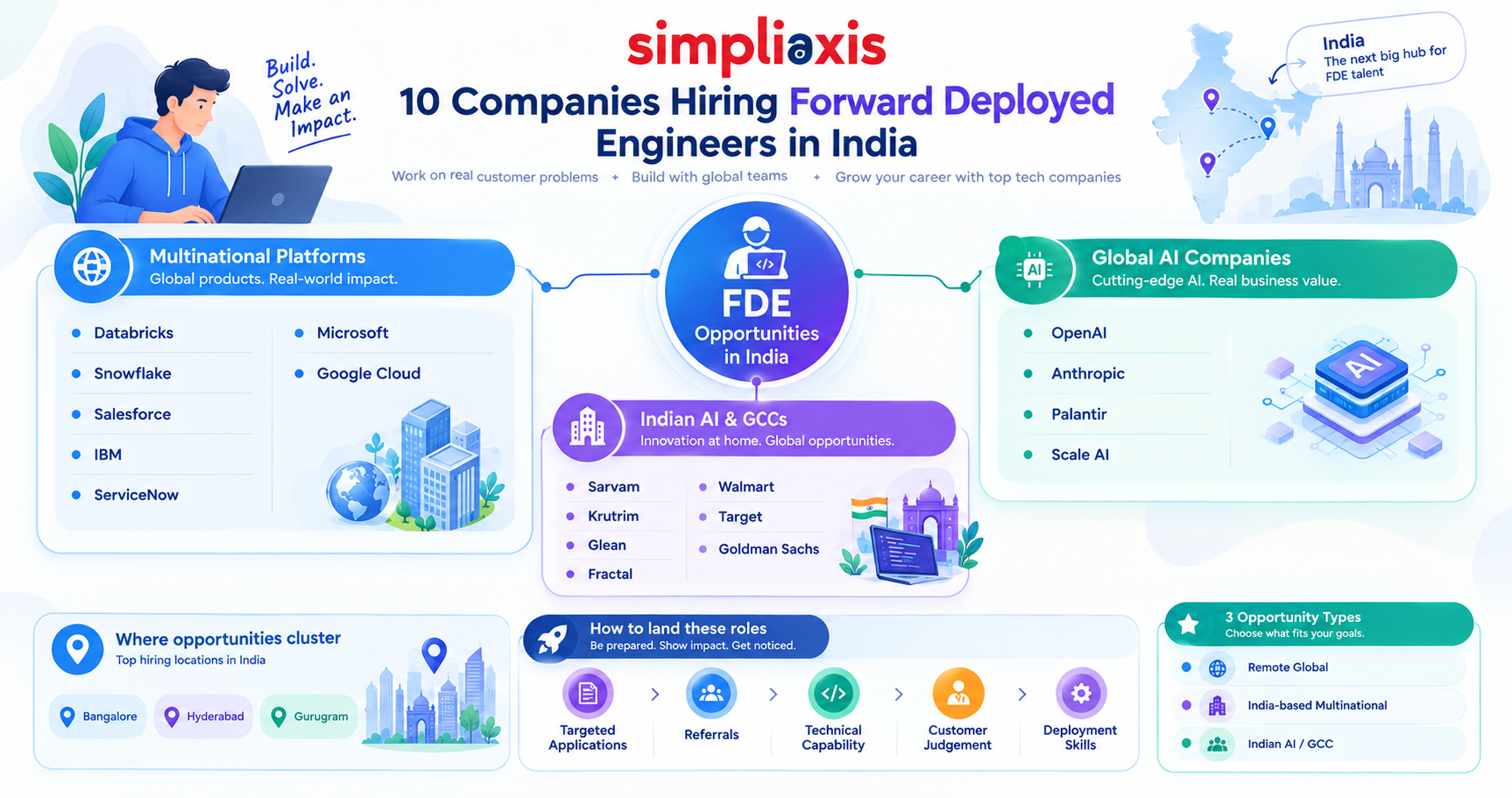
For engineers in India, the forward deployed opportunity is real and growing, but the way to pursue it is specific, because the roles cluster in particular cities, particular companies, and particular channels rather than being spread evenly across the job market. India has become a significant hub for forward deployed work, driven by its deep engineering talent, the presence of global technology companies, and a wave of Indian AI companies, but landing one of these roles requires knowing where to look. This piece names ten companies hiring forward deployed engineers in India, explains the different kinds of opportunity, and gives Indian engineers a concrete way to target their search.
Knowing who hires is only the start, because these are demanding roles filled largely through targeted applications and referrals rather than mass job boards. Building the genuine capability the role requires, through the Forward Deployed Engineering Program, is what turns a list of companies into realistic targets and helps you reach them through the channels that actually fill these roles.
Key Highlights
- India forward deployed roles cluster heavily in Bangalore and Hyderabad, with Gurugram also notable, so location shapes the search.
- The opportunities fall into three kinds: remote roles at global AI companies, India-based roles at multinational platforms, and roles at Indian AI startups.
- Multinational platforms like Databricks, Snowflake, Salesforce, IBM, and ServiceNow hire forward deployed talent from their India offices.
- Global capability centres of large enterprises are increasingly hiring for forward-deployed-style AI work in India.
- Most India roles are filled through targeted applications and referrals rather than mass-posted job boards.
The three kinds of India opportunity
Before the specific companies, it helps to understand that forward deployed opportunities in India come in three distinct kinds, because each requires a different approach. The first is remote roles at global AI companies, where an engineer based in India works for a company like OpenAI, Anthropic, or Palantir in a remote or globally distributed capacity, competing in a global talent pool for a role that happens to allow India-based work. The second is India-based roles at multinational platforms, where companies like Databricks, Snowflake, and Salesforce hire forward deployed engineers directly into their India offices to serve customers, often in the region.
The third kind is roles at India-headquartered AI companies and startups, where a growing set of Indian AI-first companies hire forward deployed talent to deploy their technology into customers. Each kind has a different character: the remote global roles are the most competitive but offer global exposure and compensation, the multinational platform roles offer the stability of an established company with India-based work, and the startup roles offer intensity and ownership in the growing Indian AI ecosystem, much like the industries hiring for the role elsewhere shape its character. Knowing which kind you are pursuing shapes how you prepare and where you look, which is why understanding the three categories is the first step for an Indian engineer targeting the role. For the detailed compensation picture across these categories, which varies widely by company tier and whether the role is global-remote or India-local, the dedicated salary analysis is the right reference rather than any single figure here.
The multinational platforms hiring in India
The most accessible India-based opportunities are at the multinational technology platforms that run substantial India operations and hire forward deployed engineers into them. Databricks and Snowflake, the two dominant data platforms, both hire forward deployed talent from their India offices to help customers turn data into working AI and analytics solutions, and their significant India presence makes these among the most realistic targets for an India-based engineer. The work involves embedding with enterprise customers to make the platform deliver inside complex data environments.
Salesforce hires forward deployed engineers in India to help its large regional customer base deploy AI within the Salesforce ecosystem, while IBM and ServiceNow similarly hire forward-deployed-style talent from their India offices to deploy their technologies into customers. Microsoft, with its enormous India engineering presence, hires for roles that deploy its AI capabilities into customer environments. These multinational platforms share a valuable characteristic for the India-based engineer: they run real India operations, hire locally, and offer the stability of an established company alongside genuine forward deployed work, which makes them the natural starting point for many Indian engineers pursuing the role. Their India offices are typically in Bangalore, Hyderabad, or Gurugram, which is where these opportunities concentrate.
Google Cloud and the global players in India
The global technology giants with major India operations are significant hirers, led by Google Cloud, which has been expanding its forward deployed hiring as it races to get AI into customers' hands, and which runs large India operations. For an India-based engineer, Google Cloud represents an opportunity to do forward deployed work with a leading cloud and AI provider from within India, serving the growing regional demand for help deploying AI. The scale of Google Cloud's India presence makes it a substantial and realistic target.
Beyond Google Cloud, the frontier AI labs and leading AI companies, OpenAI, Anthropic, Palantir, and Scale AI, hire for forward deployed roles that in some cases can be done remotely from India, placing an Indian engineer in a global talent pool for the most cutting-edge version of the work. These remote global roles are the most competitive, since you compete with candidates worldwide, but they offer exposure to the frontier and global compensation. Palantir in particular, as the originator of the model, is a notable name for Indian engineers drawn to the most rigorous version of the role. Pursuing these global roles from India requires being genuinely competitive in a worldwide pool, which raises the bar, but the opportunity is real for engineers who build the capability to meet it.
The Indian AI startups and enterprises
A distinctly Indian source of forward deployed opportunity is the growing ecosystem of India-headquartered AI companies, which need forward deployed talent to deploy their technology into customers. India-HQ AI-first companies such as Sarvam and Krutrim, building foundational AI capabilities for the Indian and global markets, need engineers who can get their technology working inside real customers, which is forward deployed work by nature. Glean, the enterprise search and assistant company, has an India presence and hires for the role as it scales. And a broad set of Series A to C Indian AI startups hire forward-deployed-style engineers as central members of their teams.
These Indian AI companies offer a version of the role with the intensity and ownership of a startup, situated in the fast-growing Indian AI ecosystem, which appeals to engineers who want to be part of building that ecosystem rather than serving it from a multinational. There is also a category worth noting: the Indian operations of large enterprises and analytics firms, such as Fractal, that build and deploy AI solutions and need forward deployed talent. Together, the Indian AI companies represent a growing, distinctly local source of forward deployed opportunity that an India-based engineer is well positioned to pursue, often with less competition from the global pool than the remote roles attract.
The GCC route: an underrated opportunity
A significant and often underappreciated source of forward deployed work in India is the global capability centre, the India-based operation that many large global enterprises run to build technology for their worldwide business. As these enterprises deploy AI across their global operations, their India GCCs increasingly hire engineers to do forward-deployed-style work, deploying AI tools internally across the company's global infrastructure. Global retailers like Walmart and Target, and banks like Goldman Sachs, run large India GCCs that hire for exactly this kind of internal AI deployment work.
The GCC route is underrated because these roles are not always titled forward deployed engineer, but the work, deploying AI into a large, complex organisation's real environment, is forward deployed work in substance. For an India-based engineer, GCCs offer a large and growing source of this kind of work, with the stability of an established global enterprise and the scale of a major operation, situated in India. Because so many global enterprises now run AI-focused GCCs in India, and because the mandate of these centres is increasingly AI-first, the GCC route is likely to be one of the largest sources of forward deployed opportunity in India over time, which is why it deserves its own dedicated treatment in the companion guide on India GCCs. An engineer who understands this route has access to a large pool of opportunity that many overlook.
How to actually land these roles in India
Knowing the companies is only useful with the right approach, and the India market has a specific characteristic worth understanding: most forward deployed roles are filled through targeted applications and referrals rather than mass-posted job boards. This means the scattershot approach of applying to many postings works poorly, and the effective strategy is to target specific companies, build genuine relationships, and reach roles through referrals and direct, tailored applications.
Practically, this means identifying the companies that fit your situation, whether a multinational platform, a global remote role, an Indian startup, or a GCC, and pursuing them deliberately rather than broadly. It means building the genuine capability these companies test for, since the interviews are rigorous and unusual, weighting customer judgement and ambiguity as heavily as coding. And it means using the referral-driven nature of the market to your advantage, building a network in the Indian AI ecosystem that can connect you to roles that never reach a job board. Genuine capability matters more than volume of applications here, which is why building the real skills of the role, through the Forward Deployed Engineering Program grounded in agentic AI foundations, is the foundation of a successful India search. The capability is what makes you worth referring and what carries you through the demanding interviews.
Why India is becoming a forward deployed hub
It is worth understanding why India specifically has become such fertile ground for forward deployed work, because the reasons suggest the opportunity will keep growing rather than plateau. The first reason is India's deep pool of engineering talent, which gives global companies a large base of capable engineers to draw on for a role that demands genuine technical skill. As the forward deployed model spreads and demand for the role outstrips the global supply of qualified people, India's talent base becomes an obvious place to find and build that talent.
The second reason is the concentration of global technology operations in India, from the India offices of multinational platforms to the vast network of global capability centres, which creates a large and growing number of India-based roles. The third is the rise of India's own AI ecosystem, with a wave of Indian AI companies building technology that needs deploying into customers. Together, these factors, deep talent, concentrated global operations, and a rising local ecosystem, make India a natural hub for forward deployed work, and they suggest the opportunity is structural rather than temporary. For an India-based engineer, this means the forward deployed opportunity is likely to keep expanding, which makes building the capability a well-timed investment, particularly given the broader durability of the role across the AI economy.
What Indian engineers should focus on
Given the opportunity, a practical question is what an India-based engineer should focus on to be competitive, and the answer is the same genuine capability the role demands everywhere, applied with awareness of the India-specific market. The core is real skill across the span of the role, discovery, scoping, building, and deployment, because the interviews test that capability rigorously regardless of location, and genuine ability is what makes an engineer competitive whether in a global remote pool or a local role. There is no India-specific shortcut around building the actual skills.
What India-based engineers should add to that core is awareness of the specific market dynamics: the concentration in Bangalore and Hyderabad, the referral-driven nature of the hiring, the three kinds of opportunity and which suits their situation, and the underrated GCC route. An engineer who combines genuine capability with a smart, targeted approach to the India market is well positioned, since they bring both the substance the role requires and the market awareness to reach the right opportunities. This combination, real capability plus market-smart targeting, is what turns the India opportunity from a general possibility into a concrete path, and building the capability through the agentic AI engineering practice that the modern role centres on is the foundation the market awareness sits on top of.
The India opportunity at a glance
To help you target, here is how the India forward deployed opportunities group.
| Kind of opportunity | Example companies | Character |
| Remote global roles | OpenAI, Anthropic, Palantir, Scale AI | Most competitive, global pool and exposure |
| Multinational platforms | Databricks, Snowflake, Salesforce, IBM, ServiceNow, Microsoft | India-based, established, stable |
| Global cloud in India | Google Cloud | Large India presence, leading provider |
| Indian AI startups | Sarvam, Krutrim, Glean, Fractal, Series A-C | Intensity, ownership, local ecosystem |
| Global capability centres | Walmart, Target, Goldman Sachs GCCs | Large, underrated, internal AI deployment |
Read the table as a targeting guide keyed to what you want. The multinational platforms and GCCs are the most accessible India-based routes, the global remote roles are the most competitive but highest-exposure, and the Indian startups offer the ecosystem-building experience. Matching your situation and goals to the right kind of opportunity is far more effective than pursuing all of them at once.
The bottom line
Forward deployed opportunity in India is real and growing, concentrated heavily in Bangalore and Hyderabad, and it comes in distinct kinds: remote roles at global AI companies like OpenAI and Anthropic, India-based roles at multinational platforms like Databricks, Snowflake, Salesforce, IBM, and ServiceNow, work with global cloud providers like Google Cloud, roles at Indian AI startups like Sarvam and Krutrim, and the large, underrated pool of forward-deployed-style work in the global capability centres of enterprises like Walmart, Target, and Goldman Sachs. Each kind has its own character and requires its own approach.
The key to landing these roles in India is understanding that they are filled largely through targeted applications and referrals rather than mass job boards, which makes deliberate targeting and genuine capability far more effective than volume. Building the real skills of the role, and reaching companies through the referral-driven channels that actually fill these positions, is the path that works. Developing that capability through the Forward Deployed Engineering Program is what makes you a credible candidate for the growing India opportunity, whichever kind you choose to pursue.
One more point worth making for India-based engineers is that the opportunity is not only large today but structurally growing, because the forces behind it, deep talent, concentrated global operations, and a rising local AI ecosystem, are all strengthening rather than fading. This makes building the capability a well-timed and durable investment rather than a bet on a passing trend. The genuine skills of the role, developed through the agentic AI practitioner path and applied engineering with agents, are what make you competitive across every category of India opportunity, from the multinational platforms to the underrated GCC route. An engineer who builds real capability and targets the India market smartly is positioned for a source of opportunity that should keep expanding for years, which makes the effort of developing the skills well worth it.
For an India-based engineer, the message is simple: the opportunity is real, growing, and reachable with genuine capability and a targeted approach, and it rewards those who build the skills and pursue the right channels deliberately.









 Lowest-Price Challenge











 Personalized Path


.webp)


 USA
USA  Canada
 India
India UK
UK Australia
 Singapore


