


 Call Us




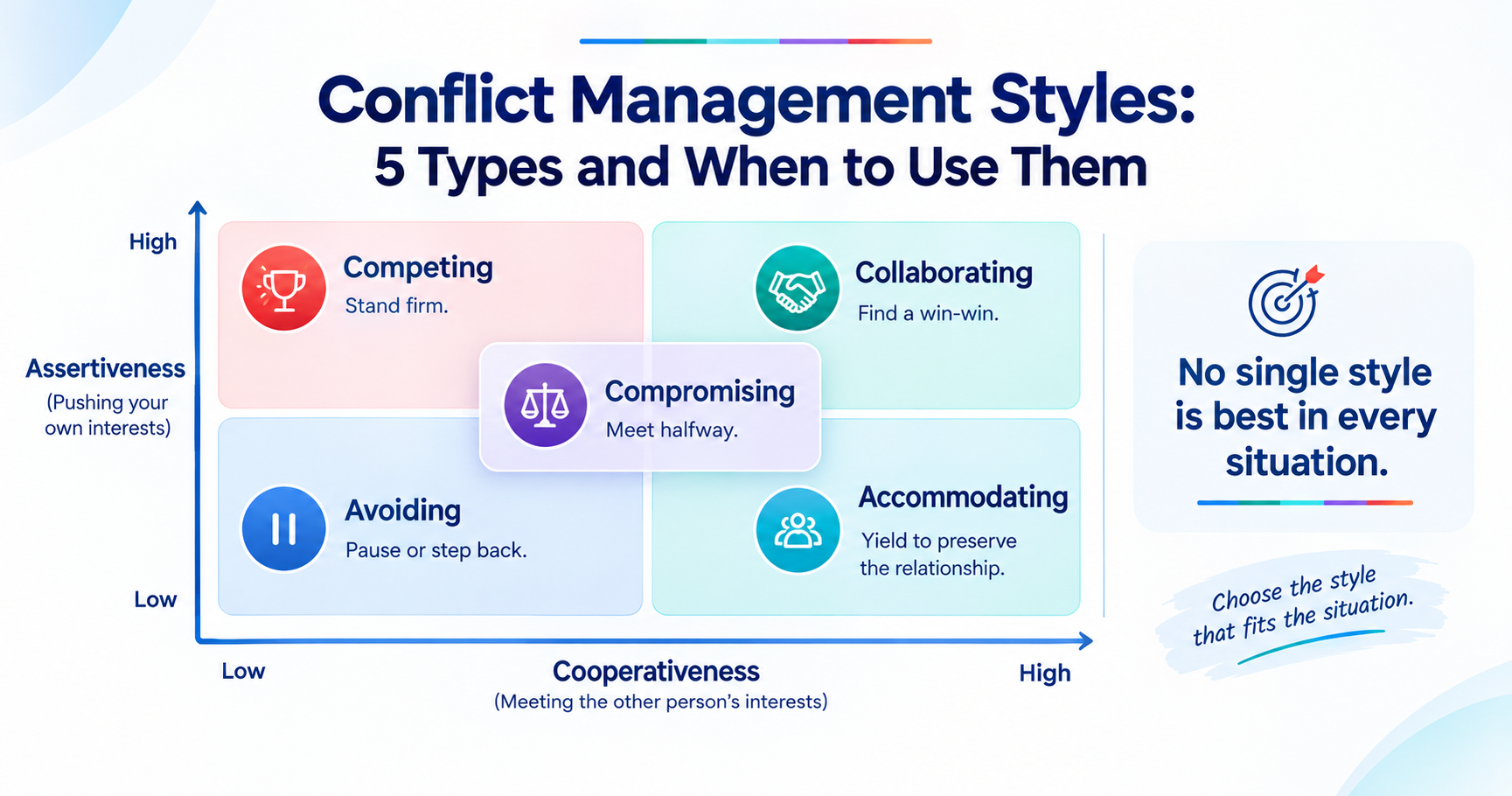
The Thomas-Kilmann model describes five conflict management styles. Each one combines how assertive you are (pushing your own interests) with how cooperative you are (meeting the other person's interests). No single style is best. Effective people switch between them depending on the stakes, time pressure, and how much the relationship matters.
Key highlights of Conflict Management Styles:
- While it’s normal to have disagreements on a team, it’s how you address those disagreements that determines the health of your team.Ideally, you want a team with enough psychological safety to have the hard conversations.
- There are five styles. In 1974, Thomas-Kilmann identified five styles of dealing with conflict based on assertiveness and cooperation. The styles are competing, collaborating, compromising, avoiding, and accommodating.
- Using the competing style means asserting your concerns in situations involving ethics, safety, and overall team compliance. It is generally constructive to use this style in situations where a hard deadline is involved. However, excessive use of this style can and will ultimately break the team’s trust.
- Using the collaborating style means reaching a solution to a problem that gives consideration to the concerns of all involved. This style can help to resolve issues related to the management of a project. However, collaborating can waste valuable time.
- If you cannot agree on a solution to a problem, using the accommodating style or the avoiding style can help to postpone the conflict, giving you more time to consider other alternatives.
- Using the compromising style means that the concern of the other party is of more value to you, and therefore you are willing to give up your position on the issue.
- There is not a single style that is best to use in all situations. In fact, the only style that is bad to use is making consistent use of the same style in all situations.
- Remote and agile teams can especially benefit from using the Matrix, as many small issues can and will ultimately build up to larger more unmanageable issues. The best teams are those that can be Agile and Remote, using available technologies and conducting meetings and interactions with team members located around the world.
Introduction
Working life means disagreement. The same architecture can result in different conclusions for engineers. Priority can be equally reasonable for different departments. What makes the difference between effective and ineffective teams is not the total absence of conflict. It is how the team responds to its presence that makes the difference.
There is a collection of frameworks for understanding how to respond to conflicts. The most famous of them is by Thomas and Kilmann. They describe 5 distinct ways for responding to conflict situations. Each way has its own pros and cons.
In this article, we will cover the 5 styles with working examples. You will learn to identify the styles and ways to respond based on the situation. You will also learn to identify your default style.
What Conflict Management Styles Are?
The definition of a conflict management style is the kind of behavior you exhibit when you encounter a situation that requires managing a conflict. It encompasses the manner in which you defend your position and consider the interests of the other person involved in the conflict.
In 1974, Thomas Kilmann introduced one of the first models which elaborated on these styles in the form of a matrix. He referred to them as ‘styles’ instead of ‘resolutions’ and positioned ‘assertiveness’ as pushing for your own interests, and ‘cooperativeness’ as striving for the interests of the other person on the matrix. Further, by combining both dimensions, he arrived at five styles, namely competing, collaborating, compromising, avoiding, and accommodating.
Over the years, a number of frames of reference concerned with leadership and management have appeared, including Blake and Mouton’s managerial grid, which also contained a treatment of conflict management.
Of these, the Thomas Kilmann model continues to be the most popular. Probably, the main reason for this is the accessibility of the model; it’s simple enough to recall when needed.
However, there are some consequences of adopting particular styles. A style which may be constructive in one situation may be destructive in a different situation. The whole purpose of imparting training in the field of management and organizational behavior is to teach flexibility and ability to distinguish between constructive and destructive consequences of the style adopted for managing conflicts.
The 5 Conflict Management Styles Explained
Let’s look at the details of each style. For each style, we will review its definition, when it is used, a workplace example, and its main disadvantage.
1. Competing
Competing is an assertive style and an uncooperative style. People who use this style focus on furthering their interests and disregard the interests of others. People who use this style focus on wearing others down using their expertise or rank.
The use of this style is justified when there are ethical violations, there are situation where a decision must be made to avoid a violation and to ensure the safety of others, and when a decision must be made to prevent a loss of integrated totality and a firm deadline is approaching.
An engineer believes there is no loss and feels a rollout should continue. A higher authority should examine the situation to protect the customer and ensure the evidence is preserved for further review.
Using this style too much can result in a loss of trust and further promote a lack of self-advocacy, for example, people can stop raising concerns because they believe they will be ignored.
2. Collaborating
This style of interaction is used when people are unable to reach a decision that incorporates all of their concerns. People who collaborate are able to identify the concerns of the other person and mutually reach a decision that satisfies them.
Product Manager and Design Lead represent two perspectives on the checkout flow. Product Manager is attempting to reduce the number of steps while Design Lead is focused on providing more help for first time users. Instead of providing or accepting more feedback, they run user tests to provide data that supports a more effective design.
The cost of collaboration is time. It can promote a culture of waste by forcing the organization to consider and process every small decision. Collaboration is appropriate for project decisions, while other decisions should be made independently.
3. Compromising
Compromising is also along both extremes. Each individual surrenders something. It is applicable for decisions with deadlines and constrained by budgets. It can also be used to prevent monopolization of a scarce resource.
Prioritization is also required for compromising. An appropriate example is the case of the two managers competing for the time of the analyst. One needs the analyst to help create a client proposal while the other needs the analyst for a manager level audit. The proposal managers surrender the last two days of the week to the manager and auditor.
You might think that “avoiding” is worse than “submit” or “take”. It is unassertive and uncooperative. You skirt the issue, put it off, or take off altogether. This can give the appearance of being diplomatic but in reality, it is a willful decision not to act.
4. Avoiding:
"Avoiding" can be a positive thing. It can be the right decision when the issue is of little importance, when emotions associated with the issue are too strong, or when there is not enough information. A manager who says "let's come back to this when we have the sales numbers" is being diplomatic and buying time. She is not avoiding it.
"Avoiding" can also be positive when done on a small scale by an individual. For example, the case of a junior developer who hears two senior people discussing and arguing about something that is of no concern to her, and which has no impact on her work. In this case, it is positive for her to ignore and not get involved.
The dangers of the habitual use of "avoiding" are more than just a concern. If a decision to avoid dealing with something is made too many times, it can and will lead to larger, more troublesome conflicts. Small, negative feelings will build and eventually be released in a bigger, more unpleasant way.
5. Accommodating
Accommodating is being unassertive and focusing on other people to your own detriment. It can seem positive, like being generous or considerate, or it can look like obedience.
Accommodating can be effective when the situation is more important to the other person. It can also be effective when being considerate is better than being stiff. For example, helping build positive work relationships is often good credit to be in, and you can spend that credit later.
Let's say a coworker has planned to take off on Friday. They owe positive credit to the team. On Thursday, a client escalation occurs, and she covers the call.
If someone always accommodates, the real opinions stop being expressed. Eventually, the employees lose their judgment. It can also lead to resentment.
Which Style Fits Which Situation? A Quick Matrix
| Situation | Stakes | Time Pressure | Relationship Importance | Recommended Style |
| Safety, ethics, or compliance issue | High | Immediate | Any | Competing |
| Complex problem needing both sides bought in | High | Moderate | High | Collaborating |
| Two teams competing for one resource | Moderate | High | Moderate | Compromising |
| Trivial issue or emotions still running hot | Low | Low | Varies | Avoiding |
| Issue matters little to you, much to them | Low to moderate | Any | High | Accommodating |
While the matrix is a great reference point, don’t be a slave to it. Combos are the name of the game. Don’t be surprised if the matrix says ‘compromise’ but in the real world, you need to ‘integrate’. The same is true vice versa.
On the bright side, using any combination of styles is usually ok. The only consistently bad style is using the same style across every conflict.
Real Workplace Scenarios, Resolved Three Ways
Abstract descriptions only take you so far. Let’s look at two scenarios and break down the possible outcomes given the constraints and styles described previously.
Scenario 1: The Scope Creep Standoff
A client wishes to add a series of requests to a project which is already complete and billed. The project lead is frustrated because they need to address this before the next Sprint Planning meeting.
Competing: The lead tells the client that if they want the requests completed, they will have to sign a contract for service and that the requests will be completed in a second phase of the work.
Collaborating: The lead schedules time to speak with the client to determine the reasons for the requests.
Compromising: The lead decides that they will perform the requested work during the next billing cycle.
In this case, collaborating is likely the most appropriate.
Scenario 2: The Design Dispute
Two members of the development team are debating whether or not to implement a particular design and architectural change to a module of the team’s software.
Competing: The team lead steps in and breaks up the debate. He/she thanks both parties for their input. Collaborating: The team lead asks the debating members to schedule time to discuss the design and implementation. Compromising: The team lead decides that the design will be implemented.
In this case, competing may be appropriate.
Resolved with competing: A post-release decision is made by the tech lead. One of the senior developers feels their input was disregarded, and as a result, does not participate in post-release activities, like code reviews.
Resolved with avoiding: The lead defers making a decision until after the release. While this takes the discussion off the current release, emotions don’t subside, and the next release becomes even more contentious.
Resolved with compromising: The team agrees to refactor the section of the module most affected by the performance issue during this release, and defines a plan to address the remaining issue after the release.
Of the three described alternatives, here compromising best describes the approach. The situation, despite the constraints, justifies the use of the interest of the two developers involved. Full collaboration workshops are normally not undertaken.
How to Identify Your Default Style?
When faced with a work-related decision, what is your instinct? Most people have default styles that they revert to in various work situations. Default styles vary from person to person, and depend on cultural values and upbringing. Being able to describe your default style provides you with an opportunity to make alternative choices.
Observe yourself, and be honest. The next time you have a disagreement with a co-worker, consider these questions: Did you take a firm position? Did you try to understand your co-worker’s interests? Did you try to reason with your co-worker? Repeat this activity with as many of your co-workers as possible and pay attention to the style you use in each situation.
To be effective, observation must be complemented by other people’s assessments. Ask a trusted peer to describe your disagreements. Your peers may tell you that, in your desire to appear agreeable, you may be avoiding situations where you really need to make a firm decision. On the other hand, they may tell you that they think you give in too easily.
An assessment on conflict management style is probably the easiest to complete as there are several versions of the formal assessment based on the Thomas-Kilman model. One assessment, the Thomas Kilmann Conflict Mode Instrument (TKI), offers a 30-item multiple-choice format, from which it bases its assessment of your conflict management style. The assessment is available for purchase through several sources. Other, less formal, assessments based on the same principles are also easily found on the web.
Once you take the assessment(s), what do you do with the results? They are best treated as feedback. One of the goals of the assessment is to increase self-awareness. They are not meant to pigeon-hole you with a label. Increasing awareness of your style can help you to better manage your conflicts with others.
Working on style management, either through teaching yourself or by learning through structured exercises, has proven to be the most effective way to manage your natural default styles. The Simpliaxis conflict management skills micro-credential teaches you de-escalation skills and integrates psychological safety to better manage interpersonal conflicts within the workplace.
Conflict Styles in Agile and Cross-Functional Teams
Conflict will occur in any cross-functional team. A basic understanding of the five styles of conflict will resolve many conflicts and save relationships in the process.
Disputes over the scope of work are the most prevalent. The Product Owner will push to add a feature and the developers will defend the length of the sprint. Often, to protect the goal of the sprint, the developers may need to hide or remove an equally large user story.
At times, the differences can run deeper. For example, developers can be very passionate about refactoring and removing poor code, and if the code is fragile, a defect in the code can easily be mistaken for an aggressive attack. Healthy sprints require a balance. If the two sides align and agree to remove or limit the debt, the current sprint can stay on track.
Maintaining a balance between delivering code and technical debt is important. If good design and technical practices are followed, the need for a refactoring should be limited. The best way to maintain a good balance is to agree on an improvement story and limit the work to be done in a given sprint.
Cross-functional priority disputes, for instance, those between marketing and engineering roadmaps, merit a trade-off solution. Define team norms to help your team resolve disputes.. Like rules, norms help channel a conflict that usually becomes “my word against yours.” The lower the temperature, the better.
While dealing with remote work adds another layer of challenge, the nature of work brings these disputes to the forefront. In an asynchronous workplace, people are less inclined to resolve a dispute, especially if it means having a conversation. Instead, they prefer to air their grievances over an extended period of time.
While a number of challenges faced by Agile teams require situational leadership and facilitation skills, effectively dealing with this challenge helps distinguish an average Scrum Master from an exceptional one.
In general, the goal for any Agile team is to have better, more effective ways to deal with, and move past conflicts and disputes.
Conclusion
Workplace conflict is an indicator of passion and commitment. Understanding the various styles of dealing with conflict helps build the arsenal of options beyond the first instinctive response.
Conflict management styles include-
- Competing: protects one’s interests
- Collaborating: finds a solution to an intricate problem
- Compromising: attempts to reach a middle ground
- Avoiding: ignoring the issue for the time being
- Accommodating: helps to maintain the health of a relationship
Learning to leverage these appropriately makes one skilled at conflict management. This is a valuable skill that enhances the quality of one’s career.
If this skill interests you, Simpliaxis offers conflict management training to sharpen your management of workplace conflict. You will be presented with realistic work scenarios, and learn to identify conflict management styles. Learn to devise strategies for managing workplace disputes. You will learn to remain composed in even the most tumultuous of work environments.







 Lowest-Price Challenge












 Personalized Path



.webp)


 USA
 Canada
 India
 UK
 Australia
 Singapore


