


 Call Us



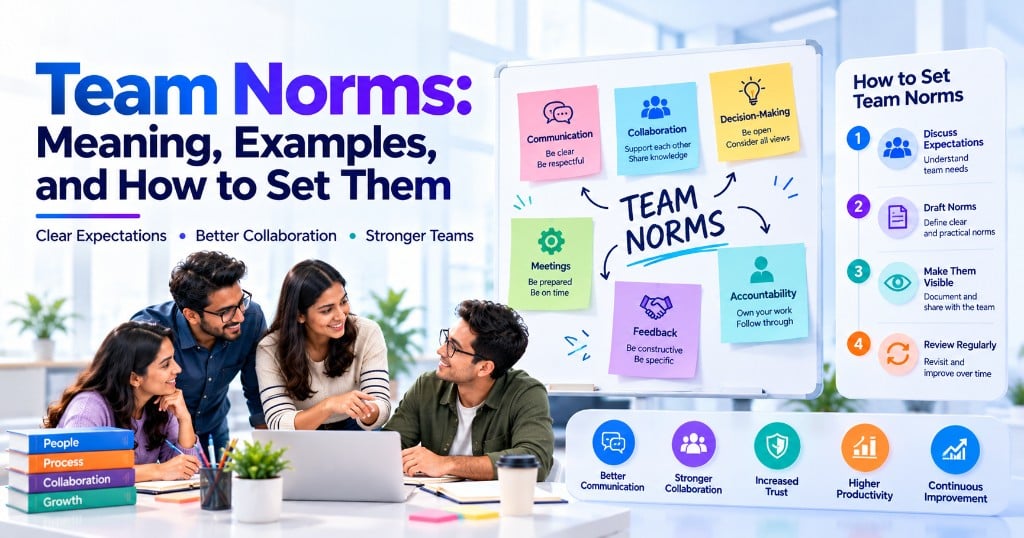
Team norms are the shared expectations about how team members communicate, work together, resolve conflicts, and make decisions. They can be created from a normal interaction or intentionally created by the team.
Some team norms include responding to messages within a certain time frame, offering helpful suggestions, and speaking up with concerns directly instead of gossiping.
Good team norms cut down on confusion, build trust, and let teams do their work without being constantly watched. But to get them in place, teams need to be clear about needs, draft and visualize expectations, and continually revise these.
Team norms are great for Agile and Scrum teams, as they help to foster collaboration and self-management. They work best, though, when members of a team share responsibility for following them.
Key Highlights of Team Norms
- Team norms set shared expectations for behavior, communication, and collaboration.
- Norms can be explicit, meaning they are discussed and documented, or implicit, meaning they develop through repeated interactions.
- Communication, meetings, decision-making, feedback, and availability are common aspects of team norms.
- Establishing team norms involves a four-step process: discussing expectations, drafting norms, making them visible, and reviewing them regularly.
- Team norms are different from working agreements on what they emphasize; in practice, the terms still overlap.
- In Agile teams, norms support autonomy, psychological safety, and continuous improvement.
- Scrum masters help teams have conversations about norms and help them address behavioral challenges without imposing unnecessary rules.
Introduction
In a team, having the same goal doesn't mean team members work towards them the same way. One member might want an immediate response to a message while another might find it reasonable to take their time with it.
Another team member likes to receive feedback directly during meetings, while another might feel uncomfortable receiving criticism in front of other colleagues.
Such differences can be uncomfortable to navigate, especially when teams work across different locations, time zones, and backgrounds.
Team norms help tackle these types of frictions by establishing a shared expectation for working together. They clarify daily behaviors, from how team meetings are conducted to how disagreements are resolved.
These expectations are especially useful for Agile teams since factors like transparency, collaboration, and self-management are all important for an effective delivery. Teams need to coordinate work, openly discuss problems, and make calls without having managers constantly intervene.
But this doesn’t mean that they become a list of restrictions or a ‘to do’ list. The goal is to make collaboration easier, not to have control over every interaction.
When teams understand what team norms and working agreements are and how they’re established, they can build the characteristics of an effective project team and transform the way they work.
What Are Team Norms?
Definition: The Unwritten Rules of Behavior
Team norms are shared expectations or guidelines that influence the way members behave and interact with each other while working towards common goals. They establish whatever the team understands as acceptable, respectful, and helpful behavior.
The norms concern different matters. Some are practical, like responding to messages or preparing for meetings. Others deal with interpersonal behaviors, like listening without interrupting, acknowledging mistakes, and treating different opinions with respect.
So, the norms for one team might look like raising urgent questions/issues directly and immediately while using a shared communication channel for non-urgent matters.
Such expectations bring down confusion about communication and let members choose the best way to reach out to each other.
While team norms can develop naturally over a period of time, relying on entirely unwritten guidelines can cause problems. New members might miss out on cues, and existing members might end up assuming everyone has the same preference.
Defining team norms explicitly can help teams have a clearer understanding of how they want to work.
Explicit vs Implicit Norms
Depending on how expectations are set, team norms can be of two types: Explicit and Implicit.
Explicit team norms are intentionally established and conveyed. Some examples of this are like agreeing on what time a meeting starts and agreeing that feedback should focus on personal characteristics but only observable actions that affect the work environment.
Since they’re explicit, team members can always refer to them when questions or conflicts spring up.
On the contrary, implicit norms are developed through repeating behaviors and not formal discussions. So, a team might gradually develop the habit of helping colleagues who are overloaded or avoid having disagreements during meetings.
Implicit norms aren’t necessarily harmful. In fact, informal habits can make relationships stronger and make collaboration feel more natural. But they can also reinforce unnecessary behaviors like expecting employees to answer messages outside working hours.
Teams should tell the difference between habits that actually help them and the ones that need to be reconsidered. Having clear discussions about important expectations can prove to be helpful.
Team Norms vs Working Agreements vs Ground Rules
These terms are similar and can be used by organizations interchangeably. But they emphasize different aspects of team behavior.
| Term | Primary focus | Example |
| Team norms | Common expectations about behavior | Listen without interrupting. |
| Working agreements | Intentional agreements about how the team works | Post blockers in the team channel |
| Ground rules | Basic boundaries for a meeting or activity | One person speaks at a time. |
Team norms talk about behavioral expectations that guide daily interactions. Working agreements usually make those expectations more actionable by specifying how team members will collaborate. Ground rules can vary based on a particular meeting, discussion, or workshop.
Let’s say a team norm is to communicate blockers early. The working agreement for this would be that members ought to post blockers in a shared channel as soon as they identify them.
But this difference isn’t universal; a set of working agreements may have team norms, ground rules, and procedures all together. The main goal is to ensure that the expectations set are clear, relevant, and understood by everyone.
Why Team Norms Matter
Building Trust and Psychological Safety
Trust is built when team members can count on each other to be honest, respectful and to have positive intentions.
Team norms make these behaviors more predictable. For example, norms that let people voice concerns without embarrassment permit members to discuss risks before they escalate.
Google’s Project Aristotle found that psychological safety was the most important factor in team effectiveness, and that clear norms help create it. Read more in Google’s guide to understanding team effectiveness.
Psychological safety is the belief that employees can ask questions, admit mistakes and challenge the status quo without fear of humiliation or retaliation.
That’s especially true in situations where employees depend on each other to solve difficult problems. If team members are not vocal, the team may overlook risk or continue using ineffective approaches.
It is worth remembering that these standards do not guarantee trust; they only define practices that preserve it. Leaders who follow core Agile leadership principles and team members must reinforce those actions in their day-to-day behaviour.
Reducing Friction and Ambiguity
Workplace disagreements usually arise from having different expectations rather than intentional malpractices or misconduct.
Let’s say a team member sends a message to which they receive no response. They can consider this delay a sign they’re being ignored. But another member assumes that the messages can wait till the next working day. When there’s no agreed expectation set in place, the situation can be interpreted incorrectly by both of them.
Team norms help bring clarity to such details. They can fix response-time expectations, communication channels, and ways to raise concerns.
Having clear expectations also brings down the risk of misunderstandings and lets members spend less time trying to clarify routine interactions.
But norms should still be accommodative of different working styles. The goal isn’t to have everyone behaving identically; it’s to establish workable boundaries.
Enabling Self-Management
Self-organizing Agile teams arrange their work and coordinate without needing a manager to direct every interaction or task.
Having good team norms supports this by providing a way for members to share information, resolve disagreements, and handle commitments.
So, a team norm that a team can agree on is that members should raise concerns about blockers as soon as they appear and offer help to another team member if they’re struggling with a task.
Such expectations help members take responsibility by themselves rather than waiting for a manager to intervene.
Team norms make accountability easier too. When expectations are covered properly, the team can talk about actions with respect to a common standard instead of depending on personal preferences or assumptions.
Categories of Team Norms
Communication Norms
Communication norms set the standards for how team members communicate and keep each other informed.
These may include, for example, response times, channels for communication, and expectations for sharing progress.
Here are some examples:
- Use Agile project management tools to update tasks
- Ask questions to clarify before you make assumptions
- Inform the affected team members of relevant information
Good communication norms are helpful to reduce information gaps without creating unrealistic expectations, such as everyone should be available at all times.
Meeting and Collaboration Norms
These are rules for how team members should behave in meetings and work together on shared work.
Some examples of this would be creating an agenda, being punctual, giving others a chance to speak, and noting decisions
Collaboration norms can also clarify workload sharing, peer support and handovers between teams.
The idea behind these norms is to help make meetings and collaborative work more productive without being too formal.
Decision-Making Norms
Decision-making norms give insight into how teams assess options, make decisions, and communicate decisions.
This could be things like clarifying who owns a decision, sharing the evidence required, and documenting key decisions.
Here is an example:
A team can agree to discuss large technical changes with the stakeholders but still allow people to make decisions within their domain of responsibility.
These norms remove unnecessary delays and reduce the confusion about who is responsible for what.
Conflict and Feedback Norms
Disagreements are normal in teamwork. Norms about these things allow team members to talk about differences constructively.
This includes voicing concerns directly, listening to different points of view, and distinguishing between criticism of an idea and criticism of a person.
They also help teams address some recurring issues early on, instead of allowing frustration to fester.
These expectations foster honest discussion while maintaining respect within the team. Teams that struggle here can build practical conflict management skills to handle disagreements before they turn personal.
Availability and Work-Style Norms
Team members may have different schedules, needs, and preferred ways of working. Availability standards help to account for these differences.
This means being mindful of work hours, marking focus time on calendars, and clarifying expectations for urgent requests as they arise.
For remote and hybrid teams, there may also be agreements about time zone overlaps and asynchronous communication.
But it’s important to ensure that these norms don’t normalize constant availability or unnecessary monitoring. They are meant to help ensure that the work is sustainable and not a source of dissatisfaction or burnout.
Examples of Team Norms
Below are a few team norms that can be used and adapted into different workplace project teams and Agile environments.
Communication Norm Examples
- Responding to non-urgent messages within one working day whenever practical
- Communicating blockers as soon as they become a threat to progress
- Ask for clarification before making assumptions
- Convey decisions to everyone affected by them
- Use designated project channels for shared updates.
These examples make communication predictable without needing people to immediately respond to every message. Teams should work with timeframes that reflect their responsibilities and working hours.
Meeting Norm Examples
- Begin and conclude meetings on time
- Let the other person finish speaking before you respond
- Just invite the right contributors rather than defaulting to everyone
- Cancel meetings that don’t add value.
- Share meeting agendas that need pre-meeting preparation
Good meeting norms are good for focus times and good for useful discussions.
Feedback and Respect Norm Examples
- Critique ideas and behaviors, not people.
- Give feedback in private, unless it needs to be discussed in public.
- Listen to different views and reach a conclusion.
- Admit mistakes and concentrate on corrective action.
- Raise recurring concerns directly and respectfully
These types of team norms enable honest conversation and help prevent disagreements from turning personal.
Remote and Hybrid Team Norm Examples
For remote and hybrid teams, clear expectations are key, as they don’t have the same shared office routines and informal habits. These norms complement wider best practices for Agile remote working.
Here are some helpful rules:
- Record decisions made in calls so that members who missed it can find out what was decided.
- Consider time zone differences when scheduling meetings.
- Use status indicators to communicate and display availability, not to monitor activity.
- Define which conversations need a live meeting and which can be asynchronous.
- Share meeting notes and pertinent project updates in shared communication channels so everyone can see.
These standards lead to more inclusive workplaces and lower the likelihood of remote employees missing out on vital information.
How to Establish Team Norms Step by Step
You can learn how to establish team norms by following these four steps:
Step 1: Facilitate a Norming Conversation
Start by talking about how the team currently works and where misunderstandings usually arise.
Ask questions like:
- What helps us work together well?
- Which recurring behaviors create problems?
- How should we raise concerns or blockers?
- What do we want to get out of meetings and communication?
- What behaviors would make our team feel safer and more productive?
Make sure everyone contributes, including the quieter members who may not convey their opinions immediately.
But it's important to make sure that the discussion doesn’t turn into a session for blaming people or spelling out every workplace rule.
The outcome of this conversation should be a clearer understanding of what a team believes to be the most important areas for improvement.
Step 2: Draft Norms as a Team
Using the discussion, list down a small set of observable expectations:
So, if a team member says they want "better communication," convert it into a tangible expectation, like, "Share blockers in the team channel as soon as they hinder work progress."
Being specific makes norms easier to understand and follow.
It’s also important to have a realistic and manageable number of expectations. Focus on the practices that are the most likely to make collaboration better.
Also make sure that the norms are realistic, relevant, and acceptable to its members and the work they do. If the proposed norms created unnecessary restrictions, revise them again.
Step 3: Make Them Visible
Once the norms are finalized, document them in a place that everyone has access to. This could be a team workspace, shared document, or project management board.
Remember to introduce the norms to new members during onboarding and refer to them whenever needed.
Visibility prevents the expectations from being forgotten. It also helps team members have a point of reference during times of disagreement.
Try recording both the norm and what it entails. Take this example below:
Norm: Respect focus time.
What it means: Avoid unnecessary interruptions during calendar-blocked focus periods, and use asynchronous messages for non-urgent questions.
Step 4: Reinforce and Revisit
Team norms should keep changing as the team and its work change.
Review them during retrospectives, periodic check-ins, or after any significant change within the team or working arrangements.
Keep asking if the norms are helpful, which expectations are difficult to follow, and whether any of them have become unnecessary.
If a norm is repeatedly ignored, find out why. It could be that the expectation is unclear, unrealistic, or not aligned with how the organization actually operates.
Recognize behaviors that reinforce the norms, and address recurring violations constructively.
The goal isn’t absolute compliance; it’s a way to help teams continuously improve the way they work.
Team Norms Example (Worked)
Let’s say we have a five-member Agile team working on a software product. Team members continuously interrupt one another during meetings, blockers are reported late, and employees working remotely miss out on decisions made during informal meetings.
To resolve this, the team decides to discuss these problems during facilitated sessions.
They identify three key areas to improve: better communication, more productive meetings, and finding a better way to include and remove team members.
The team norm template that comes out of this could look like this:
| Area | Agreed norm | Expected behavior |
| Communication | Raise blockers early | Share risks in the team channel when identified. |
| Meetings | Listen without interrupting. | Let the speaker finish before responding. |
| Decisions | Document important outcomes. | Record decisions and action owners. |
| Remote collaboration | Share relevant information. | Post notes from important discussions |
| Feedback | Address problems respectfully | Discuss observable behavior, not personality. |
| Availability | Respect focus time. | Use asynchronous messages for non-urgent requests. |
The team makes sure the norms are visible in their shared workspace and review them over the next few retrospectives.
A few weeks after establishing the norms, team members notice that blockers are flagged earlier and remote colleagues are more in tune with the decisions made by the team. But they also realize one of the communication expectations needs to be adjusted since the original response time target that’s set is unrealistic during busy periods.
The team keeps revising the norms and continues monitoring how relevant they are.
This team norms example shows that effective norms are specific, collaborative, and adaptable. They need to respond to real problems, not to exist simply to make the team appear organized.
How to Handle Broken Norms
Calling Out Violations Constructively
Even the best norms can be broken. That doesn’t mean that a missed commitment or interruption means that there’s a serious behavioral problem.
To work this out, begin by addressing the situation calmly and look at the observable behavior present.
So instead of saying, “You never respect anyone’s time,"
Say, “We agreed to convey blockers early, but this issue was only flagged after the deadline was affected. Can we discuss what happened?”
This constructive approach is diplomatic, avoids personal accusations, and opens a dialogue to discuss the cause of the problem.
But it’s important for the team to tell the difference between an occasional mistake, an unclear expectation, and a continuous pattern. If the norm is unrealistic, it needs revision. But if the behavior persists despite setting clear expectations, a more direct conversation may be needed.
Updating Norms as the Team Evolves
Norms that might’ve worked well for a small co-located team may become unsuitable when the team grows or branches out.
For example, a norm stating that all questions need to be discussed in person might need to be changed when team members begin working across different time zones.
Teams should continuously monitor whether their norms are useful, inclusive, and realistic. If any changes are needed, they should be discussed together and communicated clearly and be made accessible.
Having a Team Health Check can help detect recurring issues about communication, trust, workload, or collaboration. The findings from such assessments can help better identify the norms that need to be given attention.
Updating a norm doesn’t mean that the original one was a failure. Its value is in how much they help teams work effectively under given work conditions.
Team Norms in Agile and Scrum
Norms Within the Team Charter
Team norms for Agile teams can be documented within Agile team charters or a separate set of working agreements.
Team charters can describe the team’s goals, responsibilities, stakeholders, and working methods. Here, norms add behavioral expectations that help with those responsibilities.
For instance, a charter can help identify a team’s delivery goals, while its norms help explain how members convey blockers, talk about disagreements, and coordinate tasks.
Having a well-defined Agile Team Charter can help new members understand how the team functions.
Team norms in Scrum teams can support the Scrum framework, which is built on the five Scrum values of commitment, focus, openness, respect and courage. But it's important that team members are able to tell apart the behavioral practices they’ve chosen from the prerequisites of a Scrum environment.
Learn more about the composition and responsibilities of a Scrum Team in Agile.
Reviewing Norms in Retrospectives
Sprint retrospectives are great opportunities for Scrum teams to inspect the way they collaborate and look for ways to improve.
Scrum.org describes the retrospective as the event where the team inspects how the last Sprint went with regard to individuals, interactions and processes, which is exactly where norms belong.
Teams can talk about the norms that supported them and understand where expectations were unclear and what behaviors should change during the next sprint.
So, let’s say if a team reports that several tasks were delayed because blockers were flagged too late. They can examine their communication norm and look for a more effective approach.
Having a team health check is another way to observe trust, collaboration, and effectiveness.
But norms shouldn’t only be reviewed when something goes wrong. Having regular reflections help teams work better before small issues become persistent problems.
The Scrum Master's Role in Team Norms
As part of their core Scrum Master roles and responsibilities, Scrum Masters help their teams find better ways of working together through conversations, coaching and promoting team autonomy.
They don’t need to dictate every norm; instead, they help the team identify its needs through conversations, coaching team members, and supporting self-management.
So if team members keep disturbing one another during discussions, the Scrum Master can have a discussion about respectful participation and help the team find a way to improve the practice.
The Scrum Master can also
- Encourage quieter members to contribute.
- Help the team tell apart behavioral problems from process problems.
- Have discussions when norms are unclear or conflicting.
- Use retrospectives to look at working practices and find ways to make them better.
- Encourage accountability without creating a space where people blame one another
Also, when norms are broken, the Scrum Master can help the team address the situation in constructive ways rather than imposing solutions.
For professionals looking to build these facilitation and coaching skills, SAFe Scrum Master Certification Training provides an excellent learning pathway focused on supporting Agile teams in scaled environments.
At the end of the day, the Scrum Master's role is to help the team become increasingly capable of managing its own collaboration and making their working relationships better.
Common Mistakes and Best Practices
When norms are treated as something that is ongoing, rather than a one-off, teams can get into trouble.
Common mistakes:
- Too many norms: There are too many norms to remember and maintain. It’s good to prioritize with a few high-impact expectations.
- Vague rules: Saying “be professional” doesn’t really tell people what they are supposed to be doing.
- Rules made without discussion: Rules may be inadequate to the real needs of members when made without their involvement.
- Power differences: Junior or quieter staff may be reluctant to challenge senior colleagues. There is a need for inclusion in participation and dialog.
- Revisit expectations: Norms can become outdated as teams, tools and working arrangements change.
- Unequal application of norms: It’s important that there are the same expectations for leaders and long-standing members as for everyone else:
Good norms are realistic, observable, and relevant to the goals of the team. They help build collaboration without creating excessive restrictions in personality differences or working styles.
It’s important for teams to pay attention to the behaviors that matter the most. It’s good to reinforce them through everyday actions and make changes to them where there is a need to.
Conclusion
Team norms help teams to have a shared and agreed-upon expectation for communication, collaboration, decision-making, everyday behavior, and feedback. They help to reduce the number of misunderstandings, build up trust, and do work in a better way.
Good norms are built collaboratively, written in clear language, and reviewed continuously. They should be able to meet the needs of the team and not become a long list of restrictions.
In Agile and Scrum teams, norms can increase autonomy and support continuous improvement. Scrum masters can help teams build these expectations, address norm violations constructively, and keep reflecting on if their working practices are working.
At the end of the day, team norms aren't about getting everyone to work the same way. It’s about finding enough common ground that people with different perspectives and ways of working can work together effectively.









 Lowest-Price Challenge











 Personalized Path



.webp)


 USA
 Canada
 India
 UK
 Australia
 Singapore


