


 Call Us



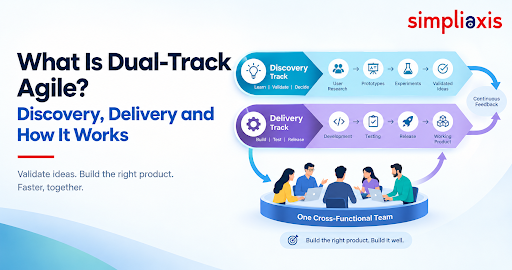
Dual-track agile is a product development approach that runs two connected streams of work at the same time. The discovery track tests ideas through research, prototypes and small experiments to confirm what is worth building.
The delivery track builds and releases those validated ideas in regular sprints. Both tracks are handled by one cross-functional team. Discovery stays a step ahead of delivery, so the team builds the right product and builds it well.
Key highlights of Dual-Track Agile
- Dual-track agile runs product discovery and delivery in parallel, so teams validate ideas before they build them.
- It uses one cross-functional team, not two. Discovery and delivery are two kinds of work, shared by the same people.
- The discovery backlog holds assumptions and experiments. The delivery backlog holds only validated stories, so sprint planning has less guesswork.
- Discovery should stay one to two cycles ahead of delivery. This avoids a mini-waterfall inside agile.
- Key benefits include less waste, faster time to market, lower risk and stronger collaboration. Common challenges are resource balance, pace and culture.
- In SAFe, the model maps to Continuous Exploration and the Continuous Delivery Pipeline. Ideas are validated before they reach the ART Backlog.
Introduction
Many agile teams ship on time. Sprints close and velocity looks healthy. Yet the product still misses the mark.
The reason is simple. The team built things right, but not always the right things. Dual track agile exists to fix this gap.
It adds a steady stream of learning to your delivery rhythm. Before an idea reaches a sprint, the team tests it. Only validated work moves forward.
This guide explains how the model works. You will learn what the two tracks do, how the backlogs connect, and how to run the process step by step. We will also cover how it compares with continuous discovery and where it fits in SAFe.
What is Dual-Track Agile?
Dual-track agile is a way of working where a team does two things at the same time. It first checks if an idea is worth building. Then it builds that idea. Both happen side by side, not one after the other.
The Two Tracks
- Discovery track: The team learns what customers need. It talks to users, tests rough prototypes and checks if an idea works. The goal is to learn quickly and cheaply.
- Delivery track: The team builds the tested ideas into real software. It codes, tests and releases in regular sprints. The goal is quality.
A Simple Example
Think of a restaurant. One chef tries new dishes on a few tables to see if guests like them. Another chef cooks the proven menu for everyone. If a new dish gets good feedback, it joins the main menu. If not, the chef drops it, and little is lost.
Why Teams Use It?
Many teams build features nobody uses. Dual-track agile reduces this risk. The team tests an idea first and builds it only when there is proof. This saves time and money, and the product improves.
Dual-Track Agile Definition
Dual-track agile is a way of organizing product work into two parallel streams. One stream is discovery. The other is delivery. Discovery decides what is worth building. Delivery builds it well.
Both streams run at the same time. They feed each other. While engineers build last week's validated idea, the team is already testing the next one.
Marty Cagan summed up the split clearly. The discovery track generates validated product backlog items, and the delivery track generates releasable software.
Think of a restaurant kitchen. One chef tests new dishes on a few tables. Another cooks the proven menu at scale. Both work every night, and the tested dishes join the menu.
Where It Came From (Marty Cagan and Jeff Patton)
The roots go back to 2007. Desiree Sy, then at Alias (later Autodesk), published a paper on adapting usability investigations for agile design. It described designers and developers working on "dual tracks"
Jeff Patton later used the model in his teaching. Marty Cagan asked what it was called. The paper's wording gave them the name, and both began using it.
Cagan then popularized the idea through his writing at SVPG. He liked the term "dual-track" because it captured the parallel nature of the work. He also warned against teams running small waterfalls inside Scrum.
There is an important update. With the second edition of his book Inspired, Cagan stopped using the term. He felt it pushed people to focus on process instead of principles. He now speaks of continuous discovery and continuous delivery.
The idea has not gone away. The name has simply evolved, and many teams still use it as a practical starting point.
One Team, Two Tracks
This is the most misunderstood point. Dual-track does not mean two teams. It means one team doing two kinds of work.
Patton is direct about it. He says discovery and development appear as two tracks because they are two kinds of work and two kinds of thinking.
He also lists a common myth. Many people believe the discovery team is different from the development team. It should not be.
A product manager, designer and senior engineer often lead discovery. Yet they should involve the whole team wherever possible. Everyone shares responsibility for product outcomes, not just on-time delivery.
The Discovery Track
(a) Goals and Activities
The discovery track answers one question: should we build this, and what exactly should it be?
Its output is not code. Its output is evidence. The goal is to produce backlog items the team can build with confidence.
Patton describes discovery work as focused on fast learning and validation. Delivery, by contrast, focuses on predictability and quality. The mindset is different, so the pace is different too.
Product discovery rests on four risks that Cagan names. A backlog item is ready only when each has been addressed.
- Value risk:will customers choose to use or buy it?
- Usability risk:can users figure out how to use it?
- Feasibility risk: can engineering build it with the time and skills available?
- Business viability risk: does it work for legal, finance, sales and brand?
Common discovery activities include:
- Customer interviews
- Problem validation
- Prototype testing
- Surveys and data mining
- Assumption testing
- Usability testing and market research
Discovery loops are short. Patton says they should run in hours when possible, and sometimes days. Several loops should fit inside a typical two-week sprint.
Timeboxing keeps them honest. A test lasts from a few hours to a few days. Then the team decides to build, kill or keep learning.
Killing ideas is a good sign. If discovery never says no, it is not doing its job.
Many teams use anopportunity solution tree here. It links a business outcome to customer opportunities, then to solutions and experiments. This keeps continuous discovery visible and focused. You can read more aboutproduct discovery as a wider practice.
Aminimum viable productalso plays a role. Early on, the MVP may be a prototype or a simple test, not production software. Patton warns that the most expensive way to test an idea is to build production-quality software.
(b) The Discovery Backlog
The discovery backlog holds questions, not tasks. It lists assumptions to test, problems to explore and ideas to validate.
Each item should name what the team believes, who it affects, and how success will be measured. This follows the learning loop Patton describes: problem and audience, proposed solution, and success measure.
A simple discovery backlog entry might read like this:
- Belief: busy shoppers abandon checkout because delivery dates are unclear.
- Test: show a prototype with estimated dates to ten customers.
- Signal: at least seven complete the purchase flow without confusion.
- Decision: build, kill or keep learning.
Sort items by risk. Test the assumption that scares the team most first. If that one fails, the rest does not matter. For other ways to order a backlog, see theseagile prioritization techniques.
Some sources describe items as mature or immature. Immature items are untested ideas. Mature items have been vetted and are ready for the delivery backlog.
The Delivery Track
(a) Goals and Activities
The delivery track answers a different question: how do we build this well?
This is the familiar agile engine. It includes sprint planning, stand-ups, coding, testing and release. Its input is a stream of validated ideas. Its output is working software.
Quality matters most here. Teams care about scalability, performance and reliability. Finished work is built, tested and reviewed by others.
Typical delivery activities include:
- Development and code reviews
- Unit, integration and system testing
- Quality assurance
- Continuous integration and deployment
- Acting on feedback from early users
Some design work still happens before coding. Patton notes that even validated ideas need tactical design decisions. Designers often work ahead of developers to prepare them.
Delivery is not the end of learning. Patton says to keep measuring and learning after you ship. Released software is the last best experiment.
(b) The Delivery Backlog
The delivery backlog looks like any agile backlog. It has user stories, acceptance criteria, bugs and technical tasks. The difference is the entry rule.
Only validated items enter. An item arrives with evidence of value, a tested design and a feasibility check. This removes the guesswork from sprint planning. User story mapping helps turn those validated items into a release-ready sequence.
Cagan describes the usual pain without this model. Planning meetings drag on because items are poorly defined. Velocity is slow because details are worked out mid-sprint. Rework is high because nothing was validated.
A healthy delivery backlog always has a few ready items. Not too many, though. Validated ideas can go stale if they wait for months.
How the Two Tracks Work Together?
The two tracks run at the same time and share one team. Discovery stays one or two cycles ahead, so ideas are tested before they reach a sprint.
Once an idea is validated, it moves from the discovery backlog to the delivery backlog. The team then builds it while discovery tests the next idea. After release, user data flows back into discovery, and that starts the next learning cycle.
Keeping Discovery Ahead of Delivery
The tracks run in parallel, but not in lockstep. Discovery should stay slightly ahead.
One practical guide says the product owner should look ahead by two to three cycles. One cycle ahead is enough to validate work before delivery picks it up. Certified Scrum Product Owner (CSPO) training covers this kind of backlog look-ahead in Scrum.
The rhythm often looks like this:
- Sprint 1: delivery builds item A. Discovery tests item B.
- Sprint 2: delivery builds item B. Discovery tests item C.
- Sprint 3: delivery builds item C. Discovery tests item D.
Watch for warning signs. If the delivery backlog runs dry, discovery is falling behind. The team may then slip back to building on opinion.
Speed is often the cause. Traditional research takes time to recruit, schedule, run and analyze. To keep up, use lighter methods. Short interviews, quick prototypes and small tests work well.
Avoid one trap above all. Do not let discovery become a long phase that hands a finished spec to developers. That is a mini-waterfall inside agile. Cagan warned about exactly this pattern.
Collaboration prevents it. The product manager, designer and engineer work side by side. They create and test backlog items together. Prototypes can even serve as the spec for delivery.
Managing Two Backlogs in One Cadence
Two backlogs can sound heavy. In practice, they share one rhythm.
Keep them visible on one board or in one tool. Many teams use Jira, Trello, Miro or a roadmap tool. The tool matters less than the clarity.
Here is a simple structure:
| Element | Discovery backlog | Delivery backlog |
| Contents | Assumptions, questions, experiments | Stories, bugs, tasks |
| Main goal | Learn fast | Ship with quality |
| Cycle length | Hours to days | Sprint length |
| Exit rule | Build, kill or keep learning | Done and releasable |
Set a few sync points. Review discovery findings in sprint planning. Share results in stand-ups. Show prototypes in sprint reviews. Patton has published recipes for dual-track planning, stand-ups and reviews that you can adapt. Teams sizing newly validated stories can use Planning Pokerduring refinement.
Some teams hold a weekly or bi-weekly session to align both tracks and adjust priorities. Keep it short and focused on what changed.
Benefits and Challenges of Dual-Track Agile
Let’s first talk about the benefits:
Dual-track Agile benefits
The main gain is less waste. Validating before building avoids work nobody wants. The other dual track agile benefits follow from that.
- Faster time to market, because weak ideas are dropped early.
- Better quality, because feedback shapes each release.
- Stronger collaboration across product, design and engineering.
- Easier adaptation when markets or customer needs shift.
- Lower risk, since problems surface before development.
The model brings developers into discovery and keeps them focused on outcomes. They respond to user feedback instead of considering the job done at release.
Common challenges
The model is not free. Teams usually struggle with four things.
- Resource balance: Time must be split between discovery and delivery.
- Pace: Research can fall behind sprint cadence.
- Skills: People must work across role boundaries.
- Culture: Killing ideas feels uncomfortable to some stakeholders.
Several fixes help:
- Schedule regular touchpoints.
- Use a strong product owner to set priorities.
- Invest in training.
- Watch for stalled discovery or growing technical debt.
How to Run Dual-Track Agile Step by Step?
Here is a simple dual track agile process you can start with. It is a lightweight dual track agile workflow, not a rigid rulebook.
- Form a cross-functional team: Include product, design and engineering. Add QA and others as needed.
- Set a clear outcome: Choose one business or customer metric to move.
- Map opportunities: Use customer research and an opportunity solution tree to list needs and pain points.
- Write hypotheses: State the problem, the solution and the success measure.
- Rank by risk: Pick the assumption that could sink the idea.
- Run small tests: Use interviews, prototypes or an MVP. Keep each test timeboxed.
- Decide: Build, kill or keep learning. Record the evidence.
- Move validated items to the delivery backlog: Add acceptance criteria and finish tactical design.
- Build and release in sprints: Keep quality high.
- Measure after launch: Feed results back into discovery.
A short example shows the flow.
Imagine a food delivery app team. They believe customers want a "reorder last meal" button. In discovery, they test a clickable prototype with eight users. Seven use it without help, and most say it saves time. The item moves to delivery. After release, the team tracks reorder rates and finds a lift. That data starts the next discovery cycle.
For measurement, track a few signals. Watch the depth of validated items in the backlog. Watch how long it takes to answer a question. Watch the ideal kill rate. Watch rework after launch.
Dual-Track Agile vs Continuous Discovery
People often ask about dual track agile vs agile. The two are not rivals. Patton's view is that dual-track is really just agile. The label confuses. Standard agile focuses on building. Dual-track adds structured discovery next to it.
The second comparison is with continuous discovery. This idea was shaped by Teresa Torres, whose book Continuous Discovery Habits appeared in 2021.
Three differences stand out:
- Customers: Continuous discovery puts weekly customer interviews at the center. Dual-track focused more on how roles work together.
- Relationship between tracks: Patton sees two kinds of work. Torres sees discovery and delivery as intertwined, even indistinguishable when done well.
- Team shape: Continuous discovery stresses a product trio of product, design and engineering.
| Aspect | Dual-track agile | Continuous discovery |
| Core idea | Two parallel tracks | Discovery and delivery intertwined |
| Customer focus | Present, less prescriptive | Weekly interviews |
| Team model | One team, shared work | Product trio |
| Typical tool | Two backlogs | Opportunity solution tree |
Both aim at the same result. They reduce the risk of building the wrong thing. Many teams start with dual-track and grow into continuous discovery.
Dual-Track Agile in SAFe
Large organizations can use the same thinking. Dual-track Agile in SAFe shows up through Continuous Exploration.
SAFe defines Continuous Exploration as the first aspect of the Continuous Delivery Pipeline. It explores market and customer needs, defines a vision and roadmap, and shapes a set of features. The other aspects are Continuous Integration, Continuous Deployment and Release on Demand.
This maps closely to the dual track agile discovery and delivery split. Exploration is discovery at scale. The rest of the pipeline is delivery.
Continuous Exploration and the Delivery Pipeline
During exploration, ideas are raised, refined and prepared as prioritized Features in the ART Backlog. Agile teams then implement those features, which are prioritized by Product Management during PI Planning.
SAFe also treats ideas as hypotheses. They need to be validated, using customer centricity and design thinking. That echoes the dual-track mindset.
Product Owners and Product Managers sit at the center of this flow. They guide discovery, shape the backlog and align teams with the vision. If you want to grow in this space, the SAFe POPM Certification Training covers these practices. You can also review theSAFe POPM roles and responsibilitiesto see how the work divides.
For dual track agile product management at scale, keep one rule. Validate before features reach the ART Backlog, not after. Product managers who own this at the train level can go deeper with SAFe Agile Product Management training.
Common Dual-Track Agile Mistakes
Most failures come from a few repeated errors.
- Creating two separate teams. This rebuilds silos and handoffs.
- Treating discovery as a phase. It should run every week.
- Handing over specs. Share prototypes and evidence instead.
- Skipping engineers in discovery. Feasibility surprises then appear late.
- Never killing ideas. Discovery becomes a rubber stamp.
- Over-researching. Timebox tests and size them to the risk.
- Stopping at launch. Keep measuring and learning after release.
- Letting the backlog go stale. Revalidate old ideas before building.
A good check is simple. Ask whether the whole team can explain why each sprint item matters. If not, discovery is not reaching delivery.
Conclusion
Dual-track agile gives agile teams something they often lack: a reliable way to choose well. Discovery cuts risk. Delivery turns evidence into working software. Together they help teams build the right thing, and build it right.
The name may be fading in favor of continuous discovery. The principles remain strong. Keep one team, test before you build, and keep learning after you ship.
Ready to put these ideas to work? Simpliaxis can help you build the skills.
Explore theSAFe POPM Certification Trainingto learn how to drive discovery, manage backlogs and deliver value at scale. Enrol with Simpliaxis today and take the next step in your product career.





 Lowest-Price Challenge











 Personalized Path


.webp)


 USA
USA  Canada
 India
India UK
UK Australia
 Singapore


