


 Call Us




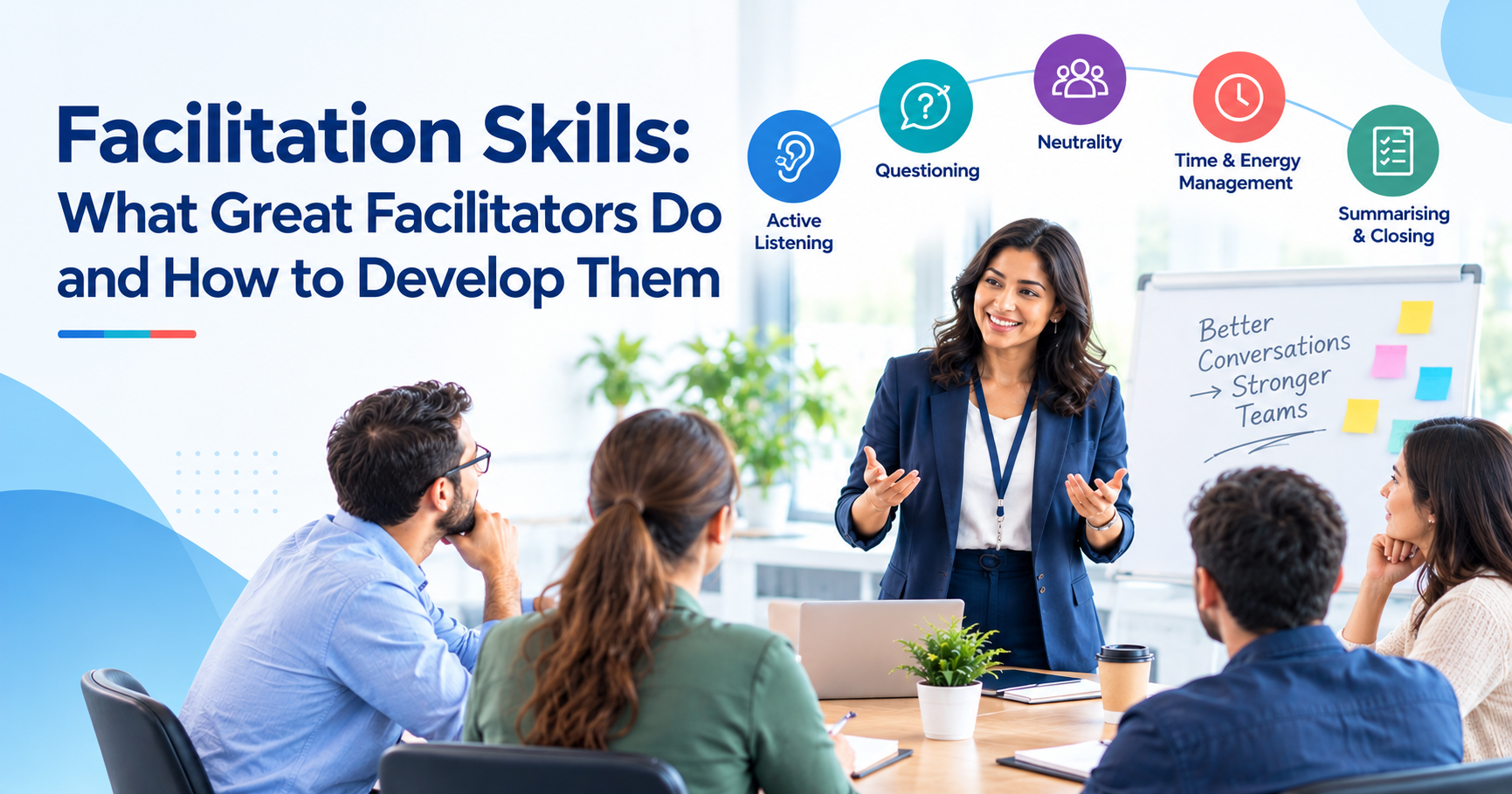
Facilitation Skills: What Great Facilitators Do and How to Develop Them

Facilitation skills are the skills required to help a group to communicate, collaborate, solve problems and achieve meaningful outcomes. These include active listening, effective questioning, neutrality, time management, managing disagreements and summarising decisions. These skills help Scrum Masters, Agile coaches and team leaders to conduct productive meetings, facilitate participation and translate discussions into actionable outcomes in Agile teams. But you can develop them through deliberate practice, structured facilitation techniques, feedback and professional training such as ICAgile’s Agile Team Facilitation certification.
Key Highlights of Facilitation Skills
- Facilitation skills are used to help groups make decisions, solve problems and work well together without one person dominating each discussion.
- Key skills: Active listening, Questioning, Neutrality, Time management, Summarising.
- Methods such as round robin, dot voting, fist of five and silent writing help teams participate more equally.
- These skills are used by Agile facilitators in sprint planning, daily stand-ups, reviews and retrospectives.
- Facilitation is managing dominant voices, bringing out the quieter participants and dealing with conflict.
- Regular practice, constructive criticism, and structured learning can help professionals become more confident facilitators.
Introduction
You can have the right people, a clear agenda and a pressing business objective in a meeting and still come away empty-handed. An individual may dominate the conversation, quieter members may fail to share important information, and the team may spend more time talking about the problem than coming up with solutions.
How the conversation is facilitated is often the difference between a meeting that just happens and one that produces results.
Facilitation is not about knowing all the answers, or telling people what to do. It is about the setting in which people can express their views, experiment with different ideas and work towards a common outcome. A good facilitator keeps a group on track and makes sure that everyone in the group has an equal opportunity to participate.
These skills are particularly useful in Agile environments where teams regularly come together to plan work, review progress, solve blockers, and improve the way they work.
For instance, a Scrum Master running a sprint retrospective cannot simply ask what went well. They have to enable productive team discussion on tough topics and agree on enhancements that the team can realistically implement.
Knowing what facilitation skills are, why they are important and how to develop them can enable professionals to run more effective conversations across teams, departments and organizations.
What Are Facilitation Skills?
Facilitation skills are the social, communication and group management skills used to direct a discussion or collaborative activity to a defined objective. A facilitator facilitates the process, not the outcomes.
Say, for example, a development team is having trouble meeting sprint commitments. Instead of suggesting shorter tasks or more ad hoc meetings, a facilitator might have team members identify recurring obstacles, share notes and prioritize the changes that are most likely to help.
The team still has to make those decisions. The facilitator clarifies, includes and makes the decision-making process more productive.
Effective facilitation can assist organizations to:
- Motivate people in different roles and with different perspectives to get involved.
- Identify assumptions, risks and disagreements before they become bigger problems.
- Make group decision-making more transparent
- Keep meetings focused on their goals.
- Translate ideas into concrete actions, with owners and timeframes.
- Build trust and enable continuous improvement.
Google’s research into team effectiveness ound that psychological safety, the ability to take interpersonal risks without fear of negative consequences, was an important characteristic of effective teams. Facilitation by itself won’t create psychological safety, but practices like inviting dissenting opinion, listening without judgment, and treating mistakes as opportunities for learning can help create it.
Core Facilitation Skills
Good facilitators are skilled in many areas, not just one communication technique. There is no one best way. The best way will depend on the group, the purpose of the meeting, and the challenges participants face.
Active Listening
Active listening means listening carefully to the participant’s message, understanding what is being said and, if necessary, asking for clarification before responding.
What does that mean? It means listening to what the speaker is saying, noting relevant issues and not interrupting or formulating a rebuttal while the other person is speaking.
At a retrospective, for example, a developer says, "We always find integration problems at the last minute.
The facilitator says, “Sounds like you’re finding integration problems too late. We should think about automated testing, not right away, but sometime soon. Can you take us through the times when they tend to pop up?"
This question helps to unearth the root problem before the team jumps to a solution.
To develop active listening:
- Let the participants get their thoughts out.
- Restate key points to check for understanding.
- Notice feelings without assuming you know what someone is feeling like.
- You will see similar themes across different contributions.
- Ask questions for clarification when a statement is unclear.
Challenge
Good questions make people think critically, explain their assumptions, and explore possibilities. We are not trying to interrogate participants, but rather to get them to think more deeply about an issue.
Open-ended questions are particularly useful for eliciting more than a yes or no answer.
Examples of this are:
- “What is preventing us from completing this work?”
- ""Why do you suppose that is?"
- “What options have we not considered?”
- What would it take to make this solution work?
- What do we want to do differently in the next sprint?
Questions should be relevant to the stage of the discussion. Exploratory questions to gather information. Clarifying questions when ideas are unclear. Decision-oriented questions, when the group is ready to make a decision about a course of action.
Avoid leading questions like, “Don’t you think we should change the process? They can push participants to accept the facilitator's favored answer and discourage honest disagreement.
Neutrality
Neutrality means to guide the conversation without taking sides with any participant, idea or result. This does not mean that we should ignore bad behavior or pretend that all claims are equally evidence-based.
A neutral facilitator makes the process of decision-making visible, gives competing perspectives a fair hearing, and helps the group evaluate ideas against agreed-upon criteria.
A product owner wants to add a feature to the sprint and the developers are worried about the capacity. The facilitator doesn’t take sides, but asks the team to think about customer value, effort, dependencies, and the sprint goal.
The dialogue shifts from personal positions to shared norms.
This is particularly important if the facilitator is an expert in the area of concern, or has authority over the participants. Splitting the roles of facilitator and decision-maker will allow the group to know when they are being facilitated and when a decision is being made.
Time and Energy Management
Good facilitation is all about finding the right balance of time available and the energy and attention of the group. A discussion that covers every detail imaginable may feel productive but leave no time for decisions.
Before the session, decide what you want to get out of it and how long you think each activity will take, and make sure you have time for unexpected questions.
During the meeting:
- Share the agenda and time limits.
- Use timeboxes for brainstorming and discussion.
- Park unrelated topics for later consideration.
- Change activities when energy drops or the group becomes stuck.
- Reserve time to confirm decisions and next steps.
For example, a 60-minute planning workshop might include 10 minutes on context, 15 minutes to identify priorities, 20 minutes to evaluate options, 10 minutes to decisions, and five minutes to action items.
The schedule must be flexible enough to allow for important discussions, but it should not be so open that every discussion drags on endlessly.
Summarising and Closing
Summarising is a way of helping a group to understand what it has been talking about and what it has agreed on and what it has not yet resolved. Closing ensures that the meeting ends with a common understanding of what’s next.
"Okay, we've identified three reasons for delayed testing: late handoffs, unclear acceptance criteria, and limited test environments." We agreed to establish acceptance criteria in refinement and review the results in the next retrospective.”
A useful closing summary should cover:
- The main findings or themes.
- Decisions made and any outstanding questions.
- Actions, owners, and due dates.
- How the team will review progress.
This step prevents valuable discussion from disappearing once participants leave the meeting.
Facilitation Techniques
Facilitation techniques help to provide structure to group conversations . They come in handy when participation is uneven, when a team needs to prioritize ideas or when a decision involves multiple perspectives.
The following techniques can be adapted for in-person, remote, and hybrid sessions.
| Technique | Purpose | When to Use | Example |
| Round robin | Gives each participant an opportunity to contribute. | Brainstorming, retrospectives, and group check-ins. | Each developer shares one improvement for the next sprint. |
| Dot voting | Helps a group prioritize options quickly. | Selecting ideas, identifying themes, or narrowing alternatives. | Team members distribute three votes across proposed process improvements. |
| Fist of five | Quickly checks agreement, confidence, or support. | Evaluating proposals and identifying unresolved concerns. | Members show one to five fingers to indicate their confidence in a release plan. |
| Silent writing | Encourages independent thinking before group discussion. | Brainstorming, sensitive topics, and sessions with dominant voices. | Everyone writes down causes of recurring defects before ideas are shared. |
How to Use Each Technique Effectively
Round robin: Go around the group and ask everyone in turn, they can pass if they’re not ready. Keep the opening remarks brief, so that the activity does not turn into a series of long speeches.
Dot voting is one of several Agile prioritization techniques teams use to narrow a long list. The use of dot voting shows preferences, but does not automatically make the best decision. Discuss the results, and deal with important objections, before making a final choice.
Fist of five: Ask a clear question, like: “How confident are we that we can deliver this scope? Participants hold up a number of fingers (usually between one and five). Ask those with lower scores to tell you what their concerns are. Teams may interpret the scale differently, so establish the scale before using it.
Silent writing: Allow participants a few minutes to brainstorm individually (using sticky notes, a shared document, or a digital whiteboard). Then combine similar contributions and discuss them as a group. This reduces the impact of the first or loudest voice.
These are not strict rules. Good facilitators choose and modify techniques according to the purpose of the session, the team’s familiarity with the activity, and the decision to be made.
Facilitation Skills Examples in Agile Teams
Agile teams often have to make decisions under time pressure, manage dependencies and learn from feedback. Their facilitation skills help them work through these activities so that not every challenge is a top-down decision.
Here are four practical examples.
1. Sprint planning
A team has more work proposed than it can reasonably complete. During Sprint Planning, the facilitator guides participants in reviewing the sprint goal, capacity and dependencies and clarifying assumptions.
The facilitator does not delegate tasks to individuals but assists the team in formulating a realistic plan as a group.
2. Daily stand-ups
The Daily Scrum has turned into a long status report.The facilitator leads the conversation back to progress on the sprint goal and brings up issues for further discussion.
The detailed problem-solving is moved to a separate conversation with the relevant people and the event stays on track.
3. Sprint review
Team members disagree on why work is delayed. Some fault fuzzy requirements, others late testing.
The facilitator gathers observations through silent writing, groups common themes and asks the team to select one or two improvements to try in the next sprint. This makes the retrospective more constructive and action-oriented.
Learn more about how to run a sprint retrospective.
4. Grooming the backlog
Developers and business stakeholders experience a requirement differently. The facilitator asks what the desired user outcome is, whether edge cases are covered and whether they’ve agreed acceptance criteria.
That means a better shared picture before you start implementing.
These examples show why facilitation sits at the heart of Scrum Master roles and responsibilities. Facilitation roles can be rotated or shared but someone needs to ensure the process is intentional and inclusive.
Handling Difficult Dynamics
When participants are dominating, silent, or in strong disagreement, facilitation gets tougher. The goal is not the elimination of all discomfort. That is to enable productive, respectful difficult conversations
Dominant Voices
Some participants talk a lot because they have strong opinions, broad expertise, or more organizational authority. If you interrupt a lot, other people may find it hard to get in on the conversation.
Agreeing on team norms for participation up front makes it easier to redirect dominant voices without singling anyone out.
For example, say, “Let’s get some people who haven’t spoken yet before we get back to this point.”
If it keeps happening, calmly and directly address the behavior. You might say, 'Let's let Priya finish what she has to say before we respond.
The idea is to get the right amount of participation without embarrassing anyone or ignoring valuable expertise.
Silent Participants
Quiet participants may be thinking carefully or may lack confidence or be uncomfortable disagreeing with senior colleagues. Silence is not consent or lack of engagement.
Propose alternate methods of participation: written responses, anonymous polling, breakout groups, or pre-work.
For example, have everyone take two minutes and write down risks before asking for comments. Then participants who prefer to formulate their thoughts independently can share them without competing for speaking time.
Don't make a person responsible for explaining their silence on the spur of the moment. Instead, create multiple opportunities to contribute and signal that different styles of communication are welcome.
Conflict
Disagreement can help teams to identify risks and to challenge bad assumptions. It is not productive when participants attack people, repeat positions without listening, or make the discussion a contest.
A facilitator should differentiate between disagreement about the work and personal conflict.
Responses that are useful include:
- Restating the problem in neutral terms.
- Have each person explain the concern underlying the position.
- Find shared goals and points of agreement.
- Comparison of alternatives against agreed criteria.
- If emotions are running high, take a break and set another time to talk.
For example, two team members disagree over whether or not to launch a feature. The facilitator asks about the customer impact, the technical risks and the evidence needed to make the decision.
This sets the stage for dialogue, not expecting either side to give up their position right away.
Where there is harassment, discrimination or a serious power imbalance, normal meeting techniques may not be enough. May require proper organizational processes and support.
Facilitating Remote and Hybrid Sessions
Remote and hybrid meetings bring their own challenges. Some people might not have the same access to the conversation, or might have technical difficulties, or not be able to read body language. Good remote facilitation isn’t just taking an in-person meeting and making it a video call. It’s a design decision.
Look at these practices:
- Share the purpose beforehand: Provide agenda, expected outcomes and preparation materials in advance.
- Use collaborative tools: Shared documents, digital whiteboards, polls and chat can help participants to contribute in different ways.
- Create explicit turn-taking: Use a speaking queue, round robin or hand-raising feature so people don’t talk over each other.
- Add asynchronous input: Let participants add comments to the session before and after, especially with different time zones.
- Make decisions visible: Capture decisions, assumptions and action items in one place.
- Hybrid equality design: Ensure remote participants can see the material and participate as easily as those in the room.
In a remote retrospective, for instance, participants might take three minutes to type in observations to a digital board. The facilitator then groups similar ideas, opens it up for discussion and uses a poll to decide on priorities.
Don’t depend only on verbal participation. Chat, written brainstorming and anonymous input are other ways that people can contribute.
Technology can help the process, but it doesn’t replace the facilitator’s responsibility to create clarity, manage participation and keep the session on track.
How to Build Facilitation Skills
Facilitation gets better with practice, reflection and feedback. You don’t have to wait until you become a Scrum Master or Agile coach to start developing these skills.
Create a hands-on learning routine by following the steps below.
1. Begin with smaller meetings: Propose to facilitate a team check-in or brainstorming session or project discussion. Start with a clear purpose and a simple agenda.
2. Practice one skill at a time: One session about active listening, another about questioning. When you try to change everything about your facilitation at once, it’s hard to gauge your progress.
3. Make up questions ahead of time: Capture open-ended questions that lead the group to discuss the topic, test assumptions and make decisions.
4. Try out techniques: If participation is uneven, use silent writing. If the team needs to narrow a long list of options, use dot voting. Before you begin, tell the purpose of each activity.
5. Seek feedback: After a session, ask participants what helped them contribute and what could have been clearer. A trusted peer can also join your facilitation and make some concrete suggestions.
6. Consider the results: Was the meeting on target, had a good cross-section of people and had clear next steps? Don't focus on how smooth the session felt; instead, focus on tracking recurring problems.
7. Ask experienced facilitators for help: Look for how they handle interruptions, how they follow up with questions and how they respond when conversations go off the rails. Adapt techniques to fit your style and context.
8. Train in a structured way: A professional program can provide a framework for planning sessions, practicing techniques and feedback within a supportive learning environment.
A simple practice goal is to facilitate one session each week and reflect on three questions afterward: What worked? Where did participation drop? What will I change next time?
Over several weeks, this creates a useful record of progress and helps turn facilitation from an informal responsibility into a deliberate professional skill.
How ICP-ATF Training Helps
The ICAgile Certified Professional in Agile Team Facilitation (ICP-ATF) certification is designed for professionals who want to improve how they facilitate Agile team activities, meetings, and workshops.
According to ICAgile, the program focuses on Agile facilitation techniques and mindset, creating an environment for communication and collaboration, facilitating Agile events, and managing team dynamics and conflict. It is relevant to Scrum Masters, Agile coaches, product owners, project managers, and team leaders.
Learn more through the official ICAgile Agile Team Facilitation certification overview.
Structured ICP-ATF learning can help professionals develop several capabilities:
- Session design: Identify outcomes, select appropriate activities and structure a meeting to suit the needs of the group.
- Practical facilitation: Get to know techniques that can support brainstorming, prioritization, decision-making, and reflection.
- Group dynamics: Be aware of imbalances in participation and respond constructively to disagreement.
- Facilitation Mindset: Concentrate on assisting the team to reach its own outcomes rather than attempting to control every decision.
- Ongoing development: Consider facilitation practice and identify areas for further development.
If you want to develop these capabilities in a structured environment, check out Simpliaxis’s ICP-ATF certification training.
We also offer Agile Coaching Skills training for those professionals who want to extend their capabilities beyond facilitating individual sessions.
Facilitation and coaching are different but related disciplines. Facilitation helps a group work through a process and coaching supports individuals or teams to develop awareness, explore options and find their own solutions.
Professionals interested in the broader role can learn more about what is an Agile coach.
Training is a starting point, not a substitute for experience. The greatest value comes from applying what you learn, reflecting on the results, and adapting your approach to different groups and situations.
Conclusion
Facilitation skills help teams turn conversations into shared understanding, better decisions and meaningful action. Every skill, from active listening and questioning to neutrality and time management, has a role to play in a process in which people can contribute constructively and work towards a common goal.
These capabilities are especially useful in Agile environments for sprint planning, retrospectives, backlog grooming, and other collaborative activities. There are practical techniques such as round robin, dot voting, fist of five and silent writing that provide ways to promote participation and structure discussions.
And a man is made perfect by practice! Begin with short sessions, try out different approaches, get feedback and look at the results. For professionals who want a more structured learning path, the ICP-ATF certification from ICAgile can be an excellent starting point for Agile team facilitation role.
Great facilitators don’t need to be the loudest people in the room or have an answer to every question immediately. They are valuable because they help the group to think clearly, to hear other perspectives, and to move forward together.





 Lowest-Price Challenge












 Personalized Path



.webp)


 USA
 Canada
 India
 UK
 Australia
 Singapore


