


 Call Us




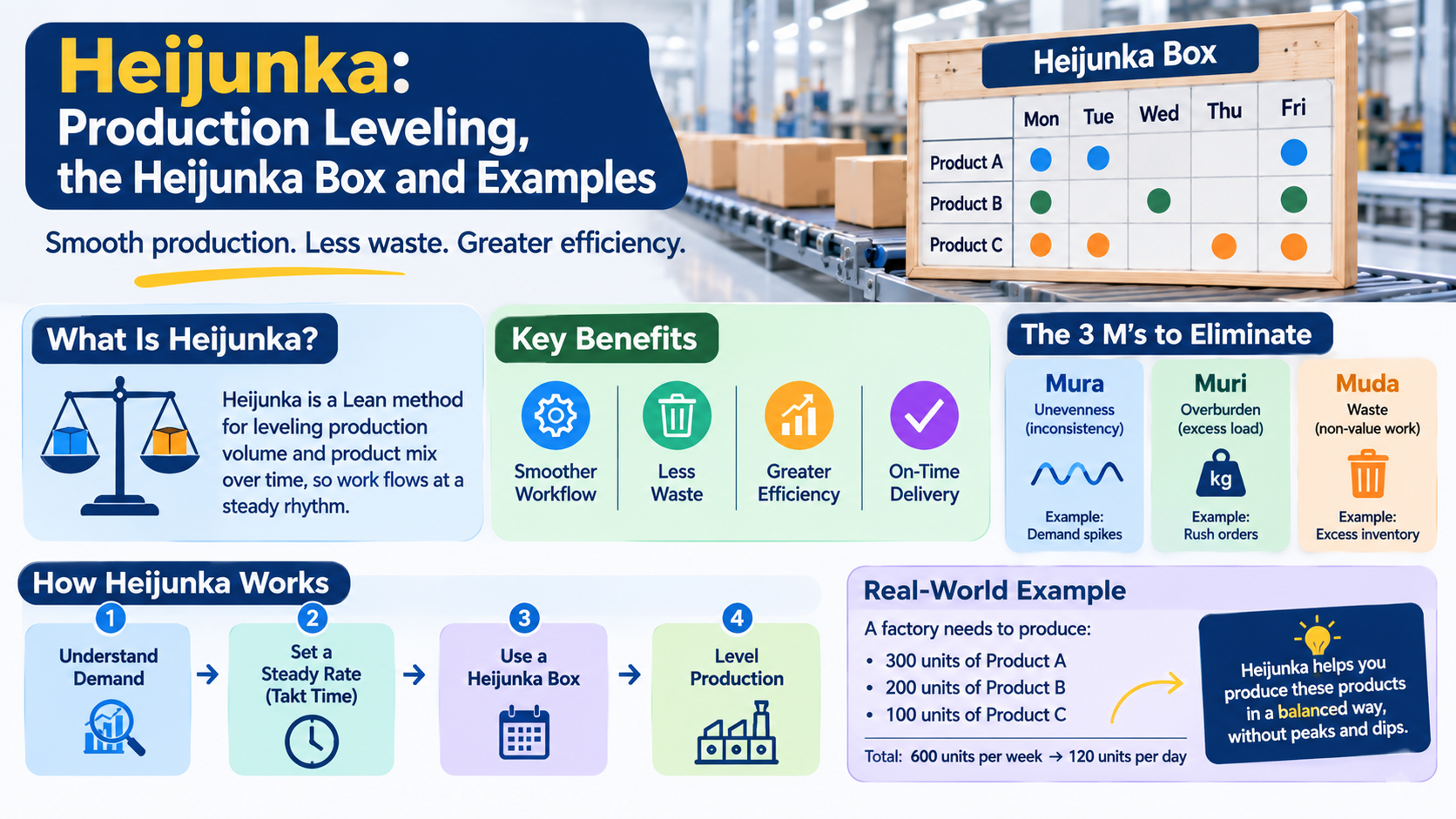
Heijunka is a Lean method for leveling production volume and product mix over time, so work flows at a steady rhythm instead of lurching between rush and idle periods. Rather than building whatever the latest orders demand, teams smooth demand into small, repeatable batches, often sequenced on a heijunka box. The payoff is less overload, less waste, and more predictable delivery.
Key Highlights
- Heijunka means “leveling” in Japanese (平準化) and is a core idea in the Toyota Production System.
- It levels two things: how much you produce (volume) and which products you produce (mix).
- The heijunka box is a physical or digital schedule board that turns demand into a steady production sequence.
- Takt time and pitch set the rhythm; heijunka decides what fills each interval.
- It reduces Mura, Muri, and Muda, and works alongside Kanban in a pull system.
- The idea travels beyond factories into services and software, with some adaptation.
Introduction
Picture a café on a Saturday morning. Between 8 and 9 a.m., thirty people walk in at once. The baristas panic, the oat milk runs out, and half the orders come out wrong. By 11, the place is a ghost town, and everyone is wiping counters that are already clean. Same staff, same menu, same total demand across the day, yet one hour is chaos and the next is wasted.
Factories live this story constantly. Orders arrive in lumps, so production swings between frantic overtime and idle machines. Quality slips during the rush, stock piles up during the lull, and people burn out either way.
Heijunka is the Lean answer to that swing. In plain terms, it is production leveling: you smooth out what you make and when you make it, so work reaches every step at a calm, predictable pace. If you have come across heijunka in Lean manufacturing, you probably know it as one of the quieter Lean tools. It is less famous than Kanban, yet it is often the thing that makes the rest of the system work.
In this guide, we will walk through what heijunka means, how it works, how to use a heijunka box, and a worked example with real numbers. We will also look at how it pairs with Kanban, whether it works outside factories, and where it shows up in training. If you are new to the bigger picture, our primer on what is the lean process is a good place to start, and you can come straight back here afterwards.
What Is Heijunka?
Heijunka is a Japanese word that translates roughly to “leveling” or “making flat.” Here is the simple heijunka definition: a Lean method of leveling production volume and product mix over a fixed period, so output follows demand without wild swings. The Lean Enterprise Institute’s heijunka entry describes it in much the same spirit, and production leveling on Wikipedia offers a broader overview if you want a second angle.
Do you know what heijunka is not about? It is not about building the same number of everything every day regardless of what customers want. It is about absorbing normal ups and downs in demand into a steady, repeatable plan. Customers might order 300 units one week and 140 the next. The plant does not need to mirror that roller coaster. It looks at demand over a longer window, sets a sensible rate, and sequences the work in small slices.
Think of it as the difference between sprinting and jogging. A sprinter is faster for a moment, but the jogger covers more ground without collapsing. That is heijunka in Lean thinking: a sustainable rhythm instead of heroic bursts. You will also hear the idea called level scheduling or demand smoothing, and all three point to the same goal.
Why does it matter? Because uneven production quietly creates most of the problems Lean tries to remove. Surges need extra stock, extra people, and extra space. Lulls waste capacity. Big batches hide defects until it is too late. Leveling the schedule goes after these problems at the root rather than patching symptoms, which is why it sits so comfortably alongside the Lean Six Sigma principles of flow, pull, and continuous improvement.
Heijunka in the Toyota Production System
Heijunka grew out of the Toyota Production System (TPS), the approach Toyota built over decades to make quality vehicles with minimal waste. Toyota’s own overview of the Toyota Production System frames it around two pillars: just-in-time, which means making only what is needed when it is needed, and jidoka, which means building quality into the process by stopping when something goes wrong. In the classic “TPS house” diagram, heijunka sits in the foundation beneath both pillars.
That placement makes sense. Just-in-time only works if demand reaches the line smoothly. Otherwise, suppliers, workers, and machines are constantly caught off guard. Jidoka only works if people have enough breathing room to notice a problem and stop the line. A level schedule gives you both: a steady flow for just-in-time to work with, and a calm enough pace for jidoka to catch defects early.
Mura, Muri and Muda
TPS names three enemies of smooth work, all Japanese words that start with “M.” Once you understand them, heijunka clicks into place.
Term | Meaning | Production impact | Simple example |
| Mura | Unevenness | Workload swings up and down, so resources are either stretched or idle | The line runs flat out on Monday and sits half-empty by Thursday |
| Muri | Overburden | People and equipment are pushed beyond a sustainable load | Operators work extra shifts to clear Monday’s pile of orders |
| Muda | Waste | Activity that consumes resources without adding value | Excess inventory, waiting time and overproduction |
They form a chain. Mura (uneven demand) creates Muri (overburden during the peaks), and Muri creates Muda (defects, breakdowns, rework and idle time afterwards). Our guide to the seven wastes of lean shows how overproduction, waiting, and excess inventory tend to multiply when production is uneven.

Heijunka targets Mura first. Cut the unevenness, and you ease the pressure that causes overburden and waste downstream. That is why Lean practitioners call it a root-cause tool rather than a quick fix.
How Heijunka Works
Strip away the jargon and heijunka planning comes down to three moves: look at demand over a longer window, decide on a steady rate, and slice the work into small, repeating sequences. Before you do any of that, understand how work moves today. A value stream mapping exercise shows where materials wait, where bottlenecks form, and which steps are slowest, so you level around reality instead of assumptions.
From there, production scheduling shifts from “build whatever just arrived” to “build to a plan that smooths what is coming.” The plant still runs as a pull system, where downstream demand triggers production. Heijunka simply controls how that demand is released to the shop floor, so it does not arrive in lumps. Two levers do the work.
Volume Leveling
Volume leveling smooths how much you make in each period. Suppose a product has weekly orders of 120, 60, 140 and 80 units. That is 400 units over four weeks, so the plant builds 100 a week (20 a day on a five-day week) and uses a small finished-goods buffer to absorb the gaps between production and orders.
The buffer is the trade-off. You carry a little stock so you do not have to flex your whole operation. Done well, volume leveling answers one question: what steady rate can we sustain? Use average demand, confirm your capacity, and size the buffer to normal variability rather than worst-case panic. After a few weeks, check whether flow is actually improving.Flow metrics such as cycle time, throughput, and work in progress make that easy to see.
Product Mix Leveling
Mix leveling smooths which products you make and in what order. Instead of building all of product A on Monday and all of product B on Wednesday, you build A, B, A, C in small repeating cycles. Customers get a wider range sooner, inventory per item shrinks, and problems show up within minutes instead of days.
The constraint is changeover time, because switching products costs minutes or hours. That is where EPEI, short for “every part every interval,” comes in. EPEI measures how often you can produce each product given changeover times and demand. An EPEI of one day means every product runs daily. Shorter changeovers allow shorter EPEI and make mixed model production, where different models run down the same line in a blended sequence, far more practical.
Aspect | Volume leveling | Product mix leveling |
| Purpose | Keep the overall output rate steady | Spread product variety evenly through the period |
| Method | Use average demand and a small buffer | Sequence products in small repeating cycles |
| Example | Build 20 units a day instead of 60, 0, 40, 0, 0 | Run A-B-A-C repeatedly instead of one long run of A |
| Main constraint | Demand volatility and buffer size | Changeover time and EPEI |
Pitch and Takt Time
These two terms are close relatives, but they are not interchangeable.Takt time is the pace set by customer demand: available production time divided by customer demand. With 450 productive minutes a day and demand of 40 units, takt time is 11.25 minutes. One unit needs to be completed every 11.25 minutes to keep up.
Pitch turns that pace into a practical interval. It equals takt time multiplied by the pack-out quantity, meaning the number of units moved or released together. With a pack-out of 4 units, pitch is 4 × 11.25 = 45 minutes. Think of pitch as the heartbeat of the line.
So the three ideas divide the work like this: takt time sets the pace, pitch sets the interval, and heijunka decides what fills each interval.
The Heijunka Box
Now for the tool that makes all of this visible. A heijunka box is a scheduling board, usually a grid of slots mounted on a wall or frame. Columns represent time intervals (your pitch). Rows represent products or product families. Production cards, often Kanban cards, sit in the slots and show what to build and when. The Heijunka Box entry from the Lean Enterprise Institute offers a concise definition if you want a reference point.
Each card represents a fixed quantity of work, usually one pitch’s worth. At every pitch, a material handler (sometimes called a runner) removes the next card and takes it to the production process. That card is the instruction. If a card is still sitting in its slot when it should have gone, everyone can see the schedule slipping. If you are new to cards, signals, and limits on work in progress, our guide to the core practices of Kanban covers the basics.
Figure 1: A simplified heijunka box (pitch = 45 minutes, each card = 4 units)
Product | 07:00 | 07:45 | 08:30 | 09:15 | 10:00 |
| A | Card A | Card A | Card A | ||
| B | Card B | ||||
| C | Card C |
Read it left to right as a timeline and top to bottom as a product list. Here, the sequence is A, B, A, C, A, so the product mix is spread through the morning rather than clumped into long runs. A good board tells a worker three things at a glance: what to make, how much, and when.

How to Set Up a Heijunka Box
You do not need fancy equipment. A whiteboard, some pockets, and a set of cards will get you started. Here is a practical sequence:
- Gather demand data: Pull several weeks of orders by product so you know average demand and normal variation.
- Calculate takt time and pitch: Use the formulas above so each slot matches a realistic production interval.
- Group products: Decide which products or families get their own row, based on similar processes and volumes.
- Build the grid: Create one column per pitch and one row per product, covering a shift or a full day.
- Create the cards: Each card should show the product, quantity per pitch, and any key instructions.
- Load the cards in a leveled sequence: Spread each product evenly across the day, within changeover limits.
- Assign a runner: One person withdraws cards at each pitch and delivers them to the line.
- Review and adjust: Check at the end of each day or week, then refine quantities and sequence as demand shifts.
Heijunka Board vs Box
You will see “heijunka board” and “heijunka box” used almost interchangeably, and the underlying logic is identical. The practical difference is format. A box usually means a physical rack of slots and cards. A board can be a wall-mounted grid, a whiteboard, or a digital scheduling screen.
Physical versions are tactile, visible to everyone, and easy to teach, which makes them ideal for a first rollout. A digital board earns its place when you have many products, multiple sites, frequent demand changes, or a need to connect with ERP and production scheduling software. A physical board is usually less suitable when your sequence changes several times a day, or your team is spread across locations. Many plants start physical, learn the logic, and then digitize.
Heijunka Example
Theory is nice, but numbers make it real. Let’s walk through a simple, illustrative heijunka example for a small assembly line, using a realistic weekly mix.
Weekly Mix Example
The setup: One line builds three product models, A, B, and C. The plant works five days a week with 450 productive minutes a day. Weekly demand totals 200 units: 100 of A, 60 of B, and 40 of C. Here are the steps:
- Daily demand: 200 ÷ 5 = 40 units a day.
- Takt time: 450 ÷ 40 = 11.25 minutes per unit.
- Pitch: With a pack-out of 4 units, 4 × 11.25 = 45 minutes. That gives 10 pitches a day (450 ÷ 45).
- Daily mix: A is 20 units (5 pitches), B is 12 units (3 pitches), and C is 8 units (2 pitches). That adds up to 10 pitches and 40 units.
- Sequence: A-B-A-C-A-B-A-C-A-B, which spreads each model evenly through the day.
In the old approach, the line builds whatever orders arrived that morning. Monday is slammed, Thursday is quiet, and the mix jumps around unpredictably. With heijunka, every day looks almost the same, even though the weekly demand is unchanged.
Sample Leveled Schedule Table
Day | Uneven schedule (build as orders arrive) | Leveled schedule |
| Monday | 50 A + 20 B (70 units) | 20 A + 12 B + 8 C (40 units) |
| Tuesday | 10 A + 10 C (20 units) | 20 A + 12 B + 8 C (40 units) |
| Wednesday | 30 A + 15 B + 10 C (55 units) | 20 A + 12 B + 8 C (40 units) |
| Thursday | 10 B + 5 C (15 units) | 20 A + 12 B + 8 C (40 units) |
| Friday | 10 A + 15 B + 15 C (40 units) | 20 A + 12 B + 8 C (40 units) |
| Weekly total | 100 A, 60 B, 40 C (200 units) | 100 A, 60 B, 40 C (200 units) |
Both columns deliver the same 200 units. The difference is that the uneven week swings from 15 to 70 units a day, while the leveled week holds a steady 40.

A few honest caveats. This is an illustration, not a universal formula. Heijunka does not mean producing identical quantities of every product in every slot. Real quantities and sequences depend on demand, capacity, product characteristics, and changeover constraints. And customers who order 70 units on Monday are served from a small finished-goods buffer, which is the trade-off that makes the steady rhythm possible.
Benefits and Challenges of Heijunka
Heijunka is not a magic wand. It delivers real gains, but it asks something of you in return. Here is an honest look at both sides.
Benefits of Heijunka
The biggest win is calmer, more predictable work. Because the schedule is steady, you cut Mura and the Muri that follows. People stop sprinting through peaks and standing around in troughs, so overtime and burnout drop.
Material flow gets smoother, too. Suppliers receive steadier orders, parts arrive in consistent quantities, and work in progress shrinks because you are no longer building large batches ahead of demand. Shorter queues mean shorter lead times, and customers feel the difference.
Quality improves as well. With small repeating batches, a defect shows up within one pitch rather than after a day-long run, so you can fix it before it spreads. Resource use becomes more efficient, because machines and people are loaded evenly instead of swinging between overload and idle time. In short, you are removing a major source of Muda.
Challenges of Heijunka
The first challenge is fluctuating demand. Highly seasonal or unpredictable products can make a steady rate hard to set, and a poorly sized buffer either runs out or ties up too much stock.
Second, changeovers. If switching products takes hours, small-batch mixing is expensive, and EPEI stretches out. Third, process reliability. A leveled sequence assumes the line runs as planned, so frequent breakdowns, quality problems, or missing materials will break the rhythm.
There are people challenges, too. Sales teams may promise rush orders, and operators may feel the plan is less flexible than the old way of working. The good news is that each obstacle is an improvement target. A consistent habit of process improvement, such as shortening changeovers and stabilizing equipment, turns every hurdle into your next project.
Benefit | Matching challenge |
| Steadier workloads and less overtime | Volatile demand makes it harder to set a sustainable rate |
| Lower inventory and smoother material flow | A finished-goods buffer ties up some stock |
| Faster response to mix changes | Long changeovers limit how often products can switch |
| Better use of people and machines | Unreliable processes break the sequence |
| Problems surface sooner | Teams need discipline and training to hold the plan |
Heijunka and Kanban
If you have ever searched for heijunka, chances are Kanban turned up beside it. That makes sense: the two are close partners, and people often mix them up. The easiest way to tell them apart is to ask what each one answers. Heijunka answers, “How should we level and sequence production?” Kanban answers, “What should we make or replenish right now, and how much?”
Kanban is a signaling system. A card, bin, or electronic signal tells an upstream process that something has been used and needs replacing. Nothing is built without a signal, which keeps the system a true pull system. But Kanban on its own reacts to whatever demand shows up. If demand is lumpy, the signals arrive in lumps, and the plant is back to Mura.
How They Work Together
Heijunka sits in front of Kanban and smooths the demand it receives. Customer orders go into the heijunka box, which releases them in small, evenly spaced, mixed batches. Those released cards then trigger production and replenishment signals upstream. The result is a pull system fed by a steady stream rather than a series of floods.
A useful picture: Kanban is the nervous system carrying signals, and heijunka is the pacemaker setting a regular rhythm. Without the pacemaker, the signals still fire, but erratically. Without the signals, the rhythm has nothing to drive. Together, they keep inventory low, flow steady, and responses quick.
Heijunka and Kanban: Comparison Table
Aspect | Heijunka | Kanban |
| Purpose | Level production volume and mix over time | Signal what to produce or replenish, and when |
| Focus | Scheduling and sequencing | Material flow and replenishment |
| Function | Smooths demand before it reaches the shop floor | Triggers production based on actual consumption |
| Typical tool | Heijunka box or board | Cards, bins or electronic signals |
| Works best when | Demand can be averaged over a window | Upstream processes need clear, real-time signals |
| Together | Heijunka paces and sequences the work | Kanban pulls the work through the system |
Heijunka Beyond Manufacturing
Heijunka was born on the factory floor, but the underlying problem, uneven demand overwhelming a system, shows up everywhere. Anywhere work arrives in bursts and capacity is limited, the same logic of smoothing, sequencing, and keeping a sensible buffer can help.
The key difference is that services and software cannot store finished goods. You cannot build up a stock of customer calls or code reviews for later. So leveling in these settings relies more on shaping demand, balancing workloads, and limiting how much work is in flight, rather than on buffers of finished product. Task sizes also vary far more than in repetitive manufacturing, so expect to adapt rather than copy.
Service and Software Examples
- Call centers: Staff schedules are matched to predicted call patterns, and non-urgent tasks like callbacks and email replies are scheduled into quieter periods, so agents are not buried at 9 a.m. and idle at 2 p.m.
- Hospitals and clinics: Elective procedures and appointments are spread across the week instead of stacking on Mondays, which smooths demand on operating rooms, imaging, and nursing staff.
- Restaurants and bakeries: Prep and baking run in small, repeated cycles through the day, so items are fresh and the kitchen is not slammed at peak and idle at off-peak.
- Software teams: Work is pulled into sprints in right-sized chunks, with limits on work in progress, so developers are not hit by a flood of urgent tickets at release time. Mixing feature work, bug fixes, and maintenance each sprint is a form of product mix leveling.
- IT support: Planned maintenance and requests are scheduled evenly across days instead of piling up before month-end.
Heijunka in Lean Six Sigma Training
Heijunka rarely appears on its own in Lean Six Sigma training. It tends to be taught as part of a wider toolkit, because it only makes sense when you also understand flow, waste, and variation. Learners usually meet it alongside Lean tools like 5S, Kanban, standard work, and value stream mapping, and it often connects back to the TPS ideas of just-in-time and jidoka that we covered earlier.
In practice, it reinforces several core skills: reading demand data, identifying bottlenecks, reducing waste, and improving production scheduling. And because leveling is about reducing variation in the schedule, it links neatly with the measurement side of Six Sigma. If you want to see how performance is tracked, our overview of Six Sigma metrics explains the measures commonly used to judge whether a process is improving.
If you would like structured learning, a Lean Six Sigma Green Belt certification is one optional pathway. It builds hands-on knowledge of Lean tools and process improvement methods you can apply to real projects. Once you have studied the material, a Lean Six Sigma Green Belt practice test is a handy way to check what has sunk in and spot gaps before the exam. Neither is required to start using heijunka, so you can begin leveling a single process this month.
Where Heijunka Appears in the Syllabus
Syllabi vary by provider, but heijunka typically sits in the Lean or process-flow modules, near topics like value stream mapping, pull systems, and Kanban. Expect to be asked to define it, distinguish it from takt time and Kanban, and apply it to a simple scenario like the weekly example above.
Conclusion
Heijunka comes down to one simple, powerful idea: even out the work, and a lot of other problems get easier. By leveling volume and mix, you reduce Mura, ease Muri, and cut the Muda that follows. The heijunka box makes the plan visible, takt time and pitch set the rhythm, and Kanban pulls the work through.
You do not need a full factory overhaul. Start small: pick one product family, calculate takt and pitch, build a simple board and run it for two weeks. Then review, adjust, and expand. Steady beats frantic, in factories and everywhere else.








 Lowest-Price Challenge













 Personalized Path






 USA
 Canada
 India
 UK
 Australia
 Singapore


