


 Call Us



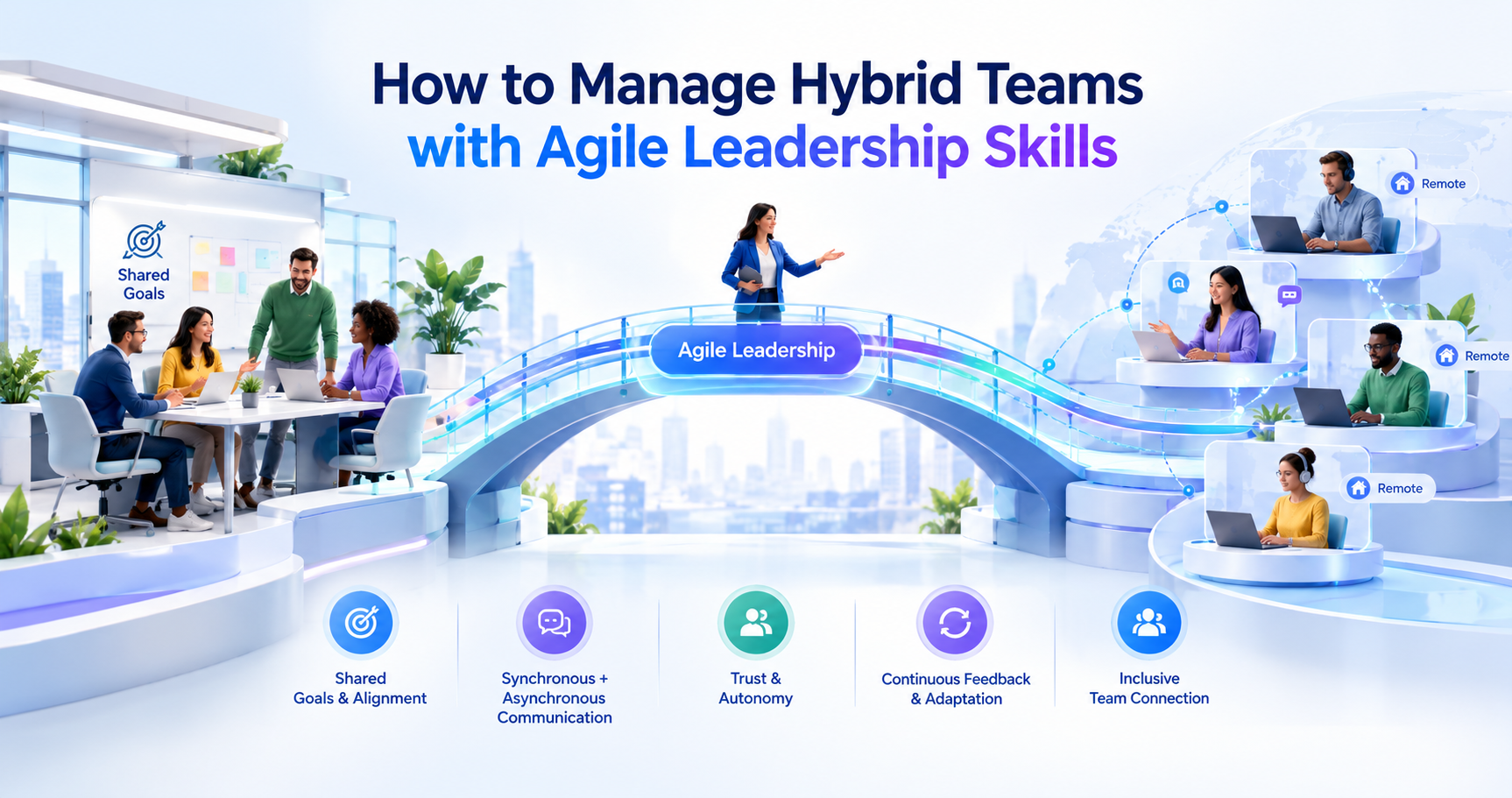
The hybrid work environment is just one example of how modern work environments are changing the way teams collaborate, communicate and get things done. Predictable and structured, traditional leadership styles do not offer the flexibility and visibility that today’s teams require, especially in the era of in-office and remote employment. But agile leadership offers pragmatic steps within which hybrid teams can work. It focuses on transparency, communication, flexibility, collaboration, autonomy, and results-driven performance.
To manage effective hybrid teams, leaders need to build trust, minimize occurrences like proximity bias, establish transparent communication practices, adapt Agile ceremonies, and create environments for employees to share and contribute equally. This guide covers key Agile leadership skills, tools, practices, and techniques that can help leaders to successfully manage hybrid teams.
Key Highlights
- Discover how Agile leadership can enhance communication and collaboration in hybrid teams
- Acquire fundamental Agile leadership competencies to build trust, team autonomy, and psychological safety for your people
- How to implement Agile ceremonies in hybrid teams
- Discover how to track communication, engagement, productivity, and team performance using various tools and KPIs
- Learn a step-by-step agile approach to managing hybrid teams effectively.
What Is Agile Leadership in a Hybrid Work Environment?
Agile leadership in a hybrid work environment uses Agile principles like collaboration, transparency, communication, and continuous improvement in hybrid work settings, that is, in teams working from the office and remote settings.
In such an environment, Agile leaders need to pay less attention to where or when employees work and focus on outcome-driven results instead. They also need to implement impactful communication, continuous feedback, and self-sufficiency in their team. This creates systems that let employees easily collaborate and contribute despite their location
Exploring courses like the Certified Agile Leader 1 (CAL 1) Certification Trainingis an excellent way for professionals to kick-start their journey in Agile leadership and help develop an Agile environment in their teams and organizations.
Agile Leadership vs. Traditional Leadership
When it comes to hybrid work models, the Agile form of leadership is preferred due to its emphasis on adaptability. While the traditional leadership style has its perks, especially in terms of structure and predictability, it may be ineffective and hindering hybrid teams.
Refer to the table below to understand the difference between Agile and Traditional leadership.
Factor | Traditional Leadership | Agile Leadership |
| Resistance to change, reliance on detailed management & planning | Adaptable and open to different management techniques, embraces uncertainty | |
Decision-Making Process | Top-down communication and centralized decision-making | Two-way communication, collaborative decision-making across employees |
Leadership Approach | Direct and authoritative | Servant leadership: guide, motivate, and support team members |
Performance Value | Tracks employee progress and task completion against planned target | Quality of output is valued over the quantity and rate of individual task completion |
Risk Management | Resistance to risk manages them through defined plans & processes. | Encourages calculated risks and creates an environment of continuous learning and improvement |
Employee Well-being | Employees need to follow strict rules and deadlines set by management | Employees are free to share their opinions and use their creativity to deliver better outcomes |
Refer to this article to know more about the key differences between Agile and Traditional Leadership.
Why Agile Principles Matter More in Hybrid Settings
Agile works better in hybrid workspaces since it promotes the idea of more adaptable work environments. Its core principles, such as collaboration, empathy, communication are all necessary to sustain hybrid environments.
Below are some of the ways Agile principles support hybrid environments:
- Continuous Communication: Events such as stand-ups, retrospectives, andsprint reviewskeep employees in different locations informed about what is important and what has been accomplished.
- Flexible Collaboration: Hybrid Agile teams can collaborate in many ways, such as conducting meetings face-to-face, working in digital spaces, talking via video calls, and sending messages using chatboxes.
- Outcome-driven: Teams are focused on the outcome delivered, not on the number of employees in and out of the office.
- Greater Autonomy: Hybrid teams can determine how and where they do their work, but they are responsible for their tasks and priorities
What You Need to Know About Managing Hybrid Teams?
More Flexibility for Your Team.
Flexibility between in-office and remote employment environments allows people to tune their work around their responsibilities and their energy. Use face-to-face time for activities that benefit from face-to-face interaction, and remote time for more focused individual work.
Wider Access to Workforce Pool
Hybrid environments provide organizations the opportunity to hire based on the candidate’s skill level rather than location. This allows for the creation of diverse teams with people from different backgrounds and experiences without them having to relocate.
Employees are More Satisfied
When employees have autonomy over when and how they work, they tend to feel a lot more satisfied. When such flexibility is combined with clear task objectives, it also helps boost their engagement.
Reduced Costs
Hybrid work models help organizations and employees reduce expenses attached to office spaces and travel. The saved money can instead be invented in training, better tools, and team development.
Hybrid vs. Remote vs. Co-located Teams
Hybrid teams combine digital collaboration with in-person interactions, their schedules being based on their own company’s needs and based on their own personal dependencies. Remote teams are entirely distributed; they exclusively work from different locations and work and collaborate online. Offline interactions do not happen or rarely happen. Employees in such environments do not use an office or shared workspace. Co-located teams work in the same geographical environment, such as a common office or workspace where visual and verbal communication can take place without any barriers. The lack of barriers enables the smooth flow of information between employees and fosters better collaboration and teamwork.
Refer to the table below to know the difference between Hybrid Teams, Remote Teams, and Co-located Teams.
Factor | Hybrid Teams | Remote Teams | Co-located Teams |
| Work location | Team members work both remotely and from office spaces | Team members are distributed & work from different locations, entirely remote | Team members work from the same geographical environment, usually an office |
| Communication | A combination of digital and face-to-face interaction | Primarily a digital mode of communication | Mainly face-to-face communication |
| Collaboration | In-person and virtual collaboration | Depends a lot on digital collaboration tools | Collaboration happens in person |
| Flexibility | High flexibility in where employees work | Very high location flexibility | Comparatively lower flexibility |
| Team interaction | Varies depending on who is present in the office or online | Mostly virtual | Frequent in-person interaction |
| Common challenges | Communication gaps, unequal access to information, coordination across locations | Isolation, time-zone differences, reduced informal interaction | Less flexibility and high dependence on physical meetings |
| Technology needs | Requires strong digital tools to connect office and remote workers | Depends greatly on digital communication and project-management platforms | Collaboration is supported by technology but is generally less critical. |
| Best suited for | Organizations balancing flexibility with in-person collaboration | Organizations designed for distributed work | Teams that benefit from frequent face-to-face interaction |
Core challenges Agile Leaders Face in Hybrid Workspaces
Proximity Bias
Proximity bias in hybrid teams happens when more attention, work opportunities, or trust is given and built with employees seen in the office more frequently. Remote working employees may perform well and deliver desirable outcomes, but their performance may be overlooked if their managers rely on their physical presence over outputs.
Since organizations depend greatly on informal discussions and physical presence, employees who interact online in hybrid environments might be left out of important and strategic discussions that happen in the office. This also reduces their opportunity to communicate and contribute to important business discussions.
Communication Gaps
Another challenge that Agile leaders face in hybrid work environments is the communication gaps that occur due to the creation of different communication channels. This model of work limits face-to-face interactions, which slows down spontaneous brainstorming and collaboration. Also, employees who are in the office may receive information a lot more quickly than those working remotely; this creates a visible gap, with one group of employees seeming closer to the decision-making process than the other.
Silos
Communication gaps caused in Hybrid workspaces can lead to the creation of silos between employees who work from the office and employees who work from home.
In-office employees can have brainstorming sessions and discussions without their involving their remotely working colleagues, which can lead to gaps in the information the two groups possess. Managers may also make the mistake of overlooking the opinions of remote employees in favor of those given by employees physically present in the office or meeting room.
Engagement Drop
Communication gaps and the creation of silos between employees can also lead to a dip in overall employee engagement.
Poor communication can slow down workflow and can affect team productivity. Teams that work online also have more difficulty coordinating and resolving conflicts than those collaborating in person. Furthermore, remote workers may have a higher chance of being disconnected due to the lack of amenities like an internet connection and work equipment that may be available offline.
These factors can make such employees feel isolated from their colleagues and affect the way in which they contribute to work in a team. In the long run, the dips in employment productivity can affect the overall progress of work.
Cybersecurity Concerns
Working in hybrid models poses big challenges when it comes to the protection of organization data. Employees working remotely on certain days may take their corporate computers with them and connect to personal or public networks that may not be secure. These can lead to possible security breaches and access to valuable and sensitive business data.
Hybrid workers may also use their personal devices to work, which causes another security concern. Personal devices may lack the right type of software, updates, encryption, and other features that can make them more susceptible to data compromise.
Core Agile Leadership Skills for Hybrid Teams
Here are some important Agile Leadership Skills that can help effectively manage hybrid teams.
Transparent & Proactive Communication
- All team members need to set rules for communication tools such as emails, chats and video conferences. Specify when to use synchronous communication and when to use asynchronous communication. This will help all team members understand how quickly all team members should reply and which communication tools to use.
- Create communication channels that help coordinate and process information across different time zones. These channels allow team members with working schedules to collaborate.
- Record and share information on a channel that all team members can access, no matter where all team members are or whether all team members attend discussions. This creates transparency across locations and time zones, making collaboration easier. Using AI helps by creating transcripts, extracting action items, and summarizing key decisions.
- All team members should set a rhythm for sharing information, such as weekly meetings, at times that work for all team members. In these meetings, all employees can meet, share information, and brainstorm ideas.
Empathy & Emotional Intelligence
Hybrid workspaces can make employees develop a sense of disconnection and isolation from the bigger team, especially for those working remotely. Agile leaders have the task of continuously addressing occurrences in this way
- Ensure and build confidence in the fact that all team members have shared and equal access to information, opportunities, and spaces to collaborate irrespective of where they are located.
- Plan regular one-on-one informal interactions with employees to recreate spontaneous relationship-building usually seen during in-person interactions.
- Ensure that there are inclusive recognition systems that acknowledge the presence and contribution of remote workers.
- Create feedback channels where remote employees can actively participate, contribute, suggest, and raise concerns.
Adaptability & Comfort with Ambiguity
Hybrid workplaces can change rapidly, from team members working from different locations to shifts in priorities and the occurrence of unexpected changes. This can change the way work gets done. Agile leaders need to ensure that they can handle such changes while ensuring that their team does not lose sight of the goals; they can do this by:
- Make adjustments to plans when circumstances and priorities change.
- If waiting for complete information could delay work progress, Agile leaders and hybrid teams should be comfortable with making decisions with incomplete information.
- Enable teams to better respond to changing business and customer needs.
- Communicate changes, information, and updates quickly so that all employees understand why changes have been made and how.
- Instead of treating every poor outcome as failure, Agile leaders should encourage an environment of continuous improvement and learning for teams to develop.
Trust-building & Delegation (Servant Leadership)
A good Agile leader is one who can serve and lead his team to make good progress with their task. This may be achieved by:
- Delegating Responsibility: Allowing team members to own tasks and decisions rather than micromanaging every aspect of a project
- Measure Outcomes: Agile leaders should focus on results and value delivered rather than employee activity
- Encourage Independence: Let the team members decide how the work gets done.
- Provide Support: Agile leaders can support their teams by providing the right resources, removing obstacles, and helping employees who are struggling with certain tasks.
- Foster Psychological Safety: Agile leaders need to build a safe environment where team members can raise concerns and questions and share their wins and failures without fear of being judged or blamed.
- Set Expectations: Clearly define responsibilities, deadlines, and expected results so employees are clear and able to complete tasks on their own.
- Consistent Communication: Ensure that the information or updates shared are accessible to both in-office and remote employees.
Active Listening
Active Listening is the act of being actively present and focused on what a person has to say; such a habit helps in the development of trust, reduces conflicts, and improves problem-solving.
In hybrid workplaces, Agile leaders can develop such a methodology by shutting down emails, enabling the ‘do not disturb’ mode on their devices, and blocking any other type of discourse during team meetings, brainstorming sessions, and one-on-one interactions. This can help deepen trust and respect for remote workers who already lack physical proximity with their other team members.
Inclusiveness & Reducing Proximity Bias
It is common to exclude remote employees from discussions that happen spontaneously in the office, which leads to proximity bias in leaders and isolation in remote workers. Agile leaders must actively attempt to curb the possibility of such occurrences by:
- Establishing Transparency: Document all information, decisions, brainstorming sessions, and changes on a shared digital platform
- Asynchronous Communication Channels: Create planning sessions andAgile ceremonies in a way that team members can contribute with their insights, opinions, and concerns over a definite time window rather than depending only on live meetings. This allows team members in different locations and time zones to be equally involved in team discussions and decision-making processes.
- Objective-Based Performance: Instead of focusing on the individual performance of each employee and the number of hours he or she spends at her desk, performance can be through delivered outputs, commitments, and quality.
- Use Digital Approaches Whenever Necessary: In mixed meetings, ensure that teams use a digital approach, such as logging into a virtual meeting where everyone joins from their own camera to prevent the conversation from becoming dominated by professionals physically present together.
- Maintain Individual Interactions: Develop structured one-on-one interactions for both remote and in-person employees to discuss growth, concerns, and progress.
Resilience Under Changing Conditions
Changing business priorities, stakeholder needs, and market shifts can make it difficult to adapt, and for hybrid workspaces, can confuse and dismantle existing workflows.
It is important that Agile leaders help their teams build resilience during such uncertain times. They can do this by:
- Avoid making spontaneous decisions when new problems or demands come up
- Explain what changes have occurred, why they have happened, why it is important, and what mode of action the teams need to take next
- Help teams prioritize the most important tasks when sudden changes occur
- Use challenges and failures as learning opportunities for teams to grow from
- Acknowledge the different needs of remote and in-office employees and support them appropriately
- Keep teams aligned towards the overarching goals even when plans and prioritise change.
Outcome-based Thinking
The transition from monitoring an employee’s individual performance and activities to evaluating the outcome delivered helps accommodate team members working in different time zones and locations while maintaining accountability.
Applying Agile Ceremonies to Hybrid Teams
To effectively manage hybrid teams with Agile principles requires leaders to adapt conventional ceremonies to accommodate both on-site and remote employees. Below are some approaches Agile Leaders can take to do so:
Running Effective Hybrid Daily Stand-ups
Daily stand-ups are arguably one of the most important ceremonies in the Agile framework. It helps teams stay updated with progress, dependencies, new priorities, and the space for queries and concerns. Effective running of stand-ups for hybrid teams may require some adjustments:
- Common Setup: Conference rooms should have good equipment such as a microphone, camera, and screen to ensure remote employees can see and participate in the discussion. Teams can also log on to their own devices and join the standup virtually, preventing passive participation or isolation.
- Virtual Boards: Have digital applications such asJira or Miro on screen to document and visualize updates in real time and also make it universally accessible.
- Timeboxed: Keep the meeting focused on primary indicators such as today’s goals and blockers.
- Asynchronous Alternatives: Let team members located in extremely different time zones send their updates through common communication channels before other members meet synchronously.
Sprint Planning Across Time Zones and Locations
Hybrid teams often work across different locations, from a common office space to remote locations in varying time zones. While this may pose itself as a unique challenge, teams can learn how to tackle this by adopting asynchronous means of communication.
While the discussions regarding the scope of a Sprint might need to happen live, the initial planning and exchange of information can happen beforehand and in an asynchronous fashion.
- Context Established Ahead of Time:Product Ownerscan post backlog items with relevant context 1-2 days before planning. Team members read and post their questions asynchronously as per their availability.
- Gather Estimations: Use techniques like asynchronous planning poker to get team members to vote independently about topics that the planning intends to discuss. This helps predict where possible agreements and disagreements might arise during the actual planning.
- Discuss and Commit: Settle on a common time, usually an overlapping window for all team members across different time zones, and conduct a live, synchronous discussion. Since everyone has already gone through the information and understands the insights drawn by the planning poker results, the meeting can focus more on negotiating disagreements and differences, discussing trade-offs, and setting ultimate sprint goals. This also reduces the time of the meeting.
Hybrid-friendly Retrospectives
While retrospectives ought to be synchronous due to their candid, occasionally critical discussions about team dynamics and performance, which are not conveyed as well through documentation as they are verbally, they can be accommodative of hybrid work dynamics in the following ways:
- Before the retrospective discussion, create a retro board where team members can add items before the meeting begins. This allows team members from across different locations the opportunity to contribute to the discussion. When this is set in place, the actual synchronization can revolve around discussion, voting, and organizing.
- To better accommodate the needs of team members working across different locations, alternate between time slots during different sprints. Some meeting windows will better align with a certain group of employees, while other employees might be required to stretch their workdays. Alternating between timings thus allows fairness.
- Ensure that the meetings are time-boxed so that discussions do not get carried away or interrupted by irrelevant discussions.
Sprint Reviews with In-person & Remote Attendees
Sprint reviews are attended by Scrum teams and key stakeholders. In hybrid scenarios, such meetings become complex because both employees and stakeholders might be located across different time zones. To handle this, Agile leaders can take the following steps:
- Run a live, synchronous review during an overlapping time window with professionals who are able to attend. Record the session and share a feedback form with asynchronous stakeholders and team members so that they can share their thoughts and opinions.
- Have two sprint review sessions if stakeholders are divided across different time zone clusters. While this may require more facilitation from the Agile Leader’s end, it can generate better insights and feedback than passive recording might.
Step-by-Step Framework: Managing Hybrid Teams the Agile Way
Step 1 – Set Clear, Outcome-based Expectations
Establish definite goals, deadlines, dependencies, and metrics to measure success for all team members. Instead of concentrating on the attendance of employees online or within the office space, focus on the outcome that is delivered. This keeps employees accountable for their actions while also allowing them flexibility.
Step 2 – Build a Communication Rhythm & Guidelines
Set up communication schedules and guidelines for activities like stand-ups, team updates, planning sessions, and individual meetings. Explain the tools and channels that need to be used for the different types of communication. Ensure that all important information, decisions, updates, and changes are documented on a shared file/board so that both remote and in-office employees can access them equally.
Step 3 – Establishing Psychological Safety & Trust
Make sure that the hybrid work environment is safe enough for employees to share ideas, flag concerns, and acknowledge and share their mistakes and failures without the fear of consequences or blame. Leaders should encourage open and honest conversations, listen to their team members and learn to assess them based on how they contribute and not based on how visible they are offline or online.
Step 4 – Use Iterative Feedback Loops (retros, check-ins)
Using Agile practices like daily check-ins, retrospectives, sprint reviews, and regular one-on-ones as interactive feedback loops helps in the identification of issues beforehand.
Smaller feedback cycles enable hybrid teams to make adjustments to their priorities, assess blockers, and bring continuous improvements in the way they collaborate.
Step 5 – Coordinate In-office Time Intentionally
Make sure that the days employees spend in the office are for activities that benefit from face-to-face interactions like brainstorming, team planning, workshops, complex problem-solving, and relationship building. Also, avoid having employees commute to the office for meetings and discussions that could be effectively conducted online.
Step 6 – Empower Self-organizing Teams
Give team members the liberty to decide how they want to complete their work while also providing them with clear goals and boundaries. Autonomous teams can distribute workloads and responsibilities, solve problems in a collective way, and adapt quickly.
Avoiding Proximity Bias and Ensuring Fairness
Proximity bias occurs when visible employees, like team members present in the office, receive more preference, opportunities, information, and work, as compared to their remote team members. In hybrid workspaces, where distributed teams are common, such a phenomenon has the tendency to arise. However, such bias can be harmful for team building and, if prolonged, can lead to remote workers becoming increasingly isolated, disengaged, and frustrated. That is why it is important to prevent it.
Signs of Proximity Bias
- In-office employees receive more recognition for their contributions, as they are visible to managers
- Remote employees get excluded from casual chats where decisions and work opportunities are being discussed
- Meetings that prioritise in-room participants, reducing involvement and contributions from remote team members
- Managers focus on visibility rather than outcomes in employee performance assessment
- Remote employees have fewer opportunities for networking, mentorship, or exposure and interaction with leadership.
Practical Fixes
- You should judge employees by what they produce, by the goals they’ve committed to, and by the impact they’ve made, not by whether they’re at the office and the visibility they have online.
- Regularly recognize the contributions of both remote and in-office staff (through updates, meetings, or other communication channels)
- During meetings, ensure that remote and in-office employees have equal time to participate and contribute to discussions.
- Store important information such as meeting notes, action items, and decisions in a shared workspace channel to ensure that no employee misses any information.
- Regardless of where they are based, conduct regular check-ins and one-on-ones with individual employees to get a better understanding of what they are doing and the challenges they face.
Tools for Agile Hybrid Leadership
Collaboration & Async Communication Tools
Agile hybrid teams need tools for real-time and asynchronous communication and collaboration. Those tools include:
- Microsoft Teams: chat, meetings, and documents all in one place
- Google Workspace: Collaborate on documents and share files
- Slack: For team communication and async updates.
- Miro: for digital workshops & collaboration
- Zoom: Real-time online communication
- Notion: For team collaboration & documentation
Tools for Managing Agile Projects
Tools for agile project management give you visibility into progress, work, priorities and dependencies. They help teams plan sprints in hybrid workspaces and provide visibility and order to backlogs across distributed team members.
Listed below are some examples of platforms:
- Azure DevOps: Backlogs, sprint planning, reporting, and team boards
- Jira: Scrum/Kanban boards, sprint planning, backlogs, and reporting
- Trello: Checklists, automation, Kanban boards
- Asna: Task management, workflows, timelines
Scheduling & Desk/Room Coordination Tools
Hybrid teams require tools to plan when and where employees come together to work. Scheduling and workplace-management tools help in managing meeting rooms, coordinating office days, and identifying team availability.
Below is a list of tools that can be used to enable such planning:
- Microsoft Teams: For workplace coordination and meetings
- Google Calendar: Meeting coordination, calendar management, and team schedules
- Outlook Calendar: Meetings and team schedules
- Envoy: Visitor and workplace management
- OfficeSpace: Workplace management
Measuring Success: KPIs for Hybrid Agile Teams
Agile leaders need to combine different metrics like retention, delivery, engagement, and team health to determine if a team is productive and able to collaborate well. KPIs can become useful indicators here.
Engagement and Retention Metrics
These metrics help organizations understand if employees feel supported, connected and motivated in hybrid work spaces.
- Employee engagement scores: Track ongoing engagement feedback and pulse surveys
- Turnover rate: Check to see if employees are leaving at a higher-than-expected rate
- Employee retention rate: Track the ability of companies to keep their employees over time
- Absenteeism: Changes in attendance patterns for employees may be an indicator of workload or engagement issues
- Team Activity Participation: Track employee contributions to activities such as retrospectives, sharing, and planning sessions
Velocity/Output Metrics
Delivery metrics can help to identify bottlenecks and other roadblocks and can help optimize workflows. Some useful measures are
- Cycle Time: Time taken to complete a piece of work from start to finish
- Sprint Velocity: Amount of work a team can get done in a sprint
- Lead Time: The time from when work is requested to when it is completed
- Work-in-Progress (WIP): Work currently being done
- Throughput: The number of work items completed in a given period of time
- Defect/Rework Rate: The number of defective outputs requiring rework divided by the number of outputs delivered in a period of time.
Trust & Psychological Safety Indicators
In a hybrid workspace, trust and psychological indicators help ensure that employees feel safe and satisfied. While it may be harder to measure, regular team feedback gives useful indications. Organizations can use anonymous surveys and retrospective questions to understand the following:
- Whether employees feel comfortable flagging concerns
- Whether team members can admit to mistakes and failure without the fear of getting blamed
- Whether employees believe that they are heard and valued
- If remote and in-office employees have equal access to opportunities and information
- Whether employees feel supported in the face of blockers and workplace challenges
- Whether employees feel comfortable collaborating and engaging in critical discussions with other colleagues and managers
Common Mistakes Leaders Make in Hybrid Agile Management
Common mistakes Agile Leaders make in Hybrid Agile Management include:
- Overloading the team with meetings: Too many video calls and synchronous meetings can reduce focus time and cause fatigue. Use asynchronous communication channels when live interaction is not necessary
- Measure presence, not results: It can be pressurizing for employees to track attendance in the office, hours online, and response times, which may not reflect actual productivity
- Exclude remote employees from informal communication: When important discussions happen in informal settings such as hallways or smaller in-office discussions, distributed team members can be left without information and context
- Managing Remote Employees: Constantly checking in is a sign of distrust and lack of autonomy among employees. With agile leadership, it should be about outcomes and measurable results, not about how visible people are online.
- Proximity bias: Employees working on-site may be more visible and get more recognition and opportunities than remote employees, which causes unequal career and development opportunities.
- Agile Ceremonies Without a Plan: Stand-ups, retrospectives and sprint reviews are supposed to help teams coordinate and improve. Agile leaders can get trapped into making them routine meetings with little or no value.
- Poor Decision Documentation : When decisions are not documented or only communicated verbally, remote employees might find it difficult to keep track of information and decisions. Record and share key actions, decisions and information in shared communication channels.
Real-World Examples
1. Building Trust Without Micromanagement in Software Development Teams
A software company has developers working from Pune, Hyderabad, and Bengaluru. The product managerworks primarily from the Hyderabad office. Initially, the team struggled with visibility because the manager kept asking for status updates. To work around this, the software development team took the following Agile leadership approaches:
- Used a Jira board to make work visible
- Replaced frequent individual check-ins with shorter and structured team updates
- Set definite sprint goals and ownership of each task
- Let developers decide how they completed their individual tasks
- Talk about blockers during stand-ups instead of monitoring individual activity
These changes led to the team gaining better autonomy over their work while enabling visibility for the manager through sprint goals, agreed metrics, and outcomes instead of constant surveillance.
2. Marketing Team: Managing Different Working Styles
A marketing team has people who work from the office and people who work remotely. Remote employees lose out on critical decisions because they can’t participate in synchronous meetings. To tackle this, the team decided to apply an Agile leadership approach:
- Use Slack as a communication platform for asynchronous updates
- Write down important decisions in a shared space
- Establish expectations for response times
- Leave the live meetings for topics that really require real-time collaboration
These measures provided distributed team members with access to the same information, reduced the reliance on informal office conversations, and kept the entire team updated.
3. Consulting Team: Coordinating Across Time Zones
Consulting projects with team members in different time zones in Europe, India, and the USA. Meetings and discussions caused delays and meeting fatigue in all time zones. To address this, the team used the following Agile practices:
- Set overlapping core hours for the important conversations that really need to be face-to-face.
- Meetings were rotated where possible to enable participation from the various regions.
- All team members were updated via a shared decision log.
- Teams had clear ownership so they could work independently, without having to wait for people across time zones.
- This also allowed the team to continue to move forward across time zones with less of a need for excessive meetings.
4. Product Team: Responding to Changing Priorities
A product team is in the middle of a sprint, but feedback from customers requires a major change to a planned feature. The team are working in different places, and face-to-face discussion is difficult to have. Therefore, they took on the following Agile leadership styles:
- Estimated impact of new knowledge
- Communicating Change to relevant stakeholders
- Re-prioritizing backlog based on new information and business and stakeholder needs
- Communicated the decision and rationale to the entire team
- Change sprint plan as needed
This enables the team to respond and adjust to the evolving requirements without losing track of the larger product goals.
Conclusion
Leading teams using Agile requires a balance of communication, trust, flexibility and accountability. Leaders can build connected, performing teams by focusing on outcomes over physical presence, adapting Agile ceremonies, capturing decisions, empowering autonomy within teams, and ensuring equal access to opportunities, information, and participation for remote and in-office employees.
Agile practices such as selecting collaboration tools, tracking measurable KPIs and tackling challenges such as communication gaps and proximity bias offer a flexible but structured way to support hybrid teams. By consistently practicing these things, teams will be able to work well together to respond to changing needs and to continuously improve how they work.







 Lowest-Price Challenge











 Personalized Path


.webp)


 USA
USA  Canada
  India
India  UK
UK  Australia
  Singapore


