


 Call Us



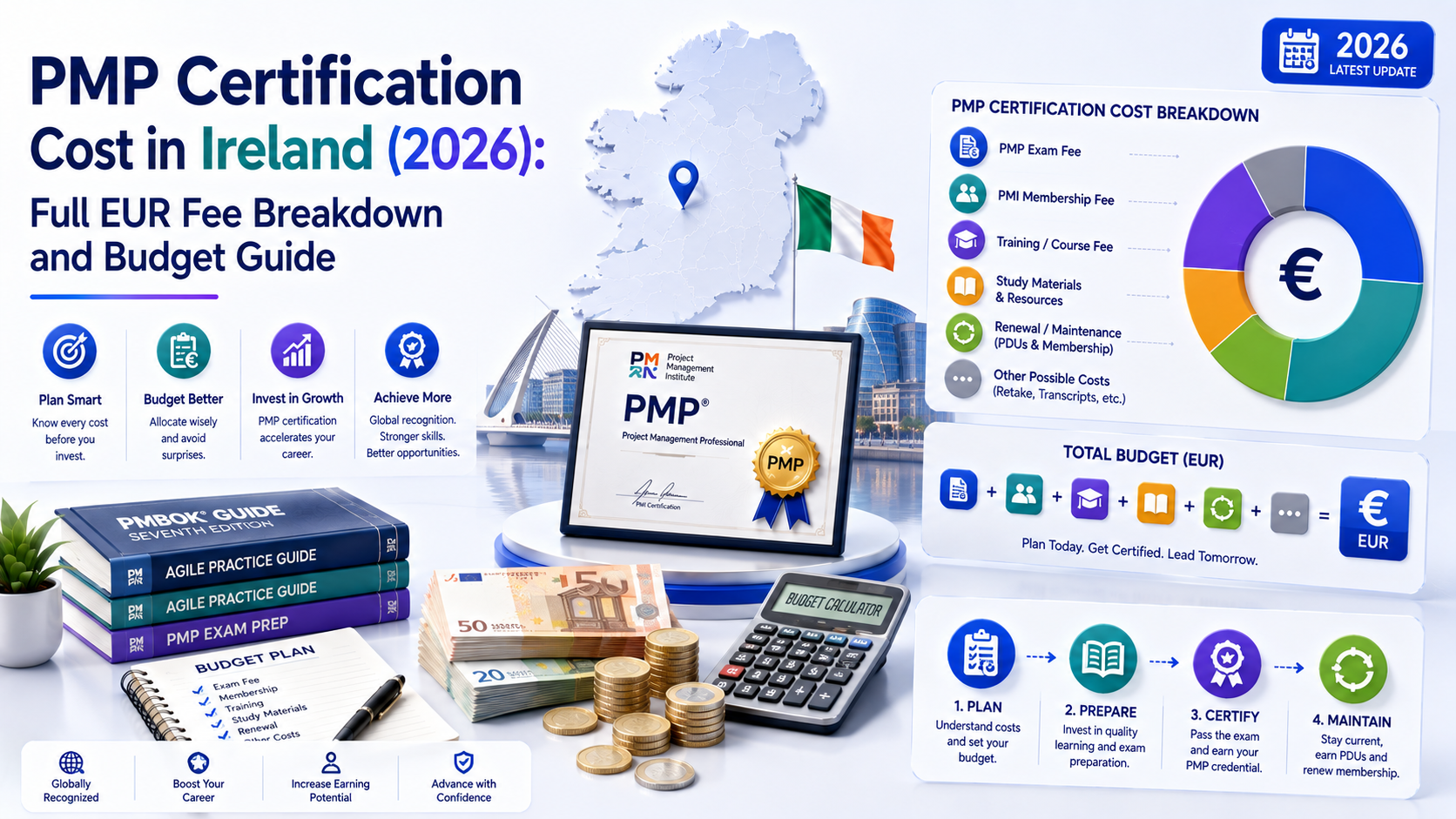
A PMP certification in Ireland typically costs between roughly €1,300 and €4,000 all-in, depending on whether you sit the exam as a PMI member or non-member, which training format you choose, and whether you pass on your first attempt. The PMI exam fee itself converts to somewhere around €365 to €580 depending on membership status and the USD to EUR rate on the day you pay, while training in Ireland ranges from roughly €400 for a budget online course up to nearly €4,000 for a premium classroom programme in Dublin. Most candidates who join PMI first, choose a mid-range live virtual or online instructor-led course, and pass on their first sitting land somewhere between €1,800 and €2,500 once every fee is accounted for.
Key Highlights of PMP Certification Cost in Ireland
- PMI's exam fee is set and billed in USD, so the euro figure you actually pay moves with the exchange rate on the day, not a fixed advertised price.
- Joining PMI before booking the exam is usually cheaper overall: the membership fee is more than offset by the reduced member exam price.
- Ireland has an authorised Pearson VUE test centre in Cork, and candidates elsewhere in the country typically sit the exam via the OnVUE online proctored option or travel to a centre.
- Training costs in Ireland vary enormously, from roughly €400 for a self-paced online course to close to €4,000 for a multi-day in-person classroom programme in Dublin.
- Ireland's technology, pharmaceutical and financial services multinationals are among the strongest sponsors of PMP training in the country, and many will fund all or part of the cost through learning and development budgets.
- A retake, if needed, adds a further cost on top of the original exam fee, so budgeting for a first-attempt pass is the single biggest lever over your total spend.
- PMI's July 2026 exam and content update did not change the fee structure directly, but it landed in the same year as a separate fee increase, so candidates researching cost should not confuse the two.
How Much Does PMP Certification Actually Cost in Ireland?
There is no single fixed price because a PMP certification in Ireland is built from several separate payments rather than one bundled fee. The exam itself is paid directly to the Project Management Institute (PMI) in US dollars, training is paid separately to whichever provider you choose, and there are smaller costs for study materials, a possible retake, and renewal three years later. When Irish candidates ask what PMP certification costs, they are usually really asking for the total of all of these pieces added together in euro terms, not just the headline exam fee.
The table below sets out a realistic low, typical and high scenario for someone based in Ireland in 2026, covering the exam, membership, training and a contingency for a possible retake.
Scenario | Membership Status | Training Format | Approx. Total (EUR) |
| Low / budget-conscious | PMI member | Online self-paced course plus own study materials | €1,300 - €1,600 |
| Typical / most common | PMI member | Live virtual or online instructor-led course with an Authorised Training Partner | €1,800 - €2,600 |
| High / premium or with a retake | Non-member or member plus one retake | In-person classroom training in Dublin | €3,000 - €4,200 |
These ranges move with two things that are outside any provider's control: the USD to EUR exchange rate on the day you pay PMI, and whether your card issuer or provider adds a currency conversion margin on top. As of 11 September 2026, one US dollar converts to roughly €0.86, meaning one euro buys around 1.16 US dollars, but this fluctuates week to week, so treat every euro figure in this article as an approximate conversion at time of writing rather than a fixed price.
What Are the Individual Cost Components?
Every PMP journey in Ireland is made up of the same handful of line items, even though the amount spent on each one varies by candidate. The table below breaks out PMI's own fees in USD alongside an approximate EUR conversion, plus the training and renewal costs that sit alongside them.
Cost Component | USD (PMI Official) | Approx. EUR | Notes |
| PMP exam fee, PMI member | $425 | €365 - €375 | Applies after PMI's fee adjustment that took effect on 6 August 2026, up from $405 previously |
| PMP exam fee, non-member | $675 | €575 - €585 | Up from $555 before the August 2026 increase; the member-versus-non-member gap widened significantly |
| PMI annual membership | $164 first year ($154 renewal years, plus a $10 one-time application fee) | €135 - €145 | Includes a digital copy of the PMBOK Guide and reduced pricing on future exams and renewals |
| Exam retake fee, member | $275 | €235 - €240 | Payable if a first attempt is unsuccessful; capped at a limited number of attempts within a 12-month window |
| Exam retake fee, non-member | $375 | €320 - €325 | The non-member retake gap is another reason membership tends to pay for itself |
| Training (35 contact hours), online self-paced | n/a, priced in EUR by Irish providers | €400 - €900 | Cheapest route to the mandatory 35 hours of project management education, but least interaction with a live instructor |
| Training, live virtual (instructor-led) | n/a | €800 - €1,600 | Common middle-ground format for Irish candidates who want live Q&A without travel |
| Training, in-person classroom (Dublin/Cork) | n/a | €1,300 - €4,000 | Multi-day in-person programmes in Dublin range widely; some providers price a short intensive course far below the top of this band |
| Renewal / CCR fee, member (every 3 years) | $60 | €50 - €55 | Paid once the 60 PDU requirement for the three-year cycle is met |
| Renewal / CCR fee, non-member (every 3 years) | $150 | €125 - €130 | Another point at which ongoing PMI membership is usually the cheaper long-term choice |
Figures for the PMI exam, membership, retake and renewal fees are PMI's own published USD schedule; the EUR conversions are approximate at the exchange rate prevailing in early September 2026 and will shift as the rate moves. Training figures are drawn from a cross-section of Irish and Ireland-facing providers rather than from a single source, since this is the part of the total that genuinely varies most.
Why Is the PMI Exam Fee Charged in US Dollars, Not Euros?
PMI is a US-headquartered, globally operating institute, and it prices and processes the PMP exam fee centrally in US dollars regardless of where a candidate is sitting the test. An Irish candidate paying through PMI's own portal is charged in USD, and their card issuer converts that to euro at whatever rate and margin the card network applies on the transaction date. This is the main reason two candidates in Dublin who booked a week apart can end up paying a noticeably different euro amount for what was, on PMI's side, the exact same fee.
This also explains why Irish training providers, and general commentary, tend to quote a range rather than a single fixed euro figure for the PMI portion of the cost. The safest way to budget is to check the current published USD fee on PMI's official PMP certification page and apply the exchange rate on the day you actually intend to pay, rather than relying on any euro figure quoted months earlier.
Does Membership Actually Save Money?
For almost every Irish candidate, joining PMI before booking the exam works out cheaper than paying as a non-member, even after accounting for the membership fee itself. The member exam fee of $425 plus a first-year membership of $164 comes to $589, compared with a flat $675 for a non-member sitting the same exam with no membership at all.
That is a modest saving on the exam alone, and it becomes larger still once the retake fee, the renewal fee three years later, and ongoing access to PMI resources and templates are factored in. Membership also includes a digital copy of the PMBOK Guide, which many Irish training providers otherwise sell separately as part of a course materials package.
The practical takeaway for someone in Ireland weighing this up is straightforward: unless you are certain you will never renew, sit a retake, or use PMI's other resources, membership is very rarely the more expensive path over a full three-year cycle.
What Do Training Providers in Ireland Actually Charge?
Training cost is the single largest source of variation in the total PMP budget, and Ireland's market spans a wide spread of formats and price points. A course at the lower end from an Ireland-facing online provider can sit as low as roughly €400, while a multi-day in-person classroom programme in Dublin from a premium provider can run to close to €4,000 for the same mandatory 35 contact hours of project management education. Neither extreme is wrong for every candidate; the right choice depends on how much live instructor access, exam simulation, and post-course support you actually need.
Irish and Ireland-facing providers that appear consistently in this space include Simpliaxis, which runs an Ireland-focused PMP certification training programme as well as a dedicated four-day live Dublin course carrying 35 PDUs, alongside The Knowledge Academy, SKILLOGIC, Institute of Project Management Ireland (projectmanagement.ie), and Invensis Learning, which lists delivery locations including Adare, Co. Limerick and Ballyfin, Co. Laois. Published Dublin classroom pricing from The Knowledge Academy, for example, spans from around €559 for online training up to roughly €3,995 for its top classroom tier, illustrating just how wide the format-driven spread can be within a single provider's own price list.
Online Self-Paced Training
This is the cheapest way to satisfy the mandatory 35 contact hours, typically delivered as pre-recorded video modules with a completion certificate. It suits candidates who are confident studying independently and mainly need the contact-hours requirement satisfied at the lowest possible cost, though it offers the least live interaction if a concept does not click on first viewing.
Live Virtual, Instructor-Led Training
This format sits in the middle of the market and has become the most common choice for Irish candidates since it removes travel time while still offering a live instructor, scheduled sessions, and real-time Q&A. Simpliaxis's Ireland PMP programme and similar Ireland-facing live virtual courses from other providers typically fall in this band.
In-Person Classroom Training in Dublin or Cork
Classroom training remains available in Dublin in particular, and to a lesser extent Cork, generally as an intensive multi-day format. It is the most expensive route per contact hour but suits candidates who want a firm, fixed schedule, in-room networking with other project professionals, and no risk of home or office distractions during study.
Will an Employer in Ireland Pay for PMP Certification?
Employer funding for PMP certification is genuinely common in Ireland, more so than for many other professional credentials, because the qualification sits squarely inside project and programme management career paths that Irish employers actively want to strengthen. Ireland's cluster of US-headquartered technology firms, its pharmaceutical and life sciences manufacturing base concentrated around Cork, Dublin and Limerick, and its financial services sector operating under global governance structures all tend to treat PMP as at least a baseline expectation for senior project and programme management roles, and, as the Institute of Project Management Ireland notes in its own guidance for Irish candidates, many of these employers will contribute to, or fully cover, the cost as part of a professional development or learning and development budget.
The practical way to make this case internally is to frame the request as an investment with a defined cost and a defined return, rather than an open-ended ask. A short business case that sets out the total euro figure from the tables above, the qualification's direct relevance to your current or next role, and the fact that renewal every three years keeps the credential (and the organisation's investment) current tends to land well with an L&D manager or line manager who controls a training budget.
For organisations that want to put several project leads or aspiring project managers through PMP training at once rather than funding individuals one at a time, cohort or group training is usually the more cost-efficient route, and it is common practice for an L&D manager at an Irish tech or pharma multinational to sponsor a whole team through certification together rather than staggering approvals one person at a time. Simpliaxis's corporate and group training programme is built for exactly this scenario, with bulk enrolment pricing designed to bring the per-head cost down when an employer is funding a cohort of project leads through PMP certification together.
Where Do You Actually Sit the PMP Exam in Ireland?
PMI delivers the PMP exam exclusively through Pearson VUE, and Irish candidates have two practical routes: an in-person Pearson VUE test centre, or the OnVUE remote-proctored option taken from home or another private location with a webcam and stable internet connection. Ireland's authorised Pearson VUE test centre sits in Cork, near the CIT campus off Rossa Avenue in Bishopstown, and candidates elsewhere in the country, including Dublin, typically either travel to an available in-person centre or use OnVUE, which has become the more commonly chosen option for many candidates simply because it removes travel entirely.
Before booking, it is worth confirming current seat availability and centre locations directly through Pearson VUE's own PMI test centre locator rather than relying on older listings, since testing centre availability and locations can change. There is no additional PMI fee for choosing OnVUE over an in-person centre; the exam fee itself is identical either way, so this choice comes down to personal preference and logistics rather than cost.
How Do You Evaluate a Training Provider Before Paying?
Not every course that promises PMP preparation carries the same weight, and the biggest financial risk in this whole process is not overspending on training, it is paying for a course that does not actually get you eligible to sit the exam or does not adequately prepare you to pass. Before paying any provider in Ireland, it is worth checking a short list of things.
- Confirm Authorised Training Partner status. PMI operates a formal Authorised Training Partner (A.T.P.) programme, and a provider's A.T.P. status is the clearest signal that its 35-hour course content is aligned to PMI's current exam content outline and will be accepted toward your eligibility application.
- Check that PDUs are actually issued. A genuine 35-contact-hour course should issue certificates or PDU records recognised by PMI, not just a generic completion badge from the provider's own learning platform.
- Ask what happens if you do not pass first time. Some providers include a free or discounted retake support package; others charge full price again for repeat access to materials, which materially changes the true cost if a retake becomes necessary.
- Compare like-for-like format, not just headline price. A €400 online course and a €3,995 classroom programme are not really substitutes for each other; compare within the same format category first, then decide whether stepping up a format tier is worth the extra spend for your own study style.
- Look for exam simulation and up-to-date content. Following the July 2026 exam content update, materials still aligned to the older content outline may leave gaps in coverage of newly weighted domains.
For a wider comparison of how established Ireland-facing and international providers stack up against each other on exactly these criteria, Simpliaxis's PMP training provider comparison guide is a useful starting point before committing to any single course.
Does the 2026 PMBOK 8 and Exam Update Change the Cost?
PMI launched a substantially updated PMP exam on 9 July 2026, rebalancing the exam's domain weightings and introducing content aligned with the eighth edition of the PMBOK Guide, including new emphasis on artificial intelligence in project delivery and sustainability considerations. The table below shows how the domain weighting shifted.
Domain | Previous Weighting | 2026 Weighting |
| People | 42% | 33% |
| Process | 50% | 41% |
| Business Environment | 8% | 26% |
This content update did not itself set the exam fee, but it landed in the same year as a separate PMI fee adjustment on 6 August 2026, which raised the member fee from $405 to $425 and the non-member fee from $555 to $675. The two changes are easy to conflate because they arrived within weeks of each other, but candidates researching cost in Ireland should treat them as two distinct events: one changed what the exam tests, the other changed what it costs. A fuller explanation of exactly what shifted and why is set out in Simpliaxis's dedicated PMP exam fee increase guide.
The main practical cost implication for Irish candidates is indirect: any training materials or practice exams purchased should be confirmed as updated for the post-July-2026 content outline, since older question banks weighted heavily toward the previous People-domain emphasis may now under-prepare a candidate for the Business Environment domain's substantially increased weighting.
What Do You Need Before You Can Even Book the Exam?
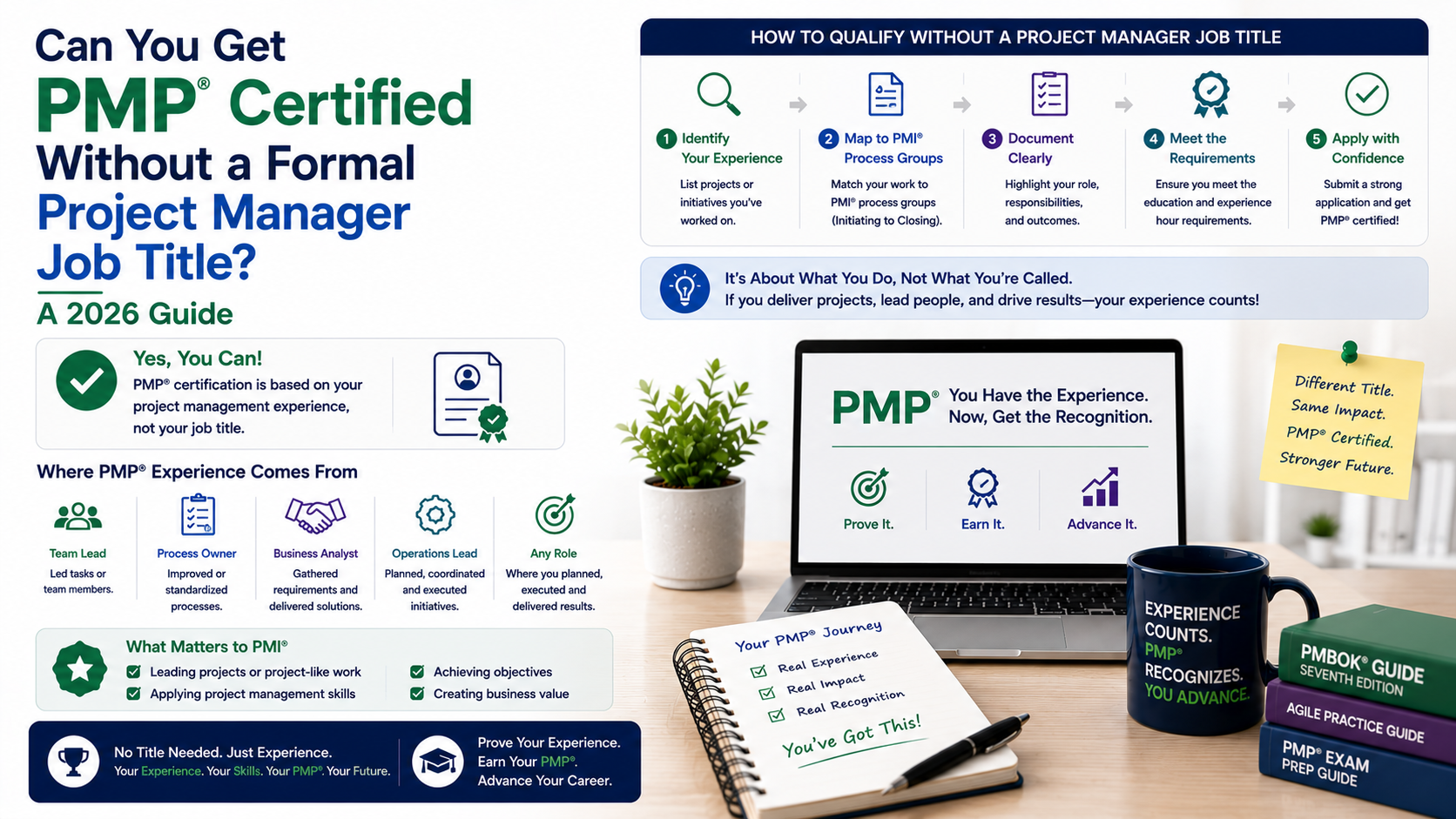
Cost planning only matters if you are actually eligible to sit the exam in the first place, and PMI's eligibility criteria require either a four-year degree with at least 36 months of project leadership experience within the past eight years, or a high school diploma or equivalent with at least 60 months of project leadership experience within the past eight years. Both routes also require the 35 contact hours of project management education referenced throughout the training cost sections above, which is exactly why that training is not optional padding, it is a hard prerequisite PMI checks before releasing exam eligibility. Getting this sequencing wrong, booking or paying for training before confirming you actually meet the experience requirement, is one of the more avoidable ways candidates in Ireland waste money on this process.
What Happens Cost-Wise After You Pass?
Passing the exam is not the end of the spending, since PMP certification runs on a three-year Continuing Certification Requirements (CCR) cycle rather than being a one-off credential. Within each three-year cycle, certified professionals must earn 60 Professional Development Units (PDUs), at least 35 of which must come from formal education activity spread across PMI's Talent Triangle areas, before paying the renewal fee of $60 for members or $150 for non-members. PDUs themselves can be earned at close to zero direct cost through free webinars, PMI chapter events, reading-based activities and volunteering, so the main ongoing cost is usually just the renewal fee itself rather than a large recurring training spend once the certification has been earned.
Conclusion
For an Irish candidate, the honest answer to "how much does PMP certification cost" is that the PMI exam fee itself is the smallest and most predictable part of the total, converting to somewhere around €365 to €580 depending on membership status and the exchange rate on the day, while training is the largest and most negotiable part, ranging from roughly €400 for a self-paced online course to close to €4,000 for a premium Dublin classroom programme. Most candidates who join PMI first, choose a live virtual or reputable online instructor-led course, and prepare thoroughly enough to pass on the first attempt will land somewhere between €1,800 and €2,600 for the entire journey to certification.
The wider spread above and below that band is almost entirely explained by training format choice and whether a retake is needed, not by anything PMI itself charges. Given how strongly Ireland's technology, pharmaceutical and financial services employers value the credential and how commonly they fund it, the single most useful step before paying anything out of pocket is simply asking whether a training or professional development budget already exists at your own organisation, since in a market this receptive to the qualification, a meaningful share of the total cost outlined here is genuinely negotiable before you ever reach for your own card.

_1738223263.jpg)





 Lowest-Price Challenge











 Personalized Path


.webp)


 USA
USA  Canada
  India
India  UK
UK  Australia
  Singapore


