


 Call Us



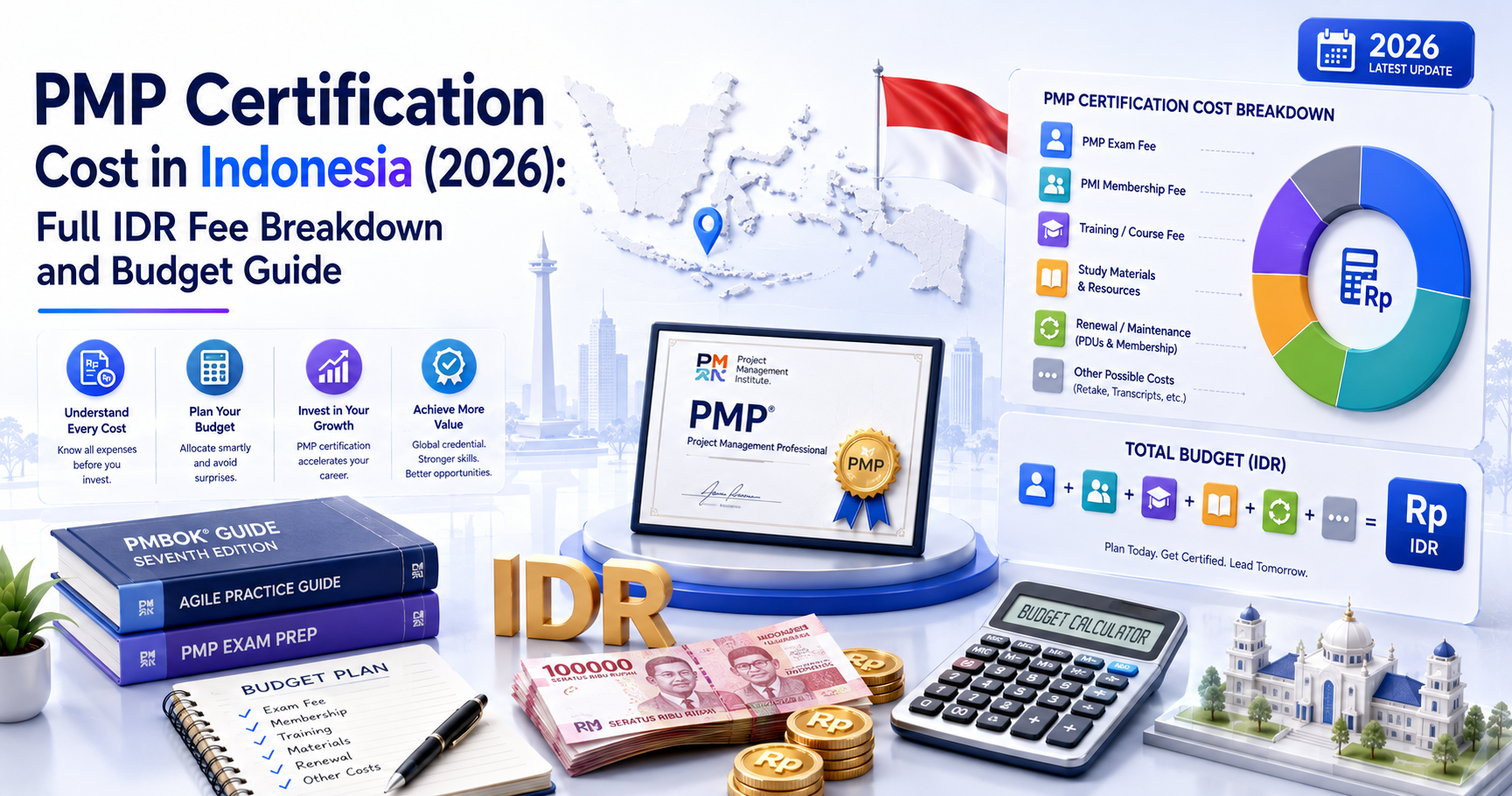
The PMP certification cost in Indonesia in 2026 runs from roughly IDR 19.2 million to IDR 28 million (about USD 1,079 to USD 1,570) depending on whether you join PMI before applying and which training format you choose, since PMI bills its exam fee in US dollars everywhere, including Indonesia. That total is made up of the PMI exam fee of USD 425 for members or USD 675 for non-members after PMI's August 2026 fee increase, optional PMI membership of USD 139 in the first year, and PMP exam preparation training that typically costs USD 495 to USD 895 through a PMI Authorized Training Partner such as Simpliaxis. Because the rupiah has been volatile through 2026, the IDR figure you actually pay can shift meaningfully between the day you budget and the day you register.
Key Highlights of PMP Certification Cost in Indonesia
- PMI raised the PMP exam fee on 6 August 2026, from USD 405 to USD 425 for members and from USD 555 to USD 675 for non-members, widening the member discount to USD 250.
- At an indicative rate of USD 1 to IDR 17,800 (20 September 2026), the non-member exam fee alone now converts to roughly IDR 12 million, up from about IDR 9.9 million before the increase.
- PMI membership costs USD 129 a year plus a one-time USD 10 application fee, so the first-year cost is USD 139, and it pays for itself immediately through the exam fee discount.
- Simpliaxis PMP exam preparation training typically costs between USD 495 and USD 895, converting to roughly IDR 8.8 million to IDR 15.9 million at current rates.
- The rupiah hit a record low of about IDR 18,247 per US dollar on 8 June 2026 and an all-time high near IDR 18,279 in July 2026 before stabilising close to the 17,700 to 17,800 range, so timing your payment matters for budgeting.
- Recertifying every three years costs USD 60 for members or USD 150 for non-members, plus whatever you spend earning the required 60 PDUs (minimum 35 from Education).
- State-owned enterprises (BUMN) and multinationals active in Indonesia's oil and gas, telecoms and infrastructure sectors commonly fund PMP certification for project teams, which materially changes the personal budgeting calculation for many candidates.
What Does the PMP Exam Actually Cost in Indonesia in 2026?
The PMP exam itself costs USD 425 for PMI members and USD 675 for non-members in 2026, and this fee is identical whether you sit the exam in Jakarta, Surabaya, Medan or anywhere else, because PMI charges the same US dollar amount worldwide. Simpliaxis's own coverage of the change confirms that PMI's 2026 PMP exam fee increase took effect on 6 August 2026, replacing the previous USD 405 member and USD 555 non-member fees that had held since PMI's last adjustment. Candidates who registered and paid before that date kept the lower fee for that attempt, but any new registration from 6 August 2026 onward is billed at the new, higher rate.
Converted into rupiah at the indicative rate of USD 1 to IDR 17,800 (the mid-market rate reported by xe.com and Investing.com on 20 September 2026), the member fee comes to roughly IDR 7.57 million and the non-member fee to roughly IDR 12.02 million. The table below sets out both the old and new fee, in USD and IDR, so Indonesian candidates can see exactly how much larger the number looks once it is billed through a local bank or card that converts to rupiah.
Fee type | USD before 6 Aug 2026 | USD from 6 Aug 2026 | IDR equivalent (approx., at USD 1 = IDR 17,800) |
| PMP exam, PMI member | 405 | 425 | ≈ 7,565,000 |
| PMP exam, non-member | 555 | 675 | ≈ 12,015,000 |
| Member-to-non-member gap | 150 | 250 | ≈ 4,450,000 |
Why Indonesian Candidates Should Care About the Rupiah, Not Just the Dollar
The rupiah's swings in 2026 mean the same USD 425 or USD 675 exam fee can cost noticeably different amounts in IDR depending on the week you pay. According to FXStreet and Asia Times reporting on Bank Indonesia's currency management, USD/IDR touched a record low for the rupiah of around 18,247 on 8 June 2026 and later reached an all-time high near 18,279 in July 2026, before Bank Indonesia's benchmark rate hike to 5.75% on 18 June 2026 helped the pair settle into a calmer 17,700 to 17,800 band by mid-August. Al Jazeera separately reported the rupiah's slide to a record low against the dollar around the same period, tying it to a widening current account deficit and capital outflows in early 2026.
For a candidate budgeting months ahead, a swing of just 500 to 700 rupiah per dollar changes the exam fee by IDR 300,000 to 500,000 and the full certification budget by well over IDR 1 million. Practically, this means locking in your training and exam budget in USD terms first, then checking the live USD to IDR rate close to the date you actually pay PMI or your training provider, rather than relying on a rate you saw weeks earlier. Corporate finance teams sponsoring staff certifications in Indonesia typically build in a currency buffer of 5 to 10% for exactly this reason.
The Full PMP Certification Cost Breakdown for Indonesia
A realistic PMP certification budget in Indonesia has four components: the one-time PMI application fee, optional PMI membership, exam preparation training, and the exam fee itself, and the table below breaks out each in both currencies. For a fuller line-by-line explanation of what each fee covers globally, Simpliaxis's own PMP certification cost overview is a useful companion reference alongside the Indonesia-specific numbers here.
Cost component | USD | IDR equivalent (approx.) | Notes | |
| PMI application fee (one-time) | 10 | ≈ 178,000 | Charged only in your first year of PMI membership | |
| PMI annual membership | 129 | ≈ 2,296,200 | Optional, but unlocks the discounted exam fee | |
| PMP exam fee, member | 425 | ≈ 7,565,000 | 2026 rate, effective 6 August 2026 | |
| PMP exam fee, non-member | 675 | ≈ 12,015,000 | 2026 rate, effective 6 August 2026 | |
| PMP exam prep training | 495 to 895 | ≈ 8,811,000 to 15,931,000 | Range for Simpliaxis-style live online and instructor-led formats | |
| Recertification (per 3-year cycle) | 60 (member) / 150 (non-member) | ≈ 1,068,000 / 2,670,000 | Plus whatever you spend earning 60 PDUs |
Putting the pieces together, a PMI member choosing a lower-cost self-paced or live online course lands close to USD 1,079 (roughly IDR 19.2 million), while a non-member choosing a premium instructor-led bootcamp lands closer to USD 1,570 (roughly IDR 27.95 million). Most Simpliaxis-trained candidates in Indonesia fall somewhere between these two figures, and Simpliaxis's PMP Certification Training course, which includes 35 contact hours and PDUs toward the education requirement, is designed to sit inside that band rather than push candidates toward the more expensive end. Indonesian candidates comparing schedules and formats can also browse Simpliaxis's dedicated Indonesia training hub, which lists locally relevant course dates alongside pricing in familiar terms.
Should You Join PMI Before Sitting the Exam?
Joining PMI before you register for the PMP exam is almost always the cheaper route in Indonesia, because the USD 250 gap between the member and non-member exam fee is larger than the USD 139 first-year membership cost. Beyond the exam discount, PMI membership includes free digital access to the PMBOK Guide and other standards, PDU-earning webinars, and access to the local chapter network, all of which Simpliaxis explains in more detail in its guide to the benefits of PMI membership. For most Indonesian candidates paying out of pocket, membership is the first cost-saving decision to make, not an afterthought.
What Drives PMP Certification Costs Up or Down in Indonesia?
Four factors move an Indonesian candidate's total PMP budget more than any others: training format, exchange rate timing, PMI membership status, and exam retakes. Instructor-led, live-online bootcamps with more coaching hours sit at the top of the price range, while self-paced e-learning with the same 35 contact hours sits at the bottom, and both formats satisfy PMI's education requirement equally on paper. Retaking the exam adds a further retake fee (billed by PMI at a lower rate than the first attempt, but still a real cost), so investing in enough preparation the first time around is usually cheaper than budgeting for two attempts.
Geography inside Indonesia matters less than currency timing. Because PMP training is delivered live online or self-paced for the vast majority of Indonesian candidates, whether someone is based in Jakarta, Surabaya, Balikpapan or Batam has little bearing on the training fee itself; the bigger swing factor is simply which week the rupiah happens to be trading at 17,700 or 18,200 to the dollar when fees are paid.
Who Pays? Employer and BUMN Sponsorship of PMP Certification in Indonesia
Employer sponsorship is the norm rather than the exception for PMP certification in Indonesia's largest project-driven sectors, particularly oil and gas, telecommunications, and state-backed infrastructure construction. Indonesia's BUMN (badan usaha milik negara, or state-owned enterprises) are among the country's largest employers and routinely fund professional development, including certification exam fees, training, and materials, as part of competitive compensation and talent-retention packages. Indonesian corporate tax guidance also treats training expenses, including certification exam fees and instructor fees, as deductible business expenses, which gives finance teams an additional incentive to approve PMP sponsorship for project staff rather than leaving individuals to self-fund.
This corporate-funding pattern is especially strong on large EPC (engineering, procurement and construction) megaprojects and telecom network rollouts, where dozens of project staff may need PMP or equivalent credentials at once. For HR and L&D teams handling that kind of group certification need, Simpliaxis's corporate and group training programme is built specifically for batch enrolments, offering negotiated group pricing and scheduling flexibility that individual course purchases do not, which is often the more efficient route than reimbursing each employee separately.
How Does Indonesia's PMP Cost Compare to Malaysia, Singapore, Vietnam and the Philippines?
The underlying PMI fee is identical in US dollars across every ASEAN market, so a PMP exam costs the same USD 675 (non-member, 2026 rate) whether you sit it in Jakarta, Kuala Lumpur, Singapore, Ho Chi Minh City or Manila. What differs is how large that fee looks once converted into each country's own currency, and how much that local-currency figure moves around. The table below shows the same non-member exam fee converted at representative rates gathered in September 2026.
Country | Currency | Approx. rate to USD 1 (Sep 2026) | PMP exam fee, non-member, in local currency |
| Indonesia | IDR | 17,800 | ≈ 12,015,000 |
| Vietnam | VND | 26,019 | ≈ 17,562,825 |
| Philippines | PHP | 60.2 | ≈ 40,635 |
| Malaysia | MYR | 4.05 | ≈ 2,733.75 |
| Singapore | SGD | 1.28 | ≈ 861.30 |
Indonesia and Vietnam sit at the high-denomination end of this comparison, which is why the same exam fee can feel psychologically heavier for Indonesian and Vietnamese candidates than for their Singaporean or Malaysian counterparts, even though the real USD cost is identical. Indonesia's added complication, unlike Singapore's comparatively stable dollar, is the rupiah's documented 2026 volatility described above, which means Indonesian candidates and their employers benefit more than most from budgeting in USD first and converting close to the payment date, rather than locking a rupiah figure into a training budget months in advance.
PMP Eligibility and the Exam Content Outline: What You're Paying For
Before spending a single rupiah, it is worth confirming eligibility, since PMI will not refund the exam fee if an application is later rejected for insufficient experience. Candidates with a four-year degree need 36 months of professional project management experience and 4,500 hours leading or directing projects, plus 35 hours of formal project management education, all earned within the last eight years. Candidates without a four-year degree need 60 months of experience and 7,500 hours leading or directing projects, on top of the same 35-hour education requirement. Holding an active CAPM credential exempts a candidate from the 35-hour education requirement, since CAPM already validates that foundational knowledge.
The exam itself is built from PMI's Examination Content Outline, which organises questions across three domains: People, covering leadership, communication and team dynamics; Process, covering the technical mechanics of running a project from scope to closure; and Business Environment, covering how a project connects to organisational strategy, compliance and change. PMI's updated 2026 outline also spreads roughly 40% of questions across predictive (waterfall-style) approaches and the remaining 60% across agile and hybrid approaches, reflecting how most Indonesian employers, particularly in telecoms and tech, now run projects using a mix of methodologies rather than pure waterfall.
Renewal Costs: Budgeting for the Next Three Years After You Pass
Passing the PMP exam is not the end of the cost conversation, because PMI requires certification holders to earn 60 PDUs (professional development units) every three years, with a minimum of 35 coming from Education activities, and to pay a Continuing Certification Requirements (CCR) fee to keep the credential active. That renewal fee is USD 60 for PMI members and USD 150 for non-members per three-year cycle, which converts to roughly IDR 1.07 million or IDR 2.67 million respectively at current rates. On top of the fee, PDUs themselves can be earned for free through PMI webinars, volunteering and reading, or purchased through paid courses and conferences, so the realistic all-in renewal cost varies widely depending on how much a candidate is willing to pay for convenience.
Because the renewal fee gap mirrors the exam fee gap, staying a PMI member after certifying continues to be the cheaper long-term path for most Indonesian professionals, particularly those who plan to hold the credential across an entire career rather than for a single job change.
Common Mistakes Indonesian Candidates Make When Budgeting for PMP
- Ignoring exchange-rate timing: Locking a rupiah figure into a personal or team budget months before payment, then getting caught out when the rate moves against the rupiah, as it did between June and July 2026.
- Skipping PMI membership: Paying the full non-member exam fee without realising the USD 139 membership cost is smaller than the USD 250 discount it unlocks.
- Underestimating eligibility checks: Applying for the exam before confirming the 36-month or 60-month experience threshold is met, risking a rejected application after the fee is already paid.
- Choosing training on price alone: Picking the cheapest available course without confirming it is delivered by a PMI Authorized Training Partner offering the required 35 contact hours, which can complicate the application.
- Forgetting the renewal budget: Treating the exam fee as the final cost, then being caught short three years later when the CCR renewal fee and PDU costs come due.
- Not asking about employer funding: Self-funding certification without first checking whether an employer, particularly a BUMN or multinational operating in Indonesia, already has a training sponsorship policy in place.
Is the PMP Worth the Investment in Indonesia's Job Market?
Indonesia's project management job market gives PMP certification clear, sector-specific relevance, particularly in oil and gas, telecommunications infrastructure, large-scale EPC construction, and Jakarta's expanding technology and startup sector. Job postings on platforms such as Glassdoor and Jobstreet regularly list PMP or CAPM as an advantage, and roles in oil and gas and telecom project delivery frequently specify years of EPC or network rollout experience alongside a project management credential. The PMI Indonesia Chapter, founded in 1996 and based in Jakarta, has grown to roughly 1,065 members drawn from a range of industries, and runs regular knowledge-sharing events and its Symposium and Exhibition (Symex) conference, giving Indonesian project professionals a visible local community around the credential.
On pay, global PMI salary survey data cited by Coursera shows PMP-certified professionals earning a median of roughly 17% more than non-certified peers across the 21 countries surveyed. Jobstreet's Indonesia career-advice data puts typical project manager pay in the broad range of IDR 9.3 million to IDR 23.2 million a month nationally, with Jakarta specifically sitting in a similar band, so a certification-linked premium at the upper end of that range can pay back the entire certification cost, including training, within a matter of months for professionals already working on qualifying projects.
Conclusion
The headline PMP certification cost in Indonesia looks large mainly because it is being converted into a high-denomination, occasionally volatile currency, not because Indonesian candidates are being charged more than anyone else: PMI's USD 425 member and USD 675 non-member exam fee is identical worldwide. What genuinely changes the Indonesian budgeting picture is the rupiah's 2026 swings between roughly 17,700 and 18,280 to the dollar, the strong local norm of BUMN and multinational employers funding certification for oil and gas, telecom and infrastructure teams, and the practical choice between joining PMI first or paying the higher non-member fee outright.
Candidates and the L&D teams sponsoring them get the best outcome by budgeting in USD, converting close to the payment date, joining PMI before registering wherever the maths supports it, and choosing a PMI Authorized Training Partner whose course fee sits inside the realistic USD 495 to USD 895 range rather than assuming the exam fee is the only number that matters.





 Lowest-Price Challenge











 Personalized Path


.webp)


 USA
USA  Canada
  India
India  UK
UK  Australia
  Singapore


