


 Call Us



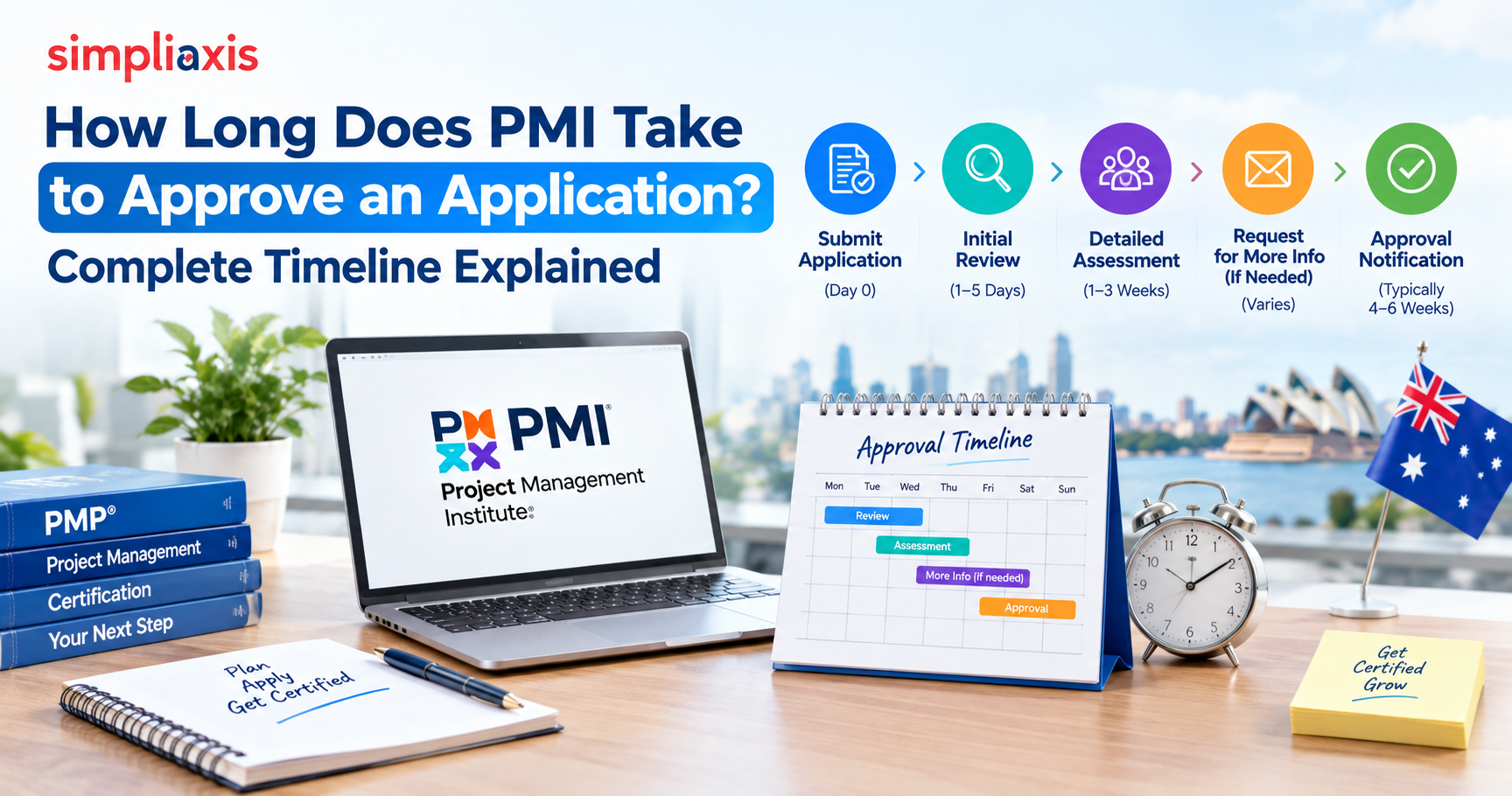
For many PMI certifications, applicants should generally allow about five days for the application completeness review after submission. However, the PMI application processing time can be longer if the application is selected for an audit or if the certification requires an additional evaluation stage. PMI's current Certification Handbook states that, once all required audit documentation has been provided, an audit should generally take about 5–7 business days to complete.
For the PMP® certification, once the application is accepted, the candidate can proceed to pay the examination fee and schedule the exam.
Therefore, there is no single PMI application approval time that applies identically to every PMI certification. The certification type, application completeness, audit selection, and any additional review requirements can influence the overall timeline. This is why the PMI application processing time can vary from one candidate to another.
Key Highlights: How Long Does PMI Take to Approve an Application?
- Around five days is a useful benchmark for the initial completeness review for several PMI certifications, according to PMI certification handbooks.
- An audit can extend the timeline. PMI currently allows candidates up to 90 days to provide requested audit documentation.
- Once complete audit materials have been submitted, PMI states that the audit should generally take 5–7 business days.
- Not every certification follows exactly the same process. For example, PgMP® involves an additional panel review after application acceptance, payment and any required audit.
- After application approval, candidates generally have a one-year examination eligibility period and can make up to three examination attempts during that period.
- Applicants should ensure that their education, experience and training information is accurate before submission because missing or inconsistent information can complicate the PMP application review process.
- PMI membership is separate from certification eligibility; candidates do not generally have to become PMI members simply to apply for a PMI certification.
Introduction
Submitting a PMI certification application can feel like a major milestone, especially after spending weeks or months completing the required training, documenting professional experience, and preparing for the examination. Once the application is submitted, however, a new question often arises: How long does PMI take to approve an application?
The answer is important because application approval determines when candidates can move to the next stages of their certification journey. For PMP candidates, for example, acceptance allows them to proceed with payment and ultimately schedule their examination.
The process is not necessarily identical for every applicant or every PMI certification. A straightforward application may progress through the normal completeness review, while another may be selected for an audit. Certain advanced credentials can involve additional evaluation stages.
Understanding all the given criteria helps to establish realistic expectations and avoid unnecessary delays.
This guide explains PMI application approval time, the PMP application review process, application statuses, audit timelines, possible reasons for delays, processing considerations for applicants in India, and what happens after approval. It also walks through the complete journey from submitting a PMI application to reaching exam day.
How Long Does PMI Take to Approve an Application?
For several PMI certifications, five days is the published application-completeness-review timeframe in PMI certification handbooks. For example, PMI's Scheduling Professional and Risk Management Professional handbooks show a five-day completeness review stage.
That does not mean every certification application is guaranteed to receive final approval within exactly five days.
The timeline should instead be understood as part of a broader process.
A typicalPMP application process can involve the following steps:
- Fill out the application form with all the required details.
- After completing the form, review each section of the application properly.
- Complete the audit if the application is shortlisted.
- The last step is to complete the payment and schedule the examination.
Apart from this, some credentials add further steps.
For example, the PgMP certification involves a panel review. PMI's PgMP handbook lists a 10-day application completeness review and indicates that panel review takes approximately 60 days.
This distinction is important when answering the question "How long does PMI take?" or how long does PMI take to approve pmp application?
The correct timeframe depends on:
- The certification
- Whether the submitted information is complete
- Whether the candidate is selected for an audit
- How quickly requested audit evidence is supplied
- Whether an additional assessment, such as a panel review, applies
Candidates should therefore consult the handbook and current certification page for their specific credential rather than assuming the PMP timeline applies to every PMI certification.
PMP Application Approval Time: What to Expect
The PMP application is designed to establish whether the applicant satisfies PMI's education, professional experience and project management training requirements.
PMI's current PMP page requires applicants to document qualifying education, project management experience and 35 hours of Project Professional training, which a PMI-authorized PMP certification trainingcourse covers, unless another accepted route such as an active CAPM® certification satisfies the training requirement. PMI's requirements vary according to the applicant's education pathway.
Applicants should therefore treat the application as an eligibility record rather than a simple registration form.
Before submission, candidates should check the following eligibility criteria:
- Education details are correct.
- Professional experience matches the applicable eligibility pathway.
- Projects and experience are documented accurately.
- Overlapping project periods are not double-counted.
- Required professional training is properly documented.
PMI currently tells PMP applicants to list each project separately and not to double-count periods when projects overlap.
Once the application has been accepted, PMI directs the applicant toward payment of the examination fee and exam scheduling. Candidates can review these PMP application examples when preparing the application.
What Counts as a Business Day for PMI?
A business day generally refers to a normal working day rather than every calendar day. Weekends and applicable organizational holidays should therefore not automatically be counted as processing days when a PMI timeline is expressed specifically in business days.
This distinction is especially relevant to audits because PMI's current Certification Handbook states that, after the necessary documentation has been supplied, the PMP audit process time should take approximately 5–7 business days.
For example, submitting requested material shortly before a weekend should not lead a candidate to assume that Saturday and Sunday necessarily represent two additional business days of review.
Candidates should also avoid interpreting a published processing timeframe as an absolute approval guarantee. Individual cases can require additional handling.
PMI Application Approval Time by Certification
One common mistake is assuming that every PMI credential follows the same review timeline. PMI offers certifications covering project, program, portfolio, scheduling, risk, business analysis and other specialized areas (see the full PMI certifications list), and the evaluation process can vary.
Here are some useful examples from PMI's published materials:
PMI Certification | Published Review/Additional Stage |
PMI-SP® | Application completeness review: 5 days |
PMI-RMP® | Application completeness review: 5 days |
PMI-PBA® | Application completeness review: 5 days |
PgMP® | Application completeness review: 10 days, followed later by panel review |
PMP® | Application acceptance precedes payment and exam scheduling |
PMI-SP, PMI-RMP and PMI-PBA handbooks each show five days for their application completeness review.
PgMP is notably different. Its handbook shows a 10-day completeness review and an additional panel-review process of approximately 60 days.
This demonstrates why candidates should not use a generic "five-day PMI approval rule" for every credential.
PMI maintains individual certification pages and a Certification Handbook to help candidates understand the requirements and processes associated with their chosen credential.
PMI Application Review Process: What Happens After You Apply
Understanding what happens behind the scenes can make the waiting period easier to interpret.
At a high level, the process begins when the candidate submits a completed certification application. PMI then reviews the application against the requirements of the credential.
The exact sequence depends on the certification, but the journey commonly includes:
1. Application submission
The applicant supplies information about education, training and, where applicable, professional experience.
2. Completeness review
PMI reviews the application to determine whether the information provided satisfies the relevant application requirements.
3. Audit selection, where applicable
Applications can be selected for audit. PMI's Certification Handbook states that the audit selection process is random, while also reserving PMI's right to select a candidate for audit at any time.
4. Payment
Once the appropriate application requirements have been satisfied, candidates proceed with the certification payment according to the applicable process.
5. Examination eligibility and scheduling
After the required payment and other applicable stages are completed, the candidate can move toward scheduling the examination.
Certain credentials include additional evaluation. PgMP, for example, requires a panel of certified program managers to assess professional experience based on the applicant's summary responses before exam scheduling.
How PMI Checks Your Application for Completeness
PMI's objective is to determine whether an applicant meets the eligibility requirements associated with the selected credential.
For PMP applicants, the information can include:
- Educational background
- Project management experience
- Project roles and responsibilities
- Duration of relevant experience
- Required professional training
PMI currently instructs PMP applicants to count professional project-management experience in which they were responsible for areas such as planning, decisions, delivery and outcomes. Each project is listed separately, and overlapping time should not be counted twice.
Accuracy matters because information supplied in the application may later need to be supported during an audit.
A useful principle is simple:
Write enough to demonstrate eligibility clearly, but do not exaggerate responsibilities or create experience merely to fit an eligibility requirement. You can refer to the PMP exam eligibility information page for detailed information.
PMI Application Status: What Each Status Means
Candidates can follow their certification journey through their PMI account. The precise wording displayed in PMI's interface can change, so applicants should treat their dashboard as the authoritative source for their current PMP application status.
More generally the stages are roughly as follows:
Application Pending:
The application has been started but is not yet submitted.
Application submitted/being reviewed:
This step lets you know that your application has been received and is moving through the other applicable review steps. This is often referred to as an application under review with the PMP.
Audit required/ chosen for audit:
Further documentation will be required before the next step can be taken.
Application received/approved:
This status means that the application has gone through the previous stages and is proceeding to schedule payment and examination.
Exam eligibility:
This is the last stage, which shows that payment is done and the candidate can book the examination within the specified time duration.
Candidates should always follow the instructions displayed in their PMI dashboard and emails rather than relying solely on generic descriptions of application statuses.
PMI Audit Process and Approval Timeline
An audit does not automatically mean something is wrong with an application.
PMI's current Certification Handbook states that audit selection is random, although PMI reserves the right to audit candidates at any time.
If selected, the applicant receives an electronic audit notification explaining what must be provided.
Depending on the certification and application, supporting documents can include:
- A copy of the candidate's degree, diploma or equivalent qualification
- Verification/signatures relating to professional experience
- Certificates or letters supporting required professional education or training
PMI gives candidates 90 days to submit requested audit documentation. Once all necessary documentation has been provided and satisfies the audit requirements, PMI says the audit should take approximately 5–7 business days to complete.
Importantly, a candidate selected for a PMP application audit cannot simply skip it and continue to the exam. The certification process remains on hold until the audit requirements are successfully completed.
PMI also states that failing to meet the audit requirements, or choosing not to comply, results in audit failure and a one-year suspension before the individual can reapply.
Applicants should therefore prepare accurate records before applying rather than waiting until an audit occurs. For more information, candidates can review the PMP audit process.
Why PMI Application Approval Can Be Delayed?
A longer-than-expected review does not necessarily indicate rejection.
Several factors can make the overall application-to-approval journey longer than the simplest published timeline. Some relate to the applicant, while others result from additional stages associated with a particular certification.
To avoid delays, the best way is to check the given information and carefully review the form before submitting.
6 Common Reasons PMI Application Approval May Be Delayed
1. Incomplete application information
Provide complete information; missing education or training experience can make it difficult to fulfill the eligibility requirements.
2. Experience information requires closer review
Describe your project experience so it clearly reflects your role and responsibilities. Provide detailed information about the project experience.
PMI's PMI-SP guidance, for example, explicitly tells candidates to describe their role and responsibilities on the project rather than the project itself.
3. Incorrect calculation of experience
Applicants can make mistakes when calculating qualifying experience, particularly when projects overlap. For PMP, PMI currently tells applicants not to double-count overlapping periods.
4. Audit selection
An audit adds another stage. The candidate must obtain and submit the required evidence, after which PMI performs the audit review.
5. Delayed submission of audit documents
PMI gives candidates up to 90 days to provide audit documentation. If a candidate waits several weeks before submitting it, that waiting time naturally extends the overall certification timeline.
6. Certification-specific additional reviews
Some certifications simply take longer because they have extra assessment stages. PgMP is an important example because it includes panel review after the relevant preceding stages.
PMI Application Approval Time in India
Candidates applying from India generally follow the same certification requirements and application process established by PMI for the relevant credential.
There is not a separate PMP application review standard simply because the candidate lives in Bengaluru, Mumbai, Delhi, Hyderabad, Pune or another Indian city.
That means an applicant in India should focus primarily on:
- Meeting the appropriate eligibility requirements
- Accurately recording education and experience
- Completing the required training
- Responding promptly if selected for audit
- Monitoring the PMI account and registered email address
Candidates should not assume that geographic distance from PMI headquarters inherently creates a significantly longer digital application-review process.
However, practical timing can still matter when communicating with support or counting business-day processing windows.
Do Time Zones and PMI Holidays Affect Processing?
India follows Indian Standard Time (IST), while PMI is headquartered in the U.S. Eastern time zone. Thus, a candidate submitting an application on an Indian standard working day should not assume that the submission has already been made. Hence, time zones can affect a candidate’s understanding of when a submission was made or when a response arrived.
Weekends and applicable holidays can also matter when a timeline is stated in business days.
The safest approach is therefore to avoid calculating approval deadlines down to the exact hour.
Instead:
- Note the date of submission.
- Determine whether the relevant PMI guidance uses days or business days.
- Allow for weekends and applicable holidays.
- Check the PMI dashboard for updates.
- Contact PMI if the application substantially exceeds the expected timeframe without explanation.
What to Do If Your PMI Application Is Taking Too Long?
If your application appears to be taking longer than expected, avoid immediately submitting another application.
Start by checking your PMI account/dashboard.
Look for:
- Current application status
- Audit notifications
- Requests for additional information
- Payment instructions
- Eligibility information
- Messages requiring action
Next, check the email account associated with your PMI profile, including the spam or junk folder.
If your application is PMP application pending or is in an audit stage, confirm whether every requested document has actually been submitted.
You should also compare the elapsed time with the published timeframe for your specific certification. Remember that a five-day completeness-review benchmark for one certification should not be used to judge a certification involving a 10-day review or panel assessment.
If the expected processing period has clearly passed and the dashboard provides no explanation, contact PMI customer support with your application details.
Keep communication concise and include information such as:
- PMI ID, where appropriate
- Certification applied for
- Submission date
- Current dashboard status
- The issue requiring clarification
Avoid creating duplicate applications merely because the original application is still being processed.
What Happens After PMI Approves Your Application?
Approval is an important milestone, but it is not the end of the certification process.
For PMP candidates, PMI explains that once the application is accepted, the next step is to pay the examination fee and schedule the exam.
The broader progression looks like:
- The application has been approved
- The next step is to pay the examination fee
- After completing the payment, you will receive the eligibility information and schedule the exam.
- Prepare for the exam and take the examination.
PMI's Certification Handbook states that after the certification fee has been received, PMI sends an email containing the candidate's PMI Eligibility ID, which is used when scheduling the examination.
Candidates do not necessarily have to schedule the earliest available exam appointment.
A better approach is to choose an exam date that provides enough time for final preparation while remaining comfortably within the eligibility period. For further details, refer to the PMP exam fee page.
PMI Exam Eligibility Period and Scheduling
Application approval starts an important clock.
According to PMI's current Certification Handbook, candidates generally have one year to take the examination after their application has been approved. They may take the exam up to three times within that one-year eligibility period.
There is an important exception for audited candidates.
If an application is selected for audit, PMI states that the one-year eligibility period begins when the candidate is informed that the audit has been completed.
Therefore, candidates should understand three different timelines:
Application review timeline – How long PMI takes to process the application.
Audit timeline – Additional time required if selected for audit.
Exam eligibility period – The period available to sit for and pass the examination after eligibility begins.
These should not be confused.
Candidates should also avoid postponing scheduling unnecessarily. A one-year eligibility window may sound long, but preparation, work commitments, personal responsibilities and potential retakes can quickly consume that time.
When deciding when to sit the exam, candidates can check the PMP exam schedule guide to plan within their eligibility period.
PMI Application to Exam Day: The Complete Timeline
It’s easier to think of the whole process as a sequence rather than just in terms of approval of the application.
Step 1: Select Your PMI Certification
Find the right certification for your career and professional experience. Make sure you know the full eligibility requirements before applying.
Step 2: Confirm Eligibility
Check the required combination of:
Education, professional experience and project management training
PMI offers different pathways for PMP eligibility based on the applicant’s education level; qualifying project-management experience and professional education are required.
Step 3: Collect Your Information
Before you start, gather the information you need to log:
Work/project experiences
Functions and responsibilities
Project dates
Education and training
Details of training providers
This reduces the chances of inconsistencies.
Step 4: Fill Out the Application
Type the required information correctly.
Don’t overstate experience or lift generic project descriptions.
Step 5: Review Before Submission
Check:
Names → Dates → Qualifications → Project periods → Experience → Training
Pay particular attention to overlapping experience.
Step 6: Submit the Application
Once submitted, the application enters PMI's relevant review process.
For several PMI credentials, the published completeness-review timeframe is approximately five days, although timelines vary by certification.
Step 7: Respond to an Audit, If Selected
If you are selected for an audit, PMI will tell you what documentation is required.
You have up to 90 days to submit the requested documents, and PMI states that a complete audit should generally take approximately 5–7 business days to process.
Step 8: Receive Application Acceptance
Once the appropriate review requirements are successfully completed, the candidate moves to the next stage. Upon successful payment candidates can proceed ahead for exam scheduling.
Step 9: Payment of Examination Fee
Once you have submitted all the necessary details, continue to the payment process.
Step 10: Book your Exam
Choose a suitable appointment in accordance with your preparation plan.
Please be aware that the time it takes to approve the application is not the same as the availability of the exam. If you are approved today, your preferred testing appointment may not be available tomorrow.
Step 11: Keep studying for the exam
Make use of the time between approval of application and the scheduled exam to:
Review the current Exam Outline.
Strengthen weak knowledge areas.
Take practice tests
Check incorrect answers
Manage time well
Familiarize yourself with exam-day requirements
Using the current exam information is especially important for PMP candidates. PMI has released a new PMP exam in July 2026, so candidates preparing now should align their study materials with the PMP Exam Content Outline 2026, not outdated versions.
Step 12: Take the Exam
Finally, attend the scheduled examination and complete the certification assessment.
The overall journey can therefore be summarized as:
Check eligibility → Prepare application → Submit → PMI review → Audit if selected → Approval → Payment → Scheduling → Preparation → Exam
The application review itself may represent only a small portion of the complete certification journey. Candidates can also use a PMP practice test as part of their exam preparation.
Conclusion
So, how long does PMI take to approve an application?
For several PMI certifications, around five days is the published application-completeness-review timeframe, but candidates should not treat that as a universal guarantee. Certification type matters, and processes such as audits and panel reviews can considerably extend the overall timeline.
If an application is selected for an audit, PMI allows up to 90 days for submission of the requested documentation and states that a complete audit should generally take 5–7 business days to process.
The best way to prevent avoidable delays is straightforward: understand the eligibility criteria, document experience accurately, provide complete information, maintain supporting records, and respond promptly to any PMI request.
Once the application is approved and the required payment process is completed, candidates can move toward scheduling their examination. The eligibility period generally covers one year along with three examination attempts.
PMI application approval should be viewed as one stage in a larger journey, from establishing eligibility and providing professional experience to preparing for the exam and taking certification.







 Lowest-Price Challenge











 Personalized Path


.webp)


 USA
USA  Canada
 India
India UK
UK Australia
 Singapore


