


 Call Us



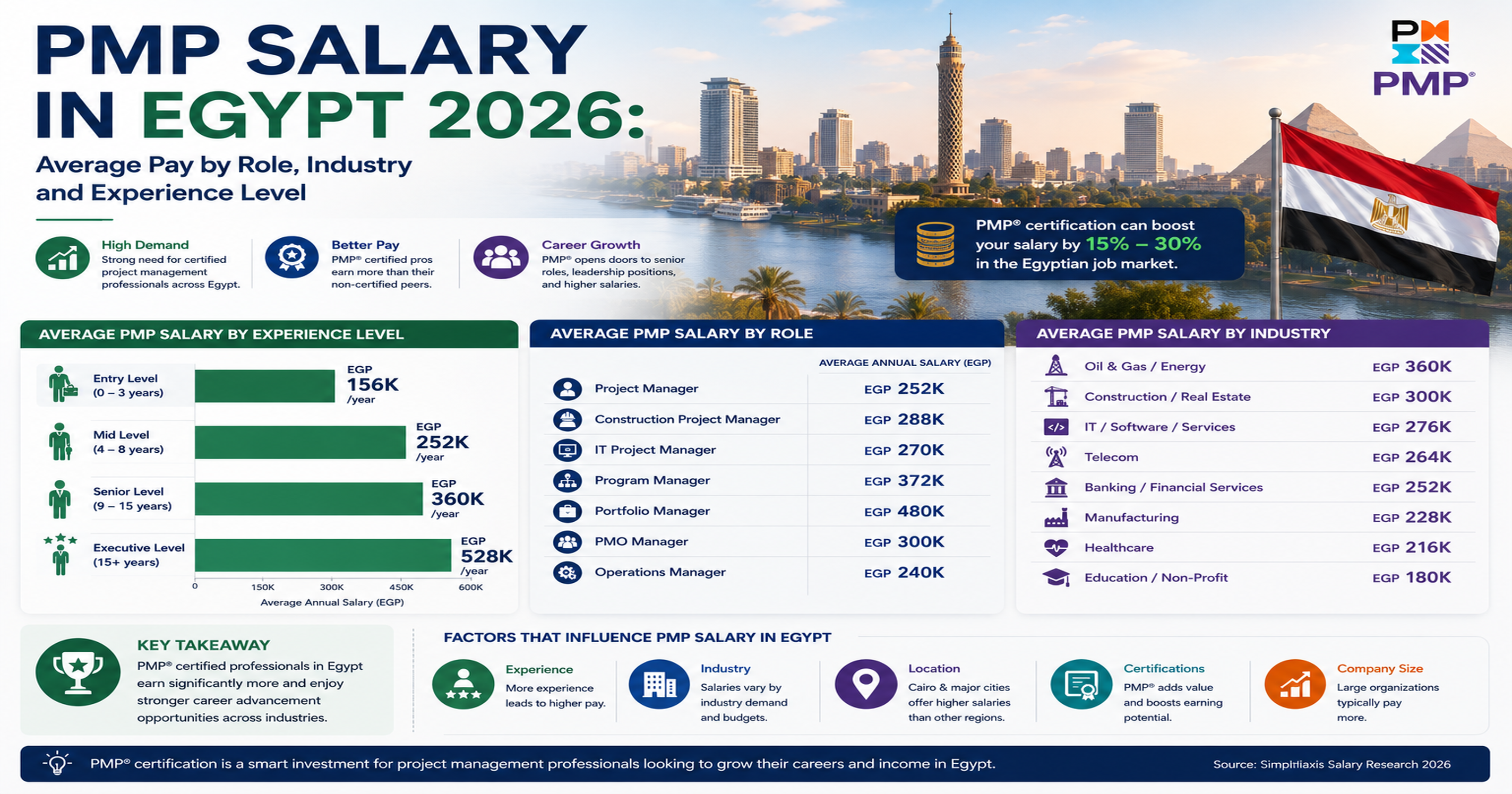
PMP certified project managers in Egypt typically earn somewhere between roughly EGP 360,000 and EGP 580,000 a year in Cairo, according to SalaryExpert's 2026 dataset, with entry level holders nearer the lower end and professionals with eight or more years of experience nearer the top. PayScale's Egypt specific data shows a lower average of EGP 220,802 a year for IT project managers and EGP 138,000 for construction project managers, which illustrates how much pay varies depending on sector and which benchmarking panel is used. Professionals working for multinational oil and gas majors, EPC contractors and international consultancies in Egypt generally earn a significant premium over peers at purely local firms, often with allowances layered on top of base pay. Because the Egyptian pound has weakened sharply since 2022, the real, inflation adjusted value of any EGP salary figure matters just as much as the headline number itself.
Key Highlights of PMP Salary in Egypt
- PMP salary benchmarks for Egypt vary widely by source: PayScale puts average IT project manager pay at EGP 220,802 a year, while SalaryExpert's Cairo panel shows a broader EGP 359,937 to EGP 573,179 range across experience levels.
- Multinational oil and gas majors, EPC contractors and global consultancies operating in Egypt typically pay materially more than local Egyptian employers for equivalent project management roles, often alongside housing, transport and performance allowances that local firms rarely match.
- PMI's Earning Power: Project Management Salary Survey, 14th Edition (2025) found PMP holders worldwide report a median salary 17% higher than non certified peers globally, with premiums reaching over 30% in some markets outside the US.
- The Egyptian pound lost more than two thirds of its value against the US dollar between 2021 and 2024, so a nominal EGP salary increase can still amount to a real pay cut once inflation, which peaked above 30% in 2023 and 2024, is factored in.
- Cairo commands the highest project management salaries in Egypt, Alexandria trails by a meaningful cost of living adjusted margin, and emerging hubs such as the New Administrative Capital and Suez carry their own project specific premiums or discounts.
- Oil and gas, EPC or construction megaprojects, and IT or telecom consistently rank among the highest paying sectors for PMP certified professionals in Egypt, according to PayScale and industry compensation guides.
- Employers, including PMOs and learning and development teams, increasingly fund PMP certification for multiple staff at once, treating it as one of the more cost efficient ways to standardise project delivery capability across a national or regional programme.
How Much Do PMP Certified Project Managers Actually Earn in Egypt?
Anyone researching project manager pay in Egypt quickly discovers that no two salary panels agree, and the gap is wide enough to be confusing rather than merely inconvenient. Glassdoor's Egypt panel lists typical project manager total pay at roughly EGP 20,083 in Cairo and EGP 23,333 nationally, with a broader range running from about EGP 13,000 up to EGP 74,000 among the highest reported earners.
PayScale's Egypt specific data tells a different story: its Project Manager, Information Technology (IT) benchmark averages EGP 220,802 a year in 2026, while its Construction Project Manager benchmark averages EGP 138,000, with a wide base salary range of roughly EGP 39,000 to EGP 357,000 depending on employer size and seniority.
SalaryExpert's Cairo dataset sits higher again, putting the average project manager salary at EGP 494,899 a year, with entry level professionals on one to three years' experience at EGP 359,937 and senior level professionals on eight or more years at EGP 573,179. Bayt.com's regional salary panel, drawn largely from job seekers actively browsing listings across the Egyptian market, lists project manager pay at around EGP 67,700.
This spread is not really a data error, it reflects who is answering each survey. PayScale and Glassdoor samples skew toward junior to mid level coordinator and in house roles reported by individual employees, SalaryExpert's methodology draws more heavily on employer reported compensation data and tends to capture more senior, better paid positions, and Bayt's figures lean toward active job seekers rather than settled senior incumbents. For a PMP certified professional trying to work out what to expect, the practical takeaway is to treat any single figure as one data point on a wide spectrum, and to weigh it against seniority, sector and employer type, the three variables that explain most of the difference.
Source | Scope | Reported Pay (EGP/year) |
| PayScale | Project Manager, Information Technology (IT), Egypt, 2026 | EGP 220,802 average |
| PayScale | Construction Project Manager, Egypt | EGP 138,000 average (range EGP 39,000 to EGP 357,000) |
| SalaryExpert | Project Manager, Cairo, all experience levels | EGP 494,899 average (EGP 359,937 to EGP 573,179 by seniority) |
| Glassdoor | Project Manager, Cairo and Egypt wide | EGP 20,083 to EGP 23,333 typical, up to EGP 74,000 for top reported earners |
| Bayt.com | Project Manager, Egypt wide | EGP 67,700 average |
PMP Salary in Egypt by Experience Level
Experience is the single biggest driver of pay within Egypt's project management market, arguably more so than in mature Western markets, because the pool of professionals with genuine large scale, multi year programme delivery experience is still relatively small. SalaryExpert's Cairo data breaks this down clearly: entry level project managers with one to three years of experience average EGP 359,937 a year, the overall average across all experience bands sits at EGP 494,899, and senior level professionals with eight or more years of experience average EGP 573,179. PayScale's narrower IT focused sample shows an early career professional on one to four years' experience earning an average total compensation of EGP 180,000, based on a smaller sample of 16 reported salaries, a useful reminder that IT specific project management pay in Egypt often runs below the broader, cross industry average once EPC, construction and oil and gas roles are folded in.
Experience Level | Average Salary (EGP/year) | Notes |
| Entry level (1 to 3 years) | EGP 359,937 | SalaryExpert, Cairo. PayScale's IT specific early career figure is lower, at EGP 180,000. |
| Mid to senior career (overall average) | EGP 494,899 | SalaryExpert, Cairo, blended across all seniority bands. |
| Senior level (8+ years) | EGP 573,179 | SalaryExpert, Cairo. Typically PMO leads, senior programme managers or EPC project directors. |
The Multinational Premium: Foreign Invested Employers vs Local Egyptian Employers
The single most important variable that generic salary panels tend to flatten is who is actually signing the pay cheque. Oil and gas majors, international EPC contractors and multinational consultancies operating in Egypt, whether on Suez Canal Economic Zone energy projects, Red Sea and Mediterranean offshore gas developments, or Cairo based regional headquarters, typically run structured, benchmarked pay scales that sit well above what purely local Egyptian firms offer for a similar job title.
Industry compensation guides note that multinational employers generally have more competitive, formalised pay structures than smaller local businesses, and that for senior professional roles in oil and gas, banking and multinational executive positions, expatriate style compensation packages, once housing allowances, transport, schooling and tax equalisation are included, can run several times higher than the equivalent locally hired package for the same job.
Egyptian hires at these multinationals do not typically receive full expatriate packages, but they do usually sit meaningfully above the local market. Petroleum engineers, a discipline closely tied to Egypt's EPC and upstream project pipeline, average around EGP 492,615 a year according to industry salary guides, well above the PayScale construction project manager average of EGP 138,000, which is a reasonable proxy for how much oil and gas sector premiums can widen the gap even before multinational versus local ownership is factored in.
Local Egyptian contractors and SMEs, by contrast, tend to compete on price for government and private tenders, which compresses what they can offer project staff, PMP certified or not. For a PMP holder deciding where to target their job search, the practical implication is that the employer's ownership structure and funding source, whether it is a foreign invested joint venture, an EPC contractor bidding for international clients, or a domestically owned company serving the local market, often explains more of the pay gap than job title or even years of experience alone. Professionals aiming for these higher paying multinational tracks typically start by completing PMI authorised PMP certification training in Egypt, since multinational employers and EPC contractors routinely list PMP as a preferred or required credential in project leadership job postings.
PMP Salary by Industry and Sector in Egypt
Sector is nearly as decisive as employer type. Oil and gas, which accounts for roughly a quarter of Egypt's GDP, sits at the top of the pay scale, followed by large scale EPC and construction megaprojects, then IT and telecom, with general construction and public sector adjacent roles trailing behind.
Sector | Typical Pay Positioning | Illustrative Data Point |
| Oil and gas / upstream EPC | Highest paying sector for project delivery roles | Petroleum engineers average EGP 492,615/year, per industry salary guides |
| IT and telecom project management | Above general market average, below oil and gas | PayScale IT Project Manager average: EGP 220,802/year |
| General construction and infrastructure | Wide range depending on client and contract size | PayScale Construction Project Manager average: EGP 138,000/year (range EGP 39,000 to EGP 357,000) |
| Banking, finance and multinational consulting | Above market average, concentrated in Cairo head offices | Qualitative: high concentration of multinational HQs and financial institutions in Cairo drives up demand and pay |
| National megaprojects and government backed programmes (for example New Administrative Capital) | Location premium over comparable Cairo based roles | Sector pay guides report roughly 15% to 25% location premiums for technical and safety roles on New Administrative Capital contracts |
Regional Pay Differences: Cairo vs Alexandria vs Suez and the New Administrative Capital
Where a PMP holder is based in Egypt changes both the nominal salary on offer and what that salary is actually worth day to day. Cairo remains the clear pay leader, since it hosts the country's economic and administrative core, the majority of multinational regional headquarters, and the deepest concentration of financial institutions and large EPC contractors. Alexandria, as Egypt's main port and a significant manufacturing and logistics hub, offers above average wages for technical and industrial project roles but sits meaningfully below Cairo overall. Cost of living trackers put Cairo somewhere between roughly a quarter and around half more expensive than Alexandria depending on the specific comparison used, which means a project manager earning a somewhat lower nominal salary in Alexandria is not necessarily worse off in real terms.
Suez presents a different pattern again. As a lower cost, canal facing industrial city, cost of living there runs roughly 23% below Cairo, so project management salaries that look modest on paper can still deliver reasonable purchasing power locally, particularly for roles tied to canal zone logistics, energy and industrial projects. The New Administrative Capital, Egypt's flagship government backed development roughly 45 kilometres east of Cairo, is a distinct case: sector pay guides note that professionals working on New Administrative Capital contracts, most visibly in technical and safety disciplines, report location premiums of around 15% to 25% over comparable Cairo based roles, reflecting the scale and government backed nature of these infrastructure contracts along with harder to staff site locations.
Professionals evaluating a move should compare not just the number on the offer letter but the city it is paid in, since the same nominal PMP salary in Egypt can represent very different real world purchasing power in Cairo, Alexandria, Suez or the New Administrative Capital. Anyone based in or targeting Cairo specifically can review PMP certification training available in Cairo as a first step toward qualifying for the city's higher-paying multinational and EPC roles.
City / Region | Cost of Living vs Cairo | Salary Positioning |
| Cairo | Baseline (highest cost of living in Egypt) | Highest nominal salaries, deepest multinational and EPC employer base |
| Alexandria | Roughly 24% to 48% cheaper, depending on tracker | Above average for manufacturing, logistics and port related project roles, below Cairo overall |
| Suez | Roughly 23% cheaper | Lower nominal pay but comparable or better real purchasing power for canal zone and industrial roles |
| New Administrative Capital | Higher effective cost due to commuting and site living, offset by allowances | Reported 15% to 25% location premium over equivalent Cairo based roles on flagship contracts |
Currency Volatility and Real Purchasing Power: What an EGP Salary Actually Buys in 2026
No discussion of PMP salary in Egypt is complete without addressing the pound itself. The Egyptian pound depreciated sharply from around EGP 15.7 to the US dollar in 2021 to more than EGP 45 by 2024, a loss of more than two thirds of its value in under three years, following a series of currency flotations driven by external financing pressure. Inflation moved in tandem: Egypt's state statistics agency, CAPMAS, recorded annual urban consumer price inflation of 26.5% in October 2024 and 25.5% in November 2024, with food prices around 29% higher than the previous year, after peaks above 30% during 2023. The IMF projected inflation easing toward roughly 21% in 2025, with more recent tracking suggesting a further moderation into the 13% to 15% range through 2025 and 2026 as monetary tightening and a more stable exchange rate took hold. Egypt's private sector minimum wage was set at EGP 7,000 a month effective March 2025, a helpful floor, but one that illustrates how quickly nominal wage floors can be overtaken by prices in a high inflation environment.
The practical implication for anyone evaluating a PMP salary in Egypt is straightforward: a headline EGP figure that looks like a healthy raise year over year may still represent flat or falling real income once inflation is subtracted out, and a salary quoted in EGP today is worth meaningfully less in dollar terms than the same nominal figure would have been worth three or four years ago. This is precisely why multinational employers, EPC contractors and foreign invested joint ventures tend to structure senior packages with dollar linked components, annual reviews, or cost of living adjustments, while purely local employers more often leave EGP base pay to lag behind inflation.
When comparing job offers, it is worth asking not just what the EGP number is, but how and how often it is reviewed against inflation and the exchange rate, since that mechanism often matters more to real purchasing power than the headline figure itself. It is also worth weighing this backdrop against the total cost of earning PMP certification, since the exam fee and training investment are typically paid in or pegged to US dollars, so currency movements affect the cost side of the certification decision just as much as the eventual salary side.
Does PMP Certification Actually Pay More in Egypt? The Certification Premium
PMI's own research is unambiguous about the global picture, even if country level detail for Egypt specifically is thin. The Earning Power: Project Management Salary Survey, 14th Edition, based on responses from 14,628 project professionals across 21 countries fielded in March and April 2025, found that PMP certified professionals report a median salary premium of around 17% globally over non certified peers, with the US premium reaching 24% (a median of $135,000 versus $109,157 for non certified professionals), and with certain emerging markets showing considerably larger gaps, in some cases exceeding 30%. Earlier editions of the same survey found premiums as high as 33% when averaged across roughly 20,000 respondents in 21 countries, underlining that the certification premium, while it moves around year to year, has consistently stayed positive and material.
Egypt specific figures are harder to pin down precisely because PMI's published country breakdowns and most third party panels do not isolate a large enough Egyptian PMP holder sample to report with confidence, which is exactly why Egypt tends to show up toward the lower end of any list ranked in absolute US dollar terms, a function of currency conversion and market size rather than a sign that certification adds no value locally.
What can be said with reasonable confidence, based on the sector and employer type patterns already outlined, is that the premium shows up less as a flat percentage add on to base pay and more as a gatekeeping effect: PMP certification is what allows a candidate to be shortlisted for the multinational, EPC and oil and gas roles that already pay well above the local market average, and it is those roles, more than the certification alone, that drive the largest jumps in take home pay. For a fuller breakdown of how the certification premium is typically calculated and where PMP fits against other credentials, Simpliaxis maintains a dedicated PMP certification salary guide covering the mechanics of the premium in more depth.
In Demand PMP Roles in Egypt's Project Management Market
Certain job titles come up repeatedly in Egyptian job postings that specifically request or prefer PMP certification, and they cluster heavily around the multinational and megaproject employers already discussed.
- Senior Project Manager or Project Director roles on EPC and oil and gas contracts, typically requiring both PMP certification and a technical engineering background.
- PMO Manager and PMO Lead positions, responsible for setting delivery standards, governance and reporting across multiple concurrent projects.
- Programme Manager roles overseeing portfolios of related projects, common at multinational consultancies and large government backed developments such as the New Administrative Capital.
- IT and digital transformation project managers, particularly at banks, telecoms and multinational shared services centres based in Cairo.
- Construction and infrastructure project managers on large scale residential, transport and utility contracts across Cairo, the New Administrative Capital and the Suez Canal Economic Zone.
Why Egyptian Employers and PMOs Are Investing in PMP Certification for Their Teams
A pattern that shows up consistently across multinational and larger local employers in Egypt is that PMP certification decisions are increasingly made at the organisational level rather than left entirely to individual employees. PMO managers and learning and development leads responsible for delivery capability across an EPC contractor, a bank's transformation office, or a government programme office have a straightforward incentive to standardise on a single, internationally recognised methodology such as PMP, since it reduces onboarding time for new project staff, gives every project manager a shared vocabulary for scope, schedule and risk, and makes it far easier to move people between projects without retraining them from scratch.
This is also, in practical terms, a cost argument as much as a career development one. Certifying a cohort of ten or fifteen project staff at once, rather than leaving each individual to self fund exam fees and preparation separately, typically works out more efficient for the organisation, and it signals to clients and regulators, especially on government backed or internationally financed contracts, that delivery capability has been formally benchmarked.
Organisations in Egypt looking to upskill project teams at scale, whether inside an EPC contractor, a bank's PMO, or a public sector megaproject delivery unit, can arrange this through Simpliaxis's corporate group training programmes, which are built specifically for organisation wide PMP and related certification rollouts rather than single seat bookings.
How to Maximise Your PMP Salary in Egypt
For an individual professional, the data above points toward a fairly clear set of priorities, roughly in the order they tend to matter most.
- Target employer type before job title. A mid level project manager at a multinational EPC contractor or oil and gas major will typically out earn a senior project manager at a small local firm, so filter job searches by ownership and funding source, not only by seniority label.
- Get certified before negotiating, not after accepting an offer. PMP certification is frequently a shortlisting requirement for the higher paying roles discussed above, so holding it before applying opens doors that applying without it does not.
- Specialise in a premium sector. Oil and gas, EPC megaprojects and IT or digital transformation consistently pay above the general project management average in Egypt, so building sector specific experience alongside the PMP credential compounds the effect of certification alone.
- Negotiate on total compensation, not base salary. Given how quickly EGP inflation can erode a fixed base salary, housing allowances, transport, annual review mechanisms and any dollar linked components matter as much as the headline figure.
- Consider regional and cross border mobility. Egyptian PMP holders with EPC or oil and gas experience are often well positioned for roles across the wider Gulf and North Africa region, where dollar pegged salaries can offer more currency stability.
- Stay current as PMI's standards evolve. With the PMBOK Guide, Eighth Edition now in circulation and a refreshed PMP exam version following it, keeping certification requirements, PDUs and exam content knowledge up to date protects the credential's shortlisting value over the long run.
Conclusion
Egypt's PMP salary picture in 2026 is less a single number than a set of overlapping gaps: a gap between benchmarking panels that survey different slices of the market, a gap between multinational and local employers that often outweighs years of experience, a gap between sectors that rewards oil and gas and EPC specialisation well above general construction or public sector work, and a widening gap between nominal EGP pay and its real, inflation adjusted purchasing power.
Taken individually, figures from PayScale, SalaryExpert, Glassdoor and Bayt each tell a partial story, but together they show that a PMP credential functions in Egypt mainly as an entry ticket to the better paying tier of employers, oil and gas majors, EPC contractors and multinational consultancies, rather than as a fixed percentage bonus on top of whatever a given employer already pays.
For professionals, that means the certification decision should be paired with a deliberate choice of sector and employer type. For PMOs and learning and development leads funding certification across teams, it means the return on a PMP investment in Egypt is best measured not just in individual salary bumps but in the delivery consistency and client confidence that come from an entire project team working to the same internationally recognised standard, even as the pound and inflation keep moving the goalposts on what any given salary figure is actually worth.








 Lowest-Price Challenge











 Personalized Path


.webp)


 USA
USA  Canada
 India
India UK
UK Australia
 Singapore


