


 Call Us



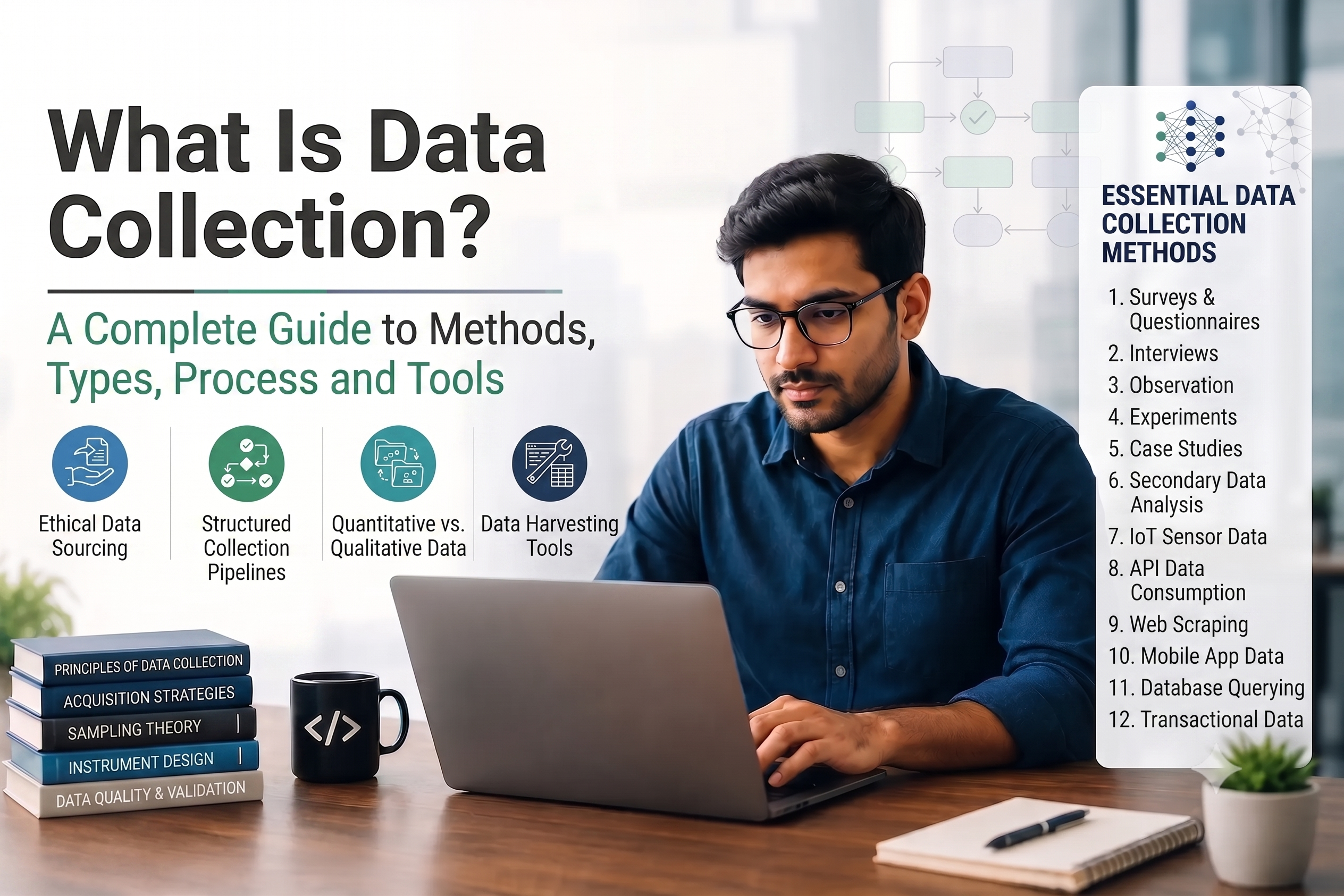
Data collection is the systematic process of gathering, measuring and recording information from people, systems, sensors or existing records so that it can be analyzed to answer a question, solve a problem or support a decision. It can be primary (collected firsthand through surveys, interviews, observation or experiments) or secondary (reused from existing sources such as government databases or company records), and it can produce quantitative data (numbers) or qualitative data (words, images, behaviors). Good data collection follows a defined plan, respects privacy laws such as GDPR, and builds in checks for bias and error so the resulting data can actually be trusted for decision-making.
Key Highlights of What Is Data Collection
- Data collection is the first and most decisive step in any research, analytics or process improvement project; poor collection cannot be fixed by good analysis later.
- All data collection methods fall along two axes: source (primary vs secondary) and nature (quantitative vs qualitative), and most real projects combine more than one.
- Common primary methods include surveys, interviews, focus groups, direct observation and controlled experiments, each suited to a different kind of question.
- A defined data collection process, from setting objectives to validating and storing data, reduces the sampling bias, measurement error and missing data that undermine analysis.
- Regulations like the EU's General Data Protection Regulation (GDPR) set legal requirements for consent, transparency and data subject rights whenever personal data is collected.
- In fields like Six Sigma, business analysis and data analytics, structured data collection during phases such as DMAIC's Measure stage directly determines whether an improvement or business case is credible.
What Is Data Collection?
Data collection is the process of systematically gathering information from various sources, people, documents, sensors, transactions, or existing databases, so that it can be organized, measured and analyzed to answer specific questions or support decisions. It sits at the very start of the broader data lifecycle: collection feeds cleaning and preparation, which feeds analysis, which feeds the insight or decision the organization actually needed in the first place.
The term applies across very different disciplines. A market researcher collecting survey responses, a Six Sigma team logging cycle times on a production line, a UX researcher observing users interact with an app, and a machine learning engineer assembling a labeled training dataset are all doing "data collection," even though the mechanics look nothing alike. What unites them is intent: the data is gathered for a defined purpose, not accumulated incidentally, and its quality is judged against how well it serves that purpose.
Because the phrase covers so much ground, it helps to break it down along two simple dimensions before looking at individual methods: where the data comes from (primary or secondary) and what form it takes (quantitative or qualitative). Nearly every specific method described later in this guide is really just a combination of those two choices.
Why Data Collection Matters
Every downstream analytical or business decision inherits the quality of the data it was built on. A perfectly executed statistical model run on biased, incomplete or mislabeled data will still produce a wrong answer, a principle sometimes summarized as "garbage in, garbage out." That makes data collection less a preliminary chore and more a determinant of whether an entire project succeeds.
Concretely, well-designed data collection matters because it:
- Grounds decisions in evidence rather than assumption. Product, marketing, operations and policy decisions backed by real customer, process or market data consistently outperform decisions based on intuition alone.
- Establishes a baseline for improvement. In process improvement work, you cannot demonstrate that a change reduced defects, cycle time or cost unless you first collected reliable "before" data to compare against.
- Feeds analytics and AI systems. Machine learning models are only as good as their training data; data acquisition and labeling are widely recognized as one of the biggest practical bottlenecks in building production ML systems.
- Supports accountability and compliance. Regulated industries and public-sector programs must document how data was collected to demonstrate that decisions, audits or reported outcomes are defensible.
- Reveals problems early. A rigorous collection plan surfaces gaps, biases or measurement issues before they contaminate an entire analysis, which is far cheaper to fix at the collection stage than after publishing results.
The scale of this challenge keeps growing. Industry analyst IDC's Global DataSphere research, tracked and summarized by Statista's worldwide data creation statistics, has estimated that the amount of data created, captured and replicated worldwide was already well over 100 zettabytes annually in the mid-2020s and is forecast to keep expanding sharply through the rest of the decade. That volume makes disciplined data collection, deciding deliberately what to gather and why, more important than ever, since the alternative is drowning in data that nobody planned for and nobody can use.
Primary Data vs Secondary Data
The most fundamental split in data collection is where the data originates.
Primary data is collected firsthand, directly from the source, for the specific purpose at hand. If a company runs its own customer satisfaction survey this quarter, that is primary data. It tends to be more accurate and more specific to the research question, but it is also more time-consuming and expensive to gather.
Secondary data is information that already exists, collected earlier by someone else for a different original purpose, and reused for a new question. Census figures, Bureau of Labor Statistics employment series, published academic studies, industry benchmark reports and a company's own historical records are all secondary data once repurposed. Secondary data is usually far cheaper and faster to access, since the collection work is already done, but researchers have less control over how it was originally gathered, which can limit its fit or introduce hidden bias.
| Aspect | Primary Data | Secondary Data |
| Source | Collected directly by the researcher or organization | Collected previously by another party for a different purpose |
| Cost and time | Higher; requires designing and running collection | Lower; data usually already exists and is accessible |
| Specificity | Tailored exactly to the research question | May only approximate the question at hand |
| Control over quality | Full control over design, sampling and instruments | Limited; must evaluate the original methodology |
| Typical examples | Company surveys, customer interviews, lab experiments, direct observation | Government census data, published research, industry reports, internal historical logs |
Most serious projects blend the two: secondary data is used first to frame the problem, establish benchmarks or check whether the question has already been answered, and primary data collection fills the specific gaps secondary sources cannot close.
Qualitative vs Quantitative Data Collection
The second key distinction is the nature of the data itself, regardless of source.
Quantitative data is numerical and measurable. It answers questions like "how many," "how much" or "how often," and it is analyzed statistically. Closed-ended survey questions, sensor readings, transaction counts and experimental measurements all produce quantitative data.
Qualitative data is descriptive and non-numerical. It captures meaning, opinion, context and nuance, the "why" behind a behavior rather than just the "what." Open-ended interview responses, focus group discussions, field notes from observation and case study narratives all produce qualitative data.
Importantly, the same underlying method can be used to gather either kind of data. A survey can ask a closed rating-scale question (quantitative) or an open-ended "tell us more" question (qualitative) in the same instrument. Observation can involve counting discrete events (quantitative) or describing behavior in narrative form (qualitative). Because of this overlap, experienced researchers choose the data type based on the question being asked, not the method label: use quantitative data when you need to measure scale, frequency or statistical relationships, and use qualitative data when you need to understand motivation, context or the reasoning behind a pattern the numbers already showed you.
Data Collection Methods Explained
With the source and nature of data established, here are the specific methods practitioners use most often, along with when each one makes sense.
Surveys and Questionnaires
Surveys collect standardized information from a group of people through a structured set of questions, typically a mix of closed-ended formats (multiple choice, rating scales) and occasional open-ended questions. Their biggest advantage is reach: a single well-designed survey can gather comparable data from hundreds or thousands of respondents at relatively low cost per response, which is why they remain the default choice for customer satisfaction tracking, market research and large-scale opinion research.
Interviews
Interviews involve direct, one-on-one interaction between researcher and participant. They can be structured (a fixed script), semi-structured (a guide with room to probe) or unstructured (fully conversational), and they trade reach for depth, surfacing detail, context and reasoning that a fixed-response survey cannot capture.
Focus Groups
A focus group brings together a small number of participants, usually selected for a shared characteristic or interest, for a guided, informal discussion. The value comes from the interaction between participants, which often surfaces reactions, disagreements and nuances that individual interviews miss.
Observation
Observational methods involve watching and recording behavior, events or interactions in a natural or controlled setting, without directly asking participants to report on themselves. Observation is especially useful when self-reported data would be unreliable (people are poor at accurately describing their own habits) or when the physical setting or workflow itself is part of what needs to be studied, as in usability research or shop-floor process observation.
Experiments
Experiments manipulate one or more variables under controlled conditions to observe cause-and-effect relationships, rather than simply describing what already exists. A/B tests on a website, controlled trials of a new process step, and lab-based product tests are all experimental data collection, and they are the only method on this list that can support genuinely causal (not just correlational) conclusions.
Secondary or Desk Research
Rather than generating new data, desk research locates and repurposes existing sources: government statistical portals, academic repositories, industry association reports, and an organization's own archived records. It is the fastest and cheapest way to establish a baseline before deciding whether primary collection is even necessary.
Digital, Sensor and Transactional Data Collection
A large and growing share of data collection today happens automatically, without a human filling out a form. Web analytics platforms log clickstreams and session behavior; point-of-sale and CRM systems log every transaction; IoT sensors and connected devices stream continuous readings from equipment, vehicles or environments. This category also increasingly includes data acquisition for machine learning, where teams assemble and label datasets specifically to train models, a process widely recognized as one of the central practical bottlenecks in building reliable AI systems, since model quality depends directly on the completeness and accuracy of the underlying training data.
The Data Collection Process: Step by Step
Regardless of which method is chosen, a disciplined process separates data that can be trusted from data that cannot.
- Define the objective and research questions. Before choosing any method, articulate precisely what decision the data needs to inform. Vague objectives produce vague, unusable data.
- Identify the exact data elements needed. Translate the objective into specific variables, fields or indicators, and check what is already available (secondary data) versus what must be newly gathered (primary data).
- Choose the method and instrument. Match the method to the type of data required: surveys or sensors for breadth and measurement, interviews or focus groups for depth and context, experiments for causal questions, observation for actual behavior over reported behavior.
- Design the sampling approach. Decide who or what will be measured and how, since a non-representative sample undermines even a perfectly executed collection instrument.
- Pilot and validate the instrument. Test the survey, interview guide or sensor setup on a small scale first to catch ambiguous questions, technical faults or logistical problems before full rollout.
- Collect the data. Execute the plan, with quality checks (such as monitoring response rates, supervising interviewers, or checking sensor uptime) built in throughout rather than only at the end.
- Validate, clean and store the data. Check for missing values, inconsistent entries and outliers, document how the data was collected, and store it securely and in a format ready for analysis.
Skipping the early planning steps is the most common root cause of unusable data: teams that jump straight to "send out a survey" without first defining objectives and required data elements routinely end up with data that cannot actually answer the question they started with.
Data Collection Tools and Technologies
The right tool depends heavily on the method chosen and the environment the data lives in.
- Survey and form platforms (such as Google Forms, SurveyMonkey and similar tools) remain the most accessible entry point, offering conditional logic, skip patterns and built-in reporting for structured feedback collection.
- Field data collection apps support offline data capture, GPS tagging and structured inspection templates for teams gathering data outdoors or in facilities without reliable connectivity.
- CRM and transactional systems capture customer and sales data automatically as a byproduct of normal business operations, requiring no separate collection effort once configured.
- IoT sensors and edge devices feed continuous operational or environmental data into a central system for real-time monitoring, common in manufacturing, logistics and Six Sigma process-measurement contexts.
- Web and product analytics platforms automatically log user behavior, clickstreams and engagement events for digital products.
- Data integration and pipeline tools increasingly matter as much as the original capture tool, since modern data collection is rarely just "capture": it also involves validating, classifying and routing that data into the CRMs, analytics platforms and BI tools where decisions actually get made.
The practical implication for teams choosing tools is to work backward from where the resulting data needs to live and how it will be analyzed, rather than picking a popular tool first and figuring out integration later.
Data Quality, Errors and Bias in Data Collection
Even a well-chosen method can produce untrustworthy data if quality issues go unmanaged. The most common problems include:
- Sampling bias, where the people or units selected are not representative of the population the conclusions are meant to apply to, which makes findings non-generalizable no matter how large the sample is.
- Measurement error, arising when an instrument, sensor or question is faulty, ambiguous, or misinterpreted by respondents.
- Researcher or interviewer bias, where the collector's own expectations unconsciously shape how questions are asked or responses are interpreted, particularly in qualitative work.
- Missing and incomplete data, caused by non-response, technical failure or incomplete records, which can skew analysis if not properly identified and addressed rather than silently ignored.
- Manual entry errors, which persist wherever data is transcribed by hand and can range from a small fraction of records to a significant share depending on process discipline; organizations that still rely on manual entry should budget for a validation or double-entry step rather than assume accuracy.
- Low response and engagement rates, which reduce both the volume and the representativeness of survey or interview data when participation is voluntary.
Professional research bodies build entire methodological frameworks around minimizing these errors. Pew Research Center, for example, explicitly designs its surveys around a "total survey error" approach that separately targets coverage error, sampling error, nonresponse error, measurement error and processing error, an approach documented in Pew Research Center's public methodology resources. Adopting even a simplified version of that discipline, naming each error type and checking for it explicitly, meaningfully improves data quality for any organization, not just professional pollsters. The American Association for Public Opinion Research similarly publishes a formal Code of Professional Ethics and Practices and Standard Definitions that many survey and market research teams use as a quality benchmark.
Data Privacy, Consent and Ethics in Data Collection
Whenever data collection involves personal information, legal and ethical obligations apply, and these are not optional best practices but enforceable requirements in most major markets.
The EU's General Data Protection Regulation (GDPR) is the most influential framework globally and sets a useful baseline even for organizations outside the EU. Per the official guidance summarized at GDPR.eu's consent requirements guide, valid consent for collecting personal data must be:
- Freely given, meaning the person has a genuine, uncoerced choice.
- Specific, tied to a clearly stated purpose rather than open-ended future use.
- Informed, so the person understands what is being collected and why before agreeing.
- Unambiguous, requiring an affirmative action such as checking a box; silence or pre-ticked boxes do not count as valid consent.
Organizations must also be able to document that consent was properly obtained, and individuals generally retain the right to withdraw consent at any time. Beyond GDPR, most jurisdictions now have comparable data protection laws, and any data collection plan involving customers, employees or research participants should confirm which regulations apply before collection begins, not after. For research specifically involving human participants, obtaining appropriate ethical or institutional review board approval before data collection starts is standard academic and clinical practice.
Data Collection in Business Analytics and Process Improvement
For professionals working in business analysis, data analytics and process improvement disciplines, data collection is not an abstract research concept, it is a defined, recurring phase of the work itself.
In Six Sigma's DMAIC methodology, data collection is central to the Measure phase, where teams build a collection plan tied to the specific variables identified in the Define phase, decide whether historical data is usable or new data must be gathered, and convert process outputs into measurable, numerical form so the current state can be objectively baselined before any improvement is attempted. Professionals studying for a Lean Six Sigma Green Belt certification spend significant time specifically on building sound data collection plans, because a flawed Measure phase invalidates every conclusion the project draws afterward.
In business analysis, practitioners pursuing credentials such as the IIBA business analysis certifications are trained to elicit requirements and evidence through structured interviews, workshops, observation and document analysis, essentially applying the same primary and secondary data collection principles covered in this guide to stakeholder and process information rather than customer opinion data.
And in data analytics roles, the distinction between collecting data and interpreting it maps closely to how business analysts and data analysts divide responsibilities: analysts increasingly rely on data collected through the CRM, transactional and IoT sources described earlier in this guide, then apply statistical and visualization tools such as those covered in a Big Data Analytics certification course to turn that collected data into decisions. Selecting the right collection tools and platforms in the first place is itself a specialized skill; a practical starting point is this overview of big data tools used for collecting and processing large-scale datasets.
Data Collection Best Practices
- Start with the decision, not the data. Define exactly what question the data must answer before selecting a method or writing a single survey question.
- Match method to question type. Use surveys for breadth, interviews for depth, observation for actual behavior, and experiments when you need to prove causation rather than just correlation.
- Pilot before scaling. A small test run catches ambiguous questions, broken instruments or logistical problems while they are still cheap to fix.
- Document the methodology. Record sampling method, response rates, instrument wording and collection dates so later analysts (or auditors) can judge the data's reliability.
- Build in quality checks during collection, not only afterward, since catching a broken sensor or a confusing interview question on day one is far cheaper than discovering it after the full dataset is gathered.
- Confirm legal and ethical requirements up front, including consent, data protection obligations and, where applicable, institutional review, before any personal data collection begins.
- Plan for analysis while planning collection. Decide how the data will be cleaned, coded and analyzed before collecting it, so the format and structure gathered actually supports that later analysis.
Key Takeaways
- Data collection is the systematic gathering of information, from people, systems, sensors or existing records, to support analysis and decision-making, and it determines the ceiling on how good any later analysis can be.
- Every method is a combination of two choices: source (primary vs secondary) and nature (quantitative vs qualitative).
- Common primary methods, surveys, interviews, focus groups, observation and experiments, each fit different kinds of questions and should be chosen based on the question, not convenience.
- A disciplined process, from defining objectives through piloting, collecting and validating, is what separates trustworthy data from unusable data.
- Data quality problems like sampling bias, measurement error and missing data are common but manageable with planning and validation built into the process.
- Personal data collection carries legal obligations, including GDPR-style consent requirements, that must be addressed before collection begins.
- In Six Sigma, business analysis and data analytics practice, structured data collection is a defined, high-stakes phase of the work, not a background task.
Frequently Asked Questions
1. What is data collection in simple terms?
Data collection is the process of gathering information from people, systems or existing records so it can be analyzed to answer a question or support a decision. It is the foundational first step before any data cleaning, analysis or reporting can happen.
2. What are the main types of data collection methods?
The main categories are primary methods (surveys, interviews, focus groups, observation and experiments, where data is gathered firsthand) and secondary methods (reusing existing data such as government records, published research or historical company data). Within primary methods, data can be further split into quantitative (numerical) and qualitative (descriptive) approaches.
3. What is the difference between primary and secondary data?
Primary data is collected directly by the researcher for a specific current purpose, giving more control and specificity but at higher cost and time. Secondary data was originally collected by someone else for a different purpose and is reused, which is faster and cheaper but offers less control over how it was gathered.
4. Which data collection method is best?
There is no single best method; the right choice depends on the question. Surveys suit large-scale measurement, interviews suit depth and nuance, observation suits actual behavior over self-reported behavior, and experiments suit questions about cause and effect. Many projects combine several methods.
5. How does data collection relate to Six Sigma's DMAIC process?
In DMAIC, data collection happens primarily in the Measure phase, where teams build a collection plan for the variables identified in the Define phase and establish a numerical baseline of current process performance before attempting any improvement. Without reliable Measure-phase data, later Analyze and Improve conclusions cannot be trusted.
6. What legal requirements apply to collecting personal data?
In the EU, the GDPR requires that consent to collect personal data be freely given, specific, informed and unambiguous, backed by an affirmative action and properly documented, with the right to withdraw at any time. Many other countries have comparable data protection laws, so organizations should confirm applicable requirements before collection begins, not after.
7. What are common data quality problems in data collection?
The most frequent issues are sampling bias (an unrepresentative sample), measurement error (faulty instruments or ambiguous questions), researcher or interviewer bias, missing or incomplete data, and manual data-entry mistakes. Building validation and pilot testing into the collection process reduces all of these.
8. How is data collection different for machine learning projects?
Machine learning data collection typically involves acquiring and labeling large volumes of examples so a model can learn patterns, rather than gathering a smaller sample to answer one specific question. Data acquisition and labeling are widely recognized as major practical bottlenecks in building reliable ML systems, since model accuracy depends directly on the completeness and quality of the training data.








 Lowest-Price Challenge











 Personalized Path


.webp)


 USA
USA  Canada
  India
India  UK
UK  Australia
  Singapore


