


 Call Us




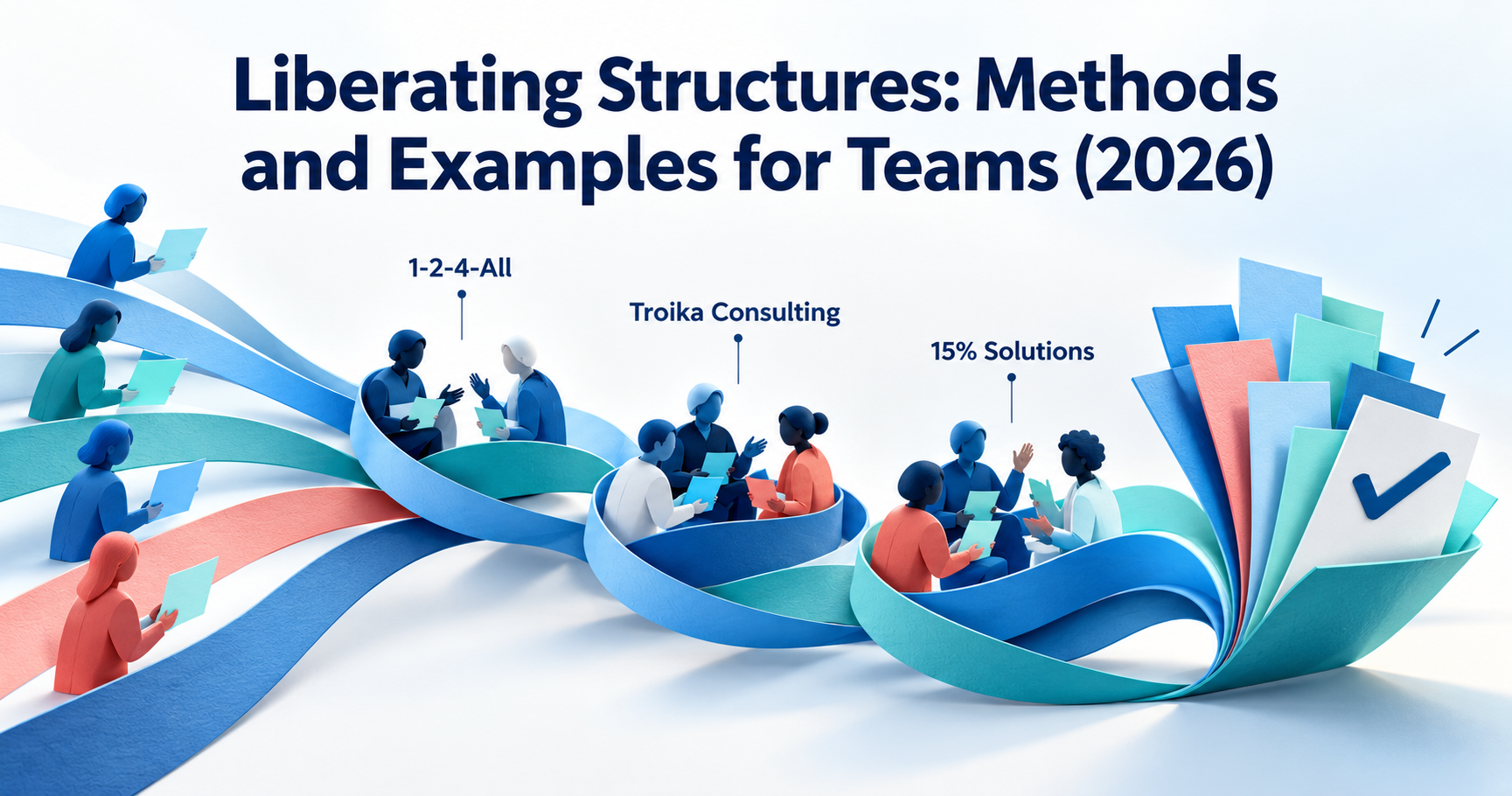
Liberating Structures are practical facilitation methods that give everyone a clear opportunity to contribute. They use focused questions, small groups, and timed steps to help people explore challenges and decide what to do next. Scrum Masters can use them to improve participation, support peer learning, and turn retrospective discussions into workable actions.
Key Highlights of Liberating Structures
- Liberating Structures are a set of 33 facilitation methods created by Henri Lipmanowicz and Keith McCandless.
- They replace long presentations and open-ended discussions with short, structured rounds that include everyone.
- Each & every structure is crafted from five design elements. An invitation, space and materials, how participation is distributed, how groups are configured, and the sequence of steps with timings.
- 1-2-4-All, Troika Consulting, Impromptu Networking, 15% Solutions, What, So What, Now What, and TRIZ are among the most useful for Scrum teams.
- Structures can be combined into "strings" to run a full workshop or Scrum event.
- They support psychological safety by giving quieter people time to think before they speak.
- The methods are free to use and shared under a Creative Commons licence.
Introduction
Picture a typical sprint retrospective.
The Scrum Master asks, "So, what went well this sprint?" Two senior developers answer. Someone nods. The tester who noticed a real problem with the release process says nothing. Forty minutes later, the team leaves with the same action items as last time.
Nobody did anything wrong. The format simply made it easy for a few people to talk and hard for everyone else to join in.
This is the problem Liberating Structures were designed to solve. Instead of asking a whole room an open question and hoping for the best, they give the conversation a small, deliberate shape. People think on their own first. They examine ideas with one other person. Then they create on them in a small group before anything is shared with the room.
The change sounds minor. In practice, it changes who speaks, what gets said, and how much of it turns into action.
In this guide, you will learn what Liberating Structures are and the methods that work best for Scrum Masters, and how to facilitate them step by step. You will also see how to use them in Scrum events, a worked example from a real-style retrospective, and the mistakes to avoid when you start.
What Are Liberating Structures?
Liberating Structures are a collection of simple facilitation methods that change the way groups interact. The original menu contains 33 structures, each with its own purpose, steps, and timings.
The word "structure" can sound restrictive. Here it means something lighter: a small set of rules about who talks to whom, about what, and for how long. Those rules are tight enough to keep the conversation focused but loose enough to let new ideas come through.
A few things make them different from most meeting formats:
- They are short: Many structures take 15-30 minutes.
- They need no special skills: Anyone can learn the basics from a one-page description.
- They scale: The similer structure works for 5 people or 500.
- They produce something: Each one ends with a clear output, such as a list of ideas, a decision, or next steps.
That makes Liberating Structures for teams a practical toolkit rather than a theory.You can use one tomorrow morning in your Daily Scrum without any setup.
Origins With Keith McCandless and Henri Lipmanowicz
Liberating Structures were developed by Henri Lipmanowicz & Keith McCandless. Lipmanowicz spent much of his career as a senior executive at Merck, where he led the company's Intercontinental region. McCandless is a co-founder of the Social Invention Group and has worked for decades with organizations in healthcare, business, and the public sector.
Their work drew on complexity science and on years of experimenting with groups who were stuck in unproductive meetings. They noticed that the problem was rarely the people. It was the way the conversations were organized.
In 2014, they published The Surprising Power of Liberating Structures, which describes the methods in detail. Since then, a global community of practitioners has grown around the approach, especially among Agile coaches and Scrum Masters.
Why They Beat Presentations and Open Discussion
Most organizations rely on five conventional formats. Presentations, managed discussions, status reports, open discussions, & brainstorms. Lipmanowicz and McCandless pointed out that these formats tend to fail in one of two ways.
Some are too controlling. A presentation lets one person speak while everyone else listens. A status report follows a fixed script. Very little new thinking happens.
Others are too loose. An open discussion has no clear question, no timebox, and no way to make sure everyone contributes. The most confident voices take over, and the meeting drifts.
Liberating Structures sit between these two extremes. They give enough shape to keep things moving, and enough freedom for people to bring their own ideas. The result is that more people participate, ideas are tested quickly, and the group leaves with something it can act on.
The Principles Behind Liberating Structures
Liberating Structures rest on ten principles. They include practising deep respect for people and local solutions, learning by failing forward, emphasizing possibilities, and never starting without a clear purpose. Two ideas run through all of them and are worth understanding before you try any of the methods.Scrum.org explains how Scrum teams can benefit from the principles of Liberating Structures.
Include and Unleash Everyone
The first principle is to include and unleash everyone. It means designing the conversation so that every person has a real chance to contribute, not just permission to speak.
There is a difference. In an open discussion, everyone is technically allowed to talk. In practice, introverts, new joiners, and junior members often stay quiet. Liberating structures build in time for each person to reflect alone and then share in a small group, where speaking up feels far less risky.
This is closely tied to Psychological Safety. People are more likely to raise a concern with one colleague than with a room of twenty. Once the idea has been tested in a pair or a small group, it is easier to bring it to everyone.
Distribute Control and Build Trust
In many meetings, control sits with the person running it. They decide who speaks, which ideas get attention, and what the conclusion is.
Liberating Structures spread that control around. Two of the principles capture this well: "amplify freedom and responsibility" and "build trust as you go." The facilitator owns the structure, but the group owns the content. Small groups work in parallel, choose what to bring forward, and shape the outcome themselves.
For a Scrum Master, this fits naturally with the idea of serving the team rather than directing it. If you want to explore that link further, read Why Is ScrumMaster A Servant Leader. Trust grows each time the team sees that its ideas actually shape decisions.
The Five Design Elements of Every Structure
Every Liberating Structure, from the simplest to the most advanced, is built from the same five design elements. Understanding them helps you run any structure well and even adapt one when needed.
- Creating an invitation: the assignment or query you pose to the group. "What is one thing that slowed us down this sprint?" is an example of a clear and open invitation.
- The materials employed and the layout of the space: Sticky notes, a shared web board, small circles of chairs, and no tables.
- The allocation of participation: Each person has an equal opportunity to take part, typically by taking turns and investing their own time.
- Group configuration: One person, two people, three people, four people, or the entire group.
- Time allotment and step sequence: How long does each step take, and what happens in what order?
When a session goes wrong, one of these five elements is usually the cause. A vague invitation, a room set up for a lecture, or a timebox that runs too long can undo even the best structure.
Key Liberating Structures for ScrumMasters
You do not need all 33 structures to get started. A handful of reliable Liberating Structures activities will cover most situations a Scrum Master faces. Here are the six worth learning first, with timings based on the standard descriptions.
1-2-4-All
Liberating Structures 1-2-4-All is the one most people learn first, and for good reason. It works almost anywhere and takes about 12 minutes.
How it works:
- 1 (about 1 minute): Everyone reflects silently on the question and notes their ideas.
- 2 (about 2 minutes): People pair up, share their ideas, and build on each other's thinking.
- 4 (about 4 minutes): Two pairs join to form a group of four. They look for similarities and differences and pick the strongest ideas.
- All (about 5 minutes): Each group shares one important idea with everyone. Repeat until the key ideas are out.
When to use it: Any time you would normally ask the room an open question. For example, "What is getting in the way of finishing stories within the sprint?"
The silent minute at the start is what makes it work. It gives every person something to say before the louder voices set the direction.
Troika Consulting
Troika Consulting gives people practical help from peers in about 30 minutes. It works in groups of three.
How it works:
- One person, the "client," shares a challenge and asks for help (about 2 minutes).
- The two "consultants" ask clarifying questions (about 2 minutes).
- The client turns their back to the group. The consultants discuss the challenge and offer ideas, as if the client were not there (about 4 minutes).
- The client turns around and shares what was most useful (about 2 minutes).
- Everyone switches roles until all three have been the client.
When to use it: When team members are stuck on individual problems, such as handling a difficult stakeholder or improving test coverage. Turning away from the group sounds odd, but it helps the client listen without defending their position.
Impromptu Networking
Impromptu Networking is a quick way to warm up a group and connect people around a shared challenge. It takes about 20 minutes.
How it works: People form pairs and answer two or three questions, such as "What challenge do you bring to this session?" and "What do you hope to get from or give to this group?" Each round lasts about 4 to 5 minutes, and people switch partners for each round, usually for three rounds in total.
When to use it:At the start of a PI Planning event, a large workshop, or a meeting where teams who rarely work together need to connect. It replaces the usual round of introductions, which often takes longer and creates less energy.
15% Solutions
15% Solutions helps people find actions they can take right now, without waiting for permission or budget. It takes about 20 minutes.
How it works:
- Each person reflects alone on the question: "What is your 15%? Where do you have the freedom to act without more resources or authority?" (about 5 minutes).
- In groups of three or four, each person shares their 15% (about 3 minutes each).
- The others ask questions and offer advice to help make the step clearer and more doable.
When to use it: At the end of a retrospective when the team feels that the real problems are "outside our control." It moves the conversation from complaint to action. Small steps also build momentum, which matters for teams that have lost faith in improvement.
What, So What, Now What
What, So What, Now What (often written as W³) helps a group make sense of a shared experience and decide what to do next. A full session usually runs around 45 minutes, though it can be shortened.
How it works: The group moves through three questions in order:
- What? What happened? What did we notice? (facts only)
- So what? Why does it matter? What patterns or conclusions do we see?
- Now what? What actions make sense now?
Each step can use a 1-2-4-All pattern or small group discussion.
When to use it: It maps neatly onto a sprint retrospective or a review of an incident. Separating facts from interpretation stops the team from jumping straight to solutions before they agree on what actually happened.
TRIZ and Other Advanced Structures
TRIZ is a playful but powerful structure that helps a group stop doing things that hurt results. It takes about 35 minutes.
How it works:
- Ask, "What must we do to make sure we get the worst possible result?" Groups list everything they can think of. For example, "How can we guarantee our sprint review is useless?"
- Go through the list and ask, "Is there anything we are currently doing that resembles this?" Be honest.
- Decide on first steps to stop those unwanted behaviours.
The humour lowers defences. People admit uncomfortable truths more easily when they start by joking about the worst case.See Scrum.org’s guide to stopping counterproductive activities with TRIZ.
Once your team is comfortable with the basics, other advanced Liberating Structures techniques are worth exploring:
- Ecocycle Planning to review a portfolio of activities and decide what to grow, sustain, or stop.
- 25/10 Crowd Sourcing to rapidly rank a large number of bold ideas.
- Wicked Questions to surface the paradoxes a team has to manage.
- Min Specs to agree on the minimum rules a team must follow.
- Conversation Café to talk through difficult or emotional topics.
How to Choose a Liberating Structure
With so many Liberating Structures methods to choose from, it is easy to pick one because it looks fun. A better approach is to start with what you need the group to achieve.
Matching the Structure to Your Purpose
Ask yourself one question before every session: "What do I want to be different at the end of this?" Then pick the structure that fits.
| If your purpose is to... | Try this structure | Approx. time |
| Get ideas from everyone on one question | 1-2-4-All | 12 min |
| Help individuals solve a specific problem | Troika Consulting | 30 min |
| Warm up a group and connect people | Impromptu Networking | 20 min |
| Find small actions people can take now | 15% Solutions | 20 min |
| Make sense of a recent event and agree next steps | What, So What, Now What | 45 min |
| Stop habits that hurt results | TRIZ | 35 min |
| Rank a long list of bold ideas | 25/10 Crowd Sourcing | 30 min |
Also consider your group. A new team with low trust may do better with pairs and small groups before trying anything that exposes individuals. A mature team can handle TRIZ, which asks people to admit uncomfortable truths.
Stringing Structures Together (Strings)
One structure rarely covers everything a meeting needs. That is why practitioners combine them into "strings," where the output of one structure becomes the input for the next.
A simple string for a team improvement session might look like this:
- Impromptu Networking to get people talking about the challenges they bring.
- TRIZ to surface the behaviours that are holding the team back.
- 15% Solutions to turn those insights into small actions each person can start right away.
When building a string, think about the flow. Start by opening up ideas, then move toward sorting and choosing, and finish with commitment to action. Keep the total time realistic, and leave a few minutes between structures for the group to settle.
How to Facilitate a Liberating Structure Step by Step
Good Liberating Structures facilitation is less about charisma and more about preparation. The five steps below apply to almost every structure.
Step 1: State the Invitation
The invitation is the question or task the group will work on. It shapes everything that follows, so spend real time on it.
A strong invitation is:
- Specific: "What slowed down our code reviews this sprint?" works better than "Any problems?"
- Open: It cannot be answered with yes or no.
- Relevant: The group cares about the answer.
Write the invitation where everyone can see it, on a flipchart or the top of an online board. Read it out, and check that people understand it before you start the clock.
Step 2: Arrange the Space and Groups
The room sends a message before you say a word. Rows of chairs facing a screen suggest that people should listen. Small circles suggest that they should talk.
For in-person sessions, remove tables where possible and set up chairs in pairs or small clusters. For remote sessions, prepare breakout rooms in advance and set up a shared board for each group.
Decide how you will form groups. Mixing roles, such as developers, testers, and the Product Owner, usually leads to richer conversations than letting people sit with their usual neighbours.
Step 3: Set the Timeboxes
Short timeboxes are central to how Liberating Structures work. They keep energy high and stop any single voice from taking over.
Tell the group exactly how long each round lasts, and stick to it. Use a visible timer or a soft chime. People often want more time, but a tight limit pushes them to focus on what matters most. If a round genuinely needs an extra minute, add it once, rather than letting the session drift.
Step 4: Sequence Individual, Pair, and Group Work
Most structures move from individual thinking to small groups and then to the whole group. This sequence is what makes them inclusive.
Protect the individual step. It is tempting to skip the quiet minute when the room feels energetic, but that minute is what gives quieter people their voice. Then let pairs and small groups do the real work of building and testing ideas. The whole group conversation should be about sharing and comparing, not starting from scratch.
Step 5: Harvest and Act on the Output
A session without a clear output feels like wasted time. Plan how you will capture the results before you begin.
These might be sticky notes grouped on a wall, a ranked list on a digital board, or a short set of actions with owners. Close the session by naming what the group decided and what happens next. Then follow up. If the team sees its ideas turn into real changes, it will engage more fully next time.
Liberating Structures in Scrum Events
Scrum gives teams a clear rhythm of Scrum events, often called Scrum ceremonies. What Scrum does not prescribe is exactly how the conversations inside those events should run. That is where Liberating Structures Scrum practices fit in. They do not replace the events. They make the time inside them more useful.
In the Daily Scrum and Retrospective
The Daily Scrum is only 15 minutes, so keep things light. You will rarely run a full structure here, but the pattern still helps. If the team is stuck on a blocker, try a two-minute version of 1-2-4-All: one minute of silent thinking, then pairs suggest a way forward. It is faster than an open debate and stops one person from deciding for everyone.
The retrospective is where Liberating Structures shine. If you need a refresher on its purpose, see What Is Sprint Retrospective In Agile. A Liberating Structures retrospective might use:
- What, So What, Now What as the overall flow, from facts to insights to actions.
- 1-2-4-All to gather input on a single focused question.
- TRIZ when the team keeps repeating the same problems.
- 15% Solutions to close with small, concrete commitments.
Rotating structures every few sprints also keeps retrospectives from becoming stale, which is a common complaint in mature teams.
In Sprint Planning and Backlog Refinement
If you need a refresher on its purpose, see what a Sprint Retrospective is in Agile. Use 1-2-4-All with the invitation, "What is the most valuable outcome we could deliver this sprint?" The Product Owner brings the business context, and the Developers shape a goal they believe in.
For capacity concerns, 15% Solutions helps people identify what they can realistically commit to without depending on others.
In Backlog Refinement, 25/10 Crowd Sourcing can quickly rank a long list of ideas.Troika Consulting works well when a developer is unsure how to split a large story, one of the common product backlog breakdown strategies. Two colleagues can suggest options in a few minutes, without pulling the whole team into the discussion.
Liberating Structures Example (Worked)
Reading about Liberating Structures examples is useful, but seeing one play out makes it clearer. Here is a 60-minute retrospective for a fictional team of eight.
The situation: A payments team has carried unfinished stories into the next sprint three times in a row. Previous retrospectives produced vague actions like "plan better," and nothing changed. The Scrum Master, Priya, decides to try a string of structures.
Part 1: What, So What, Now What (25 minutes)
Priya opens with the invitation: "Let's look at the last three sprints. What actually happened with the stories we did not finish?"
- What? (8 minutes) Each person writes facts on sticky notes for 2 minutes, then shares them in pairs. The team posts the notes on a timeline. Patterns appear quickly. Most unfinished stories were waiting for code review or for test data.
- So what? (8 minutes) In groups of four, the team discusses why this matters. One group notes that reviews pile up at the end of the sprint. Another points out that test data requests go to a separate team with a three-day turnaround.
- Now what? (9 minutes) The groups share their top insight with everyone. The team agrees to focus on the review bottleneck, because it sits within its control.
Part 2: 1-2-4-All on solutions (12 minutes)
New invitation: "What could we change to get code reviewed within one day?"
After the silent minute, a quiet junior developer suggests a daily 20-minute review slot right after the Daily Scrum. In the open discussions of past retrospectives, she had never spoken up. Her pair builds on the idea, and her group of four brings it forward. It becomes the team's favourite option.
Part 3: 15% Solutions (18 minutes)
Priya asks, "What can you personally do in the next sprint, without asking anyone's permission?" Each person names one small step. One commits to keeping pull requests under 300 lines. Another offers to raise test data requests at Sprint Planning instead of mid-sprint.
Closing (5 minutes): The team records two actions on its board, with owners, and agrees to check them at the next retrospective.
The result: In the following sprint, review wait time drops noticeably, and only one story carries over. Just as important, more people contributed than in any previous retrospective.
Common Mistakes to Avoid
Liberating structures are simple, but simple is not the same as foolproof. These two mistakes cause most sessions to fall flat.
Using a Structure Without a Clear Purpose
Some facilitators learn a new structure and look for a place to use it. The session becomes about the method rather than the problem.
Teams notice this quickly. If they cannot see why they are pairing up or turning their backs, they lose interest and the structure starts to feel like a game.
Always start with the outcome you need, then choose the structure. Tell the group why you picked it, in one sentence. For example: "We'll use TRIZ today because we keep running into the same problems, and I want us to look at them honestly."
Skipping the Individual Reflection Step
When time is short or the room is lively, the silent thinking step is the first thing to go. It feels like dead time.
It is not. That minute is what allows people who think before they speak to form an idea. Without it, the first person to talk sets the direction, and everyone else reacts to them. You are back to an open discussion, just in smaller groups.
Keep the individual step, even if you shorten other parts. Ask people to write their thoughts down, so they have something concrete to share with their partner.
Best Practices for Scrum Masters
The Scrum Masters who get the most from Liberating Structures treat them as a skill to practise, not a toolkit to show off.
Start Small and Build a Repertoire
Pick one structure, such as 1-2-4-All, and use it in several different settings over a few weeks. Try it in a retrospective, a refinement session, and a stakeholder meeting. You will learn more from running one structure five times than five structures once.
Once it feels natural, add a second, such as 15% Solutions or What, So What, Now What. Over a few months, you will have a set of five or six structures you can run with confidence. That is enough to design a full Liberating Structures workshop.
It also helps to practise with other facilitators. Many cities have Liberating Structures user groups, and online communities run regular practice sessions. Structured learning helps as well. Programs like SAFe Scrum Master Certification Training build the facilitation skills you need to run events across teams and at a larger scale.
Debrief and Improve Each Time
Treat each session like a small experiment. Afterwards, take five minutes to ask:
- Was the invitation clear?
- Did everyone contribute?
- Were the timeboxes right?
- Did we get a useful output?
You can also ask the team for quick feedback, using a simple question such as, "What helped, and what should we change next time?" Over time, these small adjustments turn into real facilitation skills, and the team learns to trust the process.
Conclusion
Most meetings do not fail because people lack ideas. They fail because the format lets only a few of those ideas come out.
Liberating structures fix that with small, practical changes: a clear question, a moment of quiet thinking, short rounds in pairs and small groups, and a deliberate way to capture the results. They are free, easy to learn, and work just as well in a 15-minute Daily Scrum as in a full-day workshop.
For Scrum Masters, they are a way to turn routine events into conversations that the whole team owns. Start with 1-2-4-All in your next retrospective. Watch for the people who speak up when they usually stay quiet. Then build from there, one structure at a time.







 Lowest-Price Challenge












 Personalized Path



.webp)


 USA
 Canada
 India
 UK
 Australia
 Singapore


