


 Call Us



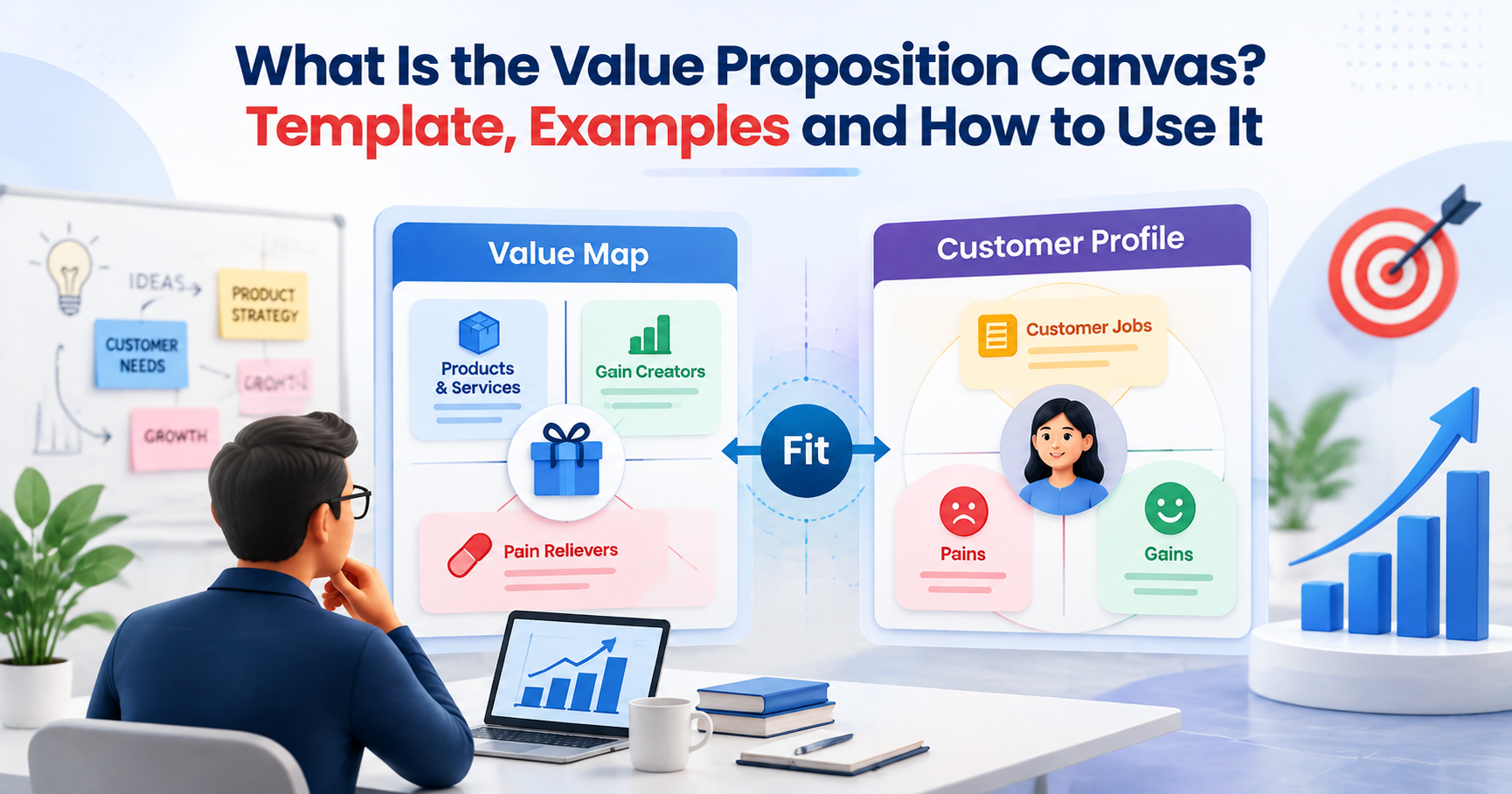
The Value Proposition Canvas is a strategic management tool created by Alexander Osterwalder and his colleagues for building a product or service around what the customer values and needs. It is divided into two parts: the Customer Profile (jobs, pains and gains) and the Value Map (products and services, pain relievers and gain creators).
When companies connect these dots, they find gaps, validate ideas through product discovery, improve their product lines and approach product-market fit. It can be useful for startups building a minimum viable product (MVP) and for established companies refining their product strategy.
Key Highlights of Value Proposition Canvas
- Helps companies to understand customer needs and expectations.
- Links customer challenges to product features and benefits.
- Two building blocks: the Customer Profile and the Value Map.
- Supports product development, customer research and product strategy.
- Can be integrated with the Business Model Canvas and other product management tools
- Helps teams validate assumptions before committing to full-scale development.
Introduction
Imagine you spend six months working on a mobile app. You invest in a beautiful user interface, advanced features, and a marketing campaign, only to find out that customers don’t find it useful enough to pay for. The technology may be perfect but the product doesn’t solve a problem that customers really care about.
This situation is indicative of a common problem in product development: confusing what a business can build with what its customers actually want.
A value proposition canvas can help you close that gap. It suggests that teams should consider customer goals, frustrations and desired outcomes before deciding what to provide, rather than starting with a list of features.
Strategyzer, the organization behind the framework, says that six in ten ideas fail in the real world because teams build something customers don’t want (Strategyzer, Value Proposition Canvas). That figure is Strategyzer’s stated estimate, not a universal failure rate, but it illustrates why the importance of validating customer needs. Strategyzer
In this guide, you’ll learn what the Value Proposition Canvas is, how its two building blocks work, how to fill it in step by step and how to use a practical example to develop a stronger customer-focused offering. You will also discover where to find a free value proposition canvas template, and how product teams can apply the framework in Agile and SAFe environments.
What Is the Value Proposition Canvas?
The Value Proposition Canvas is a tool that helps businesses to understand a specific customer segment and develop products or services around the needs of that segment.
It links the results the customers desire with the solutions the business provides. This makes it easy to see the gaps between what the customer expects and what the product can do.
For example, a company that develops project management software might assume their customers would want more reporting features. Customer research may suggest their bigger concern is knowing which tasks are overdue. That insight could result in a simpler dashboard instead of another set of reports.
Value Proposition Canvas Definition
The Value Proposition Canvas is a visual tool that aligns customer jobs, pains and gains with a company’s products and services, pain relievers and gain creators.
It helps teams answer 2 questions:
- What is the customer trying to do? What are the challenges?
- What does our product do to help them achieve their goals?
The canvas is no guarantee of a successful product. Rather, it gives teams a framework for making assumptions and validating them with real customers.
Where It Came From (Alexander Osterwalder and Strategyzer)
The Value Proposition Canvas was developed by Alexander Osterwalder and his colleagues, including Yves Pigneur and Alan Smith. It is based on the concepts of the Business Model Canvas and was popularised by Strategyzer’s work on value proposition design.
The framework encourages firms to get a sense of what customers need before they spend big on developing products. Teams don’t start with features; they start with customer problems and desired results.
This approach works really well for startups, product managers, business strategists and existing organizations who want to improve existing offerings.
How It Relates to the Business Model Canvas
The Business Model Canvas provides a broader view of how a business creates, delivers, and captures value. It covers nine areas such as customer segments, value propositions, channels, sources of revenue and costs.
The Value Proposition Canvas focuses on two specific areas: customer segments and value propositions.
For example, a company may use the Business Model Canvas to plan its pricing, sales channels, and revenue model. It can then use a Value Proposition Canvas to check if its product is solving the problems of its target customers.
Using both tools helps businesses bridge customer needs with a viable business model.
The Two Building Blocks of the Canvas
The Value Proposition Canvas has two main sections: the Customer Profile and the Value Map.
The Customer Profile explains what matters to customers, while the Value Map shows how a product or service can address those needs. The goal is to find a meaningful connection between the two.
The Customer Profile: Jobs, Pains and Gains
The Customer Profile describes a specific customer segment through three elements.
1. Customer jobs
Customer jobs are the tasks, problems, or needs customers want to address. They can be functional, emotional, or social.
For example, a freelancer may want to send invoices (functional), feel confident about managing finances (emotional), and appear professional to clients (social).
Understanding these jobs helps businesses look beyond basic feature requests.
2. Customer pains
Pains are the difficulties customers face while trying to complete their jobs.
Common examples include:
- Spending too much time on repetitive tasks.
- Dealing with complicated software.
- Paying for features they rarely use.
- Worrying about mistakes or missed deadlines.
- Finding existing solutions too expensive.
Teams should identify which pains matter most instead of treating every complaint as equally important.
3. Customer gains
Gains are the results and benefits customers want. These may include convenience, savings, better performance, or greater confidence.
A freelancer, for example, might want faster invoicing, fewer payment delays, and a clearer picture of monthly income.
Understanding these gains helps businesses focus on outcomes customers value rather than adding features without a clear purpose.
The Value Map: Products, Pain Relievers and Gain Creators
The Value Map describes how a business plans to deliver value through its products and services.
1. Products and services
This section lists what the business offers to help customers complete their jobs.
A finance platform for freelancers might include invoice creation, payment reminders, expense tracking, and financial reports.
These are the building blocks of the offering, but their value depends on how well they address customer needs.
2. Pain relievers
Pain Relievers: How the product alleviates customer pains.
For instance, automated payment reminders can reduce the need for manual follow-ups and invoice templates can help avoid formatting errors.
The best painkillers address problems that customers encounter frequently or find particularly bothersome.
3. Gain creators
Gain creators describe how a product helps customers achieve desired outcomes.
A finance platform might offer reusable client records, cash-flow summaries, and reports that simplify tax preparation.
A feature can act as both a pain reliever and a gain creator. The important thing is to explain how it improves the customer's experience.
Achieving Product-Market Fit With the Canvas
Product-market fit is when the product meets a genuine market need and has enduring customer demand.
The Value Proposition Canvas is a tool that helps teams to connect customer problems with solutions offered. It also makes assumptions visible, giving teams a better idea of what needs testing.
For example, an online learning company might have the assumption that learners want longer lessons. Research may show that it is harder for learners to find time to study. Shorter lessons and tracking progress may be more valuable than longer videos.
What "Fit" Means and How to Recognize It
A strong fit exists when a product addresses problems customers consider important and delivers benefits they value.
However, a completed canvas alone cannot prove product-market fit. Teams need evidence from actual customer behavior.
Look for signals such as:
- Customers regularly describe the problem during research.
- Users adopt the product to complete the intended task.
- Customers return, renew subscriptions, or recommend the product.
- Buyers show willingness to pay.
- Usage and retention improve over time.
The right measures depend on the business model. A subscription service may focus on retention, while an enterprise product may track adoption, contract conversions, and renewals.
How to Fill In the Value Proposition Canvas Step by Step
Knowing how to use the Value Proposition Canvas starts with customer research. The following steps help turn observations into a testable product idea.
Step 1: Map Customer Jobs
Start by choosing one specific customer segment. Avoid combining groups with different needs into a single profile.
For example, freelancers and large enterprises may use the same accounting software, but their budgets, workflows, and compliance requirements differ.
Use interviews, surveys, customer feedback, product analytics and other product discovery techniques to understand what your target customers want to accomplish.
Ask questions such as:
- What are you trying to achieve?
- How do you handle this task today?
- What makes it difficult?
- What would a successful outcome look like?
Record functional, emotional, and social jobs, then prioritize the most important ones.
Step 2: List Pains and Gains
Understand your customers’ pains and gains.
For pains, think of wasted time, high costs, complexity, risks, and unreliable results. Consider the benefits: convenience, savings, confidence and better performance.
Use an online grocery service. Customers may face issues with delayed deliveries, unavailability of products and limited delivery slots. They may want reliable timings and accurate stock information and easier shopping.
Put these pains and gains in order of importance. Differentiate between untested assumptions and customer research-based findings.
Step 3: Describe Your Products and Services
List the products and services that could help customers complete their jobs.
For the grocery service, these might include:
- A searchable product catalog.
- Updated stock information.
- Scheduled delivery.
- Saved shopping lists.
- Order tracking.
At this stage, focus on what the business offers rather than making promotional claims.
If the product is still being developed, treat proposed features as hypotheses that need validation.
Step 4: Design Pain Relievers and Gain Creators
Connect each important customer pain or gain to a specific product capability.
For example:
- Pain: Customers discover that products are unavailable after ordering.
- Pain reliever: Display stock updates and suggest alternatives.
- Gain: Customers want a faster shopping experience.
- Gain creator: Let shoppers save frequently purchased items and reorder them quickly.
Ask why each feature matters to the customer. If the team cannot explain the connection, the feature may not deserve priority.
Focus on a few meaningful improvements rather than trying to solve every problem at once.
Step 5: Test and Validate the Fit
The final step is to test whether the canvas reflects real customer needs.
Useful methods include:
- Customer interviews to understand problems.
- Clickable prototypes to test usability.
- Landing pages to measure interest.
- Pilot programs to observe actual usage.
- Pricing tests to explore willingness to pay.
- A minimum viable product (MVP) to test the core offering.
Set clear success criteria before each experiment. Depending on the product, these could include sign-up rates, task completion, repeat usage, or paid conversions.
Use the results to update the canvas. If customers do not respond as expected, reconsider the problem, target segment, or solution.
Value Proposition Canvas Example (Walkthrough)
Imagine a fictional startup that is building a meal planning app for busy professionals. It aims to help customers plan healthy meals without spending hours searching for recipes and compiling shopping lists.
The following example of the value proposition canvas shows how the startup could link its offering to customer needs.
Customer Segment: Professionals seeking convenient weekday meals.
| Customer Profile | Example |
| Customer jobs | Plan meals and organize grocery shopping |
| Customer pains | Limited time, repetitive meals, food waste |
| Customer gains | Faster planning, more variety, easier shopping |
The startup then develops its Value Map.
| Value Map | Example |
| Products and services | Meal-planning app, recipes, shopping lists |
| Pain relievers | Weekly plans and ingredient-based suggestions |
| Gain creators | Personalized recommendations and reusable plans |
How the two sides fit together
For example, let’s say the interviews reveal the biggest frustration is what to cook after work. The startup could focus on fast weekly planning, not immediate advanced nutrition analytics.
The app can suggest recipes that use common ingredients and generate consolidated shopping lists if customers also find they throw away ingredients.
The team could test a simple prototype on 20 target users. It could tell you how many complete a weekly plan, what steps are difficult, and if they want to use the tool again.
Twenty participants can give useful early usability feedback but this small group would not be representative of the market as a whole. A paid pilot down the line could help gauge willingness-to-pay.
The team will be able to refine the product based on what customers do and say. So the main benefit of the Value Proposition Canvas is that it connects customer needs to product decisions and gives teams a practical way to test assumptions.
Value Proposition Canvas Template and Tools
A value proposition canvas template provides a ready-made structure for recording customer jobs, pains, gains, products and services, pain relievers, and gain creators.
You can use a printable worksheet, a digital whiteboard, or a spreadsheet. Choose a format that your team can update as new customer insights emerge.
For a free value proposition canvas template, start with Strategyzer's official resource:
Download the Value Proposition Canvas template
The page provides access to Strategyzer's template resources. Check the current download options and terms before use.
A value proposition canvas PDF is useful for workshops and printed exercises. Digital templates are often more convenient for remote teams.
Other useful tools include:
- Miro or Mural: For collaborative workshops and visual mapping.
- Google Sheets or Excel: For documenting customer findings and ranking priorities.
- Research repositories: For organizing interview notes and customer feedback.
- Product analytics tools: for checking how customers use the product, using sound data analysis methods.
Keep track of the target customer segment and distinguish verified findings from assumptions. The canvas should evolve as you learn more about your customers.
Value Proposition Canvas vs Business Model Canvas
Both frameworks support business planning, but they address different questions.
| Comparison | Value Proposition Canvas | Business Model Canvas |
| Main focus | Customer needs and product value | The overall business model |
| Structure | Customer Profile and Value Map | Nine building blocks |
| Key question | How does our offering help customers? | How does the business create and capture value? |
| Common use | Product design and customer validation | Business planning and strategy |
| Main outcome | A clearer value proposition | A broader view of business operations |
For example, a fitness app company might use the Value Proposition Canvas to understand why beginners abandon workout plans and what would help them stay motivated.
It could then use the Business Model Canvas to examine subscription pricing, customer acquisition, partnerships, operating costs, and revenue.
Use the Value Proposition Canvas when you need to understand customer needs in greater detail. Use the Business Model Canvas when you need to evaluate the wider business. The two work well together.
Using the Canvas in Agile and SAFe Product Work
Teams practising Agile product development build incrementally, using feedback to improve what they deliver.
The Value Proposition Canvas supports this approach by connecting development decisions to customer problems.
In SAFe, product managers, product owners, and development teams can use customer insights to guide priorities and evaluate whether new features deliver meaningful value.
Professionals who want to strengthen their product management knowledge can explore SAFe POPM Certification Training.
Feeding Insights Into the Backlog and Roadmap
Canvas findings can help teams turn customer problems into product opportunities, backlog items, and roadmap priorities, and prioritize the product backlog around real customer value.
For example, research may show that new users struggle to complete account setup. The team could propose guided onboarding and test whether it improves completion rates.
A practical workflow is:
- Identify the customer problem.
- Connect it to a job, pain, or gain.
- Propose a solution.
- Define a measurable outcome.
- Test the solution and review the results.
This keeps the focus on customer outcomes instead of simply counting delivered features.
A customer journey map can complement the canvas by showing where customers encounter problems throughout discovery, purchase, onboarding, and continued use.
Customer Centricity for Product Owners and Product Managers
Product managers and product owners use customer insights in different ways, but they also work together.
The canvas can be used by product managers to assess market needs, define product positioning and guide strategic priorities. PProduct owners can use these findings to improve user stories, acceptance criteria and backlog items.
Customers abandon carts at checkout saying delivery fees are too high, so the product manager may decide to focus on transparency around pricing. Then the product owner can help to define and prioritize the changes to fix the problem.
The duties differ from one organization to another. For more information, learn about SAFe POPM roles and responsibilities.
Teams can also connect canvas findings to their broader product strategy to ensure that customer needs inform product positioning, investment, and long-term priorities.
Common Mistakes to Avoid
The canvas is easy to draw, but using it effectively requires research and regular review. Watch out for these common mistakes.
1. Treating assumptions as facts
Teams may assume they know what customers want. Validate important assumptions through interviews, observation, and experiments.
2. Mixing different customer segments
Customers can have very different needs and expectations. Create separate profiles when those differences matter.
3. Neglecting emotional and social needs
Customers want things done, but they want more. You can also make decisions based on confidence, convenience and professional reputation.
4. Features, not benefits
A feature is what the product does. The benefit explains why it's important to the customer.
5. Attempting to solve all the problems
Concentrate first on the pains and gains that matter most. Trying to do everything can make the product unfocused.
6. Alternative Unawareness
Customers may be using competitors, spreadsheets, manual processes or nothing. Learn these options before you claim differentiation.
7. Not validating
A completed canvas isn’t proof of product-market fit. Test your ideas using prototypes, customer behavior, and purchase decisions.
8. Not refreshing the canvas:
Customer needs are changing. When new research or product feedback challenges past assumptions, go back to the canvas.
9. Forget about business viability
A good product must also be useful to deliver. Look at pricing, costs, distribution and revenue potential, and also look at customer value.
Avoiding these mistakes helps teams use the canvas as an ongoing decision-making tool rather than a one-time workshop exercise.
Conclusion
The Value Proposition Canvas enables businesses to match customer needs with the value their products provide. With jobs, pains and gains, and products, pain relievers and gain creators, teams can make better decisions on developing and positioning the product.
Take one customer segment and find out what is the most important needs for them and test if your proposed solution addresses them. Templates provide structure but it is customer research and real-world feedback that makes the process useful.
Whether you’re building a minimum viable product or improving an existing product, keep your focus on solving problems that your customers really care about.








 Lowest-Price Challenge











 Personalized Path


.webp)


 USA
USA  Canada
  India
India  UK
UK  Australia
  Singapore


