


 Call Us




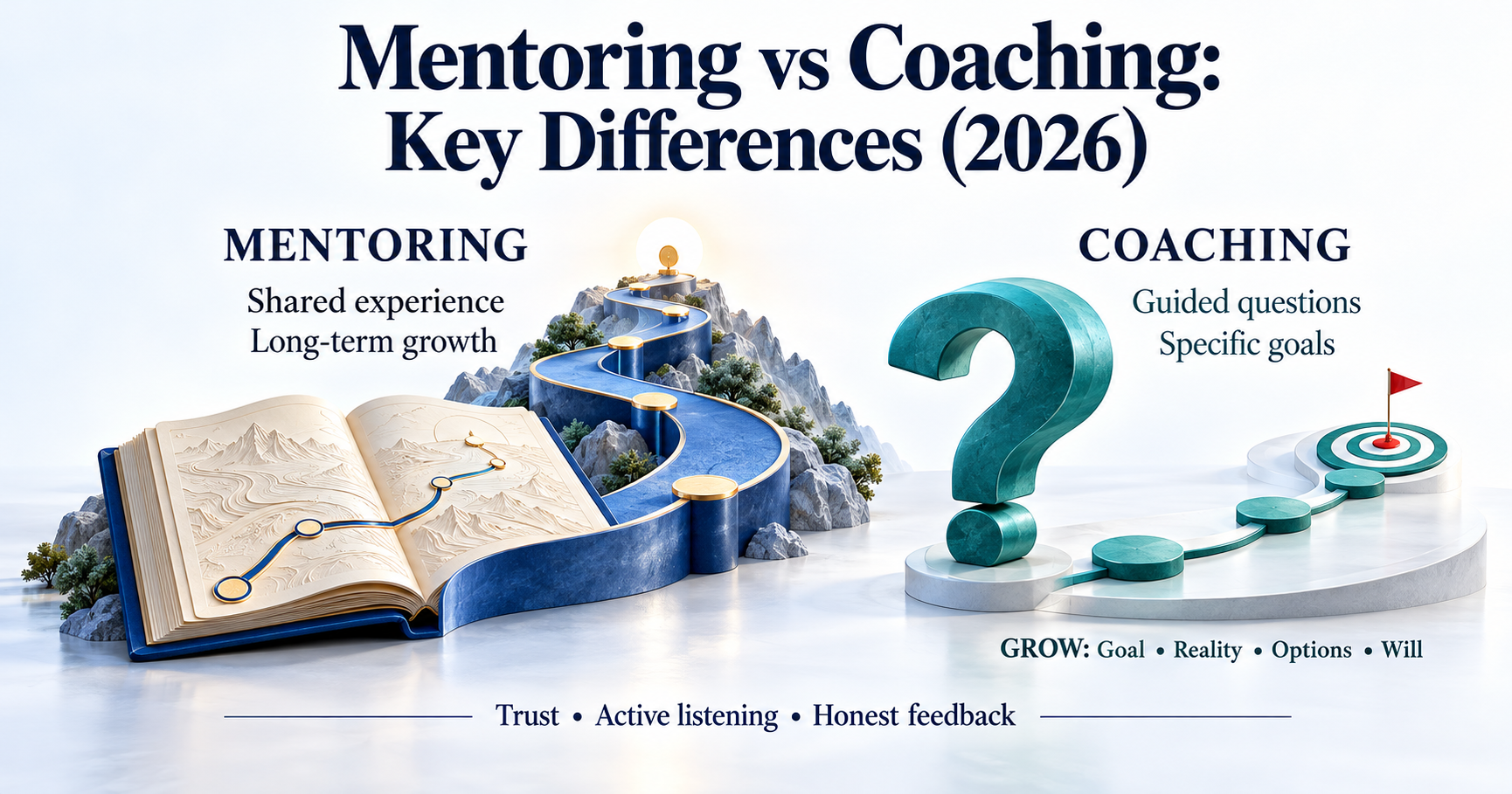
The main mentoring vs. coaching difference is how development is supported. Mentoring applies relevant experience to guide broader professional development. Coaching uses questions, self-reflection, and agreed-upon actions to help someone reach a goal. Coaches usually help people to find their own answers. Mentors tend to give direction. Both strategies can be useful for both short-term problems and long-term growth.
Key Highlights of Mentoring vs Coaching
- Mentoring is about long-term development. The mentor passes on knowledge, perspective and career advice from their own path.
- Coaching is about a specific goal or skill. The coach asks questions and guides the person to their own solutions.
- A mentor vs coach differs in expertise. A mentor needs deep experience in your field, while a coach needs strong questioning and listening skills.
- Coaching vs mentoring also differs in structure. Coaching often runs in planned sessions over weeks or months. Mentoring can last years and is often more relaxed.
- Mentoring and coaching share core skills such as active listening, trust and honest feedback.
- The GROW Coaching Model (Goal, Reality, Options, Will) is one of the most widely used frameworks for running a coaching conversation.
- Scrum Masters use both. They coach teams toward self-management and mentor people who are new to Agile and Scrum.
Introduction
A new team leader asks, “How do I handle a stakeholder who keeps changing priorities?”
You could share how you handled a similar situation. You could also ask what the leader has tried, which conversations they are avoiding, and what outcome they want. Both responses may help, but they serve different needs.
Understanding mentoring vs coaching helps you choose your response deliberately. It matters for managers developing employees, professionals seeking support, and Scrum Masters helping teams become more capable.
This guide explains the differences through practical workplace situations. The examples are illustrative, so you can adapt them to your own team rather than treat them as fixed scripts.
What Is Mentoring?
Definition and Purpose
Mentoring is a development relationship in which a more experienced person guides a less experienced person. The mentor shares what they have learned through their own career: the wins, the mistakes and the shortcuts nobody writes down.
The purpose is broad growth over time. A mentee might want help with career choices, office politics, confidence, industry knowledge or building a professional network. The topics shift as the mentee's career moves forward.
In short, mentoring answers the question: "What would someone who has been here before do?"
The Mentor's Role and Relationship
A mentor acts as a guide, sounding board and sometimes an advocate. They tell stories, offer opinions, open doors and point out risks the mentee may not see yet.
The relationship is usually:
- Mentee-driven. The mentee brings topics and decides what they want help with.
- Informal. Meetings may be a monthly coffee, a quick call or a chat after a meeting.
- Long-term. Many mentoring relationships last a year or more. Some last a whole career.
- Personal. Trust builds over time, so conversations often go beyond the current job.
Mentors are often outside the mentee's reporting line. That distance helps. A mentee can admit doubts to a mentor that they might not share with their manager.
When Mentoring Works Best
Mentoring works best when someone needs knowledge and perspective they cannot easily get on their own. Common situations include:
- A new hire learning how the company really works
- A professional moving into a new role, such as a developer stepping into the Scrum Master role
- Someone planning a career change or a promotion
- A first-time manager facing people issues for the first time
- High-potential employees being prepared for leadership
In each case, the person benefits from hearing how someone else handled the same road.
What Is Coaching?
Definition and Purpose
Coaching is a focused, structured conversation that helps a person improve performance or reach a defined goal. The coach does not hand over answers. Instead, they ask open questions, reflect back what they hear and help the person think more clearly.
The Coach's Role and Relationship
A coach acts as a thinking partner. Their job is to help the person see their situation clearly, explore choices and take ownership of the next step.
The relationship is usually:
- Goal-driven: Each coaching engagement starts with a clear objective, such as running better stakeholder meetings or managing time across two projects.
- Structured: Sessions follow a pattern, often guided by a framework like GROW.
- Time-bound: A coaching program may run for six sessions or three months, then end once the goal is met.
- Non-directive: The coach avoids telling people what to do, even when they have an opinion.
Coaches can be internal (a manager, HR partner or Agile coach) or external (a hired professional).Their value comes from the process, not from knowing your job better than you do.
When Coaching Works Best
Coaching works best when a person already has the basic knowledge and ability, but something is holding them back. Typical situations include:
- An experienced team member whose performance has dipped
- A leader working on a specific behavior, such as delegating or giving feedback
- A team that keeps hitting the same problem every sprint
- Someone facing a tough decision with no clear right answer
- A person who needs to build confidence in skills they already have
If the person can solve the problem with a little structured thinking, coaching is often the faster and more lasting route.
Mentoring vs Coaching: Side-by-Side Comparison
Now that both terms are clear, let's put them next to each other. This mentoring vs coaching comparison looks at four areas where the two approaches differ most.
Focus: Long-Term Growth vs Specific Goals
Mentoring looks at the whole person and the whole career. A single mentoring chat might move from a tricky client email to whether the mentee should apply for a team lead role next year.
Coaching narrows in on one goal at a time. If the goal is "run shorter, more useful Daily Scrums," the coaching sessions stay on that topic until it is solved.
Approach: Advising vs Asking
This is the clearest mentoring vs coaching difference. Mentors tell. Coaches ask.
A mentor might say, "When I had a difficult stakeholder, I set up a weekly 15-minute check-in. It cut the surprise requests in half."
A coach might ask, "What do you think is driving this stakeholder's behavior? What have you already tried? What else could you try?"
Neither is better. Advice saves time when the person lacks experience. Questions build ownership when the person has the ability but needs clarity.
Expertise: Domain Knowledge vs Process Skill
A mentor needs real experience in the mentee's field. A junior data analyst gains little from a mentor who has never worked with data.
A coach does not need to be a subject expert. Their expertise lies in the coaching process itself: asking powerful questions, listening without judging and holding people accountable. That is why the mentoring vs coaching skills list looks different, even though some skills overlap.
Duration and Structure Compared
Mentoring tends to be long, loose and flexible. There may be no fixed agenda and no end date.
Coaching tends to be shorter and more planned. Sessions usually have a clear start, a defined goal and a way to measure progress. Once the goal is reached, the engagement often ends or moves to a new goal.
A Full Comparison Table
Here is a quick reference that sums up the mentoring and coaching differences.
| Factor | Mentoring | Coaching |
| Main focus | Long-term career and personal growth | Specific goal, skill or performance issue |
| Main approach | Sharing advice, stories and experience | Asking questions and guiding self-discovery |
| Who sets the agenda | Mentee, often loosely | Coachee and coach, with a clear goal |
| Expertise needed | Deep experience in the mentee's field | Skill in the coaching process |
| Typical duration | Months to years | Weeks to a few months |
| Structure | Informal, flexible | Structured sessions, often using a model like GROW |
| Relationship | Personal, built on shared background | Professional, focused on the goal |
| Measuring success | Broad career progress, confidence, network | Progress against the agreed goal |
| Best for | New roles, career moves, building judgment | Performance gaps, behavior change, decision-making |
| Typical question | "Here's what worked for me…" | "What options do you see?" |
Where Mentoring and Coaching Overlap
The differences are real, but mentoring and coaching are not opposites. They sit on the same spectrum, and good practitioners move along it.
Shared Skills of Listening and Trust
Both approaches fail without trust. A mentee will not share career worries with a mentor they think might gossip. A coach will not admit what is really blocking them if they feel judged.
The core skills both roles need include:
- Active listening: Hearing what is said, and noticing what is left out.
- Curiosity: Asking follow-up questions instead of jumping to conclusions.
- Honest feedback: Saying the uncomfortable thing kindly and clearly.
- Confidentiality: Keeping private conversations private.
- Patience: Letting growth happen at the person's pace.
These shared skills are why a great mentor often makes a decent coach, and the other way around.
Blending Both in One Relationship
In practice, most workplace relationships mix both styles. A mentor may switch into coaching mode by asking, "Before I share what I did, what are you thinking?" A coach may briefly step out of the coaching role to offer a resource: "Would it help if I shared a technique some teams use?"
The key is to be open about the switch. Saying "I'm going to put on my mentor hat for a minute" keeps the person clear about whether they are hearing advice or being asked to think for themselves. Then hand the decision back to them.
Mentoring and Coaching Examples
Theory only goes so far. These two mentoring vs. coaching examples show how each approach plays out in the workplace.
A Mentoring Example
Priya has been a software tester for four years. Her company is moving to Scrum, and she has been asked to step into the Scrum Master role. She is excited but unsure where to start.
Her manager connects her with Rahul, who has been a Scrum Master for eight years. They agree to meet every two weeks for six months.
In their first meetings, Rahul:
- Explains how he handled his first Sprint Retrospective, which went quiet because nobody trusted the process yet
- Shares the books and communities that helped him most
- Tells her which stakeholders are likely to push back and how he built relationships with them
- Suggests she observe two other teams' Sprint Reviews before running her own
Later, the conversations widened.Priya asks whether she should pursue a SAFe certification and how to move toward an Agile coach role someday, a path explained in Agile coach vs Scrum Master.
Rahul shares his own career path and the trade-offs he faced.
This is classic mentoring vs. coaching in the workplace: Rahul is giving Priya the benefit of his experience so she can avoid mistakes and grow faster.
A Coaching Example (Using GROW)
The GROW Coaching Model is a four-step framework that gives coaching conversations a simple structure. It was popularized in the 1980s by Sir John Whitmore and colleagues, and it remains one of the most common coaching tools today.
The four stages are:
| Stage | Purpose | Sample questions |
| G – Goal | Agree on what the person wants to achieve | "What would you like to get out of this conversation?" |
| R – Reality | Explore the current situation honestly | "What is happening right now? What have you tried?" |
| O – Options | Generate possible ways forward | "What could you do? What else?" |
| W – Will (Way Forward) | Commit to specific actions | "Which option will you take, and by when?" |
Now let's see the GROW coaching model in action.
Arjun is a senior developer. He is skilled, respected and usually reliable. Lately, though, he has been missing sprint commitments. His team lead, Meera, decides to coach rather than advise, because Arjun clearly has the ability.
Goal
Meera: "What would you like to focus on today?"
Arjun: "I keep running out of time in the sprint. I want to finish my stories without working late."
Meera: "What would success look like by the end of the next sprint?"
Arjun: "Finishing everything I commit to, with no evening work."
Reality
Meera: "Walk me through a normal day right now."
Arjun: "I start coding, then people message me with questions. I also review most of the pull requests because I know the codebase best."
Meera: "Roughly how much of your day goes to reviews and questions?"
Arjun: "Honestly, maybe half."
Options
Meera: "What could you change?"
Arjun: "I could block two hours each morning for focused work. I could ask the team to share reviews. Maybe I could run a short session so others learn the tricky parts of the codebase."
Meera: "Anything else?"
Arjun: "I could raise it in the Retrospective so the whole team sees the bottleneck."
Will
Meera: "Which of these will you start with?"
Arjun: "I'll block focus time starting tomorrow, and I'll bring the review issue to Friday's Retrospective."
Meera: "How will we know it's working?"
Arjun: "If I finish my stories this sprint without late nights."
Notice that Meera never told Arjun what to do. He found the root cause himself and chose his own actions, which makes him far more likely to follow through. That is the heart of coaching.
How to Choose Between Mentoring and Coaching
Knowing when to use mentoring vs. coaching is a skill in itself. The right choice depends on two things: what the person needs, and how ready they are to solve the problem on their own.
Matching the Method to the Need
Start by asking: Does this person lack knowledge, or do they have the knowledge but need clarity, focus or confidence?
| If the person… | Lean toward | Why |
| Is new to a role, team or industry | Mentoring | They need context and experience they don't have yet |
| Wants long-term career direction | Mentoring | Broad guidance from someone further along helps most |
| Has the skills but is stuck on a specific problem | Coaching | Questions unlock thinking they're already capable of |
| Needs to change a habit or behavior | Coaching | Self-chosen actions are more likely to stick |
| Faces an urgent issue with real risk | Mentoring or direct advice | There may be no time for slow self-discovery |
| Is preparing for a leadership role | Both | They need experience to learn from and room to build judgment |
Reading the Person's Development Level
The Situational Leadership model, developed by Paul Hersey and Ken Blanchard, offers a useful lens here. It suggests that people move through stages of competence and commitment on any given task, and that leaders should adjust their style to match.The Ken Blanchard Companies explain the model in A Situational Approach to Effective Leadership.
A simple way to apply this to coaching vs mentoring:
- Beginner, eager but inexperienced: Use more mentoring and direct guidance. Share examples, explain the steps and check in often.
- Learning, but discouraged: Mix both. Offer advice on technique and use coaching questions to rebuild confidence.
- Capable, but unsure or inconsistent: Coach. They have the know-how; help them trust it.
- Skilled and confident: Coach lightly or step back. Ask questions only when they want a sounding board.
Mentoring and Coaching for Scrum Masters
Few roles use both approaches as often as the Scrum Master. “The Scrum Guide describes the Scrum Master as a leader who serves the Scrum Team and the wider organization, and it lists coaching team members in self-management and cross-functionality as a core part of the job.
That service-first stance is why many people ask whether a Scrum Master is a servant leader. A servant leader does not command. They help others grow, remove blockers and build an environment where people can do their best work. Coaching and mentoring are the two main tools for doing that.
When the Scrum Master Coaches
A Scrum Master coaches when the team or an individual already has the capability but needs to think more clearly or take ownership.
Scenario: The silent Retrospective. A team's Retrospectives have become flat. People say "everything was fine" and leave. Instead of listing improvement ideas, the Scrum Master asks:
- "If this sprint were a weather forecast, what would it be, and why?"
- "What is one thing that slowed you down that we haven't talked about?"
- "What small experiment could we try next sprint?"
The team names the real issue, unclear acceptance criteria, and agrees on its own fix. Because they chose it, they own it.
Scenario: The Product Owner under pressure. A Product Owner feels overwhelmed by stakeholder requests. The Scrum Master uses GROW to help her define her goal (a clearer backlog), explore reality (three stakeholders bypassing her), list options and commit to a weekly backlog review with stakeholders.
When the Scrum Master Mentors
A Scrum Master mentors when people lack knowledge or experience of Agile ways of working.
Scenario: The new team. A team has just moved from a traditional project setup to Scrum.Asking “How do you think we should run Sprint Planning?” would only confuse them. would only confuse them. Here the Scrum Master teaches the events, explains the purpose of each artifact and shares stories from past teams.
Scenario: The aspiring Scrum Master. A developer on the team wants to become a Scrum Master. The current Scrum Master shares what the role really involves, suggests training such as SAFe Scrum Master Certification Training for those working in scaled Agile environments, and invites them to co-facilitate a Daily Scrum.
Growing Team Self-Management
The long-term aim for a Scrum Master is a team that needs them less over time. That shift usually follows a pattern:
- Early stage: More mentoring and teaching, because the team is learning Scrum.
- Middle stage: A blend, with the Scrum Master asking more and telling less.
- Mature stage: Mostly coaching, with the team solving its own problems and the Scrum Master focusing on the wider organization.
This mirrors many classic Servant Leadership Examples. Here are a few servant leadership examples a Scrum Master might show in a single week:
- Taking on the task of chasing a delayed security approval so developers can keep coding
- Asking the quietest team member for their view first in Sprint Planning
- Letting the team choose its own working agreements rather than imposing rules
- Shielding the team from mid-sprint scope changes and redirecting them to the Product Owner
- Celebrating the team's wins in the Sprint Review instead of taking the credit
In each case, the leader's focus is on the team's growth and success, which is exactly what good mentoring and coaching support is.
Common Mistakes to Avoid
Even experienced leaders mix up the two approaches. These are the two mistakes that cause the most damage.
Giving Advice When Coaching Is Needed
This is the most common trap, especially for managers who were promoted because they were great at the work itself. When someone brings a problem, the instinct is to solve it.
The cost is hidden but real:
- The person learns to bring every problem to you instead of thinking it through
- Your solution may not fit their situation as well as one they create
- People commit less to plans they did not shape
- You become a bottleneck for the whole team
Workplace example: A Scrum Master hears that two developers disagree on a technical approach. She jumps in and picks one. The losing developer feels overruled, and the next disagreement comes straight back to her. A coaching approach would have built the team’s ability to resolve disagreements, a skill practised in the Conflict Management Skills microcredential.
How to avoid it: Before giving advice, pause and ask one open question first. If the person has a good answer, you have saved them from dependence on you.
Coaching When People Need Direction
The opposite mistake is just as harmful. Some leaders fall so in love with asking questions that they refuse to share what they know, even when someone is clearly out of their depth.
Workplace example: A new team member is asked, "How do you think we should estimate this story?" on his second day. He has never heard of story points.
The question doesn't empower him; it embarrasses him.
Signs that someone needs mentoring or direct guidance instead:
- They have no prior experience with the task
- They are visibly anxious or confused by open questions
- The situation is urgent or high-risk
- They have asked you directly for your advice
How to avoid it: Teach first, then coach. Once the person has the basics, shift gradually toward questions.
Best Practices for Mentoring and Coaching
Whether you are a mentor, a coach or a leader who plays both roles, these habits make your support more useful.
- Agree on the type of support upfront: Ask, "Do you want my advice, or would it help more if I asked questions?" This one question clears up most confusion.
- Set clear expectations: Agree on how often you will meet, what topics are in scope and how you will measure progress.
- Listen more than you speak: In coaching, aim for the other person to do most of the talking. In mentoring, ask about their situation before telling your story.
- Use a simple framework: The GROW coaching model keeps coaching sessions focused. For mentoring, a short agenda (wins, challenges, one question) works well.
- Share stories, not rules: Mentors are most helpful when they explain the context behind their advice, so the mentee can judge whether it applies to them.
- Let the person own the actions: Even in mentoring, the final decision belongs to the mentee.
- Follow up: Check in on the commitments made in the last session. Accountability is where much of the progress happens.
- Keep confidence: What is said in a mentoring or coaching conversation stays there unless there is a safety issue.
- Build your own mentoring vs coaching skills: Practice open questions, get feedback on your style, and consider formal training such as ICAgile Certified Coach (ICP-ACC).
- Know when to refer: If an issue goes beyond your skill, such as serious stress or a conflict involving HR, connect the person with the right support.
Conclusion
The debate around mentoring vs coaching is not about which one is better. It is about which one fits the moment.
Mentoring shares experience to support long-term growth. Coaching asks questions to unlock a person's own thinking and reach a specific goal. Mentors need deep domain knowledge. Coaches need strong process skills. Both depend on trust, listening and genuine care for the other person's success.
The best leaders, and the best Scrum Masters, read the situation and switch styles with intention. They mentor when someone is new and needs direction. They coach when someone is capable and needs clarity. Over time, they help people and teams grow to the point where they can stand on their own.
If you want to build these skills inside an Agile setting, structured learning can speed things up. Simpliaxis offers SAFe Scrum Master Certification Training that covers facilitation, coaching and servant leadership for teams working at scale.







 Lowest-Price Challenge












 Personalized Path



.webp)


 USA
 Canada
 India
 UK
 Australia
 Singapore


