


 Call Us



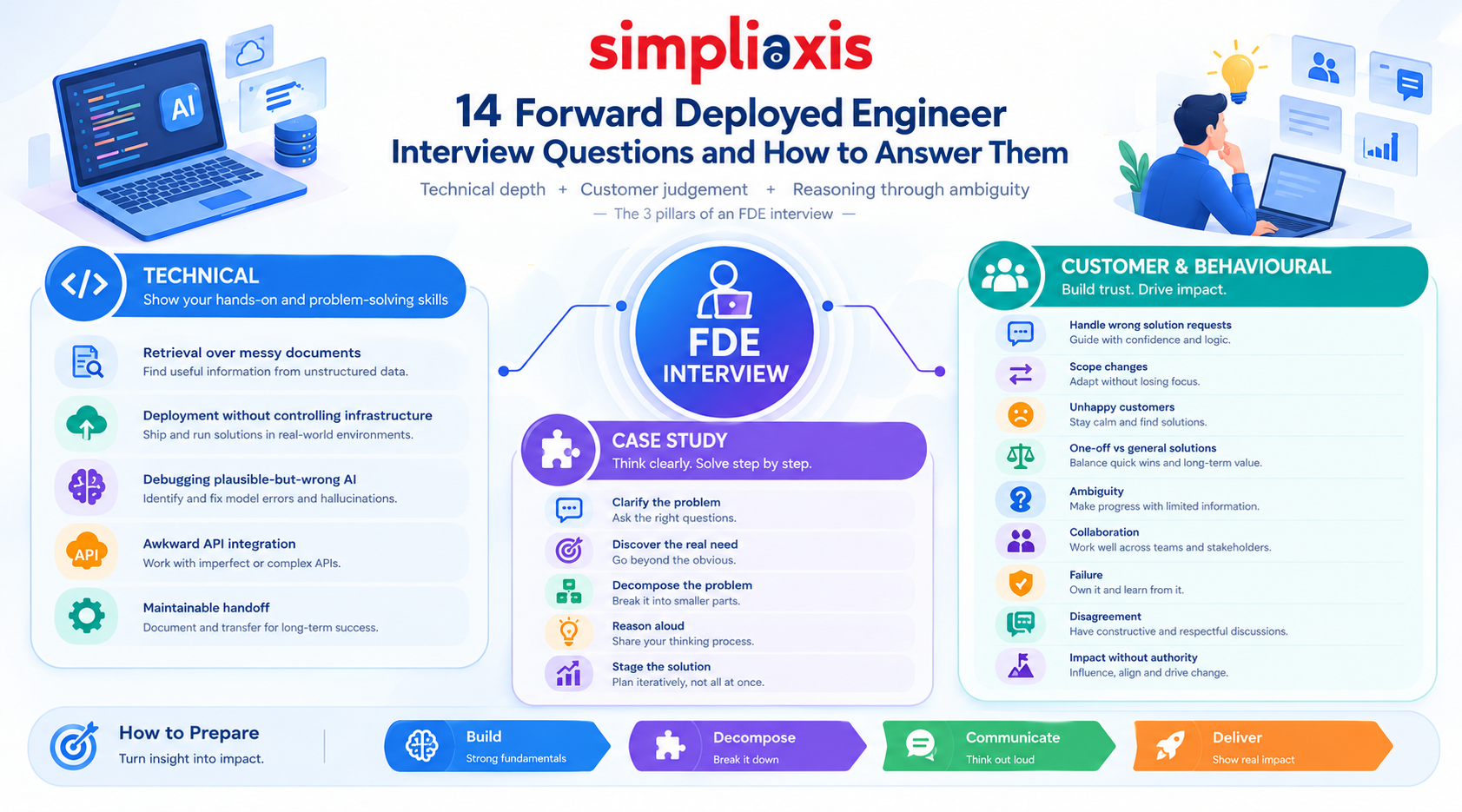
The forward deployed engineer interview looks almost nothing like a standard software engineering loop, and candidates who prepare for it like one tend to fail. Roughly half the process is not coding at all but case studies, stakeholder scenarios, and business judgement, because the role is tested on customer-facing reasoning as heavily as on technical skill. This piece walks through fourteen questions that capture what these interviews actually probe, across the technical, the case study, and the behavioural dimensions, and explains what a strong answer demonstrates. It is not a list to memorise but a map of what the interview is really testing, so you can prepare for the right thing.
Preparation matters more here than in most interviews, because the loop is unusual and rigorous, and genuine capability across the full span of the role is what it surfaces. Building that capability through the Forward Deployed Engineering Program is the real preparation, because these questions test whether you can actually do the job, not whether you memorised answers.
Key Highlights
- The forward deployed interview weights technical depth, customer-facing judgement, and reasoning through ambiguity in roughly equal measure, unlike a standard coding loop.
- About half the process is case studies, stakeholder scenarios, and business judgement rather than coding, which surprises candidates who prepare only technically.
- The signature round is a 45 to 60 minute ambiguous case study where a vague customer problem must be decomposed into a plan, and it carries heavy weight.
- The loops differ by company, with Palantir weighting data engineering and decomposition and the AI labs weighting production LLM systems.
- The questions test whether you can actually do the job, so genuine capability beats memorised answers.
What the interview actually tests
Before the questions, it helps to understand what the forward deployed interview is really probing, because it is different from a standard software loop and preparing for the wrong thing is the most common mistake. The process, which typically runs several weeks through a recruiter screen, technical rounds, a case study, and behavioural evaluation, tests three things in roughly equal weight: technical depth, the ability to work with customers and exercise judgement, and the ability to reason out loud through ambiguity. Only about half of it is coding.
This balance reflects the role itself, which is technical but also deeply customer-facing and full of ambiguity. A candidate who is a strong coder but cannot reason through a vague customer problem, communicate with stakeholders, or handle ambiguity will struggle, because those are core to the job. So the interview deliberately surfaces all three dimensions, and preparation has to cover all three rather than just the technical. Understanding this shape is the first step, because it tells you to prepare for case studies and behavioural scenarios as seriously as for coding, which is exactly what candidates who fail tend to neglect. The rest of this piece follows the three dimensions the interview probes, and connects to the differences across the three main lab loops.
The technical questions
The technical dimension tests whether you can actually build, and the questions are grounded in the real work rather than abstract puzzles. Expect questions like these. First, how would you build a retrieval system over a customer's messy, poorly structured documents, which tests whether you understand that real data is not the clean corpus of a tutorial. Second, walk through how you would deploy a solution into an environment where you do not control the infrastructure, which probes your grasp of the deployment reality that defines the role.
Third, how would you debug an AI system that is producing plausible but wrong answers, which tests your understanding of how these systems fail. Fourth, design an integration between your solution and a customer system with an awkward, poorly documented API, which probes the integration work where so much forward deployed effort goes. And fifth, how would you build something that the customer's team can maintain after you leave, which tests whether you understand that handoff is part of the job. Strong answers to these are grounded in real experience and show that you understand the messy reality of the work, not just the clean theory. They demonstrate that you have actually built things in constrained environments, which is what the technical rounds are trying to establish.
The signature case study
The single most important and distinctive round is the ambiguous case study, and it deserves focused preparation because it carries the most weight and has the lowest pass rate of any stage. In it, you are given a vague customer problem, typically over 45 to 60 minutes, and asked to decompose it into a workable plan. The interviewer plays a customer who hands you an unclear, underspecified problem, and your job is to make sense of it, ask the right questions, and produce a structured approach.
This round tests exactly what the role requires and what a coding test cannot surface: your ability to take an ambiguous real-world problem and turn it into clarity. Strong performance looks like asking sharp clarifying questions rather than jumping to a solution, uncovering the real problem beneath the stated one, structuring the problem into manageable parts, reasoning aloud so the interviewer can follow your thinking, and proposing a sensible, staged approach rather than an overambitious one. This is the customer discovery and scoping skill of the actual job, performed live. Candidates who rush to a solution, fail to ask questions, or cannot handle the ambiguity struggle here, while those who calmly decompose the problem the way a real forward deployed engineer would tend to excel. Because this round carries so much weight, it deserves the most preparation.
The stakeholder and judgement questions
Woven through the process are questions that test customer-facing judgement, and they matter as much as the technical rounds because the role is fundamentally about working with customers. Expect questions like these. First, a customer asks you to build a specific feature that you think is the wrong solution, what do you do, which tests whether you know when and how to say no by redirecting rather than blindly building. Second, you discover the real problem is bigger than what was scoped, how do you handle it, which probes your honesty and judgement under pressure.
Third, a customer is unhappy with progress, how do you respond, which tests your composure and communication in a difficult moment. And fourth, how do you decide whether to build a one-off customization or push back toward a general solution, which probes the core tension of the role between serving one customer and building something that scales. Strong answers here show mature judgement, the ability to balance the customer's satisfaction with the right technical outcome, and the communication skills to navigate difficult situations. They demonstrate that you understand the role is not just building but building in service of a real customer relationship, which is exactly the judgement that separates forward deployed engineers from pure builders. This connects to knowing when to say no to a customization, a central judgement of the actual job.
The behavioural questions
The behavioural dimension is not a separate soft round but woven throughout, and it tests whether you have actually navigated the situations the role throws at you. The most useful preparation is to have several concrete stories ready, drawn from real experience, that demonstrate the qualities the role demands. Expect to be asked about a time you handled significant ambiguity, a time you worked across functions or with non-technical stakeholders, a time a project failed and what you learned, a time you disagreed with someone technically and how you resolved it, and a time you drove impact without formal authority.
These five situations, ambiguity, cross-functional collaboration, failure, technical disagreement, and impact without authority, map directly onto the realities of forward deployed work, which is why they come up so consistently. Strong answers are specific, honest, and structured, telling a real story with a clear situation, action, and result rather than a vague generality. The behavioural round is testing whether you have actually lived the challenges of the role, so genuine examples from real experience are far more convincing than polished but hollow answers. Preparing several concrete stories in advance, covering these five themes, is one of the highest-return things you can do, because these questions are predictable and the difference between a specific story and a vague one is large.
How the questions differ by company
A practical point that catches candidates out is that the technical emphasis of these questions differs by company, so preparation should be tailored rather than generic. At Palantir, the technical questions lean toward data engineering, ontology modelling, and the decomposition of ambiguous problems, reflecting its outcome-based, ontology-driven model, so the case study and data-oriented questions carry particular weight. Preparing for Palantir means being ready to reason about modelling a customer's real-world entities and decomposing a messy problem.
At OpenAI and Anthropic, the technical questions lean toward production LLM systems, retrieval, evaluation, agents, and fine-tuning trade-offs, reflecting their frontier-model focus, so the AI-systems questions carry more weight and you should be ready to reason about building reliable production AI. OpenAI's loop also tends to be faster and to weight customer empathy and business judgement heavily. The behavioural and case-study fundamentals overlap across all three, so that preparation transfers, but the technical preparation should be pointed at the specific company. Tailoring your preparation to the company's emphasis, rather than preparing generically, is part of the deliberate targeting that these rigorous loops reward, and it connects to knowing which companies to aim at in the first place.
How to prepare for each dimension
Knowing the questions is only useful if you know how to prepare for them, and each of the three dimensions rewards a different kind of preparation. For the technical dimension, the best preparation is genuine hands-on building, because the questions probe whether you have actually built things in constrained, messy environments. Practising by building real retrieval systems, deploying into unfamiliar environments, and debugging AI systems gives you the grounded experience that strong technical answers draw on, which is far more convincing than theoretical knowledge. There is no substitute for having actually done the work.
For the case study, the best preparation is practising decomposition out loud, taking vague problems and working through clarifying questions and structured plans while narrating your reasoning, ideally with someone playing the customer. This builds the muscle of staying calm in ambiguity and reasoning aloud, which is exactly what the round tests. For the behavioural dimension, prepare specific stories in advance covering the recurring themes, and practise telling them concisely with a clear situation, action, and result. Across all three, the meta-preparation is developing genuine capability across the full span of the role, because the interview is designed to surface real ability rather than rehearsed answers. Building that capability through the Forward Deployed Engineering Program, grounded in hands-on agentic AI engineering, is the preparation that actually works, because it develops the thing the interview is trying to measure.
Common mistakes candidates make
It helps to know the ways candidates commonly fail these interviews, because most of the mistakes are avoidable once you see them. The most common is preparing like it is a standard coding interview, grinding algorithm problems while neglecting the case study and behavioural dimensions that make up half the loop, and then being blindsided by the ambiguity and customer-facing rounds. Preparing for the wrong shape of interview is the single biggest error, and understanding that the loop is not a standard coding one is the first correction.
Other common mistakes cluster around the case study, where candidates rush to a solution instead of asking clarifying questions, fail to reason aloud so the interviewer cannot follow their thinking, or propose an overambitious plan instead of a sensible staged one. In the behavioural rounds, candidates offer vague generalities instead of specific stories, or choose stories that do not actually demonstrate the quality being probed. And across the whole loop, candidates sometimes fail to show the customer-facing judgement the role requires, treating it as a pure technical exercise when half of what is being assessed is how they would handle real customers. Avoiding these mistakes is largely a matter of understanding what the interview actually tests, which is why the framing at the start of this piece matters, and why preparing for the genuine shape of the role, including when to say no to a customer, is the surest way through.
The fourteen questions at a glance
To pull it together, here are the fourteen questions grouped by the dimension they test.
| Dimension | Representative questions |
| Technical | Build retrieval over messy docs; deploy without controlling infra; debug plausible-but-wrong AI; integrate an awkward API; build for maintainability |
| Case study | Decompose a vague customer problem into a staged plan under time pressure |
| Stakeholder judgement | Handle a wrong-solution request; a bigger-than-scoped problem; an unhappy customer; the one-off versus general trade |
| Behavioural | Ambiguity; cross-functional work; a failure; a technical disagreement; impact without authority |
Read the table as a preparation checklist across the three dimensions. Prepare for all of them, not just the technical, because the interview weights them roughly equally and candidates who neglect the case study and behavioural dimensions are the ones who fail. The through-line is that every question tests some aspect of actually doing the job.
A last piece of advice: treat the interview as a preview of the job rather than an obstacle before it. Every dimension the loop tests, technical building, decomposing ambiguity, customer judgement, is a real part of the daily work, which means preparing genuinely for the interview is preparing for the role itself. Candidates who approach it that way, building the actual capabilities rather than gaming the questions, not only interview better but arrive ready to do the job, which is the entire point of a process designed to surface real ability.
The bottom line
The forward deployed engineer interview is unlike a standard software loop, weighting technical depth, customer-facing judgement, and reasoning through ambiguity in roughly equal measure, with about half the process being case studies, stakeholder scenarios, and business judgement rather than coding. The fourteen questions here map that terrain: technical questions grounded in the messy reality of the work, the signature ambiguous case study that carries the most weight, stakeholder-judgement questions that test how you handle customers, and behavioural questions that probe whether you have actually lived the role's challenges.
The questions differ by company, with Palantir weighting data engineering and decomposition and the AI labs weighting production LLM systems, so preparation should be tailored rather than generic. Above all, these questions test whether you can actually do the job, which means genuine capability beats memorised answers, and the real preparation is developing the full span of forward deployed skills. Building that capability through the Forward Deployed Engineering Program is how you prepare for what the interview actually surfaces, rather than rehearsing answers to questions that are designed to see past rehearsal.
Preparing by building, not memorising
Because the interview is designed to see past rehearsed answers and surface genuine capability, the preparation that actually works is developing real skill across the full span of the role. Building hands-on capability through agentic AI foundations and applied engineering with agents is what lets you answer the technical questions from experience, decompose the case study the way a real forward deployed engineer would, and speak to customer judgement with authority. The candidates who succeed are not the ones with the best-memorised answers but the ones who have genuinely done the work, which is exactly what the interview is built to detect.









 Lowest-Price Challenge











 Personalized Path


.webp)


 USA
USA  Canada
 India
India UK
UK Australia
 Singapore


