


 Call Us



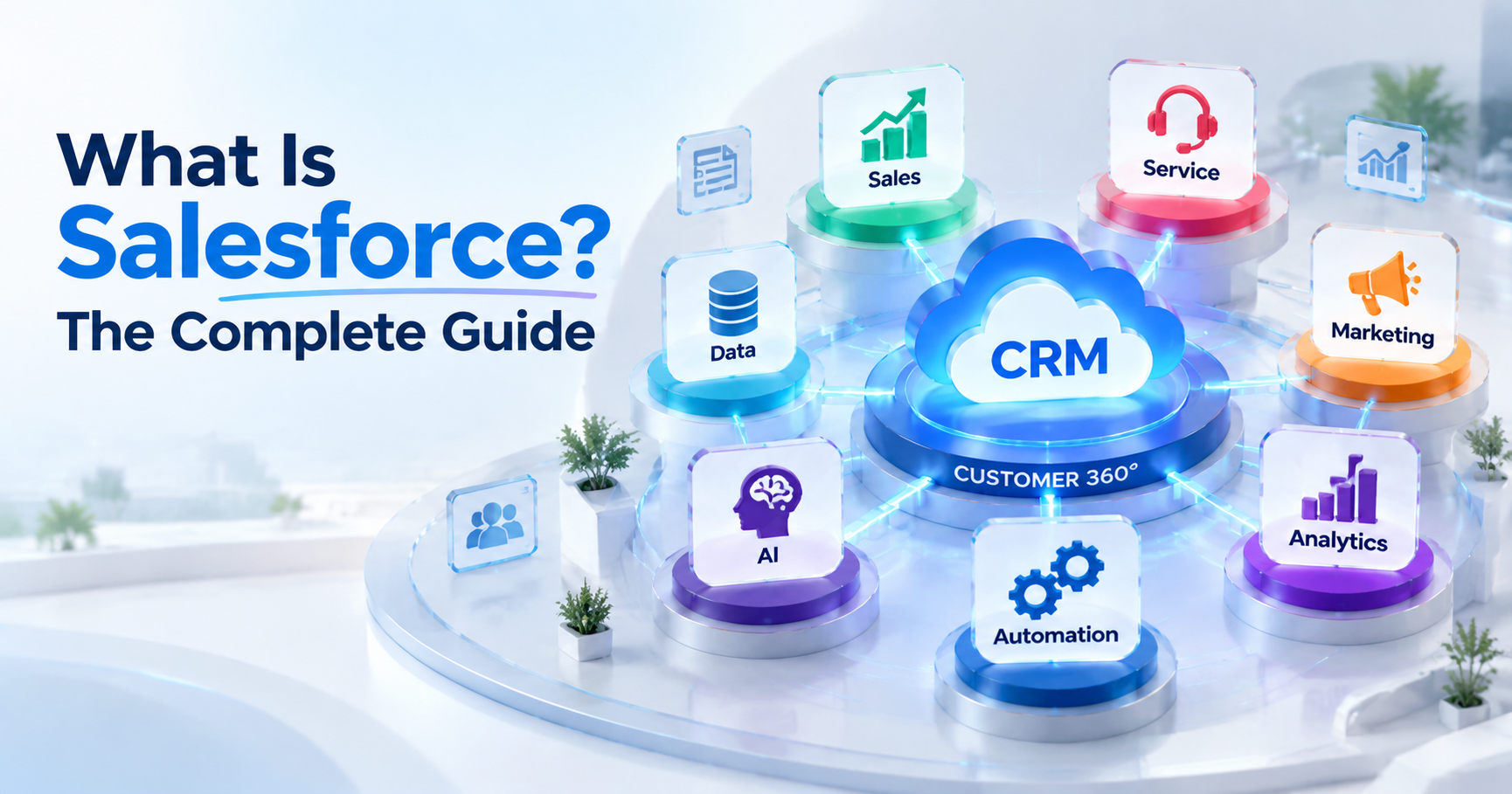
Salesforce is a cloud-based software company, and the name of its flagship product, best known for customer relationship management, or CRM. Instead of installing software on a company's own servers, Salesforce delivers its applications over the internet on a subscription basis, so sales, service, marketing, and IT teams can all work from one shared view of the customer. Beyond its original sales tool, Salesforce today is a full platform of connected products, Sales Cloud, Service Cloud, Marketing Cloud, Commerce Cloud, and an expanding set of AI-powered Agentforce tools, used by companies of nearly every size and industry.
Key Highlights: What Is Salesforce?
- Salesforce was founded in March 1999 by former Oracle executive Marc Benioff along with Parker Harris, Dave Moellenhoff, and Frank Dominguez, and it helped popularize the software as a service, or SaaS, business model.
- The platform is organized around distinct products often called "clouds," including Sales Cloud, Service Cloud, Marketing Cloud, Commerce Cloud, Experience Cloud, and CRM Analytics, plus the newer Agentforce AI agent layer.
- Salesforce has held the top position in worldwide CRM market share for well over a decade, according to IDC's CRM market share rankings, and is used across professional services, financial services, manufacturing, retail, healthcare, and the public sector.
- A Salesforce career does not require a computing background alone; distinct tracks exist for administrators, developers, consultants, architects, and business analysts, each with its own certification path.
- Salesforce Trailhead is a free, gamified learning platform that anyone can use to learn the platform and prepare for certification exams without paying for a Salesforce license.
- Certified Salesforce professionals in the United States commonly report total pay in the roughly ninety thousand to one hundred twenty thousand dollar range for administrator-level roles, with meaningfully higher pay for developers, consultants, and architects, though exact figures vary by source, region, and experience.
What Salesforce Is and How It Started?
At its core, Salesforce is a customer relationship management system, a shared database and set of tools that let a business track every interaction it has with a lead, prospect, or existing customer. Before cloud CRM existed in its modern form, most companies ran this kind of software on physical servers they owned and maintained, with expensive licenses and long, complicated installations. Salesforce built its business by betting that companies would rather rent software delivered through a web browser than own and manage it themselves.
The company was incorporated in March 1999 in San Francisco by Marc Benioff, a former Oracle executive, together with engineers Parker Harris, Dave Moellenhoff, and Frank Dominguez, working out of a small rented apartment. Their pitch rested on three ideas that were unusual at the time: delivering business software entirely over the internet rather than through installed programs, charging a recurring subscription instead of a one time license fee, and building a philanthropic model directly into the company from day one, a practice now widely known as the 1-1-1 model of giving back equity, product, and employee time.
Salesforce went public in 2004 and grew from a single sales tracking tool into a much broader platform through a combination of internal product development and a long string of acquisitions, including the marketing platform ExactTarget, the integration company MuleSoft, the analytics company Tableau, and the workplace messaging tool Slack. Most recently, Salesforce has repositioned much of its portfolio around agentic AI, rebranding under the Agentforce name to reflect a shift toward AI agents that can autonomously complete work inside a company's existing Salesforce data and workflows, alongside its traditional cloud products.
It is worth being precise about terminology. "Salesforce" can refer to the company, Salesforce, Inc., or to its original CRM product, which is why people sometimes still refer to it by its older name, Salesforce.com. In everyday business use, when someone says a company "runs on Salesforce," they typically mean the organization uses one or more of its cloud products to manage sales pipelines, customer service cases, marketing campaigns, or all three, on a single connected platform.
Core Salesforce Products and Clouds Explained
Salesforce's product line is organized into a set of applications that are informally called "clouds," each built for a different part of the customer relationship, but all sharing the same underlying data and platform. Understanding these products is the fastest way to understand what Salesforce actually does day to day inside a business.
Sales Cloud
Sales Cloud is Salesforce's original and still flagship product. It gives sales teams a single place to track leads, accounts, contacts, opportunities, and forecasts, automate routine follow-up tasks, and get visibility into where every deal stands in the pipeline. Sales managers use it for forecasting and reporting, while individual reps use it to manage their day-to-day pipeline and activities.
Service Cloud
Service Cloud is built for customer support and service teams. It centralizes support cases from email, phone, chat, and social channels into a single console, routes them to the right agent, and gives agents access to a shared knowledge base so customers get consistent answers regardless of which channel they use.
Marketing Cloud and Account Engagement
Marketing Cloud Engagement (formerly known simply as Marketing Cloud) is Salesforce's platform for building and automating marketing campaigns across email, SMS, mobile apps, and other digital channels, including personalized customer journeys triggered by specific behaviors. A related but separate product, Marketing Cloud Account Engagement (formerly called Pardot), is focused specifically on business to business marketing automation and lead nurturing.
Commerce Cloud
Commerce Cloud powers online buying experiences for both business-to-consumer and business-to-business companies, covering product catalogs, checkout, order management, and personalized storefronts, so a retailer's online store and its customer service and sales data can live on the same platform.
Experience Cloud
Experience Cloud is used to build branded portals and online communities, for example, a self-service customer portal, a partner portal for resellers, or an internal employee community, all built on top of the same underlying Salesforce data.
CRM Analytics
Originally launched as Einstein Analytics, this product, now called CRM Analytics, turns the data already living inside Salesforce into interactive dashboards, reports, and AI-assisted predictions, so leaders can spot trends in sales, service, or marketing performance without exporting data to a separate business intelligence tool.
Agentforce and the Shift to Agentic AI
Salesforce's newest and fastest-evolving layer is Agentforce, a set of AI agents that can be configured to autonomously handle tasks such as answering customer service questions, qualifying sales leads, or pulling together account research, using a company's own Salesforce data as their foundation. This reflects a broader shift across the platform in 2025 and 2026 toward embedding AI directly into existing Sales, Service, and Marketing workflows rather than treating AI as a separate add-on.
MuleSoft and Integration
MuleSoft, acquired by Salesforce in 2018, provides the integration layer that connects Salesforce to other systems a company already uses, such as an ERP, a data warehouse, or custom internal applications. As of mid-2024, MuleSoft's own certification track was folded into the main Salesforce certification program, reflecting how central integration has become to most Salesforce implementations. Businesses evaluating how Salesforce fits alongside other systems often also look at how it connects with broader project and portfolio management toolsused to plan and track that implementation work.
Who Uses Salesforce and Why
Salesforce has held the number one position in worldwide CRM software market share for well over a decade running, according to IDC's annual CRM market share rankings, with roughly one-fifth of the global CRM applications market. That scale means Salesforce shows up across almost every industry, though usage is heavily concentrated in a few sectors. Analyses of Salesforce's customer base consistently show professional services as the single largest user group, followed by manufacturing, financial and banking services, and retail, with additional industry-specific versions of the platform built for communications, media and entertainment, energy and utilities, insurance, healthcare, and government.
Publicly reported Salesforce customers span a wide range of company sizes and sectors. Large, well-known organisations that have been documented using Salesforce products include technology companies such as AWS, financial institutions such as JPMorgan and BNP Paribas, manufacturers such as Schneider Electric and BlueScope Steel, and globally recognized consumer brands such as McDonald's, Coca-Cola, Samsung, and FedEx. Alongside these large enterprises, Salesforce is also widely used by small and mid-sized businesses, which is part of why the platform's editions range from lightweight starter plans up to complex, highly customized enterprise deployments.
The common thread across these very different organizations is the same underlying need: a single, shared, always up-to-date view of the customer that sales, marketing, service, and leadership teams can all access, rather than customer information scattered across spreadsheets, inboxes, and disconnected tools.
Salesforce Career Paths and Certifications
Because Salesforce sits at the center of how so many companies manage customers, it has grown into its own career ecosystem, with distinct professional paths for people who are comfortable with configuration and business process, people who want to write code, and people who specialize in designing solutions or leading complex implementations. Salesforce currently organizes its certification program into several tracks, commonly grouped as Foundations, Administrator, Developer, Consultant, Architect, Marketer, and the newer AI and Agentforce track, with dozens of individual credentials across all of them.
Not every Salesforce career requires great technical skill. Many professionals move into Salesforce roles from adjacent disciplines. Someone with a strong business analysis background, for example, is often well positioned for a Salesforce Business Analyst role, which focuses on gathering requirements, mapping business processes, and translating them into configuration that developers or admins then build; professionals coming from a business analysis certification background such as CBAPfrequently find this transition natural. Similarly, because most Salesforce implementations are delivered in iterative sprints, many project teams are led by a product owner managing the backlog, a role that overlaps closely with skills covered in Scrum product owner certification training.
Major Salesforce Certifications by Track
| Certification | Track / Level | Focus Area |
| Salesforce Certified Associate | Foundations, entry level | Basic navigation, CRM concepts, and Salesforce terminology for people new to the platform |
| Salesforce Certified Administrator | Administrator, core level | User management, security, data management, reports and dashboards, and workflow automation using Flow |
| Salesforce Certified Advanced Administrator | Administrator, advanced level | Complex org configuration, advanced security and sharing rules, and analytics for experienced admins |
| Salesforce Certified Platform App Builder | Administrator / low code, intermediate | Building custom apps declaratively using custom objects, Lightning App Builder, and process automation |
| Salesforce Certified Platform Developer I | Developer, intermediate | Apex programming, SOQL and SOSL queries, and Lightning Web Components |
| Salesforce Certified Platform Developer II | Developer, advanced | Complex Apex design patterns, integration development, and performance optimization |
| Salesforce Certified Sales Cloud Consultant | Consultant, intermediate | Designing and implementing Sales Cloud solutions aligned to business requirements |
| Salesforce Certified Service Cloud Consultant | Consultant, intermediate | Designing and implementing Service Cloud solutions for customer support operations |
| Salesforce Certified Marketing Cloud Consultant | Consultant / Marketer, intermediate | Multi-channel campaign design and implementation using Marketing Cloud Engagement |
| Salesforce Certified Application Architect | Architect, advanced, domain credential | Awarded after completing a group of prerequisite certifications covering data modeling, sharing and visibility, and application design |
| Salesforce Certified System Architect | Architect, advanced, domain credential | Awarded after completing prerequisite certifications covering integration, identity and access management, and development lifecycle and deployment |
| Salesforce Certified Technical Architect | Architect, top tier | The most senior Salesforce credential, earned through a rigorous board review of a candidate's ability to design enterprise scale solutions |
| Salesforce Certified Agentforce Specialist | AI / Agentforce, intermediate | Configuring and managing AI agents, prompt templates, and the platform features that support Agentforce |
A few practical points are worth knowing before choosing a starting certification. Most individual Salesforce certification exams cost around two hundred to four hundred US dollars, with retakes typically priced lower, and several of the advanced architect level credentials are awarded automatically once a candidate completes a defined set of prerequisite exams rather than through one standalone test. Salesforce's own Administrator credential page on Trailhead and its broader certification directoryare the most reliable places to confirm current exam names, formats, and prerequisites, since Salesforce periodically renames or restructures individual credentials, most recently retiring its standalone AI Associate certification in early 2026 in favor of the Agentforce Specialist path.
Salesforce Salary Expectations
Salesforce skills tend to command a meaningful pay premium compared to general administrative or IT roles, and pay varies significantly by certification level, specialization, and location. Because no single salary source captures every employer, region, and job title, it is more useful to look at a range across several independent sources than to rely on one number.
For Salesforce Administrators in the United States, ZipRecruiter's 2026 salary datareports an average of roughly ninety-nine thousand dollars a year, while other salary aggregators show somewhat different averages, from the low eighties reported by PayScaleup to around ninety thousand dollars reported by Salary.com. Across these sources, the middle fifty percent of Salesforce Administrator salaries generally falls somewhere between roughly seventy-five thousand and one hundred nineteen thousand dollars a year, with top earners in the range of one hundred forty thousand dollars or more. Professionals who combine administrator and developer responsibilities tend to earn noticeably more, with combined Developer and Administrator roles reported by Glassdooraveraging around one hundred seventeen thousand dollars a year in the United States.
Certification appears to carry a real, measurable premium. Several salary guides report that earning the base Administrator certification adds somewhere in the range of ten thousand to eighteen thousand dollars compared to an otherwise similar uncertified candidate, and that stacking on the Advanced Administrator or Platform App Builder credential can add a further ten to fifteen percent on top of that. Consultant and Architect-level Salesforce professionals, and especially the small number of Salesforce Certified Technical Architects, typically earn well above general administrator pay, though fewer independent salary surveys isolate these more senior, lower volume roles precisely, so those figures should be treated as directional rather than exact.
Salary figures for Salesforce roles outside the United States, and for niche specializations such as Agentforce or Data Cloud consulting, are still comparatively thin in public salary data as of 2026, since these are newer specializations; readers evaluating a specific role are best served by cross-checking multiple current local salary sources rather than relying on a single global figure.
How to Get Started Learning Salesforce?
One of the most practical advantages of building Salesforce skills is that the primary learning resource is free and does not require a paid Salesforce license to use. Trailhead is Salesforce's own gamified learning platform, organized into bite-sized modules and hands-on challenges that let learners practice inside a real, free developer environment rather than only reading theory. Learners earn points and badges as they progress through ranks, can track their progress through the mobile Trailhead GO app, and can connect with local and online Trailblazer Community Groups, of which there are well over a thousand worldwide, for peer support and networking.
A practical starting sequence looks like this. First, create a free Trailhead account and work through a beginner trail that introduces core CRM concepts and basic navigation. Second, set up a free Salesforce Developer Edition org, a fully functional sandbox environment, and practice the hands-on challenges rather than only completing the multiple choice quizzes, since Salesforce certification exams increasingly test applied scenarios rather than pure recall. Third, choose a first certification target based on the kind of work that interests you: the Administrator credential for anyone drawn to configuration, security, and process automation, or Platform Developer I for anyone comfortable writing code, and use Trailhead's dedicated certification prep trail for that exam before registering. Most learners should plan for a meaningful, sustained study commitment rather than a quick weekend crash course, since certification prep guides commonly estimate somewhere in the range of eighty to one hundred twenty hours of study for a first certification, depending on prior familiarity with the platform.
For professionals coming from a project delivery, business analysis, or product management background rather than a hands-on configuration or coding background, it is often just as valuable to strengthen the surrounding process skills, requirements gathering, stakeholder management, and agile delivery, that make a Salesforce implementation succeed, alongside platform-specific learning. Simpliaxis maintains a broader library of professional certification training coursesacross business analysis and agile delivery disciplines that commonly sit alongside Salesforce projects inside real organizations.
Key Takeaways
- Salesforce began in 1999 as a cloud-based sales tracking tool and has grown into a full platform of connected products spanning sales, service, marketing, commerce, and increasingly agentic AI.
- The platform's core products, Sales Cloud, Service Cloud, Marketing Cloud, Commerce Cloud, Experience Cloud, and CRM Analytics, each address a different part of the customer relationship while sharing one underlying data model.
- Salesforce has led global CRM market share for well over a decade according to IDC, with usage concentrated in professional services, manufacturing, financial services, and retail, alongside dedicated industry editions for sectors like healthcare and government.
- Salesforce careers span technical and non-technical tracks alike: administrators, developers, consultants, architects, and business analysts, each with its own certification path rather than a single one-size-fits-all credential.
- Certification carries a measurable salary premium, and Salesforce's own Trailhead platform offers a genuinely free path to learning the platform and preparing for entry-level certification exams.
- Anyone evaluating a Salesforce career should treat published salary and market share figures as directional ranges drawn from multiple sources rather than single fixed numbers, since methodologies and reporting periods differ across providers.








 Lowest-Price Challenge










 Personalized Path


.webp)


 USA
USA  Canada
 India
India UK
UK Australia
 Singapore


