


 Call Us




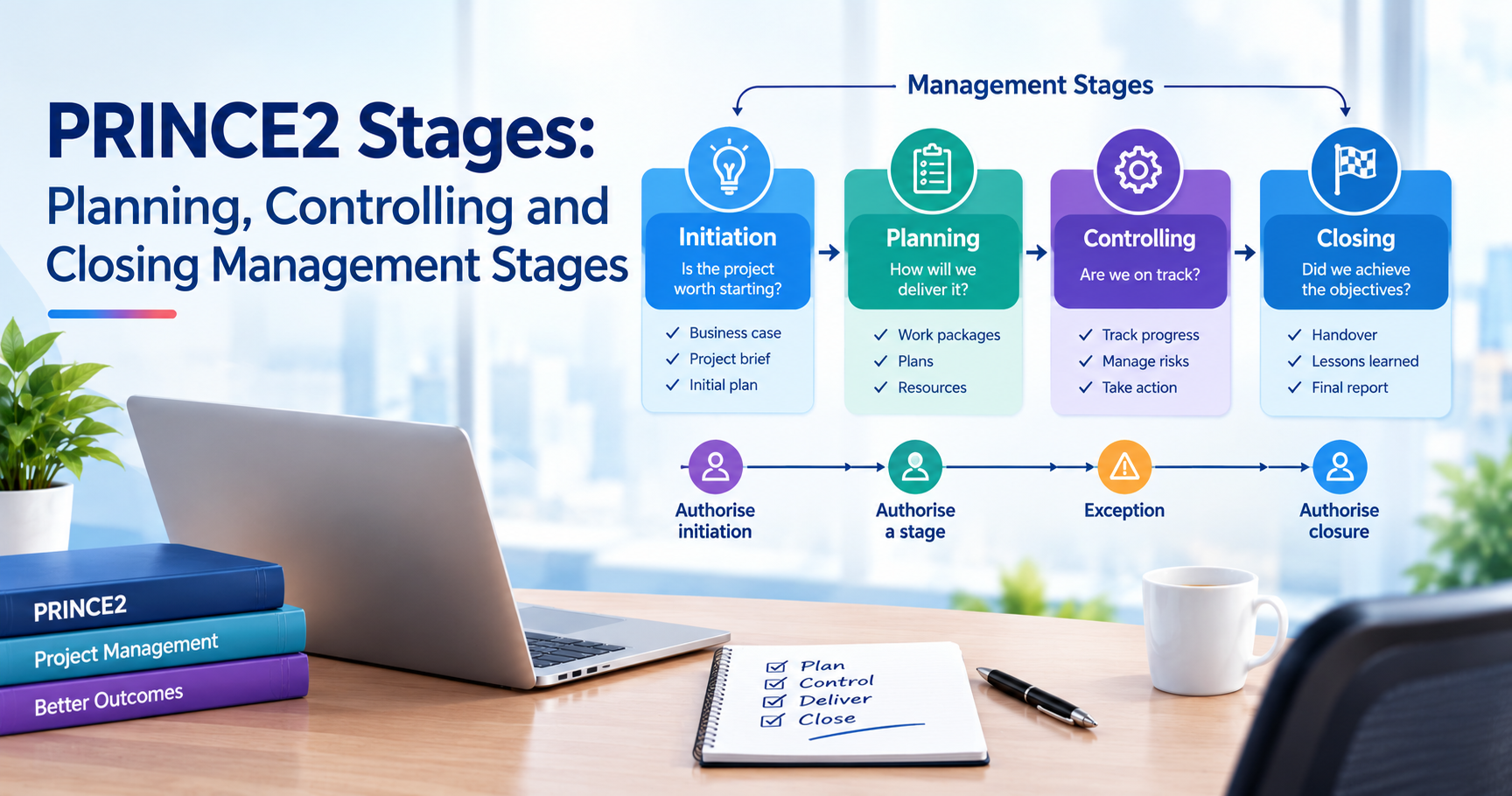
A PRINCE2 stage is a manageable component of the project and gives project managers the opportunity to plan the work, monitor progress, manage risks, and make informed decisions to continue. PRINCE2 project stages normally have an initiation stage, a number of delivery stages and a final stage to close the project. The number and length of stages will be determined by the size, complexity, risk and business needs of the project.
Each management stage ends with a decision point at which the project board reviews progress, checks that the project remains viable and decides whether to authorize the next stage. The organization has more control over costs, schedules, quality and expected benefits with this method.
Key Highlights of PRINCE2 Stages
- Stage Management: Instead of planning and approving the whole delivery effort in one go, PRINCE2 divides a project into manageable chunks.
- Clear decision-making: The project board approves the initiation stage, the subsequent management stages in PRINCE2 and the closure of the project.
- Responsibilities are clearly defined: the project manager handles day-to-day work, and the project board provides direction and makes major approval decisions.
- Regular reviews: Stage boundaries offer an opportunity to review progress, re-forecast and respond to risks or changes.
- Flexible planning: The time required for each stage is dependent upon the level of complexity, uncertainty, risk exposure and the level of oversight needed by senior stakeholders.
- In practice: PRINCE2 stages can be tailored to different industries such as IT, construction, healthcare, finance and business transformation.
Introduction
Picture yourself as a company, about to launch a new customer portal. The project scope includes website design, payment system integration, customer data migration, security testing and staff training. If the business agrees to the whole project from the beginning without monitoring its progress, it might end up paying more than it should and suffer delays.
And that’s where the management stages of PRINCE2 come in. Rather than thinking of the project as one long block of work, the project team breaks it down into manageable chunks. Each section has a clear objective, planned deliverables, agreed tolerances and a review point before the next stage begins.
The approach embodies a key principle of PRINCE2: throughout the life of a project, it must be justified in terms of its business value. Teams shouldn’t keep investing just because they’ve already invested or done part of the work.
Understanding PRINCE2 stages can help project managers to balance planning and flexibility. It also specifies the decision-makers, the timing of reviews, and the path from an initial idea to an approved result.
In this guide, we explore PRINCE2 project stages, the initiation and delivery stages, stage boundaries, stage planning, and the adjustments needed for agile environments. The article includes concrete instances of how to use these ideas in real projects.
What Are PRINCE2 Stages?
In the PRINCE2 framework, a management stage is a component of the project managed as a single entity by the project manager. The project board manages the interfaces between stages.
Each stage is planned and controlled separately. Before starting a new stage of management, the project board reviews the information from the current stage and decides whether to proceed with the project.
A management stage is a governance mechanism, not a to-do list. It provides decision-makers with a structured forum to review progress, validate the business case and approve the resources required for the next phase of work.
In a software implementation project, for example, the stages might be:
- Initiation: Define the project, confirm the business case, set up governance and prepare a detailed project management approach.
- Solution Design & Development: Design the solution, develop core functionality, and review progress against approved plans.
- Testing and deployment: Validate the solution, fix defects, prepare users, and deploy the product.
- Close the project: Accept, transfer the solution, document lessons learned, and close the project.
These are illustrative management stages, not a prescriptive sequence of PRINCE2. . A project can use more or fewer stages, and its final management stage may include delivery and closure activities.
It is also important to distinguish management stages from technical stages. A technical stage describes a type of specialist work, such as design, coding, or testing. A management stage is the period between two project board decision points. One management stage may include several technical activities, and technical work may sometimes overlap across management stages in PRINCE2.
For readers who are new to the method, understanding what is PRINCE2 provides useful background on its principles, practices, processes, and project governance structure.
Why PRINCE2 Uses Management Stages
Projects rarely go exactly as planned. Requirements change, suppliers miss deadlines, budgets come under pressure, and new risks emerge. Management stages allow a project to respond to these developments without losing overall control.
The approach offers several practical benefits.
1. Better control over cost and resources
Resources are released by the project board in phases and not just according to the original project plan. As the project progresses, it’s easier to look at costs and future commitments.
For example, if the first phase of a customer portal project finds that a third-party payment integration will cost more than expected, the board could evaluate the revised business case before signing off on the next phase of the project.
2. Earlier identification of risks
Stage reviews are a natural way to discover problems in development. The team can update risk assessments, review dependencies and create corrective actions before problems become more expensive to resolve.
3. Clear accountability
There is an agreed plan, with defined responsibilities and measurable expectations for each stage of management. The project manager manages the work within the approved limits. The project board makes decisions at the appropriate governance level.
4. Better-informed decisions
At the end of a stage, the board can review actual progress against the plan, the continued business justification, forecast costs, expected benefits and the project’s risk exposure.
5. Flexibility without losing governance
PRINCE2 gives you a controlled framework, but does not dictate the same stage length or number of stages for all projects. Smaller projects tend to have fewer decision points, but large or high-risk projects may need to be reviewed more often.
These benefits support the PRINCE2 principle of managing by stages. They also reinforce continued business justification, which means the project must remain worthwhile throughout its lifecycle.
You can explore the wider framework in this guide to PRINCE2 principles and key concepts.
The Initiation Stage
The initiation stage turns an initial project idea into an organized, approved project with a clear direction.
In a typical PRINCE2 project, the project manager develops the Project Initiation Documentation (PID) during this stage. The PID brings together the information needed to manage and control the project, including its objectives, business case, plans, risks, roles, quality arrangements, and approaches to managing changes and communication.
The initiation stage builds on the earlier decision to proceed with initiation. It should not be confused with the pre-project process, during which the organization establishes whether a project is worth initiating at all.
Purpose
The main purpose of the PRINCE2 initiation stage is to establish a sound foundation for the project before substantial delivery work begins.
Key objectives include:
- Confirm the project’s aims, scope, expected outputs and measurable benefits.
- Creating a business case that is sufficiently detailed to support the investment.
- Establishing the project management team and defining the roles.
- Planning the project and its first phase of delivery.
- Identifying risks, assumptions, constraints and dependencies
- Agree on how quality, communication, changes and progress will be handled.
- Establishing reporting arrangements and setting the tolerances within which the project manager can operate.
Think of a company that wants to move its customer records to a cloud platform. During initiation, the team identifies records to be migrated, sets security requirements, identifies data protection risks, estimates costs and agrees how to measure successful migration.
Without this work, the team might begin technical implementation without understanding the full scope, the business impact of downtime, or the conditions that must be met before launch.
The initiation stage should be detailed enough to support informed decisions but not too detailed. The degree of planning should be commensurate with the size, complexity and risk of the project.
Key Outputs
The main product of the initiation process is the Project Initiation Documentation, together with the plans, registers and other management products needed to control the project.
Typical outputs include:
- Project Initiation Documentation (PID): Establishes the project's management baseline and explains how it will be controlled.
- Business case: Explains why the project is needed, what benefits it is expected to deliver, and whether the investment remains justified.
- Project plan: Describes the overall approach, major products, milestones, resources, and expected timescales.
- Stage plan: Defines the activities, products, resources, and controls for the next management stage.
- Risk register: Records identified risks, their assessments and planned responses.
- Issue register: Captures issues requiring assessment and management.
- Quality management approach: Explains how products will be checked against agreed quality criteria.
- Communication management approach: Defines the information stakeholders need and how it will be shared.
- Project controls and tolerances: Establish the limits for time, cost, scope, quality, benefits, sustainability, or risk, as applicable to the project.
The exact set of management products should be tailored to the project's needs. PRINCE2 does not require every project to produce lengthy documents when a simpler, proportionate approach would provide adequate control.
Once the initiation products are reviewed, the project board decides whether to authorize the next management stage. Approval is not automatic: the project must have a credible plan and a continuing business justification.
Delivery Stages
Delivery stages are the periods in which the project team carries out the planned work and produces the products required by the project.
The project manager monitors progress, manages issues, coordinates resources, and keeps work within the tolerances authorized by the project board. Team managers or delivery teams complete assigned work and report progress through the agreed management arrangements.
PRINCE2 commonly describes the work through three related processes: Managing a Stage Boundary, Controlling a Stage, and Managing Product Delivery. Together, these help connect governance, day-to-day control, and the production of agreed deliverables.
Planning a Stage
Stage planning establishes what the team needs to achieve during the next management stage and how it will achieve it.
The project manager breaks down the work into manageable activities and defines the products to be created, their quality criteria, dependencies, resources, risks, and expected completion dates.
A practical stage plan should answer five questions:
- What products must be delivered?
- What activities are needed to create and verify those products?
- Who is responsible for each activity?
- What resources, budget, and time are required?
- What risks, dependencies, and tolerances could affect delivery?
For example, the stage plan in the development stage of a customer portal project might include building the login system, integrating the payment gateway, completing accessibility checks and preparing a test environment.
Clear acceptance criteria should be defined for each deliverable. Rather than saying that the login system has to be done, the team might say that it has to support approved authentication methods, pass agreed security tests, and meet the documented response-time requirements.
The stage plan provides a standard to which actual performance can be compared. It also provides the project board with a sound basis for judging whether the next stage is achievable.
Controlling a Stage
The project manager continually monitors the work, deals with issues and ensures the stage remains within tolerances. Stage management
This includes reviewing progress, comparing actual performance against the stage plan, assessing risks, authorizing work packages where appropriate, and taking corrective action when necessary.
Common control activities include:
- Reviewing regular progress reports from delivery teams.
- Checking whether completed products meet their quality criteria.
- Updating forecasts for time, cost, and resource requirements.
- Assessing requests for change through change control and reviewing reported issues.
- Taking corrective action when progress deviates from the plan.
- Escalating forecasts that exceed agreed tolerances through an exception report.
For example, suppose that a software development phase is planned for eight weeks. The team learns after five weeks that a critical external integration has been delayed.
The project manager first considers the impact and the corrective actions available. This may be something the team can work around, or use an alternative test environment, as long as it is within approved tolerances If the forecast shows the stage will be outside those tolerances, the project manager brings the matter to the project board.
This distinction is important: the project manager manages within delegated authority, while the board decides how to respond when the agreed limits are forecast to be exceeded.
Managing Product Delivery
Managing Product Delivery focuses on the relationship between the project manager and the people responsible for producing the project's products.
The process ensures that work packages are agreed, completed, checked, and returned in line with the approved plans.
A work package typically clarifies:
- The products to be created or modified.
- The expected quality criteria and quality methods.
- The work required and the relevant constraints.
- The reporting and communication arrangements.
- The agreed delivery dates and responsibilities.
A team that is responsible for developing a payment module, for example, receives a work package that describes the functionality, security requirements, testing obligations, and delivery date. The team does the work, does the checks they have agreed to do and reports their results to the project manager.
Then the project manager checks the delivery information and confirms that the product satisfies the required conditions.
Managing Product Delivery prevents a common problem of teams performing activities but not producing outputs that satisfy the actual needs of the project. The focus is still on agreed products and their quality, not just on completion of activity.
Stage Boundaries and Decision Points
A stage boundary is the point at which the project board reviews the current stage and decides what should happen next. It is a central feature of management by stages.
Near the end of a stage, the project manager prepares the information needed for the board to assess performance and make an informed decision. This will normally comprise a stage-end report, updated business case information, the next stage plan and any relevant exception or risk information.
The board considers whether the project is still viable, whether the work done so far meets expectations and whether the next stage should be approved.
Not every decision point is the same. These are initiation authorization, later stage authorization, exception response, and closure authorization, and they serve different purposes.
| Point | Who Decides | Inputs | Outcome |
| Authorize initiation | Project board | Project mandate, project brief, outline business case, and initiation-stage plan | Initiation is approved, and the project manager is authorized to establish the project's management foundation. |
| Authorize a stage | Project board | Stage-end report, updated business case, next stage plan, and relevant risk and issue information | The next management stage is approved, revised conditions are agreed, or the project is stopped if it is no longer justified. |
| Exception | Project board, or a higher authority if required by the governance arrangements | Exception report, impact assessment, and options for responding to the forecast breach | The board may approve an exception plan, request further analysis, or direct another appropriate response. |
| Authorize closure | Project board | End project report, confirmation of product acceptance, updated business case and benefits information, and lessons report | The project is formally closed, subject to any agreed follow-on actions and outstanding responsibilities. |
The exact documentation and decision processes will need to be tailored to the project and the organization’s governance requirements.
The PRINCE2 project stages board is usually created from three perspectives: business, user, and supplier. These perspectives help ensure that decisions consider commercial justification, user needs, and delivery capability.
Read more about responsibilities and decision-making in the PRINCE2 project board guide.
The Final Stage and Closing a Project
The final stage brings the project to an orderly conclusion. It confirms that the agreed products have been delivered or that any remaining work and limitations have been explicitly addressed through the appropriate governance arrangements.
Project closure is more than finishing the last task. It confirms that the project has delivered on its authorized purpose, defines ownership of the products and captures the information for future operations and learning.
Key activities typically include:
- Confirmation of products delivered and accepted to agreed criteria.
- Ensuring handover arrangements are in place.
- Prepare final project report including performance vs. approved plans.
- Lessons Learned Review and Recommendations Documentation for Future Projects.
- Update information on expected benefits and how they will be evaluated after the project.
- Checking on any outstanding actions, operational responsibilities and any follow-up arrangements.
- Getting the go-ahead from the project board to close the project.
Consider a company that has just built a new employee onboarding platform. The project team verifies the platform satisfies acceptance criteria, hands over operational ownership to the IT support team, supplies user documentation, and documents lessons learned from the implementation.
Not all benefits may be measurable to the business immediately. For example, the reduction of the time needed for onboarding may not be observable until a few months into use. In such cases, the project needs to define who will measure the benefits and when, rather than assuming that the closing of the project implies that all benefits have already been achieved.
Formal project closure prevents projects from dragging on indefinitely and enables organizations to differentiate between project delivery and ongoing business.
How to Decide Stage Length
There is no duration for a PRINCE2 management stage. Depending on the nature of the project and the level of control required, the length of a stage may be a few weeks or several months.
“The goal is to have stages that are not too long to get meaningful work done, but not too short to provide timely oversight.”
It depends on a number of things.
Complexity of the project: If a project involves several teams, technical integrations or complex dependencies, smaller stages may be more appropriate to monitor progress.
Risk and uncertainty: Where the technology, requirements, supplier arrangements or business environment are uncertain, shorter stages can help the board review evidence before committing further resources.
Cost and resource commitments: A decision point prior to a large financial commitment may be appropriate if the next part of the project demands it.
Stakeholder expectations: Some projects require ongoing executive sponsorship; others can endure longer stretches without formal reviews.
Delivery cycle: The stage should provide enough time to build a coherent set of products, check out and report on them.
Project tolerances: More frequent reviews for tighter tolerances or high likelihood of change
For example, consider two projects:
- Project A: A small website refresh. The work is well understood, the team is small and the cost is relatively low.” A few management stages in PRINCE2 may be enough to give adequate control.
- Project B: A financial services platform migration. This is a project with data security, compliance, multiple suppliers, and business-critical systems. It may be reasonable to have more frequent decision points to review the testing results, risks and readiness before major commitments.
A useful starting point is to identify the next major decision that requires board approval, then plan the stage around the products and evidence needed to support that decision.
Avoid dividing a project into stages simply to create more paperwork. Each boundary should have a clear management purpose.
Likewise, avoid stages that are so long that important risks remain unreviewed for an extended period. The right balance is the one that provides effective control without creating unnecessary overhead.
Stages in PRINCE2 Agile Projects
PRINCE2 Agile combines the governance of PRINCE2 stages with agile delivery (see PRINCE2 vs Agile). It retains management stages and decision points, but lets teams build products iteratively and respond to feedback.
One important difference is that a management stage is not the same as a sprint or an iteration.
A sprint is a short time period used by an agile team to create and review an increment of a product. A management stage is a period of governance during which the project manager manages the delivery of and reports to the project board. More than one sprint, release or iteration may exist within a single management stage.
For example, a team working on a customer portal might complete four two-week sprints within a twelve-week management phase. At the end of the stage, the project manager will report progress, revised forecasts, risk information and the next stage plan to the project board.
This allows the team to fine-tune product details based on user feedback, while maintaining control of the overall project.
PRINCE2 Agile projects can benefit from:
- Iterative delivery: Teams build and refine products in smaller increments.
- Frequent feedback: Users and stakeholders review work and help clarify priorities.
- Stage-level governance: The project board retains formal oversight of progress and continued business justification.
- Flexible scope management: Teams can manage lower-priority requirements within agreed constraints where the project approach permits.
- Evidence-based decisions: Demonstrations, test results, and product feedback can inform decisions at stage boundaries.
Agile delivery does not remove the need for planning or governance. Instead, it changes how teams organize and deliver work within the agreed management structure.
Professionals who want to explore this combination further can review the PRINCE2 Agile Practitioner certification.
Common Stage Planning Mistakes
Even when a project follows a recognized methodology, poor stage planning can reduce the value of its controls. The following mistakes are worth avoiding.
1. Treating stages as fixed phases
A project team can assume that all projects have the same order of stages. In practice, the stage design should reflect the project’s products, risks, dependencies and governance needs.
How to avoid it: Structure the stages according to meaningful management decisions, not a template that may not fit the project.
2. Making stages too long
Long stages can mean problems not being identified and assumptions not being tested for too long.
How to avoid it: Consider the risk exposure, financial commitments, and time required to get useful evidence. Add a boundary when a major decision or review is required.
3. Making stages too short
Too many stage boundaries can lead to repetitive planning, reporting and approval work, without delivering proportionate value.
How to avoid it: Ensure each boundary allows enough work to be done to measure progress and support a meaningful decision.
4. Confusing management stages with technical stages
Design, development and testing can be regarded by a team as obligatory management stages PRINCE2, even if these activities can be more efficiently planned in one stage.
How to avoid it: Distinguish between the project's governance structure and its technical delivery sequence. Select management boundaries based on the need for controls.
5. Failing to update the business case
A project may continue through successive stages even when costs rise, benefits decline, or business priorities change.
How to avoid it: Reassess the business case at stage boundaries and whenever significant changes affect the project's viability.
6. Planning the next stage too late
Without a credible next stage plan, the project board may lack the information required to make a timely decision.
How to avoid it: Prepare the next stage plan as part of stage-boundary management, using the latest delivery information, resource forecasts, risks, and dependencies.
7. Ignoring tolerances and escalation rules
Project managers who do not understand their delegated authority may escalate minor issues unnecessarily or fail to escalate serious forecast deviations.
How to avoid it: Establish clear tolerances, monitor forecasts, and use exception reporting when a breach is expected.
8. Using the same level of documentation for every project
A small internal improvement project may not need the same documentation effort as a large, high-risk technology implementation.
How to avoid it: Tailor the method while preserving the controls necessary for accountability, quality, and decision-making.
For quick revision of key terms and concepts, the PRINCE2 cheat sheet can serve as a useful reference.
Conclusion
PRINCE2 stages give a practical framework for planning, delivering, monitoring and closing projects. Breaking a project into manageable pieces allows organizations to assess how they are doing at critical decision points, manage resource commitments, and confirm that the business case remains valid.
The initiating stage establishes the foundation for the project; the delivery stages convert plans into accepted products; and stage boundaries provide opportunities for the project board to authorize the next steps or respond to exceptions. The final step is the formal closure of the project and the clear assignment of operational ownership and follow-up responsibilities.
The stage structure with the most checkpoints or longest plans is not necessarily the most effective. It is the one that provides the right level of oversight for the project’s complexity, uncertainty, risk and business needs.
If you are increasing your knowledge of project management, then the PRINCE2 Foundation certification can help you develop a structured understanding of the method and its terminology. And by knowing the management stages PRINCE2 you can apply PRINCE2 to projects of different sizes and styles of delivery with confidence.








 Lowest-Price Challenge












 Personalized Path



.webp)


 USA
 Canada
 India
 UK
 Australia
 Singapore


