


 Call Us



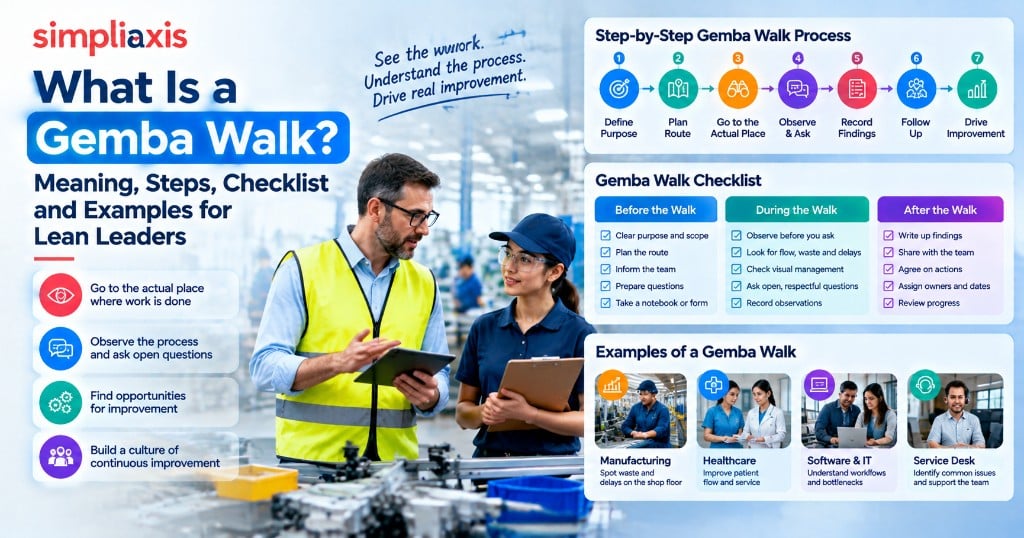
A gemba walk is a planned visit to the place where work is actually done, made by a leader or team to observe the process, ask respectful questions and find ways to improve. "Gemba" is Japanese for "the actual place". The idea is simple: you cannot understand a process from a report, so you go and see it.
This guide covers the gemba walk meaning, where it comes from, how to run one in seven steps, a ready-to-use checklist, questions that work, a template, real-world style examples, and the mistakes that turn a gemba walk into a tour or an audit.
Key Highlights of Gemba Walk
- A gemba walk means going to where value is created, observing the work and asking open questions before you act.
- The Lean Enterprise Institute describes it as a management practice for understanding current conditions through direct observation and questioning.
- A good walk has a clear purpose, a route, a short list of questions, a way to record observations and a follow-up.
- The goal is learning and improvement, not inspecting people or finding fault.
- Gemba walks work in factories, hospitals, offices, software teams and service desks.
What Is a Gemba Walk? Meaning and Definition in Lean
The word gemba (現場) means "the actual place". In manufacturing it is the shop floor. In a hospital it is the ward or operating room. In a software team it can be the team board, the build pipeline and the support queue where the work flows. The Lean Enterprise Institute's lexicon defines a gemba walk as a way of understanding current conditions through direct observation and questioning, so that leaders can act on facts.
The gemba walk meaning goes beyond a site visit. A visit is passive. A walk has a purpose, a method and a follow-up. The walker watches the work as it happens, talks with the people who do it, and records what they learn so that improvement actions can follow.
A gemba walk is not an audit and not a performance review. Nobody is being graded. The leader's job is to understand how the process runs, what gets in the way and what support people need.
Where Does the Gemba Walk Come From? Origins in Lean and the Toyota Production System
Gemba walking is closely tied to Lean thinking and the Toyota Production System, where managers were expected to spend time on the floor, see problems at their source and teach problem solving on the spot. A story often told about Taiichi Ohno, a key figure in that system, is that he would ask new managers to stand in a drawn circle and watch a process for a long time until they could describe what they saw. Treat the details as folklore, but the lesson is real: careful observation comes before opinion.
The Lean Enterprise Institute's entry on gemba adds that Japanese companies pair the word with "genchi genbutsu", or "go and see", to stress the value of direct observation. Lean rests on two pillars, continuous improvement and respect for people. A gemba walk supports both. Leaders learn about waste and problems, and they show respect by listening to the people who do the work. If you want the wider framework, see our guide to the Lean process and the seven wastes of Lean that a walker learns to spot.
Why Do Gemba Walks Matter? Benefits for Leaders, Teams and Quality
Reports compress reality. A weekly dashboard may say a process is "green" while people work around a broken tool every hour. Walking the process helps you:
- See waste, delays and rework that metrics hide
- Hear about obstacles the team may not raise in meetings
- Check whether standard work is actually being followed
- Build trust between leaders and frontline staff
- Link daily problems to strategy and priorities
- Teach problem solving through questions, not instructions
These benefits only appear when the walk is regular and respectful. A one-off visit before an executive review does the opposite. Gemba walks also put the Lean Six Sigma principles of customer value, flow and continuous improvement into daily management instead of leaving them on a poster.
What Are the Types of Gemba Walks? Leadership, Process and Problem-Focused Walks
Teams use different formats depending on the goal.
| Type of gemba walk | Purpose | Typical participants | Best used when |
| Leadership walk | Understand current conditions and support teams | Managers and leaders | You want regular contact with the work |
| Process walk | Follow one product or service from start to finish | Cross-functional group | Handoffs and delays are suspected |
| Problem-focused walk | Investigate a specific defect, delay or complaint | Problem owner and team | A known issue needs facts |
| Safety or quality walk | Look for hazards and standards gaps | Safety, quality and area staff | You are preparing for audits or reducing incidents |
| Coaching walk | Teach Lean thinking to a team or new leader | Coach and learners | You are building improvement skills |
James Womack, founder of the Lean Enterprise Institute, suggests following a single product family or customer process from end to end across departments, since value flows horizontally to the customer. That approach finds handoff problems that a single-department walk will miss. A walk of this kind pairs naturally with value stream mapping, which records the flow you observe.
Gemba Walk vs Audit vs Genchi Genbutsu vs Management by Walking Around: What Is the Difference?
These practices look alike, but their purpose and tone are different.
| Aspect | Gemba walk | Process audit | Genchi genbutsu | Management by walking around |
| Main purpose | Learn current conditions and support improvement | Check compliance with a standard | Go and see to understand facts at the source | Stay visible and informal with staff |
| Who leads | Leader or improvement team | Auditor or quality function | Anyone solving a problem | Manager |
| Method | Observe, ask open questions, record, follow up | Sample, check against criteria, record findings | Direct observation of the real situation | Informal conversation |
| Output | Observations and improvement actions | Findings and corrective actions | Verified facts about the problem | Relationships and general awareness |
| Tone | Curious and respectful | Formal and evidence-based | Fact-finding | Friendly |
| Frequency | Regular and planned | Scheduled cycle | As needed | Ad hoc |
In short, a gemba walk adds structure and follow-up to the informal habit of walking around, and it replaces judgement with curiosity. Genchi genbutsu ("go and see") is the principle behind it, while the walk is a practical way of applying that principle.
How to Do a Gemba Walk: 7 Steps From Purpose to Follow-Up
These gemba walk steps work in any setting.
1. Define the purpose of the walk
Decide why you are going. Examples: understand why orders ship late, see how a new standard is working or learn what slows incident handling. A clear purpose stops the walk drifting into small talk.
2. Plan the route and tell the team
Choose the area or the process path. Tell the team what you are doing and why, so people do not feel inspected. If possible, walk at the time when the work normally happens.
3. Go to the actual place
Go to where the work is done. Leave the laptop and the slide deck behind. Take a notebook or a simple form instead.
4. Observe before you ask
Stand and watch for a few minutes. Notice flow, waiting, searching, rework, workarounds, safety and the state of the workplace. Write down facts, not conclusions.
5. Ask open, respectful questions
Ask people about the work, not about themselves. Good questions start with what, how and why, and avoid blame. The question list below gives examples.
6. Record what you learned
Capture observations, quotes and ideas for improvement the same day. A simple table works: what I saw, what I asked, what I learned, possible action.
7. Follow up
Close the loop. Share what you learned, agree on actions with the team and report back on results. If nothing happens after a walk, people stop being honest on the next one.
Gemba Walk Checklist: What to Prepare, Observe and Do Afterwards
Use this checklist to prepare and run a walk. Adapt it to your setting.
Before the walk
- Purpose and scope are clear
- The team knows the visit is for learning
- You have a route and a time slot
- You have a notebook or form and a short question list
During the walk
- Observe the process for a few minutes before talking
- Look at flow: queues, waiting, movement, rework
- Check visual management: boards, signs, standards, metrics, and whether the workplace follows 5S principles
- Notice safety and housekeeping
- Ask open questions and listen more than you speak
- Avoid giving instructions or fixing problems on the spot unless safety requires it
After the walk
- Write up observations the same day
- Share findings with the team
- Agree on two or three actions with owners and dates
- Review progress on the next walk
Which Gemba Walk Questions Should You Ask Employees?
The best gemba walk questions are curious and neutral. Pick a few for each walk.
About the work
- Can you show me how this task is done?
- What is the first step, and what happens next?
- What does a good day look like here?
About problems
- What gets in your way most often?
- What problem did you deal with today? What did you do about it?
- Where do you wait, search or redo work?
About standards and flow
- How do you know if the work is going well or badly?
- What is the standard for this step, and is it realistic?
- What happens when something goes wrong?
About support
- What would help you do this work better?
- What do you need from other teams that you do not get?
- What have we asked you to do that does not add value?
Avoid questions that sound like blame, such as "Why didn't you follow the procedure?" Replace them with "What made the procedure hard to follow?" The shift from "who" to "what" keeps people talking and keeps the focus on the system.
Gemba Walk Template: A Simple Form to Record Observations and Actions
A short form keeps notes consistent and makes follow-up easier.
| Field | What to record |
| Date, area and walker | Who walked where and when |
| Purpose | The reason for this walk |
| Observation | What you saw, in facts |
| Question asked | What you asked and who answered |
| Insight | What you learned about the process |
| Opportunity | Waste, risk or improvement idea |
| Action, owner and date | Who will do what, and by when |
| Follow-up result | Outcome on the next walk |
Keep the template to one page. The longer it is, the less likely people are to fill it in. Review the completed forms monthly to find patterns, for example the same delay appearing on several walks. Patterns are what turn a set of walks into a process improvement programme.
What Are Some Gemba Walk Examples in Manufacturing, Healthcare, Software and Service Desks?
These are illustrative scenarios, not case studies from named organisations.
Manufacturing. A plant manager walks the packing line to understand late shipments. She notices operators walking to a distant shelf for labels. A simple change, placing labels at the workstation, removes the walking. It is a small fix that no report would have revealed.
Hospital. A nursing leader follows a patient's discharge process from the ward to the pharmacy. The walk shows that discharge paperwork waits in a tray until the afternoon. The team agrees on a morning pickup time.
Software and IT. A delivery lead walks through the team's board and the support queue. She finds that tickets sit in "Ready for QA" for days because testers are pulled into urgent work. The team adds a work-in-progress limit and a daily swap, in line with the core practices of Kanban.
Service desk. A manager sits with agents during peak time and sees that many calls are about the same password reset. The team publishes a self-service guide and the repeat calls fall.
In each case the improvement came from watching the real work, not from a meeting about it. People who enjoy this kind of problem solving often move into improvement roles, and the guide to the difference between Yellow, Green and Black Belts shows how those roles progress.
How Often Should You Do a Gemba Walk? Frequency, Duration and Rotation
There is no single rule, but the following guidance works for most teams.
| Question | Practical guidance |
| How often? | Daily or weekly for team leaders, weekly or monthly for senior leaders |
| How long? | 20 to 60 minutes for a focused walk |
| Where? | Rotate areas so that every process is seen regularly |
| With whom? | Walk with the process owner, and sometimes with someone from another department |
| When? | At a time when the work is normally happening, including different shifts |
Short, regular walks beat long, rare ones. The point is to build a habit and a relationship with the work, so choose a rhythm you can keep and protect it in the calendar.
How Do You Measure Whether Gemba Walks Are Working?
A walk is only useful if it leads to learning and change. Track a few simple indicators.
| Indicator | What it shows |
| Number of walks completed against plan | Whether the habit is being kept |
| Actions raised and closed from walks | Whether observations lead to improvement |
| Time from observation to action | How quickly the organisation responds |
| Repeat issues across walks | Where deeper problem solving is needed |
| Team feedback on walks | Whether people find them respectful and useful |
| Process metrics in the walked area | Whether defects, delays or incidents fall over time |
Do not turn the count of walks into a target on its own. Quality matters more than quantity, and a leader who rushes through ten walks learns less than one who spends time on two. For guidance on tracking improvement, see our overview of how to implement Six Sigma.
What Are the Most Common Gemba Walk Mistakes and How Can You Avoid Them?
- Walking as an inspection. If people feel judged, they will hide problems. Say clearly that the purpose is learning.
- Having no purpose. A tour without a question produces no learning. Write the purpose before you go.
- Talking more than listening. The walker should do most of the asking and observing.
- Fixing problems on the spot. Taking over teaches people to wait for the boss. Coach instead, unless safety is at risk.
- Blaming individuals. Most problems come from the system, not from people.
- Skipping follow-up. Observations without action destroy trust.
- Going once. One walk gives a snapshot. A regular rhythm builds understanding.
How Do Gemba Walks Support Lean Six Sigma and DMAIC Projects?
Gemba walks feed the Define and Measure phases of improvement work. They show where waste and variation occur, which then guides process mapping, data collection and root cause analysis. The DMAIC process starts from a clear view of the current state, and a gemba walk is one of the fastest ways to get it.
They also help sustain results. After an improvement, walking the area shows whether the new standard is followed and whether the gains hold, which links directly to the control plan stage. Our overview of Lean Six Sigma tools shows where each method fits.
Conclusion
A gemba walk is a simple habit with a big payoff: leaders go to where the work happens, watch, ask and learn. Keep each walk purposeful, respectful and followed by action, and repeat it regularly. Start with one team, one process and one clear question, and let what you see guide the next improvement.
Learn Lean basics: Build the vocabulary and tools behind gemba walks with the Lean Six Sigma Yellow Belt certification.
Lead improvement projects: Take the next step with the Lean Six Sigma Green Belt certification and turn what you see on the floor into measured results.






 Lowest-Price Challenge











 Personalized Path


.webp)


 USA
USA  Canada
 India
India UK
UK Australia
 Singapore


