


 Call Us



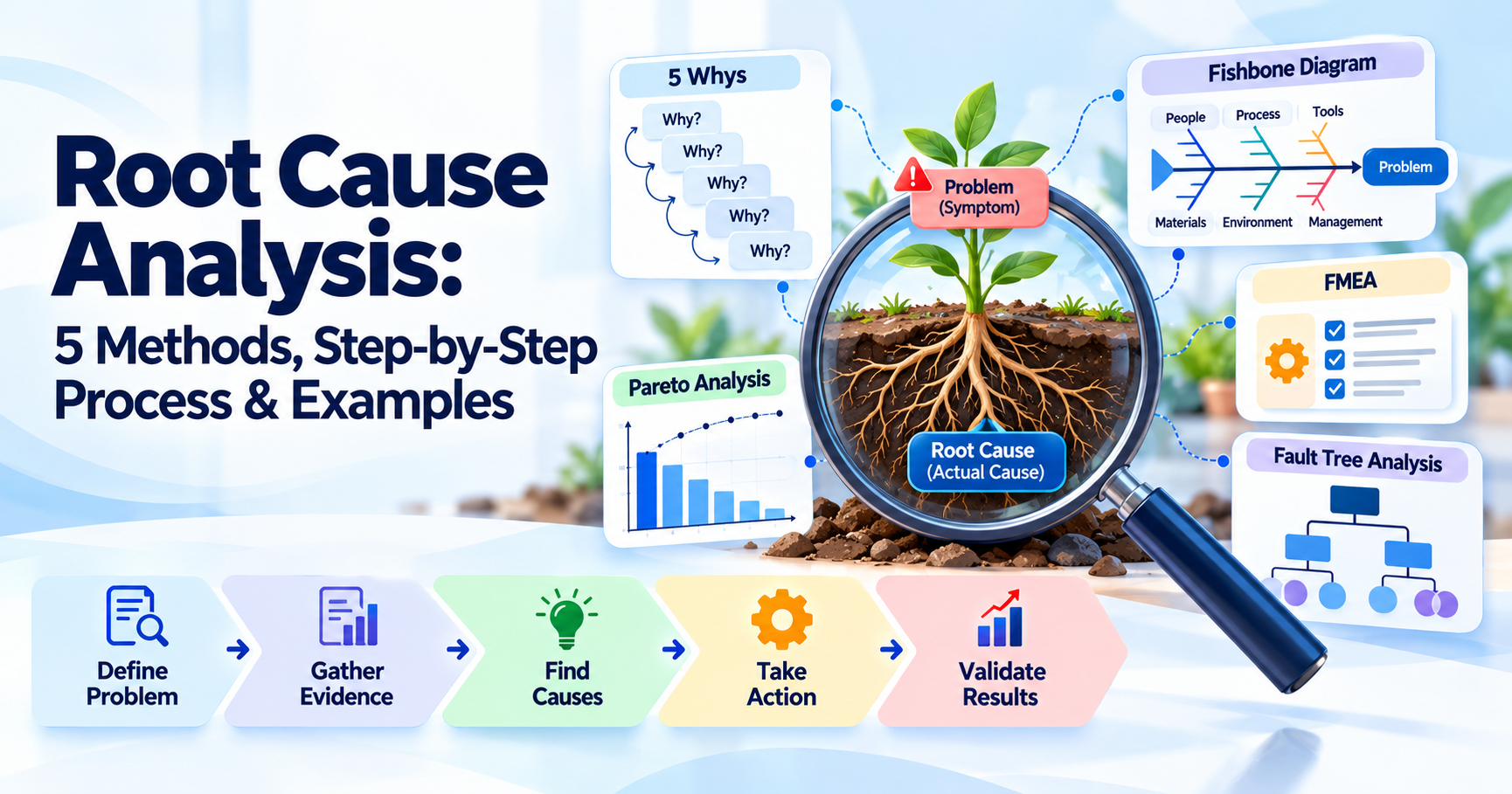
Root cause analysis (RCA) is a methodical approach to identifying the cause of a problem rather than just the symptoms. The idea is to find the root cause, fix it, and reduce the chance of the same problem recurring.
Common root cause analysis methods are 5 Whys, fishbone diagrams, Pareto analysis, FMEA, and fault tree analysis. The choice of approach depends on how much data you have, how complex the cause-and-effect relationship is, and the nature of the problem.
The typical root cause analysis process starts with the definition of the problem, collection of evidence, identification of possible causes, determination of the root cause, and implementation of corrective actions. This last step is important, as a team’s discovery of a possible cause does not mean that the RCA is complete. The team has to verify if the solution worked.
Key Highlights of Root Cause Analysis
- Root cause analysis looks beyond the visible symptom of a problem.
- RCA can be used in quality, IT, software, operations, projects, and Agile teams.
- The 5 Whys is useful for simple problems with a fairly clear chain of causes.
- A fishbone diagram works well when several possible causes need to be considered.
- Pareto analysis helps teams focus on the causes creating the biggest share of problems.
- FMEA helps identify and assess possible failures before they cause serious problems.
- Fault tree analysis is useful when a failure has several connected causes.
- Good RCA depends on evidence, not assumptions or personal blame.
- Corrective actions should be tracked and checked after implementation.
Introduction
Problems are part of almost every workplace. A software release can have a serious bug. A project can miss an important deadline. A customer may receive the wrong product. A team may keep facing the same issue even after fixing it several times.
In many cases, people deal with the immediate problem and move on. That may solve the issue for a few hours or days, but it does not always stop it from coming back.
This is where root cause analysis becomes useful.
Root cause analysis gives teams a way to slow down, look at what happened, and understand why it happened. Instead of asking only, "How do we fix this?" the team also asks, "What allowed this problem to happen in the first place?"
RCA is used across quality management, project management, software development, operations, and Agile ways of working. The basic idea is simple: fix the problem at its source rather than repeatedly treating the same symptom.
What Is Root Cause Analysis?
Definition and Purpose
Root cause analysis is a systematic approach to determine the root causes of a problem or an undesired event.
It’s not just a meeting to talk about what went wrong. A thorough RCA is based on facts, observations, records, data, and team knowledge to provide a clear explanation of the problem.
The point is not to find someone to blame. The idea is to find something that we can change.
For example, suppose a customer report arrives two days late.
The immediate explanation might be that an employee forgot to send the report, but stopping there is not the whole story.
Why did the employee stare blankly?
Maybe the deadline was not looming.
Why could it not be seen?
There was no common tracking system.
Why wasn't there a tracking system?
Ownership of the report was never clearly defined.
The team has gone from a one-off mistake to a process problem that can actually be solved.
This is the reasoning behind root cause analysis.
Root Cause vs. Symptom vs. Contributing Factor
These three words are easy to get mixed up.
A symptom is what you see happening.
"Contributing factor" is something that helped create or make the problem worse.
A root cause is a condition that, if fixed, will prevent the problem from happening again or greatly reduce the chance of it happening.
Imagine a website that goes down when it’s busy.
The symptom is that the site goes down.
Another possibility is that there’s a sudden surge in traffic.
This may be because capacity planning does not take into account expected growth in traffic.
The answer will depend on the evidence. This is why a good root cause analysis avoids premature conclusions.
Why RCA Matters for Continuous Improvement?
RCA is very much connected with continuous improvement. If teams are only reacting to problems as they happen, they can never continuously improve.
Done correctly, RCA can help teams identify weaknesses in processes, communication, planning, testing, training, tools, or decision-making, the foundation of anyprocess improvement effort.
This can lead to a change that helps to prevent a number of future problems, not just the one that is being investigated.
Hence, the value of RCA is not only in solving today’s issue. It can also help a team to develop a stronger way of working.
When to Run a Root Cause Analysis?
Defects, Incidents, and Missed Goals That Follow
A root cause analysis can be helpful after a serious incident, a repeated defect, a missed deadline, a failed deployment, a customer complaint, a quality issue, or a project setback.
But every little problem does not need a formal RCA.
A long analysis would waste time if someone makes a small mistake once and it doesn’t have a wider impact. RCA is more useful the more serious, repeated, costly, risky, or likely to happen again the problem is.
One useful question is:
If we solve this problem today, is there a good chance it will recur?
If the answer is yes, it would be worth exploring the reasons why.
In Inspect and Adapt and Retrospectives
RCA can also be used as part of the Agile improvement activities such as thesprint retrospective.
The teams discuss what worked, what didn't work, and what we should change. If an issue keeps occurring, root cause analysis can help the team go deeper instead of putting in another temporary action.
In SAFe, the Inspect and Adapt event features a structured problem-solving workshop that addresses large systemic problems. The SAFe guidance explicitly ties this work to root cause analysis, Fishbone, 5 Whys, and Pareto analysis.
The Main Root Cause Analysis Methods
No single RCA approach will apply to every situation. The root cause analysis techniques are designed to help teams see problems from different angles.
5 Whys
The5 Whysis one of the simplest root cause analysis techniques.
The idea is to keep asking “Why” until the team gets to a root cause. Five is not a fixed number. Some problems might take three questions. Others might take six or seven.
For instance:
Problem: Delay in Shipment of Customer Order.
Why? The order was not packed in time.
Why? The packing team got the order late.
Why? The order was okayed late.
Why? Information pending approval. Missing.
Why? The original order form lacked some required information.
The last problem might be a poor order-entry process, not a lag by one worker.
You can also refer to this detailed guide on the 5 Whys to learn the technique in depth.
The 5 Whys works very well if there is a relatively clear cause-and-effect chain. SAFe also includes 5 Whys as a problem-solving practice used during Inspect and Adapt.
Fishbone (Ishikawa) Diagram
A fishbone diagram is useful when a problem can have multiple possible causes.
At one end is written the problem, with possible causes branching off the main line. Teams can categorize reasons according to their situation.
For instance, a software defect could be:
- Folks
- Procedure
- Equipment
- Information Technology
- Testing Requirements
- Environments
Then the team can explore each area rather than latch onto the first explanation that comes to mind.
The fishbone diagram, also called the cause-and-effect diagram, is a tool that helps teams identify potential causes and organize them in a meaningful way, according to ASQ.
For a different explanation, see theFishbone Diagram guide.
A fishbone diagram is useful for group discussions because it provides a common perspective of possible causes. It is one of the most widely usedSix Sigma Green Belt tools.
Pareto Analysis (the 80/20 Rule)
Pareto analysis assists teams in choosing where to begin when there are many problems or causes.
A Pareto chart sorts categories by importance, typically from highest frequency or impact to lowest. This makes it easier to identify which areas need to be looked at first.
Say, for example, a support team logs 500 customer complaints and discovers that:
- 220 are related to login problems
- 140 are payment problems
- 80 are related to delivery status
- 40 are settings for your account
- 20 are concerning other issues
The team doesn’t have to fix everything at once; they can start with the biggest category.
Pareto analysis does not tell you the root cause automatically. It helps you know where to focus your investigation.
Failure Modes and Effects Analysis (FMEA)
FMEA stands for Failure Mode and Effects Analysis. FMEA is a systematic approach for identifying the possible failure modes and their effects and causes.
While RCA is often done after something has gone wrong, FMEA can be used proactively to think about what could go wrong before it happens.
For example, a team launching a new payment process might list potential failure modes such as invalid payment status, duplicate payments, or failed confirmation messages.
Then the team can evaluate each possible failure to decide which risks need to be addressed first.
Learn more about it inWhat Is FMEA Analysis.
FMEA is also among the quality tools recognized by ASQ.
Fault Tree Analysis
Fault tree analysis begins with an undesirable event and traces backward to the conditions that could produce it.
It is useful for a complex problem, and several events may have to occur together before the failure happens.
A system outage, for example, might be a combination of a server failure, an unavailable backup, and a monitoring gap.
Fault tree analysis helps teams to map these relationships instead of treating each event as an isolated issue.
For small day-to-day issues, it is often not so useful, but for complex technical or safety-related problems it can be useful.
Scatter Diagrams and the Five Ws
Scatter diagrams can help teams determine whether there may be a relationship between two variables. For example, a team might compare the number of defects to the volume of production, or the response time to the workload.
Scatter diagrams do not prove cause-and-effect relationships between variables. They just help to see patterns worth investigating.
The Five Ws approach asks questions like What, Where, When, Who, and Why to build a clearer picture of the problem.
ASQ lists scatter diagrams as one of the basic quality tools, along with cause-and-effect diagrams and Pareto charts as common quality tools.
How to Conduct a Root Cause Analysis Step by Step?
The following root cause analysis steps can work for many business, project, quality, and software problems.
Step 1: Precisely Articulate the Problem
Begin with a specific problem statement.
Do not make statements such as:
“Things went wrong.”
Instead, write something measurable:
“The release was delayed by 3 working days because the final testing was not finished on the planned date.”
A good problem statement describes what happened to the team, not why it already happened.
You may include:
- What happened?'
- When did this happen?
- Where did this happen?
- How did it happen? How often?
- What was the effect?
We all begin in the same place.
Step 2: Gather Data and Evidence
Then collect information about the event.
Depending on the problem, this might involve:
- Project files
- Complaints from customers
- Error log files
- Test Result
- Process the docs
- Timelines
- Team Comments
- Performance information
- Screenshots
- Email or approval trail
This is one of the most important root cause analysis techniques, as assumptions can easily lead the investigation astray.
If the team believes that a process failure was due to poor training, the team should review the records and talk to the employees involved before concluding that training was to blame.
Step 3: Determine Possible Causes
Now list all the things that could have caused the problem.
This is where fishbone diagrams, brainstorming, the five Ws, and other root cause analysis tools can help.
Do not remove a possible cause just because it sounds unusual.
The objective at this stage is to produce a sensible list. The team can look into the causes later.
Step 4: Identify Root Causes
Once you've got a list of possible causes, begin to test them against the evidence.
Ask:
- Is there evidence that this is the cause?
- Are we able to reproduce the problem?
- Did this condition exist at the time the problem occurred?
- If we take away this condition, would it solve the problem?
- Are there other causes?
This step isolates a possible cause from a root cause that has been supported.
The 5 Whys might be helpful here. A fishbone diagram also helps the team to organise causes before investigating them.
Step 5: Implement and Validate Corrective Actions
Once you know what caused it, decide what needs to be different.
A corrective action is not a band-aid; it is a cure for the cause, not the symptom.
If incorrect reports stem from a lack of validation, telling employees to be more careful is not the right corrective action.
A more robust method may be to have an automated validation check prior to report submission.
Then the team needs to measure the result.
The action may be successful if the problem disappears. If it does come back, the team may have to go back to the RCA.
It's the final check that makes root cause analysis a process for improvement and not a discussion.
Root Cause Analysis Example (Worked)
Consider a software team that has just released a new feature. Several customers report within one week that the feature stops working after a specific action.
The first sign is a broken feature.
The team begins by checking the error logs. They discover that the problem occurs when a specific data field is left blank.
The first explanation is that the developer forgot to deal with the empty field.
The team employs the 5 Whys.
What was wrong with the feature?
The application did not process an empty field.
Why did it not handle an empty field?
The test case only used completed records.
Why did testing only use completed records?
This is because the test data did not include incomplete records.
Why were there missing partial records?
This is because the requirements did not define empty fields as a possible state.
Why were those conditions not recognized?
There was no standard review of unusual or incomplete data during the refinement.
The root cause is more than just a missing line of code.
The team may respond by adding the missing test case. But it can also improve the review process so that similar data conditions are considered for future features.
This case is one of the more useful root cause analysis examples because it illustrates why stopping with the first technical cause may not be enough.
Choosing the Right RCA Method
Matching the Method to the Problem
Various problems require different root cause analysis methods.
If the chain of events in the problem is relatively simple, use 5 Whys.
Use a fishbone diagram when many potential causes need to be considered.
If you have a lot of data on problems and need to decide which to work on first, use Pareto analysis.
Use FMEA when you want to identify and assess potential failures before they occur.
Use fault tree analysis when a critical failure has multiple contributing conditions.
The method should aid in the investigation. There should be no additional paperwork.
Integrating Methods for Complex Problems
Occasionally one way isn’t enough.
A team might use Pareto analysis to identify the most common defect type first. It can then use a fishbone diagram to identify possible causes and the 5 Whys to explore the most likely cause. This layered approach mirrors the Analyze phase of theSix Sigma DMAIC process.
Tools for root cause analysis can help teams better understand a complex problem.
ASQ also points out that quality tools can be used in conjunction to help the improvement work.
Common Mistakes in Root Cause Analysis
Stopping at the First Reasonable Cause
The first explanation is not always the cause; "Someone made a mistake” may be true, but it is seldom the explanation for why the process allowed the mistake to occur.
Continue asking what situations permitted the mistake to occur.
Blaming People Instead of Fixing Processes
Blame reduces the usefulness of RCA.
Telling an employee to be more careful if they miss a step does not necessarily solve the problem of it happening again.
The more important question is whether the mistake was caused by the process, instructions, tools, workload, training, or system design.
“The idea is to make the system better, not to instill fear in reporting problems.”
No Follow-Through on Actions
A team can spend two hours figuring out causes and get nowhere unless the agreed-upon actions are followed through on.
Each corrective action shall be:
- Clear ownership
- A date to aim for
- A true result
- A way to check completion
A simple root cause analysis template may include these fields to make sure that actions don’t disappear after the meeting.
Best Practices for Effective RCA
Collaborative & Blame-Free Facilitation
Get people in the conversation who understand different pieces of the process.
A developer could understand the technical issue. The tester might know the scenario that was missed. The product owner may know the history of the requirements.
By merging these perspectives, we can see things that one person might miss.
Base Conclusions on Evidence
Use records and data whenever possible.
If a team says, “This situation often happens because of X,” then ask if the evidence you have supports that.
This habit prevents RCA from turning into a guessing game.
Track Actions to Closure
The cause found is only half the job.
Document the corrective action. Assign ownership and set a date for the review to determine whether the change achieved the expected result.
If the problem occurs again, reopen the investigation rather than closing the original action.
Root Cause Analysis for SAFe Scrum Masters
Root cause analysis has a practical application in agile environments.
A Scrum Master or Agile facilitator is often a third party who helps a team identify blockers, recurring problems, communication gaps, quality issues, and process weaknesses. In SAFe, problem-solving also happens during the Inspect and Adaptevent.
The SAFe framework describes its Problem-Solving Workshop as a structured method for identifying root causes and actions for systemic problems.
Enabling Blameless RCA in Agile Teams
A Scrum Master should help create an environment where people can talk openly about what happened.
Don't ask:
"Who did this?
question:
"What happened?”
“What were the conditions for it?”
“What enabled the issue to go into production?”
“What can we alter?”
The Scrum Master can help the team choose an appropriate way of working, keep the discussion focused, capture the evidence, and turn findings into actionable improvements.
SAFe Scrum Master Certification Trainingcan also help professionals working with scaled Agile teams get a better understanding of the Scrum Master role in an SAFe environment.
In SAFe, Inspect and Adapt specifically includes root-cause problem solving, and the current facilitator guidance lists Fishbone, 5 Whys, and Pareto as techniques Scrum Masters and Team Coaches should be familiar with.
Conclusion
Root cause analysis is not about finding someone to blame for a problem. It's about understanding why the problem happened and making a useful change.
The best RCA work begins with a problem statement and evidence. Teams can then apply different root cause analysis techniques such as 5 Whys, fishbone diagrams, Pareto analysis, FMEA, and fault tree analysis.
Corrective action and follow-up should be completed with the root cause analysis process. Without that last step, even a well-run investigation may have little lasting value.
RCA can be a regular part of continuous improvement for project teams, quality professionals, developers, Scrum Masters, and managers, and structuredRoot Cause Analysis trainingcan help teams apply these methods consistently. . The goal is simple. Solve today's problem and reduce the chances of having the same problem tomorrow.





_1738228225.jpg)



 Lowest-Price Challenge











 Personalized Path


.webp)


 USA
USA  Canada
 India
India UK
UK Australia
 Singapore


