


 Call Us



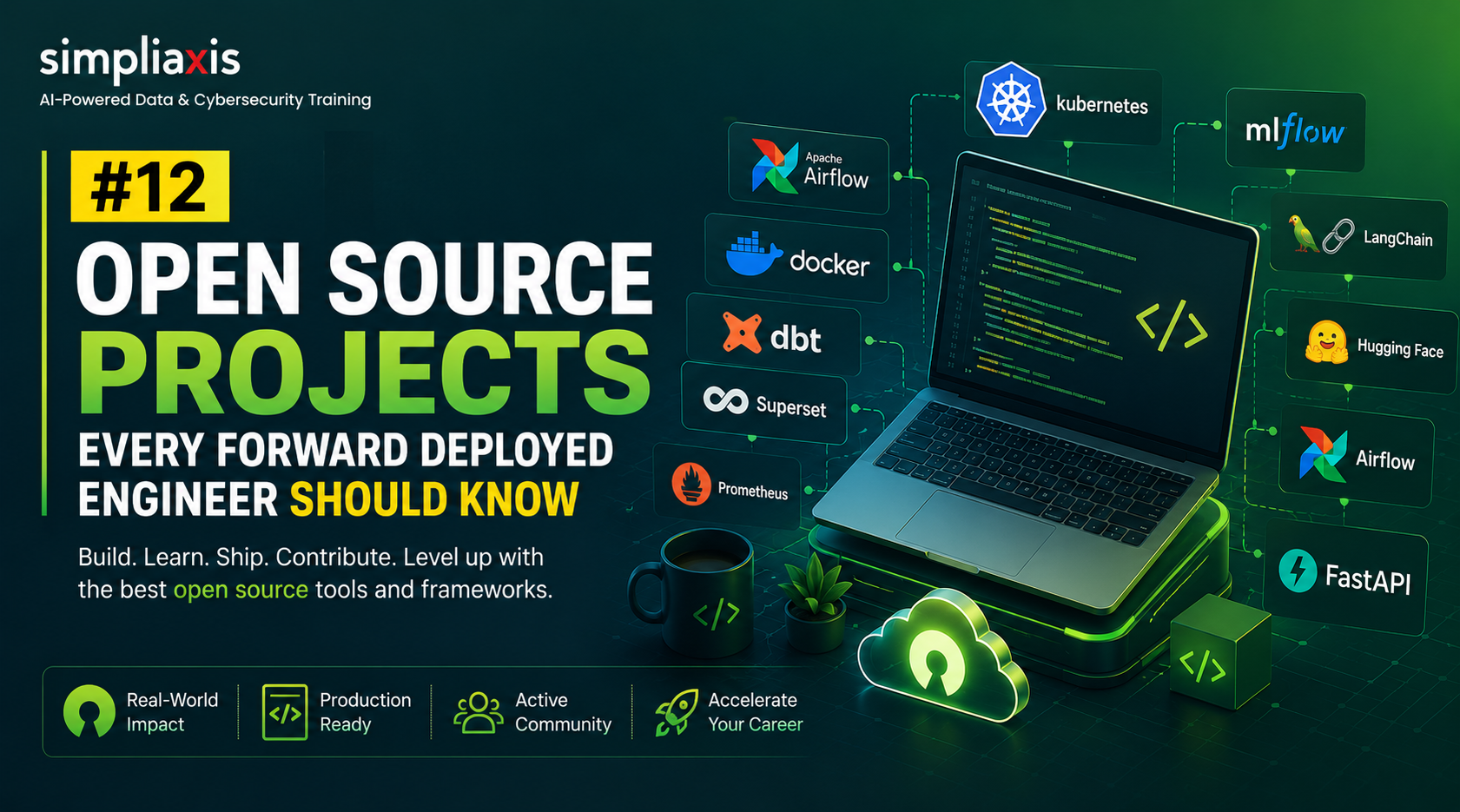
The most credible forward deployed engineers are fluent in the open-source projects that do the unglamorous heavy lifting of real AI systems, and knowing them signals that you build things rather than just talk about them. These are not the headline frameworks but the workhorse tools that solve specific, recurring problems in deploying AI: running models efficiently, parsing messy documents, ingesting data, validating quality, and tracking what you build. This piece walks through twelve open-source projects that show up repeatedly in forward deployed work, what each solves, and why familiarity with them separates engineers who ship from those who only prototype.
Open-source fluency matters especially in forward deployed work, because you often build inside customers who cannot or will not adopt proprietary services, and open tools you can run in their environment are frequently the only option. Building genuine command of this ecosystem, as part of what the Forward Deployed Engineering Program teaches, is what lets you assemble real systems from the tools available rather than depending on a single vendor.
Key Highlights
- These are the workhorse open-source tools that solve specific, recurring problems in deploying real AI, not the headline frameworks.
- Model-serving projects like vLLM and Ollama let you run models efficiently and locally, which matters when data cannot leave the customer's environment.
- Data and document projects like Unstructured, Airbyte, and Great Expectations handle the messy reality that makes enterprise AI hard.
- Tracking and lifecycle tools like MLflow and Prefect bring engineering discipline to AI systems that would otherwise be ad hoc.
- Open-source fluency lets you build inside customers who cannot adopt proprietary services, which is often the constraint that matters.
vLLM and Ollama: running models on your terms
vLLM is a high-performance open-source library for serving large language models efficiently, and it matters enormously when you need to run models with good throughput and control rather than calling a hosted API. For forward deployed engineers deploying in environments where models must run on the customer's own infrastructure, whether for data residency, cost, or performance reasons, vLLM is often the tool that makes self-hosted model serving practical, delivering the efficiency that naive serving cannot.
Ollama solves a related but distinct problem: running models locally with minimal friction, which makes it invaluable for development, prototyping, and deployments where a model needs to run on local or on-premise hardware. For a forward deployed engineer working in a restricted environment, or building against a model that cannot call out to a hosted service, Ollama provides a straightforward way to run capable models where the data is. Together, vLLM and Ollama represent the open-source answer to a recurring forward deployed problem: how to run models when you cannot simply call a managed cloud service, which is exactly the situation in the regulated and on-premise environments where much of the highest-value work happens. Knowing these tools means you can deploy AI where hosted services are not an option, which is a genuine differentiator in constrained settings that overlaps with building AI under data governance constraints.
LiteLLM: one interface across many models
LiteLLM solves a mundane but constant problem in real AI work: the friction of working with many different model providers, each with its own interface. It provides a single, consistent way to call models from many providers, so your code does not have to be rewritten every time you switch or add a model. For forward deployed engineers, who often have to work with whatever models a customer prefers or already uses, this abstraction is quietly valuable, letting you build against a stable interface rather than coupling your system to one provider.
The practical benefit is flexibility and portability. A system built on LiteLLM can switch between model providers with minimal change, which matters when a customer's preferences, constraints, or costs dictate the model choice, and when those choices may change over the life of an engagement. It also simplifies the common situation of using different models for different tasks, or falling back from one to another. This kind of provider-agnostic building is exactly the flexibility forward deployed work rewards, since you rarely control which models a customer wants and often have to accommodate their existing choices. LiteLLM is a small tool that solves a real recurring problem, which is precisely why experienced engineers reach for it, and it complements the orchestration frameworks that coordinate the larger system.
Unstructured and Sentence-Transformers: the retrieval toolkit
Two projects address the specific challenges of building retrieval systems on real documents. Unstructured is an open-source library for parsing and preprocessing the messy documents that enterprise retrieval systems have to handle, extracting usable content from PDFs, presentations, and the awkward formats that real enterprise knowledge lives in. Because the dirtiness of enterprise documents is one of the main reasons retrieval systems fail, a tool that helps turn messy real documents into clean, usable input is genuinely valuable, addressing exactly the problem that makes enterprise RAG break.
Sentence-Transformers is a widely used library for generating the embeddings that power retrieval, providing accessible, high-quality models for turning text into the vectors a retrieval system searches. Since the quality of embeddings directly affects retrieval quality, and since forward deployed engineers frequently build retrieval systems, familiarity with the tooling for generating good embeddings is important. Together, Unstructured and Sentence-Transformers cover two critical, unglamorous parts of building real retrieval: getting clean content out of messy documents, and turning that content into good embeddings. These are exactly the parts that tutorials skip and that real enterprise retrieval depends on, which is why knowing them marks an engineer who has actually built retrieval on real data rather than clean demo corpora.
Hugging Face Transformers: the model ecosystem
Hugging Face Transformers is the foundational open-source library and ecosystem for working with models, and familiarity with it is close to assumed for anyone doing serious AI engineering. It provides access to a vast range of models and the tools to work with them, and the broader Hugging Face ecosystem is where much of the open model world lives. For forward deployed engineers, this matters because real work often involves open models rather than only the big commercial APIs, whether for cost, control, data residency, or capability reasons.
Knowing the Hugging Face ecosystem means you can find, evaluate, and use the open models that suit a specific situation, which is essential when a customer's constraints rule out commercial APIs or when an open model is simply the better fit. It also connects to the whole open-model workflow, from finding a model to fine-tuning it to deploying it, much of which runs through Hugging Face tooling. For an engineer who may need to work with open models in a customer's environment, familiarity with this ecosystem is foundational, and it underpins much of the practical agentic AI engineering that the modern role involves. It is the open-source counterpart to the commercial model APIs, and real forward deployed work frequently requires both.
Airbyte and Great Expectations: the data foundation
Because enterprise AI is fundamentally data work, two projects that address the data foundation deserve a place in every forward deployed engineer's awareness. Airbyte is an open-source data-integration tool for moving data from where it lives into where an AI system can use it, addressing the constant challenge of getting a customer's scattered data into a usable place. Since so much forward deployed work involves connecting to and ingesting a customer's data from many sources, a tool that handles data integration is genuinely useful, and its open-source nature means it can run inside the customer's environment.
Great Expectations addresses data quality, providing a way to validate that data meets expected standards, which matters because AI systems are only as good as the data feeding them and enterprise data is notoriously unreliable. Building data validation into a system, so that bad data is caught rather than silently degrading the AI's output, is a mark of engineering discipline, and Great Expectations is a leading open-source tool for it. Together, Airbyte and Great Expectations represent the data foundation that AI systems depend on, moving data into place and ensuring its quality, which are exactly the unglamorous concerns that determine whether an enterprise AI system actually works. Neglecting them is a common cause of quiet failure, which is why experienced engineers treat the data foundation as seriously as the AI itself.
MLflow, Prefect, DuckDB, and Instructor: engineering discipline
A final group of tools brings engineering discipline and practical capability to AI work. MLflow is a widely used open-source platform for managing the machine-learning lifecycle, tracking experiments, models, and their versions, which brings order to what would otherwise be ad hoc model development. Prefect is a modern workflow-orchestration tool for building and managing the data and processing pipelines that AI systems depend on, providing reliability and visibility for the pipelines that feed and support an AI system.
DuckDB is a fast, in-process analytical database that has become popular for data work because it lets you query and analyse data efficiently without standing up a separate database server, which suits the kind of contained, practical data work that forward deployed engagements often involve. Instructor addresses a specific modern need: getting reliable, structured output from language models, so that a model's output can be used programmatically rather than parsed from free text, which is essential for building dependable systems on top of models. Each of these tools solves a real problem that comes up in building production AI, and together they represent the engineering discipline, lifecycle management, orchestration, efficient data work, and reliable outputs, that separates robust systems from fragile ones. Knowing them means you can bring real engineering rigour to AI work, which is exactly what building systems that survive production requires and what the evaluation and observability discipline complements.
Why open source matters more in forward deployed work
It is worth dwelling on why open-source fluency matters more in forward deployed work than in many other engineering roles, because the reason is structural rather than ideological. A forward deployed engineer builds inside customers' environments, and those environments come with constraints that frequently rule out proprietary hosted services. Data cannot leave the environment, so a managed service that requires sending data out is a non-starter. Budgets or procurement rules may forbid a particular vendor. Security policies may prohibit external dependencies. In each case, an open-source tool that can run inside the customer's own environment is not just a preference but the only workable option.
This is why the forward deployed engineer who knows the open-source ecosystem well has a real advantage: they can build in situations where an engineer who only knows proprietary services is stuck. When a customer's constraints rule out the hosted option, the ability to reach for a capable open-source alternative that runs on the customer's own infrastructure is what lets the work proceed at all. This is the same fit-the-customer principle that governs every technology choice in the role, from cloud platforms to vector stores, applied to the whole toolchain. The engineer who insists on proprietary tools limits themselves to the customers who permit them, while one fluent in open source can serve the many customers, especially in regulated sectors, whose constraints demand it. That flexibility is a genuine differentiator, and it is why open-source fluency is worth building deliberately rather than picking up incidentally.
How to build fluency across the ecosystem
Given how many tools matter, a fair question is how to build genuine fluency across the open-source ecosystem without trying to master everything at once, and the answer is to focus on the categories rather than the individual projects. The categories, model serving, retrieval, data, lifecycle, and reliable outputs, are stable even as the specific tools within them change, so an engineer who understands what each category does and has hands-on experience with a leading tool in each can adapt to whatever specific project a situation calls for. Depth in the categories transfers; memorising a fixed list does not.
The practical path is to build real things with representative tools from each category, because hands-on use teaches what documentation cannot: how the tool behaves, where it breaks, and when it is the right choice. An engineer who has actually served a model with vLLM, parsed real documents with Unstructured, and validated data with Great Expectations understands those categories in a way that reading about them never conveys, and that understanding transfers to adjacent tools. This is why building genuine capability through hands-on practice, in the agentic AI foundations that underpin the modern role and the applied engineering with agents that puts the tools to work, matters more than surveying the ecosystem passively. Fluency comes from building, and the categories are what make that fluency durable as the specific tools evolve. That durable, category-level command is what the Forward Deployed Engineering Program is built to develop.
The twelve projects at a glance
To fix the picture, here is what each project solves and why it matters in forward deployed work.
| Project | What it solves | Why it matters in the role |
| vLLM | Efficient model serving | Self-hosting models in the customer's environment |
| Ollama | Running models locally | Development and on-premise deployment |
| LiteLLM | One interface across providers | Provider-agnostic, portable systems |
| Unstructured | Parsing messy documents | Real enterprise retrieval on real documents |
| Sentence-Transformers | Generating embeddings | The quality retrieval depends on |
| Hugging Face Transformers | The open model ecosystem | Working with open models when APIs will not do |
| Airbyte | Data integration | Getting a customer's scattered data into place |
| Great Expectations | Data quality validation | Catching bad data before it degrades output |
| MLflow | ML lifecycle management | Order and versioning in model development |
| Prefect | Workflow orchestration | Reliable data and processing pipelines |
| DuckDB | Fast in-process analytics | Efficient data work without a server |
| Instructor | Structured model outputs | Reliable, programmatic use of model output |
Read the table as a map of the real, unglamorous problems that forward deployed AI work involves, and the open-source tools that solve them. Fluency across these marks an engineer who has actually built production systems, because these are the tools you reach for when you move past the demo into the messy reality of real deployment.
The bottom line
The open-source projects that matter most in forward deployed work are the workhorse tools that solve specific, recurring problems: running models efficiently and locally with vLLM and Ollama, staying provider-agnostic with LiteLLM, building real retrieval with Unstructured and Sentence-Transformers, working with open models through Hugging Face, laying a solid data foundation with Airbyte and Great Expectations, and bringing engineering discipline through MLflow, Prefect, DuckDB, and Instructor. None of these is a headline framework, and all of them solve problems that real deployment cannot avoid.
Fluency across this ecosystem is especially valuable because forward deployed engineers often build inside customers who cannot adopt proprietary services, making open tools that run in the customer's environment the only viable option. Knowing these projects signals that you build real systems rather than prototypes, and it equips you to assemble working solutions from the tools available. Building that command, as part of the practical capability the Forward Deployed Engineering Program develops, is part of becoming an engineer who ships production AI rather than one who only demos it.
A closing thought: the open-source ecosystem is where much of the real innovation in applied AI now happens, so staying engaged with it is not just a matter of having tools available but of staying current with how the field is actually advancing. The engineer who follows and uses these projects is plugged into the leading edge of practical AI, which is exactly where a forward deployed engineer needs to be.
The engineers who know this ecosystem well can assemble a working system from open components in situations where others are stuck waiting for a vendor, which is a quiet but real advantage in the constrained environments where the role so often operates.






 Lowest-Price Challenge










 Personalized Path


.webp)


 USA
USA  Canada
 India
India UK
UK Australia
 Singapore


