


 Call Us




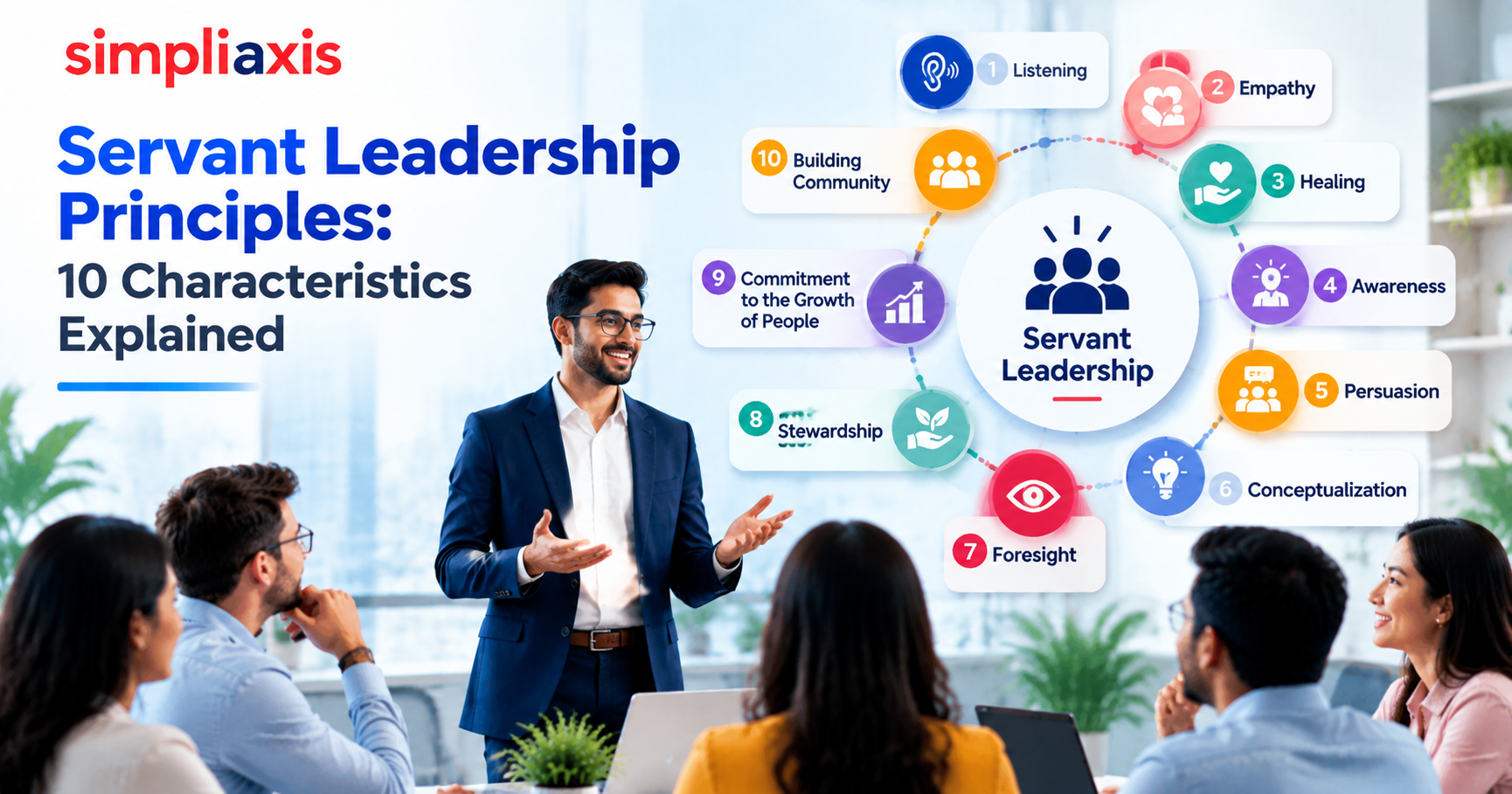
Servant leadership principles talk about a leadership approach where the leader seeks to serve, develop, and build up others instead of depending on control and authority to lead. The modern concept first appeared in Robert K. Greenleaf’s essay The Servant as Leader in 1970.
In 1998, Larry Spears pointed out ten characteristics from Greenleaf’s writing. These servant leadership characteristics are healing, listening, empathy, awareness, persuasion, conceptualization, foresight, stewardship, building community, and commitment to the growth of people.
These traits aren’t just a list of personality traits that servant leaders need to check; they teach leaders how to practically build trust, make decisions, help people, and create better organizations. This fits Agile setups, where Agile leadership principles call on Scrum Masters to promote collaboration, remove obstacles, guide teams, and help them become more self-sufficient.
Key Highlights of Servant Leadership Principles
- Servant leadership puts people and their growth at the center of leadership while still being accountable for the goals of the organization.
- Servant leadership stemmed from Robert K. Greenleaf’s essay, The Servant as Leader. Larry Spears later identified ten servant leadership characteristics from it.
- The ten servant leadership characteristics are listening, empathy, healing, awareness, persuasion, conceptualization, foresight, stewardship, building community, and commitment to the growth of people.
- Servant leadership isn’t about being passive and letting teams make decisions without any guidance. It is a combination of influence, accountability, and service.
- Servant leadership principles can be practiced through day-to-day activity like listening, promoting self-sufficiency, removing blockers, coaching, and building up team members.
- Servant leadership principles are great for Scrum Masters since they closely tie themselves to Scrum principles like empowerment, facilitation, and coaching.
Introduction
Servant leadership is very different from traditional leadership.
Conventional leadership is associated with traits like control and authority, which places leaders at the top of a hierarchy. Often at times, leaders might begin with the question:
“How can I make sure that people contribute to the goal?"
But in servant leadership, leaders begin with a different type of question:
“How can I help the people I lead learn, grow, succeed, and effectively contribute?”
Servant leadership doesn’t get rid of authority or put employee preferences over business goals. Instead, leaders get to use their role to create spaces where employees can perform in the best way possible.
The idealology of servant leadership is attributed to Robert K. Greenleaf, who argues that the desire to serve others should come before the desire to lead. Later, American scholar Larry Spears identified ten central servant leadership characteristics from Greenleaf’s writings.
These servant leadership principles and characteristics help professionals have a structure to understand what this type of leadership looks like in practice.
This is very suitable for Agile environments, since leaders like Scrum Masters don’t lead teams through authority. Instead, they help make the way their teams work better, promote collaboration, guide stakeholders, and help with obstacles that might block the team’s workflow.
Servant leadership means creating the right environment for people to succeed.
What Is Servant Leadership?
Servant leadership is a leadership style in which leaders focus on growing and helping employees while simultaneously meeting the goals of the organization.
It’s different from situational leadership, where leaders adapt their behaviour to the needs of the moment. It also underpins Lean-Agile leadership.
The primary foundation of servant leadership was established by Robert K. Greenleaf in his pivotal essay The Servant as Leader. His central argument, that good leadership begins with the desire to serve, creates a radical relationship dynamic between leaders and employees. The concept is maintained today by the Robert K. Greenleaf Center for Servant Leadership.
This radical concept does not do away with leadership as a whole. Servant leaders still give directions, make calls during critical circumstances, and hold people accountable.
What’s changed is the way they exercise their leadership.
Servant leaders don’t dictate their teams; instead, they build trust and relationships, listen, empower, persuade, and coach them. In fact, Spears lists persuasion as one of the ten servant leadership characteristics since leaders aim to influence their teams through reasoning and agreement and not forced compulsion.
But it's important to know the difference between servant leadership characteristics and personality traits. A person looking to become a servant leader does not need to naturally have all the characteristics before becoming one. They can be built through reflection, feedback, practice, coaching, and experience.
The 10 Principles of Servant Leadership
The ten principles of servant leadership usually describe the ten characteristics pointed out by Larry Spears from Robert K. Greenleaf’s essay.
Spears describes them in Character and Servant Leadership: Ten Characteristics of Effective, Caring Leaders.
The ten characteristics are
- Listening
- Empathy
- Healing
- Awareness
- Persuasion
- Conceptualization
- Foresight
- Stewardship
- Commitment to the Growth of People
- Building Community
1. Listening
Listening is a fundamental characteristic of servant leadership.
While traditional leadership styles talk about how a good leader needs the ability to clearly communicate and make decisions, servant leadership takes it a step further add another requirement: a good leader must learn how to listen to truly understand what people need.
Servant leaders don’t just listen to what is being said; they also pay attention to what is being left unsaid through agreements, disagreements, and other patterns in team behavior.
So, how would this look in practice?
If an employee says, “This deadline is becoming difficult to meet.” A good servant leader might follow up with these questions
- What support could help make it easier?
- What is making the deadline difficult to meet?
- Is there something in the process we should change?
- What part of the task is creating the biggest challenge?
The goal isn’t just to hear what’s being said; it’s also to understand the needs that lie underneath.
Take this example:
A Scrum Master notices that developers rarely flag issues during the daily stand-up.Instead of assuming that there aren’t any blockers, the Scrum Master talks to team members individually to listen to their concerns. This helps them discover that people are hesitant to interrupt discussions because they feel the meeting is too short to have such conversations.
After this revelation, the Scrum Master works with their team to make standup better.
2. Empathy
Empathy is having the ability or making honest efforts to understand the feelings, circumstances, and experiences of another person.
A good servant leader realizes that each employee brings something unique to the workplace, since each has a different background, set of strengths, concerns, and even challenges.
Having empathy doesn’t mean you accept poor outputs or agree with every decision made by a team member; it means understanding where they come from before choosing how to respond.
So, how would this look in practice?
Let’s say an employee's performance level drops all of a sudden. Rather than immediately labeling them as uncommitted, a servant leader will try to understand what the change might have been caused by.
That means they:
- Take different perspectives into consideration
- Ask questions before jumping to conclusions
- Separate a person’s behavior from their identity
- Respond to mistakes with curiosity
This characteristic is especially important during conflicts. Combined with practical conflict management skills, it turns blame into constructive problem-solving.
3. Healing
Healing is an unconventional servant leadership characteristic since it's not related to performance or productivity.
But that doesn’t make it any less important.
Healing, in this context, means helping people recover from stress, setbacks, conflict, and difficult experiences while giving them all the support that they need. Spears has this as one of the ten characteristics since servant leadership understands that employees aren’t just expendable resources to get outputs from.
A leader can’t solve every personal problem an employee goes through, but they can create an environment where people can recognize setbacks, learn from errors, and recover without getting blamed unnecessarily.
For example, if a project fails because of a wrong technical decision, a servant leader pays attention to what went wrong and what the team can learn from it rather than looking for someone to blame.
In practice, healing would look like
- Encouraging people to reflect after failures
- Creating psychological safety around mistakes
- Treat setbacks like learning opportunities
- Give people the space to recover after difficult situations
4. Awareness
Awareness means understanding yourself, other people, the environment under which you operate, and the relationships between each.
The sub-characteristic of self-awareness is especially important for leaders since they can unintentionally influence teams through their reactions, tones, preferences, and assumptions.
A self-aware leader should ask themselves these questions:
- Do I dominate conversations?
- What leadership behaviors should I improve or change?
- How do I respond under pressure?
- Do people feel comfortable disagreeing with me?
- Are there biases that influence my decisions?
Once leaders are self-aware, it might lead to scenarios like this:
A manager realizes that they become increasingly controlling as deadlines begin approaching. To change this practice, they stop automatically giving instructions and pause to ask the team what their recommended action plan is.
5. Persuasion
Servant leaders influence people by means of persuasion and not by the authority that their position gives them.
This doesn’t mean that servant leaders don’t make decisions; it just means that they try to build understanding rather than merely saying, “Do this because I said so.”
But persuasion isn’t just a one-sided conversation; it involves:
- Listening to conflicting views
- Providing evidence
- Justifying why decisions were made
- Helping people understand the need behind changes
Let’s take, for example, a team that needs to adopt automated testing. Rather than adding the practice without discussion, the leader shows how repeated bugs and errors cause delays and works with the team to develop an appropriate method to handle it.
Persuasion isn’t about getting the team to comply with decisions; it's about helping them understand why the changes matter.
6. Conceptualization
Conceptualization helps servant leaders think beyond immediate needs and imagine broader, future goals.
If a leader just aims at completing today’s task, they might be able to deliver short-term results but might miss out on chances to make the organization better.
That is why servant leaders need to find a balance between achieving immediate responsibilities and meeting long-term goals. Larry Spears describes this servant leadership characteristic as the ability to “dream great dreams” and think beyond daily targets.
A leader who is able to conceptualize should be asking these questions:
- What capabilities will we need in the future?
- What should the team look like in a year from now?
- What would make this process better?
- What recurring problem should we address instead of constantly working around it?
For example, instead of asking developers to constantly work overtime to meet deadlines, a leader can think about a future process where there is better prioritization, automation, and lasting delivery practices.
7. Foresight
Foresight involves contemplating the consequences of decisions that are made.
It means having a holistic collection of experiences from the past, circumstances of the present, and possible outcomes of the future. Spears sees foresight as a characteristic that can help servant leaders brace for consequences and rely on experiences to make decisions.
A leader using foresight might ask:
- What happened the last time we made a similar choice?
- What can this choice lead to in the next three months?
- What risks might we be ignoring?
- What unforeseen consequences might take place?
Let’s say, for example, a team wants to skip testing to meet the deadline for a release. A leader with foresight will consider the consequences: product defects, customer dissatisfaction, and technical debt.
8. Stewardship
Stewardship means staying true to the leadership role and responsibility placed upon them and treating leadership with integrity.
A servant leader recognizes the responsibility entrusted upon them and views the organization, team, budget, and other factors as things to protect and improve.
Leaders can practice stewardship in these ways:
- Maintaining trust with stakeholders
- Ethical decision-making
- Mindful usage of resources
- Protecting the well-being of the team
Let’s look at this scenario: A manager gets a budget increase. Before going ahead and spending it on expanding their own department, they see which investments would give the most value for the organization, employees, and customers.
9. Commitment to the Growth of People
An honest commitment to helping people grow is one of the most important servant leadership principles.
A good leader is aware that employees have value that goes beyond the immediate output they produce. So, they must help them build up their capabilities instead of limiting them.
It might look like developing the following:
- Leadership abilities
- Technical skills
- Decision-making
- Confidence
- Career Development
- Self-sufficiency
Let's say, for example, that a manager observes that a junior employee has strong analytical skills but rarely takes part in discussions with stakeholders. To help them grow, the manager slowly starts to give them chances to present findings and proceeds to mentor them afterwards.
This characteristic is important for Scrum Masters, since they help their teams become more self-organizing and productive.
10. Building Community
Community building helps create valuable relationships and a sense of belonging in the organization.
Even though teams technically work together, just placing people in the same department doesn’t automatically build a community.
Servant leaders need to deliberately create environments where people can:
- Share knowledge
- Trust one another
- Ask for help
- Solve disagreements in a constructive way
In practice, this might look like having frequent knowledge-sharing sessions for a team that works from across different locations. These discussions give a platform for different employees to explain their work to one another, which improves not only their knowledge but also their relationships with one another.
Why the Principles Work Together
The ten servant leadership characteristics are the most effective when they work together as one system and not as isolated behaviors.
This is because a leader who has foresight but lacks empathy might make good strategic decisions but damage employee trust in the process, and a leader who might be empathetic towards employees but doesn’t pay attention to organizational growth can help employees but lacks accountability.
Character and Trust as the Foundation
Trust is built through consistency.
Employees are a lot more likely to be trusting of a leadership that pays attention, shows empathy, honestly communicate, use their authority responsibly, and helps people grow.
But this doesn’t happen in one shot; it takes repeated interactions.
A leader can’t claim to take employee feedback seriously while continuously overlooking their concerns. Servant leadership principles are only reliable when behaviors match the values that are stated.
Balancing Service With Results
A belief that people get wrong is that servant leadership means giving more importance to employee needs and not business goals.
But that is not true. A good servant leader asks both
“What does my team need?" and “What does the organization need?”
The role of a leader is to balance both whenever possible.
Let’s say, if employees are having a hard time doing their work due to a large number of meetings, a good servant leader won’t simply cancel every meeting to make their team feel better. Instead, they would investigate which meetings provide actual value, remove unnecessary ones, and redesign important meetings so that it is easier for employees to manage.
A practice like this leads to better employee experience and the better utilization of organizational time.
How to Practice Servant Leadership Principles
The servant leadership principles explained above are just the beginning. It's not enough that you just know about them; you need to instill them into everyday practices
Everyday Behaviors That Signal Service
- Ask questions before you provide instructions
- Admit your mistakes
- Give team members credit for their tasks
- Listen to people without interrupting them
- Allow constructive disagreements
- Acknowledge the contributions of others
- Explain reasons behind important decisions
These behaviors lead to the growth of a leadership environment where people aren’t just seen as expendable resources but valuable contributors to the business.
Coaching and Developing Others
Another way to show servant leadership is through coaching, a skill developed in Certified Agile Facilitator training.
You can exercise this by asking employees questions that help them build problem-solving skills instead of immediately giving them solutions.
So, instead of saying, “Do X and Y to solve this.”
You can ask:
“What options have you thought about?”
“Which choice do you think would make the most difference?”
“Is there anything you’re missing out on?”
Removing Obstacles for the Team
Servant leadership isn’t about doing everyone’s work.
It means identifying the things that stop people from being able to effectively work and help in removing them.
So, a leader might:
- Clarify conflicting priorities
- Improve processes that are unclear
- Fix unnecessary dependencies on approvals
- Secure access to tools that are required
These practices are relevant to Agile teams, especially since leaders build value by making the environment better and not by controlling individual tasks.
To see how these practices play out in real life, you can check out a few servant leadership examples.
Servant Leadership Principles for Scrum Masters
The relationship between Scrum and servant leadership is deep, especially since the role of a Scrum Master is to serve the Scrum Team, Product Owner, and organization by creating the right conditions for Scrum and continuous improvement to take place.
If you want to know more about the relationship between both, see why a Scrum Master is a servant leader.
The Scrum Master as a Servant Leader
The 2020 Scrum Guide describes Scrum Masters as ‘true leaders who serve the Scrum Team and the larger organization.A Scrum Master doesn’t work the way a traditional project manager does. They don’t assign tasks and control team members.
Instead, they help Scrum teams become more self-managing and effective.
This can look like
- Coaching team members
- Promoting collaboration
- Helping make Scrum events productive
- Helping organizations understand what Scrum is
- Encouraging transparency
Their responsibilities reflect a lot of Greenleaf’s servant leadership characteristics, like
- Listening: Scrum Masters listen for blockers, concerns, and patterns
- Awareness: Scrum Masters are aware of team dynamics and how their own actions have influence
- Persuasion: Scrum Masters coach and influence their teams and not control them
- Empathy: The Scrum Master keeps in mind the opinion of other people on their team.
Applying the Principles in Scrum Events
The principles of servant leadership can be seen in all Scrum activities:
During Sprint Planning:The Scrum master can help the team have a meaningful discussion about the sprint goal and understand the team capacity all without dictating what each person has to do.
During Scrum Standup:Instead of treating the standup as a daily status report, the Scrum Master helps the team look at their progress towards the sprint goal and helps them change their plan accordingly.
During Sprint Review:The Scrum Master promotes interaction with stakeholders and feedback since they are meaningful. They don’t treat the event as a mere presentation.
During the Sprint Retrospective:
it’s up to the Scrum Master to create an environment where team members can openly discuss problems and look for ways to improve without the fear of getting blamed.
During Sprint:The Scrum Master helps remove obstacles while also helping their team build the skills to independently tackle similar issues.
If you are a professional looking to develop the skills to become a Scrum Master, then the SAFe Scrum Master Certification Training can help you gain knowledge on Scrum and Agile practices and lead teams effectively in scaled work settings.
Conclusion
Servant leadership principles provide an approach to leadership that focuses on empowering, serving, supporting, and building other people while also being responsible for the outcomes of the organization.
Robert K. Greenleaf first introduced the modern concept of servant leadership in his essay The Servant as Leader, which Larry Spears further refined into these ten widely acknowledged servant leadership characteristics: empathy, listening, awareness, healing, conceptualization, persuasion, foresight, commitment to the growth of people, stewardship, and building community. While each characteristic is important in itself, its true value lies in how they work together.
Such traits are valuable for Agile teams, especially for Scrum Masters who can use the servant leadership principles in their day-to-day responsibilities. For example, coaching rather than dictating, facilitating, and not controlling, and removing blockers rather than taking over. These behaviors improve employee experience and productivity and make them more self-sufficient.
The bottom line is that servant leadership isn’t just about having a title, its describes the way a person uses the influence given to them. It's not just about whether a leader gets results, but more about whether their leadership makes the people around them more confident, capable, and effective.








 Lowest-Price Challenge












 Personalized Path



.webp)


 USA
 Canada
 India
 UK
 Australia
 Singapore


