


 Call Us




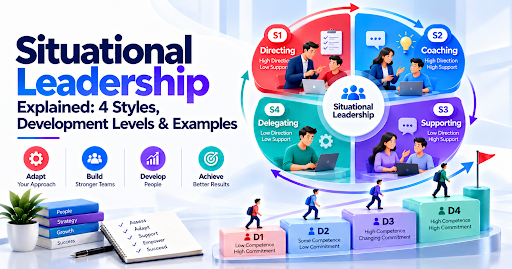
Situational leadership is a leadership style where leaders make changes in their behavior and approach based on the capability of a person or team and the nature of the task at hand.
There are four situational leadership styles:
- S1: Directing: High direction and low support
- S2: Coaching: High direction and high support
- S3: Supporting: low direction and high support
- S4: Delegating: low direction and low support
Which parallel these four development levels:
- D1: Low competence, high commitment
- D2: Some competence, low commitment
- D3: High competence, changing commitment
- D4: High competence, high commitment
Key Highlights of Situational Leadership
- Situational leadership means adapting leadership behaviors instead of depending on a fixed leadership style.
- Hersey and Blanchard’s situational leadership model has four styles: directing, coaching, supporting, and delegating.
- The four development levels help in explaining a person’s competence and commitment towards a certain task.
- Leaders can move between different leadership styles as a person’s capability, confidence, and commitment changes.
- Explore a few situational leadership examples to see why different employees might need different leadership styles to achieve their tasks
- Scrum Masters can use situational leadership to balance coaching, facilitation, support, and team autonomy based on how capable a team is.
Introduction
Let’s say two employees receive the same assignment. Employee 1 has done the task several occasions and knows what to do, but Employee 2, on the other hand, is doing the task for the first time and is not sure where to start.
Would using the same type of leadership style make sense in this situation?
Probably not.
Giving the experienced employee step-by-step instructions could put an unnecessary limit on the amount of autonomy they have, but at the same time, giving the inexperienced employee complete freedom and no guidance could leave them struggling to understand what to do.
The challenge of choosing what leadership style to use during different situations is just what situational leadership aims to solve.
Under situational leadership, leaders don’t try to identify what their leadership style is but take the adaptable route of asking:
“What does this person or situation need from me right now?”
And the answer for that question lies in the levels of skills, motivation, experience, and confidence a person has.
The situational leadership approach is handy in modern work environments where teams are diverse and priorities keep changing.
What Is Situational Leadership?
Definition and Core Premise
Situational leadership is where leaders make adjustments to their leadership approach based on the capabilities of a person or team and task requirements.
It grounds itself on this simple principle: there is no universal leadership style.
A leadership approach that works well for one employee might not be so great for another, and if there is a different situation or task at hand, the approach that might’ve worked well before might not be ideal now.
Let’s take this situation for example:
A software developer might be highly experienced in coding, but lacks experience when it comes to presenting to senior stakeholders.
So, they might need little direction in situations where they need to develop software but more help and guidance when preparing for their first presentation.
Origins With Hersey and Blanchard
The situational leadership model was first introduced in the late 1960s by Paul Hersey and Ken Blanchard, who spread the belief that no leadership style is perfect and should instead be adjusted based on what their followers need and how prepared they are. This page covers the 1969 origin and the later split into the Hersey model and SLII:Situational leadership theory – Wikipedia
The model combines these two leadership behaviors:
- Directive behavior: The level of instructions, expectations, explanations, and monitoring a leader gives or does.
- Supportive behavior: The level of listening, encouragement, involvement, motivation, and support a leader gives or does.
These two behaviors give rise to four distinct leadership styles.
Why There Is No Single Best Leadership Style
One of the biggest leadership mistakes is believing that a good leader needs to behave the same way in every situation.
Let’s say a highly democratic manager involves employees in every decision. While collective decision-making is important, an employee facing a critical deadline might need quick and clear instructions rather than prolonged conversations on what the best action plan could be.
Or take another example of a highly directive manager who loves to give extremely detailed instructions to everyone. While such guidance could be of great help to novices, experienced professionals might see the excessiveness of details as micromanagement.
But situational leadership provides an alternative that can cater to every situation.
So, a leader might be able to:
- Give a beginner detailed instructions
- Motivate an uncertain but experienced employee
- Entrust a task to a highly capable employee
The goal isn’t to label or categorize a leader based on how they lead but to gauge which behavior is most appropriate in a given situation.
The 4 Situational Leadership Styles
The four situational leadership styles stem from different combinations of directive and supportive leadership behaviors.
S1: Directing (Telling)
The directive style of leadership involves high directive behavior and low supportive behavior.
Here, leaders give clear instructions about:
- What needs to be done
- When it should be finished
- How it should be done
- What standards need to be followed
- How progress gets monitored
This style is perfect for employees with limited experience but high motivation levels.
But it isn’t meant to control them; the aim of directing a person is to give them enough structure and support until they’re able to perform the tasks by themselves. It reduces the number of uncertainties while helping employees develop their capabilities.
Let’s see this play out through this situational leadership style example:
A junior analyst is asked to prepare a monthly performance report for the first time. To help them out, the manager uses a directive leadership style and provides the analyst with a report template, explains each section, teaches them how to collect data, sets a deadline, and reviews the report once it's complete.
S2: Coaching (Selling)
The coaching style of leadership mixes high-directive behavior with high-supportive behavior.
Here, the leader doesn’t only provide direction but also spend time explaining decisions, answering questions, encouraging people, and involving them in problem-solving.
This is particularly helpful for reasonably capable employees struggling with motivation, consistency, or confidence. Hence, it combines instructions with encouragement.
Let’s take a look at this example:
A junior product coordinator knows how to create project schedules but grapples with changes requested by stakeholders. The manager uses the coaching leadership style to explain how to assess the changes, talk about possible responses, and encourage them to handle future requests independently.
S3: Supporting (Participating)
The supporting style of leadership has lower directive behavior and higher supportive behavior.
By this stage, an employee is well capable of executing tasks but can struggle to do them due to a lack of commitment, consistency, or even confidence.
Here, the leader doesn’t explain each step but focuses more on:
- Asking questions
- Encouraging employees
- Fostering decisions
- Removing obstacles
- Building confidence
- Listening to opinions
This leadership style pushes employees to determine how to complete the work at hand rather than having the leader take ownership of it instead.
Let’s see this situational leadership style in action:
A capable experience designer has been put in charge of leading a major task but lacks the confidence to do so after receiving critical feedback. The manager uses a supportive style of leadership to discuss the designers' concerns, provide helpful support, and give them the room to think of the best approach to the task.
S4: Delegating
The delegating style of leadership has low directive behavior and low supportive behavior.
That doesn’t mean that the leader stops caring about their employees or becomes unavailable; it simply means that a large part of task planning and execution is now under the ownership of the team.
This is best suited for employees who are highly competent, confident, and committed towards their tasks.
Take this situation for example:
An established project manager is given ownership over a project that they are familiar with. While they have the liberty to determine how it’s planned and executed, the leader still establishes the outcomes that are expected from it and some major constraints.
This ensures accountability is upheld while still giving autonomy.
The 4 Development Levels
Development levels measure how ready a person is to perform a certain task. This measurement accounts for both the commitment and competence of the individual. Blanchard’s own explanation of SLII styles and development levels:A Situational Approach to Effective Leadership – Blanchard
But these levels can’t be used to label a person permanently. Someone can be D4 for one task but D1 for another.
D1: Low Competence, High Commitment
A D1 individual has very limited experience or knowledge about a certain task but shows a lot of enthusiasm to know more about.
Here are some traits that are associated with this level:
- High enthusiasm
- Limited task experience
- Desire to learn
- Need for clear direction
One such example could be of a new but highly motivated employee. Although they might have little to no knowledge about how the company’s internal processes work, they show high levels of interest learn about them.
The best leadership style to use while dealing with people at this level is the S1 Directing. That means giving adeqate structure, instructions, expectations, and feedback.
D2: Some Competence, Low Commitment
Being at the D2 level implies that the person has a certain level of competence but might be facing frustration, declining confidence levels, and disappointment. Possibly because a task turned out to be more complex than initially thought to be.
Here are some common traits observed in this level:
- Moderate knowledge and experience
- Awareness of how complicated the task is
- Frustration or reduced motivation
- Need for guidance and encouragement
It's ideal for leaders to approach such individuals with the S2 Coaching leadership style.
Here, leaders give guidance but also explain the reasons behind decisions and motivate the person struggling to solve the task.
D3: High Competence, Variable Commitment
A D3 person has the capacity of getting tasks done but may not be able to show enough confidence or commitment towards it.
They might know just what to do but hesitate when it comes to making independent decisions.
Here are some common characteristics of the D3 level:
- Strong competence
- Wavering confidence or motivation
- Need for encouragement rather than detailed instructions
- Ability to work independently
The best way to assist such individuals is through the S3 Supporting leadership style.
Here, the leader is more focused on providing confidence, encouragement, building participation, and problem-solving skills in the person.
D4: High Competence, High Commitment
People at the D4 level have a high degree of competence, confidence, and commitment.
They can understand the task, make decisions by themselves, and are motivated enough to achieve the outcome expected of them.
Common characteristics seen in the D4 level:
- High confidence
- Consistent performance
- Strong competence
- Ability to work independently
- High commitment
The best leadership style to use with such individuals is the S4 Delegating leadership style. While leaders set the expectations, the individual still gets a considerable amount of freedom in how they want to complete the task.
Matching Leadership Style to Development Level
The S1-D1 to S4-D4 Mapping
This table gives a thorough mapping of each development level and what type of leadership style they match with.
Development Level | Typical Characteristics | Matching Style | Leadership Behavior |
| D1 | Low competence, high commitment | S1 Directing | High direction, low support |
| D2 | Some competence, low commitment | S2 Coaching | High direction, high support |
| D3 | High competence, variable commitment | S3 Supporting | Low direction, high support |
| D4 | High competence, high commitment | S4 Delegating | Low direction, low support |
You might observe that there appears to be progressive transfer of responsibilities from the leader to the employee.
At D1, the leader seems to be saying, “Here’s what you need to do," but by D4, the tone happens to be, “You have ownership over this. Let me know if you need anything.”
But this progression isn’t rigid and cannot be used to permanently label how capable an employee is. Someone’s development can move forward or backwards based on the task, circumstances, and their confidence level.
How to Diagnose Development Level
Leaders need to gauge an employee’s development based on the task that’s given to them, not just their job title or their overall experience.
To do this, ask these questions:
- Has this person performed this task before?
- Can they complete this task without too many instructions?
- Have they shown consistent performance?
- How motivated are they to complete the task at hand?
- Do they have the technical/practical skills to perform?
- Is there something that’s stopping them from doing their tasks?
- How confident are they?
For example, an employee with five years of experience could still be D1 when they’re given responsibility over an entirely new task.
And on the flip side, a junior employee may be D4 for a task that they do every day.
How to Apply Situational Leadership Step by Step
Step 1: Assess the Task and the Person
The first thing to do is separate the person and task. It’s important not to make assumptions about how much work a person can do.
So, don’t say, "She's experienced, so she doesn’t need guidance.”
Instead, ask, “How experienced is she with this task?”
It's important to measure the competence and commitment of the person.
Here are some useful questions to ask to understand a person’s capabilities better:
- How comfortable are you with the task?
- What parts are unclear?
- What have you independently handled before?
- How confident are you that you can complete this?
The goal of these questions is to identify what the person’s development level is.
Step 2: Choose the Matching Style
Once you know the development level, you need to choose which leadership style will give the best type of direction and support to the person.
So, this would look like :
- For D1 individuals, structure
- For D2 individuals, coaching
- For D3 individuals, support
- For D4 individuals, delegating
But it’s important to find the right balance between giving too much or too little support. Too much of it can lead to dependence, while too little of it can lead to confusion.
Step 3: Flex as Competence Grows
Situational leadership needs to be flexible. It's important that employees get the right kind of leadership at a given moment.
Let’s say an employee begins at D1. Over several weeks of practice, they might move towards D2 and later onto D3 or even D4.
Leaders need to change their approach accordingly.
If an employee’s capability increases but their manager keeps giving them step-by-step instructions, the leadership style becomes overwhelmingly restrictive. On the flip side, if an employee finds it hard to work with too much autonomy, the leader might need to momentarily increase the amount of support and direction they give.
Situational Leadership Examples (Worked)
A New Team Member Example
Let’s say a new marketing executive joins an organization.
During their first month, the employee has little knowledge of the company’s content approval process but is enthusiastic to learn about it.
Thus, they’re at a D1 level. To help the employee out, the manager uses the S1 Directing form of leadership and explains:
- Which tools to use
- Who approves content
- What quality standards are applied
- What drafts need to be submitted
- How briefs are created
After several weeks, the employee gets a hang of the process but becomes frustrated because the revisions end up being more complicated than expected. This indicates that they’re now at a D2 level.
The manager now approaches them with S2 Coaching by giving them direction while also talking to them about the reasons behind decisions and helping the employee solve recurring problems.
Soon, the employee is equipped to handle content independently but still might lack the confidence needed to deal with complex feedback from stakeholders.
The employee is now at the D3 level.
The manager can guide the employee using S3 Supporting. This lets the employee make most of the important decisions while still able to seek encouragement and guidance during difficult situations.
Eventually, the employee learns to consistently handle the entire process by themselves.
They have finally reached D4, which lets the manager use the S4 Delegating approach.
You should keep in mind that the employee didn’t just get “more freedom” over time. The manager was consistently adjusting the level of direction and support that they gave based on the development level of the employee.
An Experienced but Demotivated Member Example
Now let’s take an experienced software developer who has worked on similar projects over the years.
Objectively, they are highly capable. But after multiple unsuccessful product launches, their motivation and confidence have dropped rapidly.
Their competence remains high, but their commitment towards their tasks has become inconsistent. This reflects the D3 level of development.
The manager doesn't need to approach this person with detailed instructions; they already know how to code. It’d be beneficial if they received encouragement and guidance instead.
The manager can do this by approaching the employee with the S3 Supporting style of leadership.
They can:
- Involve the developer in planning
- Ask what obstacles affect their motivation
- Listen without immediately giving solutions
- Give more ownership over technical decisions
- Give the developer clarity on how their work contributes to project outcomes
If their commitment improves, the developer can progress towards D4, which allows more delegation.
These situational leadership examples show why it’s not just about skills.
Competence and commitment both play an important role.
Situational Leadership vs. Other Models
Situational vs. Servant Leadership
Situational leadership and servant leadership can overlap with one another, but both answer different leadership questions.
The question that situational leadership usually answers is
“What leadership approach does this person need in this situation?”
While servant leadership answers the question:
“How can I help with the growth, well-being, and success of the people I serve?”
Servant leaders usually concentrate on listening, empathy, stewardship, empowerment, and building up people.
You can explore more about this leadership style through Servant Leadership Examplesand Servant Leadership Principles.
On the other hand, situational leadership gives leaders a framework to approach situations through different intensities of direction and support.
Let’s take a look at this example:
AScrum Master uses servant leadership to get rid of organizational obstacles from the team but might also use situational leadership to give more guidance to a new team and greater autonomy to a team that’s already experienced.
So, you don’t need to choose one approach exclusively. Both styles can complement one another and give you an effective way to guide your team.
Strengths and Criticisms of the Model
One of the advantages of the situational leadership approach is how practical it is.
Instead of treating leadership as a fixed personality trait, it gives leaders the freedom and flexibility to approach people or teams based on the situation they’re in and the competence they have.
It also helps in preventing these common problems:
- Micromanagement: Giving too many instructions to capable employees
- Under-support: Giving too much freedom to people who still need direction
It also prompts leaders to observe behaviors and ask questions instead of assuming a person's experience and seniority as a validation of how much work they’re capable of.
But situational leadership also has its limitations.
Understanding development levels can vary based on who the judge is. A manager might wrongly interpret low confidence in a person as low competence and assume that an employee with a high level of experience is ready to be delegated work to.
You need to keep in mind that development levels can change based on the task, environment, and circumstances a person is in. Which is why situational leadership should be treated as a helpful framework rather than a rigid categorization system.
Situational Leadership for Scrum Masters
Agile environments can use situational leadership sinceScrum teams often evolve in their skills over time
A newly formed team might need more facilitation, structure, and clarification, while a mature team might need less guidance and can be given more freedom.
Flexing Style as a Team Matures
Let’s take the example of a newly formed Scrum team.
Members might be unfamiliar with one another, theScrum events, what the definition of ‘Done’ is, expectations, and collaborative working practices.
At first, a Scrum Master can help give some guidance on:
- Scrum events
- Working agreements
- Sprint planning
- Retrospectives
- Definition of Done
- Roles and responsibilities
This type of guidance parallels the S1 Directing style of leadership.
But, as the team becomes more familiar with Scrum, the Scrum Master can move towards coaching (S2), usingagile coaching skillsto pose questions instead of giving answers.
Rather than walking the team through every step, they pose questions that help the team to think and explore better ways of working.
As the team’s capabilities grow, the Scrum Master can then move into supporting them.
Soon, the seasoned team may need very little intervention. The Scrum Master can then pay attention to removing obstacles, improving the organization, and creating conditions in which the team canself-manage.
This progression parallels the S4 Delegating approach to leadership.
But that doesn’t mean that the Scrum Master disappears or ceases to support the team.
It just means that the way that they interact with the team has evolved based on what their team needed.
Balancing Directive and Supportive Facilitation
It’s important that Scrum Masters do their best to avoid these two extremities.
First, becoming overly directive by saying things like, “Here’s how every team must conduct aretrospective.” or, “You need to handle the situation by doing X and Y. ”
Detailed instructions like this can create dependence and limit the amount of freedom a team or individual has when it comes to their task.
The second is giving autonomy too early.
This could be reflected in beliefs like, “The team is able to sustain by themself; they can figure it out.”
If the team is still struggling with basic Scrum events, completely withdrawing support can lead to unnecessary confusion and issues.
Situational leadership becomes an excellent middle ground.
The Scrum Master can give structure when the team needs structure, coaching when the team needs learning, support when the team needs encouragement, and autonomy when the team becomes self-sufficient.
If you’re interested in becoming a Scrum Master and leading your team into excellence, then consider the SAFe Scrum Master Certification Training, which helps you build the skills to become an effective Scrum Master, facilitate Scrum ceremonies, and lead teams effectively.
Situational leadership is also tied with the broaderLean Agile Leadership(LAL), where leaders build up teams and individuals to reach their full potential by creating working environments in which they can learn, adapt, and improve.
Common Mistakes to Avoid
1. Treating a Leadership Style as an Absolute
A leader doesn’t need to have a fixed leadership style. Good situational leadership requires leaders to be flexible with the approach and mindful of the situation they’re in.
2. Assuming Experience Means Competence
An employee with ten years of experience doesn’t automatically belong to the D4 development level. Their levels can vary based on the responsibility assigned to them. They might be at a D1 level if they’re dealing with a task for the first time.
It's important to measure the capacity of an employee.
3. Confusing Competence With Commitment
A highly capable employee might temporarily be detached from a task at hand; that doesn’t mean they’re lacking in skill. Often, the person may be in need of support rather than instructions.
4. Directing for Too Long
Giving details to an individual or team is useful when they’re learning. But using the same approach towards the team as their competence increases can create frustration and dependencies.
5. Delegating Too Early
Delegation isn’t just about giving someone a task and assuming that they can figure it out by themselves.
If a person does not have the relevant skills or commitment, delegating too early can create confusion and potential errors in the tasks given to them.
6. Ignoring Changes in Circumstances
Development isn’t always linear or straightforward; circumstances might change.
A normally confident employee might need extra encouragement and support after a difficult project or major role change; likewise, a junior employee who’s been assigned a familiar task might not need detailed instructions on how to get it done.
7. Turning the Model Into a Rigid Formula
You cannot assume what the development level of a person is or what leadership approach to use just based on someone’s experience.
New employees don’t always need S1 like the same way experienced employees don’t automatically need S4.
Conclusion
Situational leadership tells us why effective leadership can’t always look the same.
Developed by Hersey and Blanchard in the 1960s, the situational leadership model is divided into four main styles: directing, coaching, supporting, and delegating. These styles parallel four different development levels based on the competence and commitment a person has.
But the real value of the model lies in how flexible it is.
It doesn’t see leadership as a personality trait that leaders need to always stick by; it prompts them to think, "What does this person need from me to achieve this task?”
Having this mindset can help leaders reduce micromanagement, provide better support, build up the capabilities of employees, and slowly transfer ownership when teams become self-reliant.
The situational leadership model is relevant for Scrum Masters and leaders who followagile leadership principles, since teams keep changing as they gain more experience and exposure. A new team might need more direction while a seasoned team can thrive better with autonomy.
At the end of the day, it isn’t about controlling people differently. It’s about intentionally adapting leadership so that people can move from needing direction to being able to independently take ownership of their work.To build these skills in a structured way, explore theICAgile Agile Leadership (ICP-LEA) certification.







 Lowest-Price Challenge












 Personalized Path



.webp)


 USA
 Canada
 India
 UK
 Australia
 Singapore


