


 Call Us




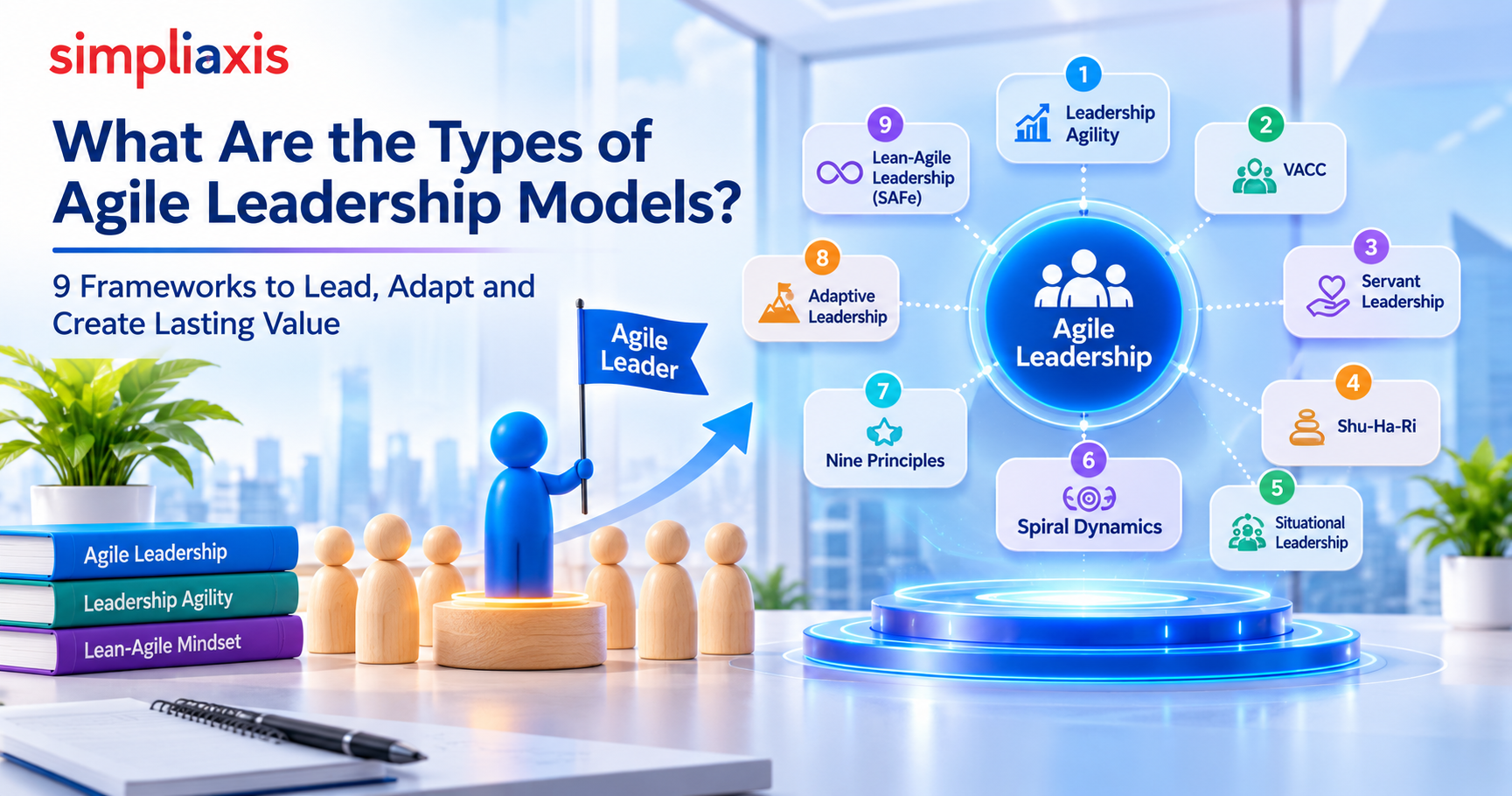
Why do some Agile transformations take off while others stall, even when every team has the same tools and the same training? Often, the difference lies one level up. Leaders who keep directing, controlling, and approving will slow down even the best Scrum team.
That is why Agile leadershiphas become its own field of study. For the main leadership styles, see thetypes of Agile leadership. This guide focuses on the frameworks behind them.
Several frameworks now describe what good Agile leadership looks like, and they do not all say the same thing. Some map how leaders grow. Some describe the roles leaders play. Others focus on values, team stages, or scale. Here, you will get to know nine of the most-cited frameworks in plain language, compare them side by side, and learn how to choose or combine them.
If you want a quick answer first: the main types of Agile leadership models are developmental models (such as Leadership Agility), role-based models (VACC), values-based models (Servant Leadership and the Nine Principles), situational models (team-stage leadership and adaptive leadership), and scaled models (Lean-Agile leadership in SAFe).
Model | Core question it answers | Type |
| Leadership Agility (Joiner & Josephs) | How do leaders grow? | Developmental |
| VACC (McKinsey) | What roles do leaders play? | Role-based |
| Servant leadership | Whom does the leader serve? | Values-based |
| Shu-Ha-Ri | How does mastery develop? | Developmental |
| Situational leadership by team phase | How should style change as teams mature? | Situational |
| Spiral Dynamics lens | What worldview shapes the culture? | Developmental/cultural |
| Nine Principles (Agile Business Consortium) | Which behaviours define Agile leadership? | Values-based |
| Adaptive leadership (Heifetz) | How do leaders handle problems with no known answer? | Situational |
| Lean-Agile leadership (SAFe) | How do leaders lead agility at scale? | Scaled |
What Is an Agile Leadership Model?
An Agile leadership model is a structured framework that describes the mindset, behaviours, roles, or development stages an Agile leader needs in order to guide teams and organisations through change and complexity.
A leadership style is how one person tends to lead, such as directive, supportive, or coaching. A model is broader. It explains what leaders should do, why, and how they grow into it. One model can contain several styles.
It also helps to understand what an Agile leader is. An Agile leader sets direction, builds the conditions for teams to make good decisions, and keeps learning from feedback. Compare that with the traditional approach. McKinsey describes traditional leaders as planners, directors, and controllers, who focus on shareholder value and on making sure everyone follows the plan.
Aspect | Traditional leadership | Agile leadership |
| Decision-making | Top-down | Distributed to people closest to the work |
| Role of leader | Plan, direct, control | Set vision, coach, remove obstacles |
| Response to change | Resist or manage it | Expect it and adapt |
| Source of ideas | Senior leaders | Anyone in the organisation |
| Feedback | Periodic reviews | Continuous |
This comparison is the heart of agile leadership vs traditional leadership. The models below each describe a different way of making that shift real. For a practical example of how Agile leadership works within a team, explore Scrum Master roles and responsibilities.
1. What Is the Leadership Agility Model? (Joiner & Josephs)
Can leaders really "level up"? According to this research, yes. The Leadership Agility model, created by Bill Joiner and Stephen Josephs in their 2007 book Leadership Agility, describes five stages of leadership development: Expert, Achiever, Catalyst, Co-Creator, and Synergist. Each stage includes and goes beyond the previous one. Joiner defines leadership agility as the ability to lead effectively under conditions of rapid change and mounting complexity.
The authors also describe four types of agility that effective leaders combine:
Context-setting agility (deciding what to take on),
Stakeholder agility (engaging the right people),
Creative agility (turning complex issues into results), and
Self-leadership agility (growing as a leader).
Expert
The Expert leads through technical knowledge and authority. The orientation is tactical and problem-solving. Experts tend to manage people one-on-one and get absorbed in the details of their own work. This level suits stable, low-complexity environments.
Achiever
The Achiever is strategic and outcome-focused. Achievers motivate people by making it satisfying to contribute to larger goals. They run meetings to build buy-in and accept feedback when it helps them reach targets. This level works well in moderately complex settings with episodic change.
Catalyst
The Catalyst has a visionary, facilitative orientation. Catalysts articulate an inspiring vision, bring the right people together, and empower them. They balance assertiveness with openness, question their own assumptions, and seek feedback actively. Joiner describes this as "post-heroic" leadership, in which the leader keeps accountability but shares responsibility.
Co-Creator
The Co-Creator builds on the Catalyst's collaborative style and deepens it. Co-Creators treat colleagues as true partners, bring more of their own values and purpose into their work, and invest heavily in trust and community. Most published research and practitioner material focuses on the first three levels, so evidence for the top two is thinner.
Synergist
The Synergist is the rarest and most integrative level. Synergists work comfortably with paradox, sense patterns across systems, and lead with a strong sense of purpose and presence. Treat this stage as a long-term aspiration rather than a practical hiring filter.
How do Leaders Progress Through the Levels?
Joiner's white paper for ChangeWise reports approximate percentages from the authors' research on hundreds of managers:see AMA's overview of the five levels of leadership agility
Level | Approximate share of managers studied |
| Pre-Expert | ~10% |
| Expert | ~45% |
| Achiever | ~35% |
| Catalyst | ~10% |
The paper does not give figures for Co-Creator or Synergist. Treat these numbers carefully. They come from the model authors' own research, and the paper was published in the mid-2000s. They show the general pattern, which is that most managers operate at Expert or Achiever, not that the exact split applies to your organisation today.
Progress is not automatic. According to the paper, the main engine of growth is self-leadership. Leaders assess their current level, set development goals, experiment with new behaviours in everyday work, and reflect on the results. Workshops, action-learning programmes, and coaching help, but daily practice does the heavy lifting. Leaders move through the leadership agility stages by experimenting and reflecting, not by attending a single course.
2. What Is the VACC Leadership Model? (McKinsey & Company)
The VACC leadership model describes four roles that leaders in agile organisations play: Visionary, Architect, Coach and Catalyst. McKinsey & Company presented it as a response to the complexity of modern business, where leaders must co-create value with employees, customers, partners and society, not just shareholders. In McKinsey's description, the traditional planner, director, and controller roles do not disappear. They become woven into how people work.
Visionary
Visionaries create a clear, shared direction that people believe in. They do not simply announce a strategy from the boardroom. They build meaning with the people who will deliver it.
For Example: a product director who explains why a platform migration matters to customers, then invites teams to shape how it happens.
Architect
With direction clear, architects design the structures, processes, and ways of working that let teams deliver. They shape the organisation so good decisions happen without escalation.
For Example: a head of engineering who removes three approval layers and creates a lightweight guardrail instead.
Coach
Coaches develop people. They help individuals and teams build capabilities, learn from experience and take ownership.
For Example: a manager who asks open questions in a retrospective rather than handing out the answer.
Catalyst
Catalysts create the conditions for change. They energise others, remove blockers, and help the organisation move faster than any one leader could push it. The term overlaps with the Catalyst level in Leadership Agility, but the two are different ideas. In VACC, Catalyst is one of four roles. In Leadership Agility, it is one of five stages of development.
For Example: a product leader who notices that teams are waiting weeks for decisions from other departments. Instead of solving every issue personally, they bring the teams together, remove cross-functional blockers, and encourage them to test a new collaboration process so work can move forward faster.
3. What Is Servant Leadership in Agile?
Servant leadership in Agile is a values-based approach in which leaders put the needs of their teams first, so that the teams can deliver value and grow. The concept comes from Robert K. Greenleaf's 1970 essay The Servant as Leader, and it sits at the heart of how many Agile frameworks describe leadership.
Core Principles
- Listening first: Servant leaders seek to understand before directing.
- Empathy and awareness: They notice what people need and what blocks them.
- Removing impediments: They clear obstacles instead of assigning blame.
- Empowering decisions: They trust teams to decide how the work gets done.
- Growing people: They invest in the development of everyone around them.
- Building community: They create trust, psychological safety, and shared ownership.
Role in Scrum/Agile Teams
Scrum gives the clearest example. The Scrum Guide describes Scrum Mastersas true leaders who serve the Scrum Team and the wider organisation. Here’swhy a Scrum Master is a servant leader.
A Scrum Master does not assign tasks. They coach the team, facilitate events, protect focus and help the organisation remove obstacles.
Servant leadership applies beyond Scrum Masters. A department head who clears budget approvals for a team, or a product owner who shields developers from shifting demands, is practising the same idea. The Agile Business Consortium also stresses mentoring future leaders in servant leadership as a way to help an Agile culture thrive.
One caution applies. Servant leadership does not mean avoiding accountability. A servant leader still sets expectations, gives direct feedback, and makes tough calls. They simply do it in service of the team and the outcome.
4. What Is Shu-Ha-Ri? Three Stages of Learning Agile Leadership?
Shu-Ha-Ri is a three-stage learning model from Japanese martial arts that Agile practitioners use to describe how people master a practice: first follow the rules, then break them, then transcend them. Applied to Agile leadership principles, it explains why a new leader should not improvise from day one, and why an experienced one should not stay rigid.
Shu: Learning the Rules
In the “Shu” stage, leaders follow the framework as written. A new Scrum leader runs every event by the book, learns why each practice exists, and avoids shortcuts. The goal is to build a solid foundation.
Ha: Breaking the Rules
In the “Ha” stage, leaders understand the rules well enough to adapt them. They tailor ceremonies to the team's context, combine practices from different frameworks, and challenge practices that no longer help. Judgment replaces compliance.
Ri: Transcending the Rules
In the “Ri” stage, leaders move beyond the framework. They act from principle and intuition, create new approaches, and often teach others. The rules are no longer a reference point because they are embedded in how the leader thinks.
Shu-Ha-Ri works well as a companion to a developmental model like Leadership Agility. One describes the stages of a leader's worldview. The other describes the stages of mastering a practice.
5. What Is Situational Agile Leadership? Leading Teams Through Their Phases
Situational Agile leadership means changing your leadership style to match the team's maturity, rather than using one style everywhere. A common way to apply it is to pair Bruce Tuckman's team development stages (forming, storming, norming, and performing) with the four styles from Hersey and Blanchard's situational leadership model: directing, coaching, supporting, and delegating. This pairing is a widely used practitioner mapping, not a single official standard.
Forming
The team is new. People are polite, unsure of roles, and look to the leader for direction. A leader here sets clear goals and helps the team agree team norms. And makes the Agile process visible. The style leans directing.
Storming
Conflict appears. People challenge approaches, authority, and each other. A leader here coaches, keeps discussions productive, and helps the team resolve disagreements without suppressing them. The style leans coaching.
Norming
The team settles into shared norms. Trust grows, and collaboration becomes easier. A leader here supports, encourages ownership, and helps the team refine its own practices. The style leans supporting.
Performing
The team works fluidly with high autonomy. A leader here delegates, removes external obstacles, and protects the team's focus. The style leans delegating.
How Leadership Style Shifts With Each Phase?
Team phase | Team behaviour | Leader focus | Leadership style |
| Forming | Uncertain, dependent | Clarity and structure | Directing |
| Storming | Conflicted, testing limits | Conflict resolution and coaching | Coaching |
| Norming | Cooperative, building trust | Encouraging ownership | Supporting |
| Performing | Autonomous, productive | Removing blockers | Delegating |
Teams do not move through the phases in a straight line. A new member, a reorganisation, or a tough release can push a performing team back into storming. Good Agile leaders watch for those signals and adjust.
6. What Is Spiral Dynamics, and How Does It Inform Lean-Agile Leadership?
Lean-Agile leadership is the practice of leading with Lean and Agile values, principles, and behaviours, so that teams can deliver value continuously. Spiral Dynamics is not an official Lean-Agile framework. It is a developmental model of human values, developed by Don Beck and Chris Cowan from the research of psychologist Clare Graves, that some Agile coaches use as a lens to understand culture and leadership. Treat it as a thinking tool, not a proven measurement system.
First Tier vs. Second Tier Memes
Spiral Dynamics describes value systems, called memes, that people and organisations move through as life conditions change. The model groups them into two tiers.
- First tier (Beige to Green): Each worldview believes its way is the right one. Conflict between worldviews is common.
- Second tier (Yellow and Turquoise): Leaders can see and value all earlier worldviews, and flex between them as needed.
The idea for leaders is simple. A second-tier leader can recognise that a team needs structure in one moment and freedom in the next, without judging either as wrong.
The 8 Levels (Beige → Turquoise)
Colour | Core value | What it looks like in an organisation |
| Beige | Survival | Crisis mode, basic needs first |
| Purple | Belonging and tradition | Tight-knit groups, loyalty, rituals |
| Red | Power | Strong personalities, quick decisions, little process |
| Blue | Order and purpose | Rules, hierarchy, clear roles |
| Orange | Achievement | Goals, metrics, competition, innovation |
| Green | Community | Consensus, empathy, equality |
| Yellow | Integration | Flexible, systems thinking, fit-for-context |
| Turquoise | Holistic awareness | Deep interconnection, global perspective |
Applying Spiral Dynamics to Team Culture
Suppose a bank introduces Scrum. Teams from a Blue-heavy culture may want detailed rules for every ceremony. Teams from an Orange-heavy culture may focus on velocity charts. A Green-leaning team may resist metrics altogether. A leader using the Spiral Dynamics lens might ask which values are driving each reaction, then frame Agile practices in a language each group can accept. This is an illustrative example, not a case study.
Use the model with care. It is influential among coaches but is not backed by the kind of empirical validation behind some other frameworks, so avoid labelling individuals with colours.
7. What Are the Nine Principles of Agile Leadership? (Agile Business Consortium)
The Nine Principles of Agile Leadership are a values- and behaviour-based framework from the Agile Business Consortiumthat describes the competencies, capabilities and capacities of an Agile leader. The Consortium built them around three concepts: communication, commitment and collaboration. It argues that Agile leadership is not simply good leadership, and treats it as a continuum that improves over time.
The nine principles, as summarised in practitioner material that cites the Consortium, are:
# | Principle | What it means in practice |
| 1 | Actions speak louder than words | Lead by example and be the change |
| 2 | Improved quality of thinking leads to improved outcomes | Examine problems from several angles and find root causes |
| 3 | Organisations improve through effective feedback | Collect honest, timely feedback and visibly act on it |
| 4 | People require meaning and purpose to make work fulfilling | Connect organisational goals to personal purpose |
| 5 | Emotion is a foundation for enhanced creativity and innovation | Build an environment where people can do their best work |
| 6 | Leadership lives everywhere in the organisation | Recognise and grow leadership at every level |
| 7 | Leaders devolve appropriate power and authority | Empower people instead of relying on position |
| 8 | Collaborative communities achieve more than individuals | Build trust, respect and psychological safety |
| 9 | Great ideas can come from anywhere in the organisation | Invite ideas from the people closest to the work |
These Agile leadership principles and practices make a useful self-check. A leader can ask which principle they practise least, then pick one small behaviour to change this month. The Consortium also offers a free Agile leadership assessment based on the nine principles. Check its site for current availability, since it has been described as a beta tool.
Note that these nine principles are different from the Shu-Ha-Ri stages in Section 4. Shu-Ha-Ri describes how people learn. The Nine Principles describe how Agile leaders behave.

8. What Is Adaptive Leadership, and How Does It Apply to Agile?
Adaptive leadership is a framework developed by Ronald Heifetz and colleagues at Harvard that helps leaders mobilise people to tackle challenges with no known solution. The adaptive leadership model separates technical problems, which have known fixes, from adaptive challenges, which require people to change their habits, values, or beliefs.
Core Concept: Creating Conditions vs. Imposing Solutions
A technical problem can be solved by an expert. An adaptive challenge cannot, because the work involves learning and loss. Imposing a solution may create compliance but not real change.
Adaptive leaders therefore create conditions in which people can face the problem themselves. Common practices from the framework include:
- Getting on the balcony: stepping back to see patterns, not just events
- Regulating distress: keeping tension high enough to motivate, but low enough to avoid panic
- Maintaining disciplined attention: keeping people focused on the hard issue
- Giving the work back: helping people own the problem instead of rescuing them
- Protecting voices from below: making sure dissenting views are heard
These ideas fit Agile well. A retrospective is an adaptive mechanism because it asks the team to examine its own behaviour.
Use Cases (Complex, High-Stakes Domains such as Healthcare)
Adaptive leadership is especially useful where complexity is high, and mistakes are costly. Healthcare is a common example. Consider a hospital that wants to reduce hospital-acquired infections. Introducing a hand-hygiene checklist is a technical fix. Getting senior clinicians to accept being corrected by junior staff is an adaptive challenge, because it touches status and habit. A leader using this model would convene the groups, surface the tension, and let them design new norms. This is an illustrative example.
Other suitable settings include regulated finance, government digital programmes, and large post-merger integrations.
9. What Is Lean-Agile Leadership at Scale? (SAFe, LeSS, Disciplined Agile)
Lean-Agile leadership at scale is the practice of leaders driving and sustaining Agile and Lean ways of working across many teams, value streams, or an entire enterprise. The Scaled Agile Framework (SAFe) makes this explicit. It lists Lean-Agile Leadership as one of its sevenSAFe core competenciesof business agility.
Leading Agility Across Multiple Teams
At scale, leaders cannot rely on personal influence alone. They need shared cadences, clear priorities, and consistent behaviours. Different frameworks approach this differently:
Framework | How it approaches leadership at scale |
| SAFe | Defines Lean-Agile Leadership as a core competency with explicit dimensions and assessments |
| LeSS (Large-Scale Scrum) | Keeps Scrum principles with minimal added roles. Managers commonly focus on improving the system and teaching, not directing teams |
| Disciplined Agile | Provides a context-based toolkit, so leaders choose ways of working to fit their situation |
Whichever approach you use, the leader's job shifts from managing tasks to managing the system, which includes flow, dependencies, culture, and capability.
Read more about SAFe vs. LeSS
Lean-Agile Leader Competencies in SAFe
According to the Scaled Agile Framework,Lean-Agile Leadership describes how leaders drive and sustain change by empowering individuals and teams. It builds on three dimensions:
- Mindset and principles: leaders embed the Lean-Agile mindset, values, and principles in their beliefs, decisions, and actions. Understanding theSAFe principlesis part of this dimension.
- Leading by example: leaders model the behaviours they expect, such as trusting teams with decisions.
- Leading change: leaders guide the organisation to a new way of working, usually with help from coaches and change agents.
For leaders who want to learn these ideas formally,Leading SAFe trainingis the usual starting point in the SAFe ecosystem.
How Do Agile Leadership Models Compare?
This Agile leadership models comparison shows how they differ in purpose and scope.
Model | Focus | Best used for | Main limitation |
| Leadership Agility | Leader development | Coaching and growth plans | Assessment often needs trained facilitators |
| VACC | Leadership roles | Designing leadership expectations | Describes roles, not development path |
| Servant leadership | Values and service | Building trust and autonomy | Can be misread as being soft |
| Shu-Ha-Ri | Skill mastery | Onboarding and mentoring | Does not address team or system factors |
| Situational (team phases) | Style by team stage | Leading new or changing teams | Phases are not strictly linear |
| Spiral Dynamics lens | Culture and worldview | Understanding resistance | Limited empirical validation |
| Nine Principles | Behaviours | Self-assessment and culture work | Principles are broad |
| Adaptive leadership | Complex challenges | Change with no known answer | Demands high tolerance for ambiguity |
| Lean-Agile (SAFe) | Enterprise-scale leadership | Large transformations | Tied to a specific framework |
Developmental vs. Situational vs. Values-Based Models
- Developmental models (Leadership Agility, Shu-Ha-Ri, Spiral Dynamics) describe how people and cultures grow. They answer "where am I, and what comes next?"
- Situational models (team phases, adaptive leadership) describe how to respond to the context in front of you. They answer "what does this moment need?"
- Values-based models (servant leadership, the Nine Principles) describe what leaders should believe and do. They answer "what do I stand for?"
- Role-based and scaled models (VACC, Lean-Agile) describe what leaders should do and where. They answer "what is my job here?"
Which Agile Leadership Model Is Best for Different Situations?
Situation | A good starting model |
| A new team that is still forming | Situational leadership by team phase |
| A senior leader wants a personal development plan | Leadership Agility |
| Defining expectations for leaders in a transformation | VACC |
| Building trust and autonomy in teams | Servant leadership |
| A complex change that resists simple answers | Adaptive leadership |
| Rolling out Agile across a large enterprise | Lean-Agile leadership (SAFe) |
| Cultural resistance you cannot explain | Spiral Dynamics lens |
How Do You Choose or Combine Agile Leadership Models?
Pick one framework and risk blind spots. Pick all nine and risk confusion. So how do you decide? When you ask how to choose an Agile leadership model, start with the problem, not the model. Check these six factors:
- Team maturity: assess where teams sit on theAgile maturity levels. New teams need clarity and structure; mature teams need space.
- Organisational context: A highly regulated, hierarchical organisation may need a gradual approach and clear roles (VACC). A start-up may need less structure.
- Complexity: Where answers are known, expert-led solutions work. Where they are not, use adaptive leadership.
- Scale: One team rarely needs a scaled framework. A programme of fifty teams usually does.
- Leadership development needs: If the goal is personal growth, Leadership Agility and Shu-Ha-Ri give a path. For role clarity, use VACC or the Nine Principles.
- Time and capacity: A model nobody has time to apply is just a poster.
When combining makes sense: Most real organisations combine models. For example, a leadership team might use VACC to define roles, the Nine Principles for self-assessment, Leadership Agility for individual coaching, and adaptive leadership for specific change challenges. Combine them when each model answers a different question. Avoid combining when it creates conflicting vocabulary or when people cannot say which model applies to which decision.
A useful rule of thumb is to choose one primary model for development, one for roles, and one for context-specific challenges. Anything beyond that tends to add noise.
What Are the Common Misconceptions About Agile Leadership Models?
Think Agile leadership means giving up control? Here are the Agile leadership myths worth retiring.
- Myth 1: Agile leaders have no authority: In fact, Joiner describes Catalyst leaders as retaining ultimate accountability and authority while sharing responsibility.
- Myth 2: Agile leadership is just good leadership: The Agile Business Consortium argues otherwise, seeing it as a distinct, evolving continuum of capability.
- Myth 3: You must pick one model: Models answer different questions, and combining them is common.
- Myth 4: Higher levels are always better: Leadership Agility notes that Expert and Achiever styles suit stable or moderately complex settings. Skilled leaders move between modes as needed.
- Myth 5: Servant leadership means saying yes to everything: Servant leaders still set direction, hold people accountable, and decide.
- Myth 6: Agile leadership applies only to managers: The Nine Principles state that leadership lives everywhere in the organisation.
- Myth 7: A certification makes you an Agile leader: Training helps, but leadership agility grows through daily practice and reflection.
Conclusion
Agile leadership is not one model. It is a set of lenses, each useful for a different question. Leadership Agility shows how leaders grow. VACC clarifies roles. Servant leadership and the Nine Principles define values. Situational and adaptive leadership guide you through changing teams and complex problems. Lean-Agile leadership helps you scale.
The practical takeaway is to match the model to the problem. Start with one lens that fits your biggest challenge today, apply it for a quarter, and add another only when you need it. Agile leadership principles matter most when leaders practise them visibly, so choose a behaviour to change this week, and ask your team for feedback on it.







 Lowest-Price Challenge











 Personalized Path



.webp)


 USA
 Canada
 India
 UK
 Australia
 Singapore


