


 Call Us




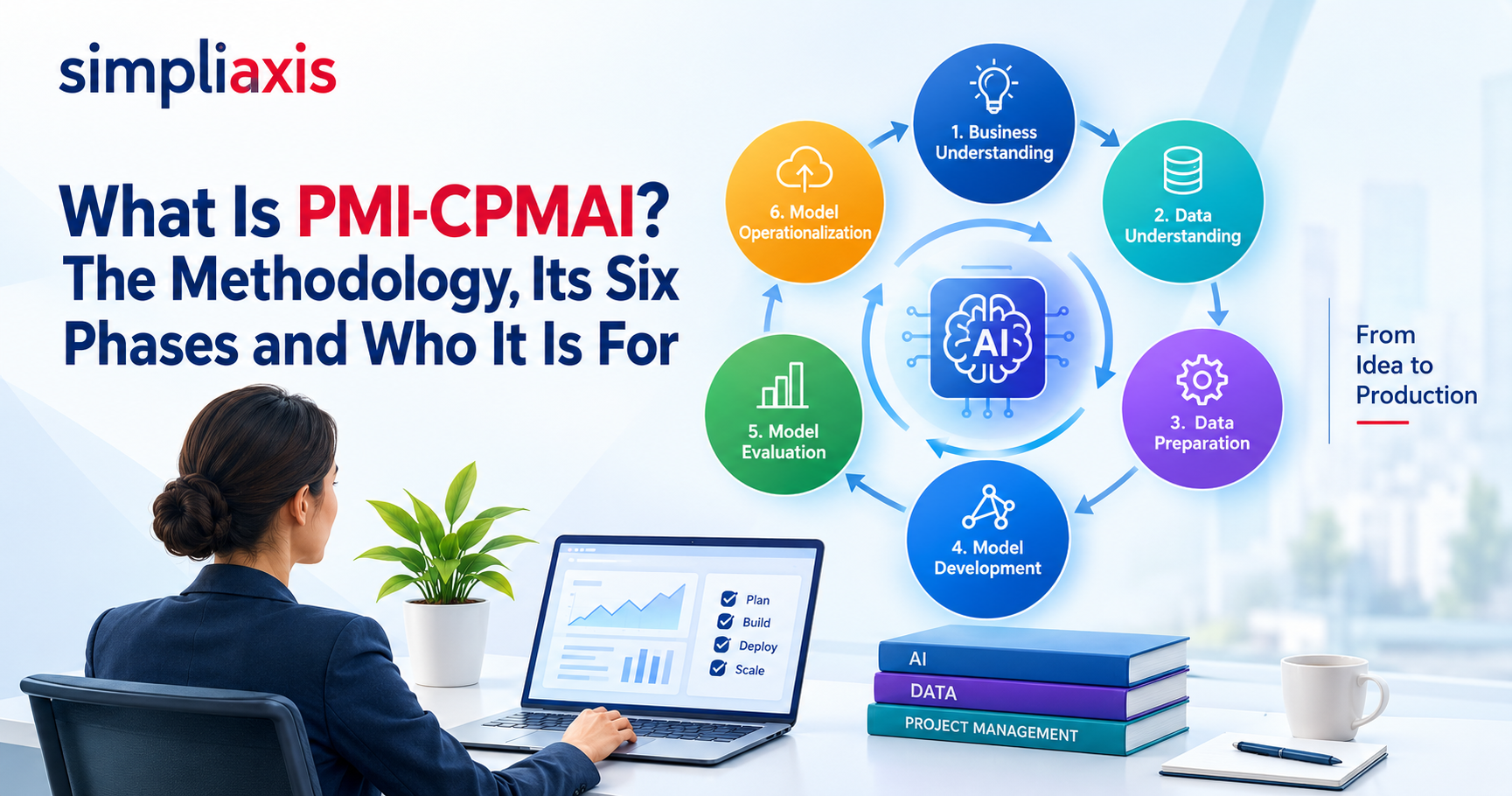
A team builds a model that works beautifully in a demo. Six months later it still is not in production, nobody can explain why, and the project plan that looked sensible at the start no longer describes reality. This pattern is common enough that a certification now exists to address it: PMI-CPMAI, PMI's credential for managing AI and data projects.
This guide explains what PMI-CPMAI is, where the method comes from, how its six phases work with a worked example, what the seven patterns of AI are, who should consider the certification and how it differs from technical AI courses. It is an explainer for people deciding whether to learn more, so it keeps exam logistics short and points to detailed sources for them.
Key Highlights: What Is CPMAI?
- PMI-CPMAI stands for PMI Certified Professional in Managing AI. It is PMI's certification for professionals who lead AI and machine learning projects.
- The credential is built on the CPMAI method, a six-phase, iterative approach for data-driven projects that grew out of the CRISP-DM process.
- The six phases are Business Understanding, Data Understanding, Data Preparation, Model Development, Model Evaluation and Model Operationalization.
- It is a management certification, not a coding or data science one, and it has no experience prerequisite beyond completing PMI's exam prep course.
- It suits project managers, product owners, analysts and data leads who are responsible for delivering AI outcomes, not building the models themselves.
What Is PMI-CPMAI? A Plain-Language Definition
PMI-CPMAI is a project management certification for AI work: it certifies that a professional can take an AI idea from business problem to production using a structured, iterative method, with data readiness and responsible AI built in. The credential name is PMI Certified Professional in Managing AI, and PMI describes it on its page for PMI-CPMAI.
The underlying method was originally called CPMAI, short for Cognitive Project Management for AI, and was developed by Cognilytica. PMI acquired Cognilytica in 2024 and relaunched the credential under its own name. If you see CPMAI mentioned without the PMI prefix, it usually refers to the earlier version or to the method in general.
The key idea is simple: AI projects behave differently from conventional projects, so managing them needs a different approach. In a typical software project, you can specify the output and plan to build it. In an AI project, you often do not know whether the data can support the outcome until you try. That uncertainty is what the method is designed to manage.
Why AI Projects Need a Different Project Management Approach
Four features make AI projects harder to manage with a classic plan.
- The output is discovered, not specified. A model's accuracy depends on the data. You may learn in week eight that the goal needs data you do not have.
- Data is the critical path. Teams often underestimate how much time goes into finding, cleaning and labelling data.
- Results are probabilistic. A model is right some of the time. Deciding how right is good enough is a business decision.
- The work does not end at launch. Models degrade as the world changes, so monitoring and retraining are part of delivery.
Our article on why enterprise AI pilots stall explores how these features lead to pilots that never reach production, and the guide to building AI without data access covers the data problem in more depth. Traditional approaches still matter, and our overview of project management methodologies shows where each fits.
Where PMI-CPMAI Came From: CRISP-DM, Cognilytica and PMI
The method builds on CRISP-DM, a long-established process for data mining projects that structures work around understanding the business, understanding and preparing data, modelling, evaluating and deploying. CPMAI adapts that process for modern AI projects, adds an explicit focus on project management concerns and keeps the iterative loop at its centre.
PMI's acquisition of Cognilytica in 2024 brought the method into a mainstream project management body. Since then PMI has revised the exam, and study material written before the change can be out of date. If you plan to study, check the version a resource describes. Our article on whether PMI-CPMAI is worth it covers that history and the value question from a career point of view.
The Six CPMAI Phases Explained
The phases are not a straight line. Teams move back when they learn something new, and the method expects that.
| Phase | Key question | Typical outputs |
| 1. Business Understanding | Is this a problem worth solving with AI, and what would success look like? | Problem statement, success measures, go or no-go decision, AI pattern chosen |
| 2. Data Understanding | Do we have the data, can we use it and is it good enough? | Data inventory, quality assessment, privacy and compliance checks |
| 3. Data Preparation | How do we get the data into usable shape? | Cleaned and labelled data, pipelines, feature set |
| 4. Model Development | Which approach produces a model that meets the need? | Trained models, experiments, validation results |
| 5. Model Evaluation | Does the model meet business and technical criteria, and is it fair and explainable? | Evaluation report, bias and explainability checks, readiness decision |
| 6. Model Operationalization | How do we run it, monitor it and improve it? | Deployed solution, monitoring, retraining plan, ownership |
Why the loop matters
A team in phase four discovers the labelled data is biased. A conventional plan treats that as a failure. The CPMAI approach treats it as an expected loop back to phases two and three. The method also encourages short, repeated cycles, so the team learns early whether the idea is feasible instead of discovering it at the end.
A Worked Example: Predicting Equipment Failure Through the Six Phases
This example is fictional and shows how the phases look in practice. A manufacturer wants to predict when a machine will fail so that maintenance can be scheduled before breakdowns.
| Phase | What the team does |
| Business Understanding | Agrees the target: reduce unplanned downtime on three critical machines. Defines success as catching failures early enough to act, and decides a prediction that warns at least two days ahead is useful |
| Data Understanding | Finds sensor readings exist for two of the three machines, and maintenance logs are in free text. Notes that failure events are rare, which will affect modelling |
| Data Preparation | Cleans sensor data, converts maintenance logs into labelled failure events and builds a pipeline that refreshes weekly |
| Model Development | Builds several candidate models and compares them using past failures held back for testing |
| Model Evaluation | Finds the model misses a common failure type. The team loops back to collect more examples of that type, then re-evaluates |
| Model Operationalization | Deploys alerts to maintenance planners, sets a monitoring rule for changing sensor patterns and schedules retraining |
Notice what the project manager does. They do not build the model. They ask whether the goal is worth pursuing, whether the data exists, whether the evaluation reflects the business need and who owns the model after launch. That management layer is what the certification is about.
The Seven Patterns of AI: Matching Problems to Solutions
The method teaches that AI applications fall into a small number of recurring patterns, which helps teams describe what they are building and anticipate typical issues. The patterns are commonly listed as follows.
| Pattern | What it does | Example |
| Hyperpersonalization | Treats each person as an individual with tailored recommendations | Personalised product suggestions |
| Autonomous systems | Operates with little human involvement | Robotic process handling |
| Predictive analytics and decision support | Uses past data to forecast and guide decisions | Demand or failure prediction |
| Conversational and human interaction | Communicates in human language | Chatbots and voice assistants |
| Patterns and anomalies | Finds what is unusual or what repeats | Fraud detection |
| Recognition | Identifies things in images, sound or text | Image inspection |
| Goal-driven systems | Learns the best action by trial against a goal | Route or resource optimisation |
Knowing the pattern helps in phase one, because each pattern has typical data needs and risks. A conversational system, for example, raises questions about accuracy and safety that a forecasting model does not. For background on the technology, see our guide to what machine learning is and the overview of generative AI.
Responsible and Trustworthy AI in the Method
Responsible AI is not a separate step. It runs through every phase. In business understanding it appears as questions about who could be harmed by a wrong prediction. In data understanding it appears as privacy, consent and representativeness. In evaluation it appears as tests for bias and explainability. In operations it appears as monitoring for drift and clear accountability for decisions.
This matters for project managers because many AI failures are governance failures, not technical ones. Someone has to ask the uncomfortable questions early, and the method gives the project manager a structured place to do it.
Who Should Consider PMI-CPMAI?
The certification is aimed at people who are accountable for AI outcomes without necessarily building the technology.
| Role | Why it fits |
| Project and programme managers | They are asked to lead AI initiatives and need a method suited to the work |
| Product owners and product managers | They define what AI features should achieve and judge whether they work |
| Business analysts | They frame problems and assess data readiness |
| Data and analytics leads | They need delivery discipline to move from pilot to production |
| PMO and portfolio leaders | They oversee several AI projects and need a common way to judge health |
It is less suited to people who want to build models or write machine learning code. For that goal, technical AI and data science courses are a better match. If your aim is to use AI tools to be more productive in project work, a practical programme such as generative AI for project managers fits that purpose better.
How PMI-CPMAI Differs from Other AI Certifications
AI certifications fall into three groups, and mixing them up leads to the wrong purchase.
| Type | Focus | Example audience |
| Management of AI projects | Method, governance, delivery | PMI-CPMAI candidates |
| Technical AI and machine learning | Building and deploying models | Engineers and data scientists |
| Using AI tools | Productivity with AI assistants | Any professional |
If you already hold a project management credential, PMI-CPMAI sits beside it. Our guide to AI in project management shows where the profession is going, and the piece on AI in project portfolio management covers the portfolio level.
What the Certification Involves, in Brief
Candidates complete PMI's exam prep course and then sit a scenario-based exam, delivered through PMI's testing partner. The credential is renewed through PDUs on a three-year cycle. Exam length, number of questions, domain weights and fees have changed since the PMI relaunch, so use PMI's current handbook for specifics, and treat older guides with caution. You can check your readiness with the PMI-CPMAI practice test.
Common Misconceptions About CPMAI
- "It is a coding certification." It is not. It tests management of AI projects.
- "It replaces project management." It builds on it. Governance, stakeholders and planning still matter.
- "The phases are a waterfall." They are iterative, and looping back is normal.
- "AI is always the answer." Phase one includes the option to decide that AI is not the right tool.
- "Any CPMAI guide is current." Material for the earlier version describes a different exam.
Risks a CPMAI-Trained Project Manager Watches For
The method is practical about what goes wrong. These are typical risks, with the phase where they usually first show up and the question that exposes them.
| Risk | Where it appears | Question that exposes it |
| Solving a problem that AI cannot or should not solve | Business Understanding | What decision will change if the prediction is right? |
| Data that exists but cannot be used for this purpose | Data Understanding | Do we have the right to use this data for this goal? |
| Underestimated data preparation effort | Data Preparation | Who owns data quality, and how long did the last cleanup take? |
| A model that scores well on test data but fails on real cases | Model Evaluation | Do the test cases reflect production conditions? |
| A model nobody monitors after launch | Model Operationalization | Who is alerted when performance drops, and what do they do? |
| A pilot that cannot be scaled | Operationalization | What infrastructure and skills would production need? |
Many of these are also operational concerns, which is why the operations side of AI is increasingly taught as its own discipline. Our guide to what MLOps is explains how models are deployed and monitored, and a project manager does not need to run those systems to ask whether they exist.
How to Start Learning: A Practical Path
You do not need to begin with the certification. A useful path for a project manager new to AI looks like this.
1. Learn the vocabulary. Understand what models, training data, accuracy and drift mean at a plain-language level. Short glossaries and the overview articles from your data team are enough at this stage.
2. Understand the delivery difference. Read about how iterative delivery differs from fixed-scope delivery. Our comparison of agile and traditional project management is a good starting point.
3. Try AI in your own work. Using assistants for planning and reporting builds intuition, and our guide to AI for project scheduling and planning shows practical uses.
4. Study the method. Learn the six phases and practise applying them to a real idea.
5. Consider the credential. If you want formal proof, take PMI's course and exam.
If you already hold a broad credential such as the PMP, PMI-CPMAI is a natural next step, because the two cover different ground.
Conclusion
PMI-CPMAI is PMI's answer to a specific problem: AI projects fail for management reasons as often as technical ones. Its six-phase, iterative method puts business value, data readiness and responsible AI at the centre, and its certification confirms a professional can lead that work. If you are accountable for AI outcomes but do not build the models, it is worth understanding, whether or not you take the exam.
Learn the method with an instructor: Prepare for PMI's AI project management credential with the PMI-CPMAI certification training.
Check your readiness: Try scenario questions with the PMI-CPMAI practice test.







 Lowest-Price Challenge












 Personalized Path



.webp)


 USA
 Canada
 India
 UK
 Australia
 Singapore


