


 Call Us



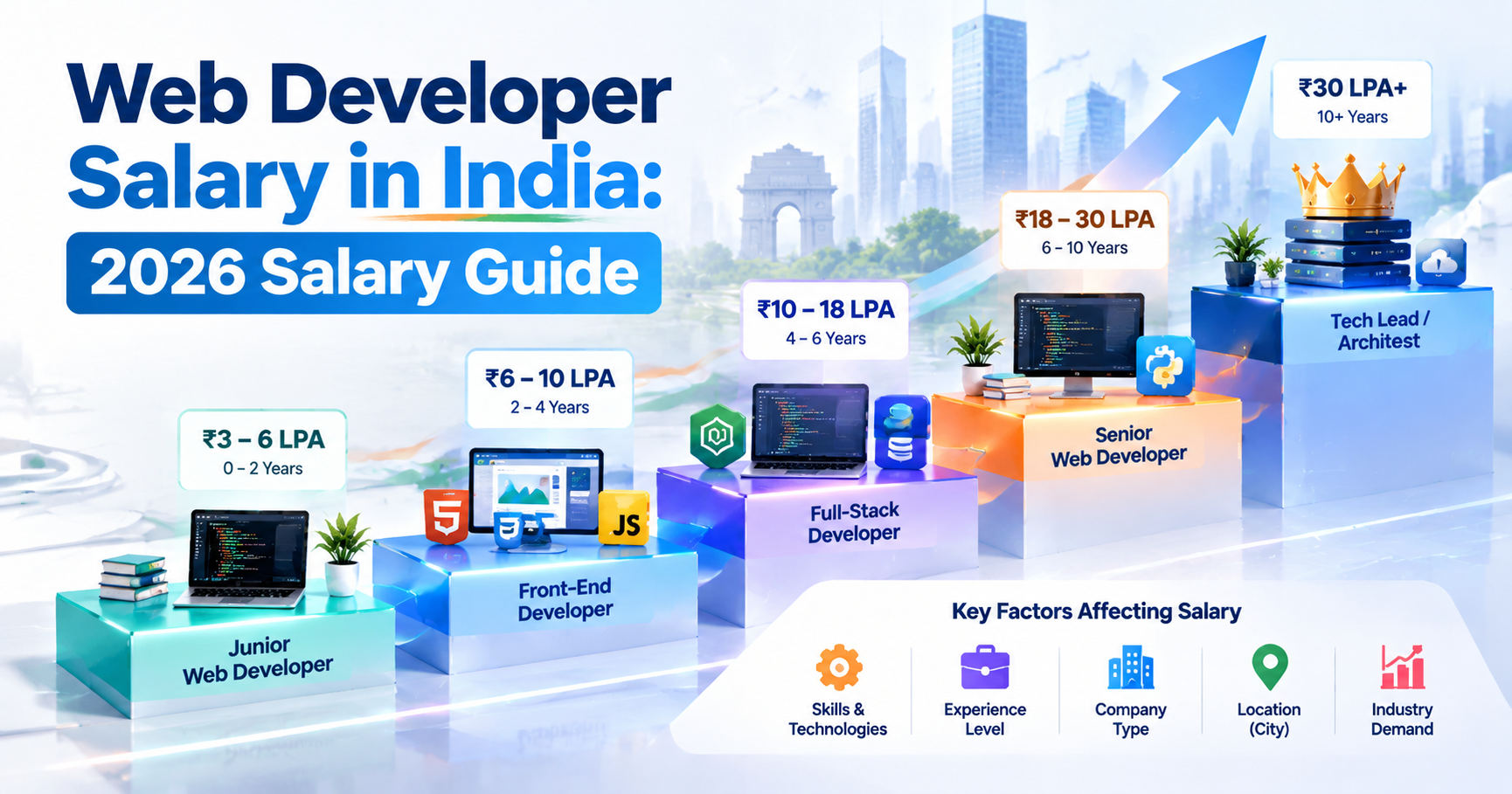
The average salary of a web developer in India is around ₹4- 4.2 LPA in 2026. Glassdoor claims an average total income of ₹4,15,000 per year, however Payscale reports an average base salary of ₹4,21,634 per year. Freshers usually start at a lower salary. Payscale estimates the average total pay for web developers with less than 1 year of experience as ₹3,02,124.
That average range is quite long. Payscale data for web developers shows basic income data ranging from around ₹1.8 lakh at the 10th percentile to around ₹10 lakh at the 90th percentile, with specialized titles such as Back-End developer and software developer reporting significantly higher averages.
What you actually earn depends on:
- Experience
- Roles & responsibility
- Location
- Tech skills
- Portfolio
- Education qualification
- Negotiation Skill
- Company type
- Employment type
- Industry
Key Highlights
- In India, web developer salaries start at ₹3-6 LPA for freshers and associate professionals.
- Full-stack developers are generally paid more because they are able to do the frontend, backend, databases and deployment of the software.
- Good opportunities are in top cities like Bangalore, Hyderabad, Pune, Mumbai and Delhi NCR as they have a technology ecosystem.
- Familiarity with JavaScript frameworks, cloud computing, databases, APIs and DevOps technologies can influence wage increases.
- A strong portfolio with live projects might improve chances of getting a job for freshers as well as experienced developers.
Introduction
Imagine a final-year BCA student who has just built her third-year project. She knows she enjoys web development. What she doesn't know is whether the offer letter she might get in the next six months will say ₹2.5 lakh, ₹4 lakh or ₹8 lakh, and why her classmate's cousin in Bengaluru seems to earn twice as much as someone doing "the same job" in a smaller city.
That confusion is common, and it isn't limited to students. Junior developers wonder if their current package is fair. Mid-level developers wonder whether switching from PHP to Node.js, or from front-end to full-stack, would change their pay. Career switchers want to know if the effort of learning to code will pay off.
This guide pulls together the latest 2026 salary data from Glassdoor, Payscale, Indeed and industry reports, explains what each figure actually measures, and walks through how experience, city, role, skills and company type change the picture.
Who Is a Web Developer and What Does Web Development Involve?
In simple terms, a web developer builds and maintains the websites and web applications people use through a browser. So when someone asks what a web developer means, the answer covers everything from a five-page company website to a complex online banking dashboard.
Web development has two broad layers. One is Front-End Development & another is Back-End Development. The front end is what you see and interact with, like buttons, forms, menus and layouts. The back end is where the behind-the-scenes activity happens including storing data, checking passwords, processing orders and talking to other systems. The developer may be working on one or both layers.
What Does a Web Developer Do?
Basically, web develops’ day-to-day task depend upon the firm and the role, but most web developers spend their time on some combination of these:
- Transforming designs or specifications into websites
- Build web apps like dashboards, portals, booking systems, online retailers
- Develop and maintain code that is understandable and extendable by other developers.
- Working with databases to save, retrieve, and update data
- Test functionality to verify that features are working as planned
- Fixing issues reported by users and testers
- Optimizing performance to get pages to load quickly, especially on weaker mobile connections
- Working with designers, product managers, and other developers to turn concepts into working features
- Maintenance of current programs (security updates, library upgrades)
Front-End vs Back-End vs Full-Stack Web Developers
Front-end development is the part of the application that the user sees and uses. Front-end developers translate designs into responsive pages, ensuring the interface functions across browsers and devices. If this is the side you want to specialise in, this roadmap on how to become a front-end developer covers the skills and timeline.
Back-End development is all about the server, the database and the application logic. Back-end engineers write APIs, manipulate data and solve problems like authentication and security.
Full-stack development combines both. A full-stack developer can build a feature from the interface all the way to the database, though most full-stack developers are stronger on one side than the other.
Area | What It Focuses On | Common Technologies |
| Front-end | User interface, layout, interactivity, accessibility | HTML, CSS, JavaScript, TypeScript, React, Angular, Vue |
| Back-end | Servers, APIs, databases, business logic, security | Node.js, Java, Python, PHP, .NET, SQL and NoSQL databases |
| Full-stack | End-to-end features across front-end and back-end | Combinations such as MERN (MongoDB, Express, React, Node.js), Java with Angular, or Python with React |
Web Development Salary in India: Salary Ranges by Experience
Experience is one of the greatest aspects that might affect a developer's salary. As developers gain more hands-on experience, they tend to move on to bigger projects, more complicated issues and more important technical challenges.
Here is how the main sources describe the overall web developer market in India right now:
Experience Level | Reported Salary Range / Figure | Salary Data Type | Source |
| Fresher (0–1 Year) | ₹3L – ₹6L per year | Base pay range | Glassdoor |
| Fresher / Entry Level (0–2 Years) | ₹18,052 per month (~₹2.1L per year) | Average base salary | Indeed |
| Junior Web Developer (1–3 Years) | ₹1.8L – ₹10L per year | Base salary range (10th–90th percentile) | Payscale |
| Mid-Level Developer (3–6 Years) | ₹4,15,000 per year | Average total pay | Glassdoor |
| Mid-Level / Experienced Developer (3–7 Years) | ₹4,21,634 per year | Average base salary | Payscale |
| Senior Web Developer (7+ Years) | Up to ₹10L+ per year (90th percentile) | Higher-end base salary range | Payscale |
Web Developer Salary for Freshers in India
Most freshers enter through titles like trainee web developer, junior front-end developer, associate software engineer, or web developer intern who converts to full-time. The web developer starting salary depends as much on the employer as on the candidate.
Metric | Figure | Data Type | Source |
| Web developer, less than 1 year | ₹3,02,124 per year | Average total compensation | Payscale, July 2026 |
| Front-end developer, less than 1 year | ₹3,58,489 per year | Average total compensation | Payscale, July 2026 |
| Full-stack software developer, less than 1 year | ₹4,04,090 per year | Average total compensation | Payscale, July 2026 |
| Web developer (all levels, national) | ₹18,052 per month | Average base salary | Indeed, April 2026 |
So, a realistic web developer salary for a fresher in India, based on these sources, is roughly ₹2.5- ₹4 lakh a year, with some freshers at well-funded product companies earning more and some small-agency roles paying less.
Employers hiring freshers usually expect:
- Solid HTML, CSS and JavaScript fundamentals
- Working knowledge of at least one framework, often React or Angular
- Basic understanding of how APIs and databases work
- Comfort with GitHub
Junior Web Developer Salary in India
The junior stage roughly covers developers with 1-3 years of experience, though some companies call anyone under five years "junior". At this point, developers stop being trained and start being trusted with features on their own.
Metric | Figure | Data Type | Source |
| Junior web developer (title) | ₹4,13,566 per year; base ₹3L–₹6L | Average total pay | Glassdoor, 2026 |
| Web developer, 1–4 years | ₹4,06,509 per year | Average total compensation | Payscale, July 2026 |
| Front-end developer, 1–4 years | ₹6,02,291 per year | Average total compensation | Payscale, July 2026 |
| Full-stack software developer, 1–4 years | ₹6,10,159 per year | Average total compensation | Payscale, July 2026 |
Mid-Level Web Developer Salary in India
Mid-level developers usually have somewhere between four and eight years of experience, although titles matter. They're expected to design solutions, not just implement them.
Metric | Figure | Data Type | Source |
| Web developer, mid-career (5–9 years) | ₹7.2 lakh per year | Calculated from Payscale's +71% vs. national average | Payscale, July 2026 |
| Senior web developer title, 5–9 years | ₹9,52,662 per year | Average total compensation | Payscale, Nov 2025 |
| Front-end developer, mid-career | ₹14 lakh per year | Calculated from Payscale's +110% vs national average | Payscale, July 2026 |
| Full-stack software developer, mid-career | ₹14 lakh per year | Calculated from Payscale's +103% vs national average | Payscale, July 2026 |
At this stage, the skills that tend to separate developers include:
- Architecture: structuring an application so it stays maintainable as it grows
- Framework expertise: understanding how React, Angular or Spring work internally, not just how to use them
- APIs: designing clean, versioned, well-documented APIs
- Databases: writing efficient queries, indexing and data modelling
- Cloud: deploying and running applications on AWS, Azure or Google Cloud
- Testing: unit, integration and end-to-end testing as a habit
- Performance optimisation: finding and fixing slow pages, heavy bundles and expensive queries
A mid-level developer who can explain trade-offs, such as why a team chose server-side rendering or a particular caching strategy, usually has a stronger case for senior roles than one with the same years of experience but narrower exposure.
Senior Web Developer Salary in India
Senior developers, tech leads and specialists own larger parts of a system, mentor others and make technical decisions that affect the whole team.
Metric | Figure | Data Type | Source |
| Senior web developer (title) | ₹6,42,500 per year; base ₹4L–₹10L | Average total pay | Glassdoor, 2026 |
| Senior web developer (title) | ₹9,13,105 per year; total pay ₹3.93L–₹30L | Average base salary | Payscale, Nov 2025 |
| Web developer, experienced (10–19 years) | ₹10 lakh per year | Calculated from Payscale's +137% vs national average | Payscale, July 2026 |
| Web developer, late career (20+ years) | ₹12 lakh per year | Calculated from Payscale's +185% vs national average | Payscale, July 2026 |
Senior compensation varies more than any other level. Payscale's total pay range for the senior web developer title starts at about ₹3.9- ₹30 lakh, which tells you how differently organisations define "senior". At a small agency, a senior developer might lead a team of three. At a large product company or global capability centre, a senior engineer might own a service used by millions of people, with pay to match.
Web Developer Salary Per Month in India
Many professionals search for web developer salary per month in India because that's how they think about their budget. Here are approximate monthly equivalents for the main annual figures above:
Annual Figure | Source & Data Type | Approx. Monthly Equivalent (Annual ÷ 12) |
| ₹3,02,124 (entry level) | Payscale, total compensation | ₹25,177 |
| ₹4,06,509 (1–4 years) | Payscale, total compensation | ₹33,876 |
| ₹4,15,000 (all levels) | Glassdoor, average total pay | ₹34,583 |
| ₹4,21,634 (all levels) | Payscale, average base salary | ₹35,136 |
| ₹6,42,500 (senior title) | Glassdoor, average total pay | ₹53,542 |
These are calculations, and they are not the same as the money that lands in your bank account. Indian offer letters use several different terms:
- CTC (Cost to Company): the total amount the employer spends on you in a year. It can include base salary, allowances, variable pay, employer PF contribution, gratuity, insurance and sometimes one-time bonuses.
- Gross salary: CTC minus certain employer-side costs such as the employer's PF contribution and gratuity.
- Base salary: the exact part of your income, before allowances and variable components.
- Variable pay: Bonuses or incentives for performance based on your rating or on the company’s results. That’s not assured.
- Take-home salary: what you actually get in your hand every month after deducting income tax, your PF contribution, professional tax and other deductions.
Web Developer Salary in India by City
City-level data shows real differences, but it needs careful reading. Crowd-sourced city pages are often based on smaller samples, and averages can shift depending on which companies and seniority levels happen to be represented.
City | Salary Information | Experience/Data Context | Source |
| Bangalore | ₹5,00,000 per year; base ₹3–₹8LPA | Average total pay, all levels, 2026 | Glassdoor |
| Bengaluru | ₹41,281 per month | Average base salary | Indeed, April 2026 |
| Hyderabad | ₹4,60,000 per year; base ₹3–₹6LPA | Average total pay, all levels, 2026 | Glassdoor |
| Pune | ₹4,98,500 per year; base ₹3–₹7LPA | Average total pay, all levels, 2026 | Glassdoor |
| Pune | ₹27,742 per month | Average base salary | Indeed, April 2026 |
| Mumbai | ₹4,35,000 per year; base ₹3–₹6 LPA | Average total pay, all levels, 2026 | Glassdoor |
| Mumbai | ₹53,036 per month | Average base salary | Indeed, April 2026 |
| Delhi NCR (New Delhi) | ₹5,20,000 per year; base ₹3–₹6PAL | Average total pay, all levels, 2026 | Glassdoor |
| Delhi NCR (New Delhi) | ₹36,467 per month | Average base salary | Indeed, April 2026 |
| Delhi NCR (Noida) | Median base ₹20,000 per month; range ₹15K–₹30K per month | Base pay, 2026 | Glassdoor |
| Chennai | ₹4,50,000 per year; base ₹3–₹6LPA | Average total pay, all levels, 2026 | Glassdoor |
| Chennai | ₹51,655 per month | Average base salary | Indeed, April 2026 |
Web Developer Salary in Bangalore
Glassdoor reports an average total pay of ₹5,00,000 per year for web developers in Bangalore, with a base pay range of ₹3 - ₹8 lakh. The upper end of that base range is wider than in most other cities on the list.
Bengaluru hosts a dense mix of product companies, startups, global capability centres and IT services firms. That variety means a web developer in Bangalore can find everything from entry-level agency roles to highly paid product engineering positions. It also means competition for the better-paying roles is strong, and living costs, especially rent, can take a large share of a fresher's salary.
Web Developer Salary in Hyderabad
Glassdoor lists an average total pay of ₹4,60,000 per year in Hyderabad, with a base range of ₹3- ₹6 lakh. Indeed's April 2026 data did not include Hyderabad among its top-paying cities for this title.
Hyderabad has a large base of global technology firms, captive centres and IT services companies. Many web-related roles, there are advertised as "software engineer" or "full-stack developer", so looking only at the "web developer" title may understate the pay available to experienced developers.
Web Developer Salary in Pune
Pune's Glassdoor average is ₹4,98,500 per year, with a base pay range of ₹ 3- ₹ 7 LPA, while Indeed reports an average base of ₹27,742 per month.
Pune combines IT services campuses, product engineering centres and a growing startup scene, along with manufacturing and automotive companies that increasingly need web-based internal tools. Developers who can work on enterprise web applications often find steady demand here.
Web Developer Salary in Mumbai
Glassdoor reports ₹4,35,000 per year for Mumbai, with a base range of ₹3 lakh - ₹6 lakh. Indeed, by contrast, Mumbai ranks first among Indian cities at ₹53,036 per month in average base salary.
Mumbai's employer mix leans towards banking, financial services, media and e-commerce. Fintech and financial-sector web roles can pay well, but the city also has many agencies and small businesses hiring web developers, which pulls averages in different directions depending on who reports.
Web Developer Salary in Delhi NCR
For New Delhi, Glassdoor reports an average total pay of ₹5,20,000 per year, with an average additional pay of about ₹1 lakh on top of a ₹3–6 lakh base range. Indeed puts the New Delhi average at ₹36,467 per month.
Noida tells a different story on Glassdoor, with a median base of about ₹20,000 per month. Delhi NCR is a large, varied region covering Delhi, Noida and Gurugram, and each part has a different mix of IT services firms, startups, consulting companies and small agencies.
Web Developer Salary in Chennai
As per the Glassdoor reports, professionals earn a salary of ₹4,50,000 per year in Chennai, with a base range of ₹3- ₹6 LPA and average additional pay of about ₹50,000. Indeed, Chennai ranks second among Indian cities at ₹51,655 per month.
Chennai has a strong presence of SaaS companies, IT services firms and global capability centres. SaaS in particular tends to need front-end and full-stack developers who can build complex, data-heavy web interfaces.
Web Developer Salary by Role: Front-End, Back-End, and Full-Stack
Job titles overlap a lot. One company's "full-stack developer" does the same work as another company's "software engineer – web". Salary databases group roles by the title people report, so treat these comparisons as directional.
Role | Salary Information | Notes | Source |
| Web developer | ₹4,15,000 per year | Average total pay, all levels | Glassdoor, Sept 2026 |
| Front-end developer | ₹5,83,500 per year; base ₹4L–₹9L | Average total pay, all levels | Glassdoor, 2026 |
| Front-end developer /engineer | ₹6,64,713 per year | Average base salary, 872 profiles | Payscale, July 2026 |
| Back-end developer | ₹7,60,000 per year; base ₹5L–₹10.9L | Average total pay, all levels | Glassdoor, 2026 |
| Full-stack web developer | ₹5,50,000 per year; base ₹4L–₹8L | Average total pay, all levels | Glassdoor, Sept 2026 |
| Full-stack software developer | ₹6,91,543 per year | Average base salary, 823 profiles | Payscale, July 2026 |
| Web application developer | ₹4,03,999 per year | Average base salary, 59 profiles (older data) | Payscale, Sept 2024 |
Front-End Developer Salary in India
Front-end developers build the part of a web application users actually touch. Their core tools are HTML, CSS and JavaScript, usually alongside a framework such as React, Angular or Vue.
According to Glassdoor, the average total pay for front-end developers in India is ₹5,83,500 per year. Payscale mentions an average base income of ₹6,64,713 (July 2026), with total pay ranging from about ₹2.9 - ₹20 lakh.
Back-End Developer Salary in India
On Glassdoor India, back-end developers report an average total pay of ₹7,60,000 per year, with a base range of ₹5- 10.9 LPA. That is noticeably higher than the generic web developer average, although the difference partly reflects the experience levels and company types behind each title.
Common back-end technologies in India include Node.js, Java (especially Spring Boot), Python (Django, FastAPI), PHP (Laravel) and .NET. Knowledge of relational databases like PostgreSQL and MySQL, plus caching tools like Redis, is widely expected. If Python is your preferred back-end language, Python Django training focuses on web app development and building REST APIs.
Full-Stack Web Developer Salary in India
Full-stack engineers work across Front-End, Back-End, databases, and APIs, and they typically touch deployment and cloud setup too. That scale is quite helpful, especially in a startup or small staff.
On Glassdoor, the average compensation for a full-stack web developer in India is ₹5,50,000 per year (with a base salary between ₹4 lakh and ₹8 lakh), and the average base for Payscale’s title of “full stack software developer” is ₹6,91,543.
Web Application Developer Salary in India
A web application developer builds interactive software that runs in the browser: think CRMs, analytics dashboards, internal HR tools or online learning platforms. Compared with website-focused roles, the work involves more application logic, user authentication, data handling, state management and integration with other systems.
The most recent data from Payscale for the web application developer title reveals an average base salary of ₹4,03,999; however, this is based on only 59 profiles and was last updated in September 2024, so take this as a historical benchmark rather than a 2026 one. In reality, many web application jobs are listed as full-stack or software engineer jobs, where you’ll find more up-to-date income data.
How Skills and Technologies Affect Web Developer Salary?
Skills can command higher-paying jobs, but you can’t put a technology on your CV and expect a premium. Employers pay for what you can build and maintain with a skill, and for how that skill fits the problems they're trying to solve.
JavaScript Developer Salary and Career Opportunities
JavaScript is the language of the browser, and through Node.js it also runs on servers. That makes it one of the most useful languages for a web development career.
Title | Salary Information | Data Type | Source |
| JavaScript developer | ₹5,50,000 per year; base ₹4L–₹8L | Average total pay | Glassdoor, Sept 2026 |
| React developer | ₹5,42,500 per year; base ₹4L–₹6L | Average total pay | Glassdoor, Sept 2026 |
| Node.js developer | ₹5,45,000 per year; base ₹3L–₹7L | Average total pay | Glassdoor, Sept 2026 |
The JavaScript developer salary in India figures above sit above the generic "web developer" average, but they're close to each other. That suggests the ecosystem as a whole, rather than any single framework, is what employers value.
React.js and Front-End Development Skills
React is popular because its component-based approach makes building and maintaining huge interfaces easier, and it has a vast ecosystem of libraries and developers. But when hiring React engineers, employers frequently seek more than React itself:
Fundamentals of JavaScript: closures, async code, event loop
TypeScript: type components, properties, and api replies
APIs: Fetch, caching, and Error Handling
State management: when to utilize local state, context or a dedicated library
Testing: Unit and Integration Testing
Performance: eliminate needless re-renders, lazy loading, code splitting
Accessibility: semantic HTML, screen reader support, keyboard navigation
A React developer who is familiar with these areas can usually pick up other frameworks fast, making them more robust to changes in technology trends. Structured React JS training can help you practise these areas on real components.
Node.js and Back-End Development Skills
Node.js lets JavaScript developers work on the server, which is one reason it's popular with startups and full-stack teams. Strong Node.js developers typically know:
- REST APIs (and increasingly GraphQL) design and versioning
- Authentication and authorisation, such as JWT, OAuth and session handling
- Databases, both SQL and NoSQL, and how to model data for each
- Express or equivalent frameworks like NestJS or Fastify
- Testing for APIs and business logic
- Security, including input validation, rate limiting and protecting secrets
- Scalability, such as queues, caching and handling concurrent requests
Cloud, DevOps, and Database Skills for Web Developers
Many web developers now deploy and monitor their own code. Familiarity with AWS, Azure or Google Cloud, Docker, CI/CD pipelines, SQL and NoSQL databases, Git workflows and monitoring tools can broaden your responsibilities and make you useful across more parts of a project.Docker and Kubernetes training is one way to get hands-on with containers before using them on a live project.
A cloud certification can help structure your learning, but it doesn't automatically raise your salary. What tends to count is whether you've used these tools on real systems and can talk through the decisions you made. If AWS is your platform of choice, this AWS Solutions Architect Associate certification guide covers exam cost, preparation and salary.
Web Developer Salary by Company Type and Industry
Two developers with identical skills can receive very different offers depending on where they apply. The type of company shapes pay structure, growth pace and the kind of work you'll do.
Web Developer Salary in Service-Based Companies
IT services and consulting firms hire large numbers of developers, often through campus drives with standardised fresher packages.
In these companies, salary increases tend to be based on established bands and annual appraisals. The average raise projection for the technology consulting and services sector was 6.6% as per Aon’s 2026 India wage study published in February 2026. That’s an average, although the actual percentage increases differ by role, project and performance.
Many developers use service companies as a strong starting point, then grow faster by taking on client-facing work, niche skills or technical leadership.
Web Developer Salary in Product-Based Companies
Product companies build and sell their own software. Developers there usually work on the same product for longer, with more direct ownership over features and quality.
In the same Aon survey, technology platform and product companies were projected to give average increments of 9.4% in 2026, and global capability centres 9.3%, both above the services sector. Product companies also often include performance bonuses and, in some cases, stock grants in total compensation, which can make their offers look very different from a fixed-salary package. Interviews tend to be more demanding, with more focus on problem-solving, system design and depth in core technologies.
Web Developer Salary at Startups
Startups depend on several factors. A well-funded startup may match or beat product-company salaries to attract talent, while an early-stage startup might offer a lower salary with ESOPs.
Things to weigh at a startup:
- Salary: check the fixed component carefully, since that's what you can count on
- ESOPs: understand the vesting schedule, exercise price and what happens if you leave. Equity has value only if the company succeeds and there's a way to sell the shares.
- Role breadth: you might work on front end, back end, deployment and even product choices
- Learning: rapid exposure to actual problems and responsibility
- Risk: Funding fluctuations can influence job security and pay adjustments
Startups aren't necessarily paid more or less than established firms. Your best bet depends on your finances, risk appetite and what you want to learn.
How Company Size and Industry Can Affect Salary
Industry impacts funds and complexity of web work. SaaS, fintech and e-commerce enterprises generally view their online platform as their key business, therefore web developers there might be working on high-traffic, revenue-critical systems. Healthcare technology and edtech add compliance, privacy or scale challenges. IT services, consulting and enterprise technology firms tend to offer broad project exposure across clients.
If you're weighing web development against other technology careers, it helps to compare roles side by side. Our guide to the highest-paying jobs in India looks at the broader picture, and theproduct manager salary in Indiaguide is useful if you're a developer drawn towards product decisions.
Web Development Salary in India vs Other Countries
International salary comparisons are popular, but they're easy to misunderstand. The table below shows local-currency figures with an approximate rupee conversion.
Country | Salary Figure (Local Currency) | Data Type | Source |
| India | ₹4,21,634 | Average base salary | Payscale |
| United States | $92,650 | Median annual wage (web developers) | US Bureau of Labor Statistics |
| United States | $72,062 | Average base salary | Payscale |
| United Kingdom | £31,065 | Average base salary | Payscale |
| Canada | C$61,120 | Average base salary | Payscale |
| Australia | AU$75,055 | Average base salary | Payscale |
| Germany | €42,500 | Average base salary | Payscale |
These numbers look dramatic, but they don't mean a developer abroad is ten or twenty times better off. Keep these points in mind:
- Cost of living: rent, food, transport and healthcare cost far more in cities like London, Toronto, Sydney or San Francisco.
- Taxation: Income tax and social security contributions vary greatly from one country to another.
- Benefits: health insurance, pensions and paid leave are arranged differently and, in some countries, are deducted from your wages.
- Local compensation structures: Some nations quote gross yearly pay, while Indian offers are commonly quoted as CTC.
- Remote employment: When a developer in India works remotely for a foreign company, they are sometimes compensated on a different scale than someone living in that nation and contract conditions can vary.
- Visas and job access: Working abroad involves visa rules, credential recognition and competition from local candidates.
A better way to use this table is to understand why some Indian developers seek international remote or contract roles, not to assume that a foreign salary converts directly into purchasing power.
How to Increase Your Web Development Salary
Salary growth usually comes from becoming more useful to an employer in ways that are visible and hard to replace. Here's where to focus.
Build Strong Front-End, Back-End, or Full-Stack Skills
Depth beats a long list of logos on a resume. Pick a primary direction and get properly good at it before spreading out.
- If you're front-end focused, master JavaScript and TypeScript, one major framework, accessibility, performance and testing.
- If you're back-end focused, go deep on one language and framework, database design, API design, security and scaling.
- If you want full-stack, choose a stack like MERN or Java with Angular, and build complete applications with it rather than half-finished demos in five stacks.
Build a Portfolio of Real Web Development Projects
A strong portfolio does more than a certificate list to show what you can do. Good portfolio projects usually have:
- A real-world problem: a tool someone could actually use, like an expense splitter, a clinic appointment system or a library catalogue
- A working application: deployed and accessible via a live link
- Clean code: readable, consistently formatted and sensibly organised
- A GitHub repository: with a clear commit history
- Documentation: a README explaining the problem, stack, setup steps and design choices
- Deployment: on a cloud platform or hosting service
- Testing: at least some automated tests for important features
- Responsive design: working properly on mobile and desktop
- Performance: fast load times and sensible handling of large data
Two or three projects like this usually impress interviewers more than ten tutorial clones.
Learn JavaScript Frameworks, Cloud, and DevOps Tools
Grow your skill set in layers. A practical sequence for many developers looks like this:
- Strengthen core JavaScript and TypeScript.
- Get comfortable with one front-end framework.
- Add a back-end framework and a relational database.
- Learn Git workflows and write tests.
- Containerise your application with Docker.
- Deploy it with a CI/CD pipeline on a cloud platform.
Trying to learn all of this at once usually leads to shallow knowledge. Add each layer when your current project needs it.
AI coding assistants can speed up this learning if you use them to explain code, generate test cases or review your work, and then check the results yourself. Our roundup offree AI toolsincludes options developers can try without extra cost.
When Should You Consider Switching Roles or Companies?
There's no universal rule about how often to switch. Instead, look at signals like these:
- Learning stagnation:you haven't learned anything meaningful in a long time
- Responsibilities: your role hasn't grown even though your skills have
- Market alignment: your pay is well below market data for your skills and experience
- Compensation:internal increments aren't keeping up with your growth
- Career progression:there's no clear path to senior or lead roles
- Role quality: you're stuck on maintenance work with little real engineering
- Technical exposure: you're working on outdated technology with no plan to modernise
Developers who gradually move towards team leadership, delivery, mentoring, or Agile ways of working may also explore roles beyond hands-on development. If that career path interests you, our guide onAgile coach salary explains the earning potential and factors that influence compensation in Agile coaching roles.
Common Factors That Can Limit Web Developer Salary Growth
Most of these are fixable, and recognising them early can save years of slow progress.
- Outdated skills: working only with older tools and not keeping up with widely used alternatives
- Lack of practical projects: knowing concepts without having built anything substantial
- Weak fundamentals: relying on frameworks without understanding JavaScript, HTTP or databases underneath
- Poor communication: struggling to explain progress, blockers or ideas to teammates and managers
- Limited system understanding: knowing your small piece of code but not how the whole application works
- No portfolio: having nothing to show outside your employer's private codebase
- Inability to explain technical decisions: not being able to say why you chose an approach
- Avoiding modern development practices: skipping testing, code reviews, version control discipline or CI/CD
- Lack of ownership: waiting for instructions rather than taking responsibility for outcomes
- Staying in the same narrow role without developing depth: doing the same type of task for years
- Poor interview preparation: walking into interviews without practising problem solving or system design
- Weak negotiation skills: accepting the first offer without checking market data or asking questions
If a few of these sound familiar, pick one to work on this quarter. Improving communication or building one solid project can make a noticeable difference in your next appraisal or interview.
Is Web Development Still a Good Career in India in 2026?
It remains a solid career option, but the job is changing, and the developers who adapt tend to do better.
From the demand side companies still require websites and web apps for sales, services and internal processes. Web technology is the backbone of SaaS products, e-commerce platforms, digital payments, online learning and cloud-based corporate solutions. The Indian technology industry is expected to rise 6.1% to $315 billion in revenue in FY26, with AI-related revenue reaching $10–12 billion (Nasscom via YourStory, February 2026).
The same report shows headcount growing only 2.3%, which is well below the level of income. And companies are receiving more production per person, thanks in part to automation and AI. So, recruiting is more selective, and employers are scrutinising talent and productivity more.
For developers who want to move beyond using AI coding tools and start building AI-powered applications and systems, AI engineering can be a natural career direction. Our guide onhow to become an AI engineerexplains the skills, technologies, and career path involved.
Conclusion
There is no defined salary for web developers in India. The data for 2026 suggests that the national averages are approximately ₹4-4.2 lakh per annum on Glassdoor and Payscale. Freshers typically begin in the range of ₹2.5 lakh to ₹4 lakh while experienced specialists earn multiples of that. The same title can represent substantially different compensation based on:
- Experience
- Skills
- Role
- City
- Company
- Industry
- Responsibilities
- Career progression
If you are just starting to concentrate on fundamentals, two or three genuine projects and one stack you are good at. If you're already working, look for chances to take on ownership, learn how your system runs in production and build the communication skills that senior roles demand. Use salary data to benchmark, but judge offers by the learning, responsibility and long-term growth they offer, not just the headline CTC.
Structured learning can help you move faster at any of these stages. Simpliaxis offers professional training across Agile, project management, Generative AI and related areas, which many developers use to prepare for team leadership, delivery or AI-focused roles as their careers grow.










 Lowest-Price Challenge











 Personalized Path


.webp)


 USA
USA  Canada
 India
India UK
UK Australia
 Singapore


