


 Call Us



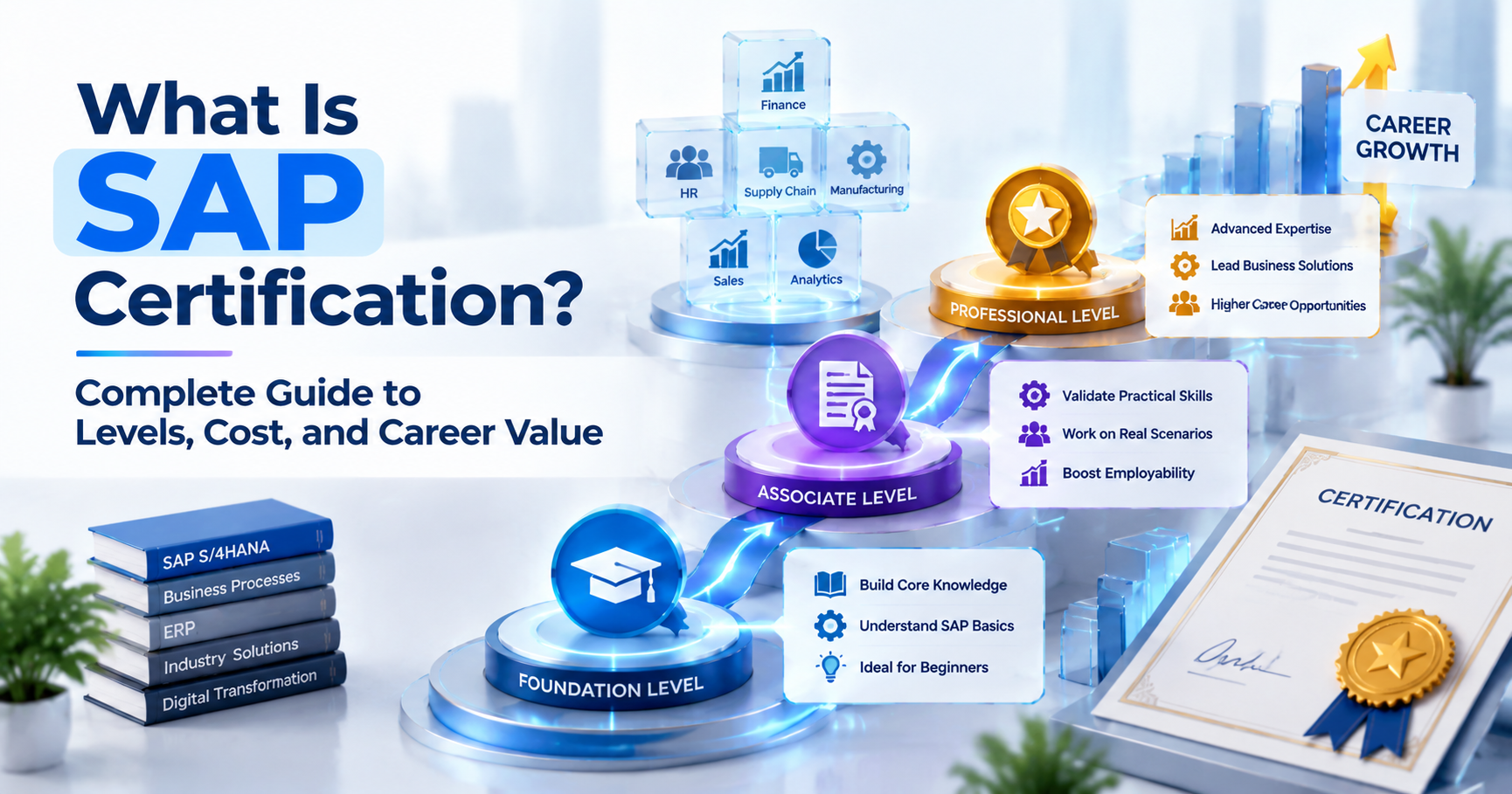
SAP certification is an official, performance-based credential issued by SAP that verifies a professional's skill in configuring, implementing, or supporting SAP software, most commonly SAP S/4HANA, SAP BTP, or SAP SuccessFactors. Certifications are organized into three levels, associate, specialist, and professional, and are earned by passing a proctored exam booked through the SAP Learning Hub or the SAP Training and Certification Shop. Since August 2024, most SAP certifications are valid for one year and must be kept current through an annual "Stay Certified" assessment or a full retake.
Key Highlights of SAP Certification
- SAP runs its own global certification program, delivered and proctored online through the SAP Certification Hub rather than through third-party test centers.
- Certifications sit at three levels: associate (foundational, prefix C_), specialist (a narrower add-on or delta topic, prefix E_), and professional (senior, project-tested expertise, prefix P_).
- The dominant tracks in 2026 are built around SAP S/4HANA modules such as Financial Accounting (FICO), Sales and Distribution (SD), and Materials Management (MM), alongside SAP BTP, SAP SuccessFactors, and the SAP Activate project manager credential.
- Most associate-level exams run 80 questions over 180 minutes, while shorter delta or specialist exams run around 40 questions in 90 minutes, with passing scores that vary by exam.
- Since August 1, 2024, SAP certifications are valid for one year and are renewed through a short annual "Stay Certified" assessment rather than staying valid indefinitely.
- Demand for S/4HANA-certified professionals is climbing as SAP's mainstream maintenance window for SAP ECC 6.0 (EHP6 to EHP8) closes on December 31, 2027, pushing thousands of enterprises through migration projects.
What Is SAP Certification?
SAP SE is the German enterprise software company behind the ERP (enterprise resource planning) systems that run finance, supply chain, HR, and operations for a large share of the world's largest companies. SAP certification is the company's own credentialing program: a set of exams, administered and scored by SAP itself, that confirm a professional actually knows how to configure, implement, extend, or run a specific SAP product or module. It is not a third-party or vendor-neutral credential like PMP or CompTIA; SAP writes the syllabus, owns the exam content, and issues the certificate.
Because SAP's product portfolio is enormous, spanning ERP, finance, human capital management, supply chain, analytics, and its Business Technology Platform, there is no single "SAP certification." Instead, there are dozens of distinct certifications, each tied to one solution or module, and each sitting at one of three difficulty levels. A newly certified associate consultant and a certified professional architect both hold "SAP certifications," but they have proven very different things.
Professionals who plan and lead the projects around these systems often pair SAP module knowledge with broader project delivery skills; Simpliaxis's guide to the top project manager certifications is a useful reference for how SAP-focused project credentials like SAP Activate fit alongside vendor-neutral options such as PMP.
Why SAP Certification Matters?
SAP software is deliberately configurable rather than off-the-shelf, which means the gap between "has used SAP" and "can configure SAP correctly for a live business" is large. Certification exists to close that credibility gap for employers, staffing agencies, and SAP implementation partners who need proof of skill before assigning someone to a client-facing project.
For hiring managers, an SAP certification is a fast, standardized signal that a candidate has covered the core configuration steps, business processes, and terminology of a module without the employer needing to test that knowledge itself. For consultants and internal IT staff, it is a way to formally document expertise gained on the job, make a lateral move into a new SAP module, or qualify for SAP partner staffing requirements, since SAP implementation partners are often contractually required to maintain a minimum ratio of certified consultants on client engagements.
SAP Certification Levels Explained
SAP structures its entire certification catalog around three levels. Each level tests a different kind of competence, so moving up the ladder is not simply a matter of studying harder; it requires real project exposure.
| Level | Typical Prefix | What It Verifies | Who It's For
|
| Associate | C_ | Foundational, implementation-level knowledge: navigation, core business processes, and basic configuration in one solution area. | Newcomers to a module, career switchers, and consultants validating a first SAP skill. |
| Specialist | E_ | Focused depth in a narrower add-on capability or a delta between two solution releases, usually layered on top of an associate credential. | Associates who want to prove expertise in one specific capability or the latest release. |
| Professional | P_ | Senior-level design and architecture judgment across a full solution, built from real project delivery rather than study alone. | Experienced consultants, solution architects, and team leads. |
In practice, most people entering the SAP ecosystem start at the associate level in one module (for example, SAP S/4HANA Sales), gain a year or more of hands-on project experience, and then either pursue a specialist certification in a related add-on or move directly to a professional-level exam once they have led implementation work rather than just supported it.
Major SAP Certification Tracks and Modules
SAP's certification catalog, browsable through the official SAP certification directory, spans functional (business-process) tracks and technical (developer or administrator) tracks. The tracks seeing the strongest demand as of 2026 include:
- SAP S/4HANA Financial Accounting (FICO): covers general ledger, accounts payable/receivable, asset accounting, and management (controlling) accounting inside S/4HANA Finance.
- SAP S/4HANA Sales and Distribution (SD): order-to-cash processes, pricing, billing, and sales document configuration.
- SAP S/4HANA Materials Management / Sourcing and Procurement (MM): procure-to-pay processes, inventory management, and vendor/material master data.
- SAP S/4HANA Production Planning (PP) and Extended Warehouse Management (EWM): manufacturing execution and warehouse logistics configuration.
- SAP Business Technology Platform (BTP): cloud extension, integration, and application development on top of SAP's core systems, a technical track aimed at developers and integration specialists.
- SAP SuccessFactors: cloud human capital management modules such as Employee Central, Recruiting, and Performance & Goals.
- SAP ABAP: SAP's proprietary programming language, the core technical/developer certification for custom code and enhancements.
- SAP Activate Project Manager: a certification built around SAP's own implementation methodology rather than a functional module, covering the discovery, prepare, explore, realize, deploy, and run phases used on S/4HANA projects, along with greenfield, brownfield, and selective data transition approaches. Its official page is listed under SAP Certified Associate, Project Manager, SAP Activate.
Functional tracks (FICO, SD, MM, PP) suit professionals with finance, supply chain, or business-process backgrounds; technical tracks (ABAP, BTP) suit those with programming or systems administration experience. Consultants who move between the two, or who lead cross-functional rollouts, sometimes find it useful to also compare how their skill set maps against adjacent analyst roles; Simpliaxis's breakdown of business analyst versus data analyst career paths is a helpful reference point for functional consultants weighing where their SAP experience could lead next.
Prerequisites and Who Should Get Certified
SAP does not impose a strict, universally enforced prerequisite (like a minimum number of documented project months) for associate-level exams the way some project management bodies do. In practice, however, the exams assume familiarity with the module's core business processes, so most candidates prepare through one of three routes: formal instructor-led SAP training, self-paced e-learning through an SAP Learning Hub subscription, or on-the-job exposure to the module as part of an implementation team.
Specialist and professional-level exams are different: SAP explicitly positions them for candidates who already hold the associate credential in the same solution area and have real project experience, since the exam scenarios test judgment calls that only come up in live implementations, not textbook configuration steps.
SAP certification tends to make the most sense for functional and technical consultants working inside SAP implementation partners or in-house SAP teams, IT professionals transitioning into ERP work from adjacent fields such as finance, supply chain, or software development, and project managers and business analysts who need enough SAP fluency to run or scope a project credibly, even if they never touch configuration themselves.
How to Get SAP Certified: Step by Step
- Choose a solution area and level. Match the module (FICO, SD, MM, BTP, SuccessFactors, ABAP, SAP Activate, etc.) to your background and career goal, and confirm whether an associate, specialist, or professional exam is the right entry point.
- Review the current exam details on SAP's own site. Each certification's official page on learning.sap.com/certificationslists the topic areas, weighting, and any recent changes, since SAP periodically retires and reissues certifications when a product releases a new version.
- Build the underlying skill. This can be through an SAP Learning Hub subscription's e-learning content, instructor-led training from an SAP-authorized partner, or structured hands-on project work.
- Get hands-on practice. SAP Learning Hub subscriptions include access to live SAP practice systems so candidates can actually perform the configuration steps being tested, not just read about them.
- Purchase an exam attempt. Buy either a Learning Hub subscription that bundles exam attempts, or a standalone exam voucher (SAP's standard options are a single-attempt voucher and a six-attempt voucher, each valid for a defined period) through theSAP Training and Certification Shop.
- Schedule and take the proctored exam. SAP certification exams are delivered as online, remotely proctored assessments booked through the SAP Certification Hub, so candidates can test from home or office on a schedule that suits them rather than traveling to a fixed test center.
- Stay certified annually. After passing, calendar the renewal window so you can complete the short annual assessment before the credential's one-year validity period ends.
SAP Learning Hub and the SAP Training and Certification Shop
Two official SAP platforms sit at the center of the certification journey, and it is easy to conflate them:
SAP Learning Hub is SAP's subscription-based learning platform. A subscription bundles e-learning content across SAP's product portfolio, access to live hands-on practice systems, expert-led digital sessions, and a defined number of certification exam attempts, all in one package, so a working consultant can study, practice configuration steps in a real system, and sit the exam without juggling separate vendors. Details and current subscription tiers are published on SAP's own SAP Learning Hub page.
SAP Training and Certification Shop (training.sap.com) is the commercial storefront where individuals and companies browse, compare, and purchase specific training courses, certification exam vouchers, and Learning Hub subscriptions. It is the practical starting point if you already know exactly which exam or course you want to buy rather than a full subscription.
SAP also publishes exam-specific vouchers through this shop, most commonly a single-attempt exam booking and a bundled multi-attempt option, which is useful for candidates who want to retake an exam without re-subscribing to a full Learning Hub package.
SAP Certification Exam Format and Structure
SAP certification exams have historically followed a fairly consistent structure, though SAP has been transitioning some exams toward more scenario- and task-based assessment formats. Based on the current published format for most standard associate exams:
- Question count: most associate-level exams run roughly 80 questions, though the range across different certifications spans about 60 to 80 questions.
- Duration: a standard 180-minute (three-hour) window for a full associate exam.
- Question types: primarily multiple-choice and multiple-response, with some exams also including matching, fill-in-the-blank, or scenario-based items.
- Passing score: set per exam rather than fixed globally; published passing scores across different certifications commonly fall somewhere in the 60 percent to low-70s percent range.
- Delta and specialist exams: these are typically shorter, often around 40 questions in a 90-minute window, since they test a narrower slice of updated or specialized content rather than an entire solution area.
Exam delivery itself is entirely online: SAP certification exams are remotely proctored through a webcam on the candidate's own computer and can be scheduled through the SAP Certification Hub at a time that suits the candidate, rather than requiring a visit to a physical test center. Because exam blueprints, question counts, and passing scores are set and updated by SAP per certification, and SAP has signaled an industry-wide shift toward more performance-based exam formats, candidates should always confirm the exact format, duration, and passing score on that specific exam's official SAP page before booking, since these details can change between certification versions.
SAP Certification Cost
SAP certification cost is not a single number; it is a stack of components, and the total varies by region, module, and whether you buy a standalone exam or a bundled Learning Hub subscription. The main components are:
- The exam fee or voucher itself, purchased directly from SAP through the Training and Certification Shop rather than a third-party testing vendor.
- A learning route, which could be an SAP Learning Hub subscription, instructor-led training from an authorized partner, or self-study, each with very different price points.
- Hands-on practice system access, typically bundled into a Learning Hub subscription rather than purchased separately.
- Retake costs, if a first attempt does not pass and the candidate did not buy a multi-attempt voucher.
Because SAP sets and periodically updates exam pricing by region and certification, and third-party estimates vary widely (some quote roughly $500 to $1,200 per exam attempt depending on region and module), the only reliable figure at the moment you are budgeting is the one shown on the specific exam's page in the SAP Training and Certification Shop at checkout. Companies sponsoring employee certification, and individuals comparing several modules, should treat any dollar figure from a third party, including this article, as an estimate to confirm rather than a locked price.
Certification Validity and Renewal: Staying Certified
This is one of the most significant recent changes to SAP's program, and one many older articles about SAP certification have not caught up with. As of August 1, 2024, SAP certifications are valid for one year from the date earned, not indefinitely as in SAP's older certification model. To keep a credential active, SAP requires professionals to complete a "Stay Certified" process, documented on SAP's own help center under Staying Certified:
- A renewal window opens 90 days before the certification's expiry date and closes on the expiry date itself.
- Within that window, certified professionals with an active SAP Learning Hub subscription can complete a short "Stay Certified" assessment, which, if passed, extends validity by another 12 months.
- Professionals without a Learning Hub subscription at renewal time must instead retake the full certification exam to stay current.
- If the window is missed entirely, the certification is no longer considered valid, and the professional needs to get recertified by passing an exam against the current release of that certification.
- When SAP formally retires a certification (as it periodically does when a product version changes significantly), anyone holding a valid certificate on the retirement date automatically receives a further 12 months of validity from that date.
This annual renewal cycle is a meaningful practical detail for anyone budgeting time or money for certification, since it converts SAP certification from a one-time achievement into a recurring commitment, closer to how continuing-education requirements work for credentials like PMP.
SAP Certification vs Other IT and Business Certifications
SAP certification is often compared to, and sometimes confused with, vendor-neutral IT and project certifications. The comparison matters because career paths frequently combine an SAP credential with a complementary one.
| Certification | Issuing Body | Focus | Best Paired With SAP When...
|
| SAP Certification (any track) | SAP SE | Product-specific configuration, implementation, or development skill in one SAP solution. | You need to prove hands-on SAP expertise itself. |
| SAP Activate Project Manager | SAP SE | SAP-specific implementation methodology and phases. | You manage SAP rollouts but want SAP-native methodology credibility. |
| PMP | Project Management Institute | Vendor-neutral project leadership across any industry or system. | You lead SAP projects but also manage non-SAP initiatives. |
| ITIL | AXELOS/PeopleCert | IT service management processes, independent of any single software vendor. | You support SAP systems within a broader IT service management function. |
Professionals evaluating whether to pursue an SAP certification alongside a service-management credential often start by checking baseline requirements; Simpliaxis's overview of ITIL certification eligibility requirements lays out how that vendor-neutral path compares to a product-specific one like SAP's.
Career Paths and Salary Impact
SAP-certified professionals typically move into roles such as SAP functional consultant (FICO, SD, MM, and similar), SAP technical consultant or ABAP developer, SAP Basis administrator, SAP BTP/integration developer, SAP SuccessFactors consultant, and SAP project manager using the Activate methodology. Demand for these roles is closely tied to the ongoing wave of SAP S/4HANA migrations, since SAP has confirmed that mainstream maintenance for SAP ECC 6.0 on Enhancement Packages 6 through 8 ends December 31, 2027 (with an optional, premium-priced extended maintenance period beyond that), a deadline detailed on SAP's ownproduct support strategy page. That deadline is pushing a large base of ECC customers into S/4HANA conversion projects, which directly increases demand for consultants certified on current S/4HANA modules.
On compensation, general salary-aggregator data for SAP-certified roles in the United States shows wide variation by module, seniority, and region; ZipRecruiter's SAP Certification salary datais one publicly available benchmark worth checking directly rather than relying on a single averaged figure, since pay for an entry-level associate-certified consultant and a professional-level solution architect can differ substantially. As with exam pricing, treat any single "average salary" figure as a starting point for research rather than a guarantee, and weigh it against local market data, the specific module, and years of hands-on project experience, which typically matters more to employers than the certification alone.
Tips to Prepare for Your SAP Certification Exam
- Start from the official topic areas, not a third-party study guide. Each certification's SAP page lists the weighted topic areas the exam draws from; use that as your syllabus.
- Get real system time. Reading about a configuration step and performing it in a live SAP system (available through Learning Hub practice access) tests different skills, and the exam increasingly rewards the latter.
- Don't skip the associate level to chase a professional credential. Professional exams assume associate-level fluency and real project judgment; attempting one without that foundation is a common reason candidates fail.
- Budget for the renewal cycle, not just the first exam. Since certifications are valid for one year, factor the annual Stay Certified assessment, or a Learning Hub subscription that includes it, into your ongoing plan rather than treating certification as a single expense.
- Time-box practice exams to the real duration. Simulating the 180-minute (or 90-minute, for delta exams) window helps surface pacing issues before exam day.
- Confirm the current format before you book. Because SAP has been updating exam formats and retiring older certification versions, always check the specific exam's current page rather than relying on a prior year's format.
Key Takeaways
- SAP certification is SAP's own credentialing program, organized into associate, specialist, and professional levels, each testing a different depth of skill.
- The strongest current demand sits around SAP S/4HANA modules (FICO, SD, MM), SAP BTP, SAP SuccessFactors, and the SAP Activate project manager credential.
- Certification is purchased and delivered through two official SAP channels: the SAP Learning Hub subscription and the standalone SAP Training and Certification Shop.
- Exams are remotely proctored online through the SAP Certification Hub, typically 80 questions in 180 minutes for a full associate exam, or around 40 questions in 90 minutes for shorter delta/specialist exams.
- Since August 2024, certifications are valid for only one year and require an annual "Stay Certified" assessment or a full retake to remain active.
- Rising demand for S/4HANA-certified professionals is directly tied to SAP ECC's mainstream maintenance ending December 31, 2027, which is pushing large numbers of enterprises through migration projects.
- Always confirm the exact exam format, passing score, and pricing on the specific certification's official SAP page before booking, since these details are set per exam and updated over time.








 Lowest-Price Challenge











 Personalized Path


.webp)


 USA
USA  Canada
 India
India UK
UK Australia
 Singapore


