


 Call Us



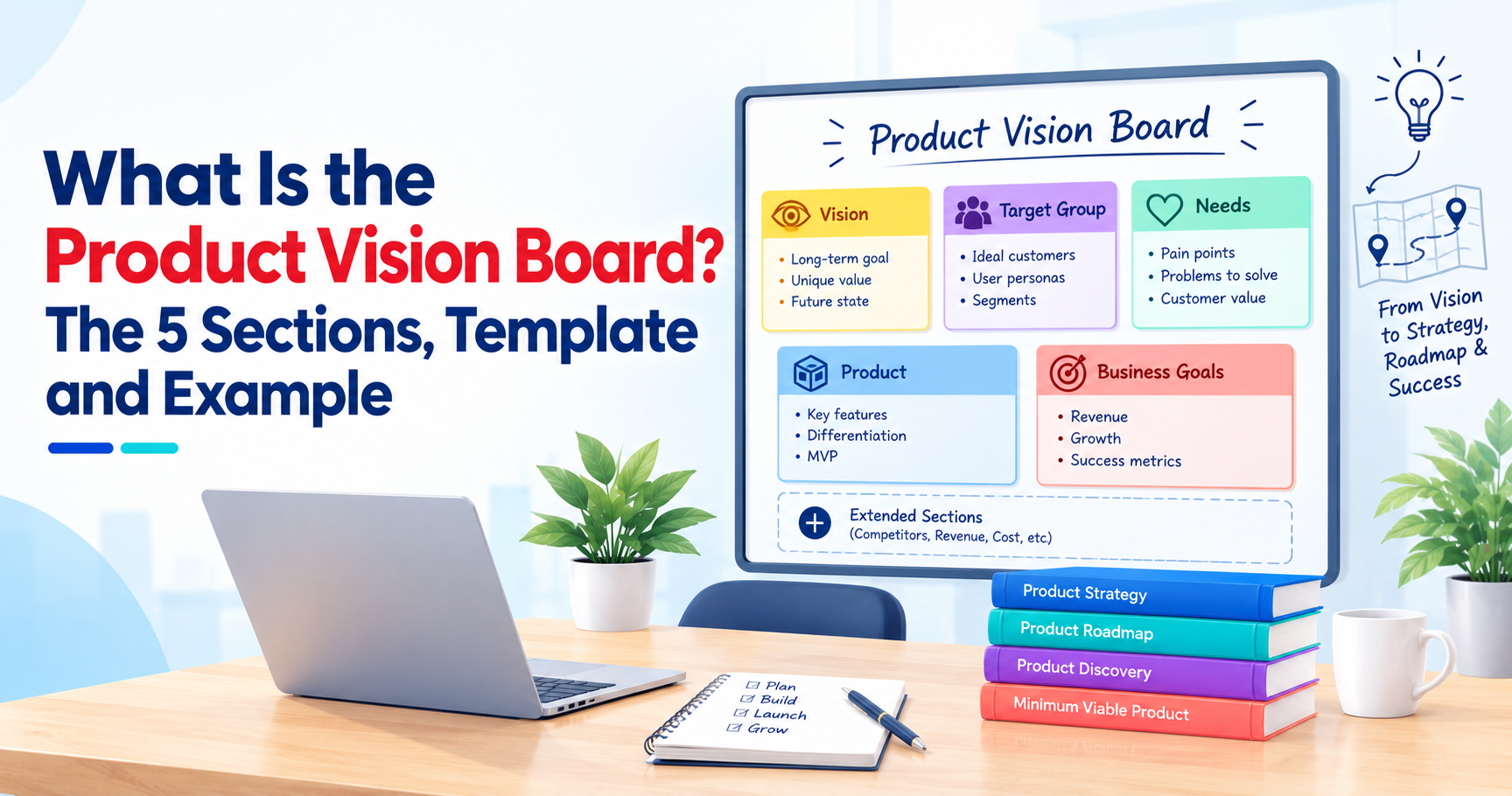
A product vision board is a one-page tool that helps teams define what they want to achieve, who the product serves, what customer needs it addresses, what the product will offer, and what business goals it should deliver. Created by Roman Pichler, the framework has five sections: Vision, Target Group, Needs, Product, and Business Goals.
In short, it turns a broad product idea into a clear strategic direction. It doesn’t replace a product roadmap, requirements, or backlog; instead, it provides the strategic foundation for them and helps keep product, business, and development teams aligned.
Key Highlights of the Product Vision Board
- A product vision board captures product vision and high-level strategy on one page.
- It was created by Roman Pichler in 2011.
- The standard board has five sections: Vision, Target Groups, Need, Products, and Business Goals.
- The board should contain assumptions that can be tested through product discovery, research, prototypes, interviews, and competitor analysis.
- It complements rather than replaces a product roadmap or product backlog.
- Pichler recommends inspecting and adapting the strategy regularly, with a three-month review being a useful rule of thumb.
Introduction
Product teams often start with an exciting idea: a new app, an AI-powered feature, an internal platform, or a completely new digital service.
The problem begins when the idea moves into execution.
Marketing may believe the product is designed for one audience. Engineering may be building for another. Sales may promise features that were never part of the strategy. Meanwhile, the product backlog continues to grow. A product vision board helps prevent this fragmentation by putting the most important strategic decisions in one visible place.
Think of it as a strategic snapshot. It does not attempt to answer every product question. Instead, it answers the questions that need to be aligned before detailed execution begins:
- Who are we building for?
- What problem are we solving?
- What value are we creating?
- What will make our product different?
- Why should the business invest in it?
- What future are we ultimately trying to create?
This makes the product vision board especially useful during early-stage product planning and product discovery.
What Is the Product Vision Board?
Product Vision Board Definition
A product vision board is a visual framework for capturing a product's vision and high-level strategy.
At the top, the board captures the product vision: the ultimate purpose and positive change the product should create.
The four sections underneath capture the core elements of the strategy: target group, needs, product, and business goals.
The result is deliberately compact.
For example, imagine a company wants to build an online learning platform for working professionals.
Instead of immediately writing dozens of user stories, the team could begin with:
- Vision: Make continuous professional learning practical for busy working adults.
- Target Group: Working professionals who need to develop job-relevant skills.
- Needs: Flexible, credible, affordable learning that fits around work.
- Product: Short learning paths, practical projects, expert feedback, and progress tracking.
- Business Goals: Build recurring subscription revenue and establish a strong professional-learning brand.
That is enough to begin asking the right questions without prematurely designing the entire solution.
Where It Came From (Roman Pichler)
The Product Vision Board was created by Roman Pichler, a product management author, trainer, and consultant. He introduced the framework in 2011 (The Product Vision Board) as a simple way to capture product vision and strategy.
Pichler's original approach deliberately keeps the board concise. His view is that detailed product information belongs in other artifacts, such as the product backlog, while the board should preserve the strategic picture.
His current checklist describes six desirable characteristics for the vision: it should be inspiring, shared, ethical, concise, ambitious, and enduring. The suggested horizon for an enduring vision is approximately five to ten years.
Why Use a Product Vision Board
A product vision board is useful because product teams need alignment before they need detail.
It can help you:
- Align product, business, design, engineering, sales, and marketing stakeholders (a quick stakeholder analysis helps you decide who to involve).
- Make the target customer explicit.
- Connect customer needs to product capabilities.
- Make business outcomes visible.
- Identify assumptions that need validation.
- Prevent feature lists from becoming the strategy.
- Create a foundation for product discovery.
- Provide strategic context for the product roadmap.
It is particularly useful when a product idea is still uncertain. Rather than spending months developing a solution based on untested assumptions, teams can use the board to identify the riskiest assumptions first.
Pichler specifically recommends validating statements in the Target Group, Needs, Product, and Business Goals sections through activities such as user interviews, observation, prototypes, and competitive analysis.
The Five Sections of the Product Vision Board
The five product vision board sections work together. Changing one section can affect the others.
Vision
The Vision describes the ultimate purpose of the product.
It should answer:
What positive change do we want to create?
A strong product vision is bigger than a feature.
For example:
“Help people manage their money with confidence.”
is a stronger vision than:
“Build an AI-powered budgeting app.”
The second statement describes a solution. The first describes an outcome that could remain relevant even if the solution changes.
Pichler recommends that the vision be inspiring, concise, ambitious, enduring, shared, and ethical.
Target Group
The Target Group identifies who the product is intended to serve.
This can include:
- Users
- Paying customers
- Organisations
- Market segments
- Specific demographic or behavioral groups
Avoid writing “everyone.”
For example, instead of:
“Anyone who wants to learn.”
use:
“Working professionals aged 25–45 who need flexible learning alongside a full-time job.”
The second description gives the product team something they can research and validate.
Pichler recommends that a target group should be clear, specific, and cohesive. If a proposed audience contains significantly different groups, it may be better to split them into separate segments.
Needs
Needs explain why the target group would use or pay for the product.
The key question is:
What problem are we solving, or what outcome are we helping customers achieve?
For example, a project management product might identify these needs:
“Anyone who wants to learn.”
“Working professionals aged 25–45 who need flexible learning alongside a full-time job.”
Pichler recommends that a target group should be clear, specific, and cohesive. If a proposed audience contains significantly different groups, it may be better to split them into separate segments.
Needs
What problem are we solving, or what outcome are we helping customers achieve?
- Teams need to understand project priorities.
- Managers need visibility into progress.
- Distributed teams need fewer status meetings.
Notice that these are needs—not features.
“Automated weekly reporting” is a product capability.
“Managers need visibility without requesting manual status updates” describes a need.
This distinction matters because it prevents teams from becoming overly attached to an initial solution.
Product
The Product section describes what you intend to build and what makes it stand out.
Pichler recommends identifying approximately three to five standout features and keeping them at a high level.
For a remote collaboration platform, that might be:
Product
The Product section describes what you intend to build and what makes it stand out.
For a remote collaboration platform, that might be:
- Shared project workspace
- Real-time collaboration
- Automated progress summaries
- Role-based dashboards
It should not become a list of 50 product backlog items.
The Product section answers:
What will we offer, and why will customers choose it over alternatives?
Business Goals
A product needs customer value and business value.
Business Goals explain what the organization expects to achieve by investing in the product.
Possible goals include:
- Generate recurring revenue.
- Enter a new market.
- Reduce operating costs.
- Increase customer retention.
- Strengthen brand positioning.
- Improve productivity.
- Develop strategic capabilities.
- Generate valuable market knowledge.
Where possible, make goals measurable.
Instead of:
“Increase revenue.”
write:
“Generate $2 million in annual recurring revenue within three years.”
The exact target will vary by organization, but specificity makes later measurement easier.
The Extended Product Vision Board
Adding Competitors, Revenue and Cost Sections
The standard board deliberately focuses on vision and strategy rather than the complete business model.
However, some products require additional commercial context.
The extended product vision board adds business-model elements such as competitors, revenue sources, cost factors, and channels. Pichler describes the extended version as being inspired by the Business Model Canvas.
For example, an extended board for a SaaS product might include:
| Area | Examples |
| Competitors | Existing project management platforms |
| Revenue | Monthly and annual subscription |
| Costs | Cloud infrastructure, development support |
| Channels | Direct sales, website, partnerships |
| Target Group | Mid-sized technology companies |
| Needs | Better cross-team visibility |
| Products | Collaboration and reporting performance |
The extended format is particularly useful when the commercial model itself is uncertain.
How to Fill In the Product Vision Board Step by Step
Step 1: Capture the Vision
Start with the desired change, not the feature list.
Ask:
- What future do we want to create?
- Who benefits from that future?
- What would success look like at a high level?
- Can the vision survive if our initial solution changes?
Keep it short enough that a team member can remember it.
A useful test is to ask someone who was not involved in creating the board to read the vision once and explain it back to you.
Step 2: Define the Target Group and Needs
Next, identify the people who matter most. Avoid trying to serve every potential customer at launch. Then identify their most important needs. This is where product discovery becomes important. Interviews, observation, surveys, prototypes, usability testing and other product discovery techniques can help determine whether the assumptions on the board reflect reality.
For example, suppose a team believes small-business owners need “more accounting features.”
Customer interviews might reveal that their real problem is not missing features but uncertainty about cash flow.
That insight could completely change the product strategy.
Step 3: Describe the Product
Once the needs are clearer, describe the product at a high level.
Ask:
- What type of product is this?
- Which capabilities directly address the important needs?
- What differentiates the product?
- Which capabilities are essential for success?
Limit the list.
A crowded Product section is often a warning sign that the team is moving from strategy into implementation too early.
Step 4: Set the Business Goals
Now establish why the organization should invest.
Business goals might include revenue, market entry, retention, cost reduction, productivity, brand development, or learning.
Prioritize them.
For example:
- Achieve product-market fit in the target segment.
- Acquire 10,000 paying customers.
- Reach a sustainable recurring-revenue model.
The business goals also provide context for future product decisions, and can later be expressed as OKRs and KPIs.
Step 5: Validate the Assumptions
A completed board is not proof that the strategy is correct.
It is a collection of strategic hypotheses that should become increasingly evidence-based.
Validate questions such as:
- Does the target group actually experience the problem?
- Is the problem important enough to solve?
- Will customers pay for the proposed value?
- Does the proposed product solve the problem better than alternatives?
- Can the organization build and operate it?
- Are the business goals realistic?
Do research and experiments before locking up significant development capacity.
This is one reason the product vision board works well with a minimum viable product (MVP) approach, where the team can test key assumptions before investing heavily in a full solution.
Product Vision Board Example
Consider a fictional product called SkillSprint, a learning platform for working professionals.
Vision
Make continuous career learning practical for every working professional.
Target Group
Working professionals who want to develop job-relevant skills but have limited time for traditional courses.
Needs
- Learn in short, manageable sessions.
- Apply new knowledge to real work.
- Know which skills are most valuable for career progression.
- Receive useful feedback.
Product
- Personalized learning paths
- 15-minute lessons
- Work-based projects
- Expert feedback
- Progress and skills dashboard
Adding Competitors, Revenue and Cost Sections
However, some products require additional commercial context.
Business Goals
- Reach 50,000 registered users within two years.
- Convert a sustainable percentage of active users into paid subscribers.
- Establish SkillSprint as a recognized professional-learning brand.
This product vision board example illustrates an important principle: the board does not attempt to describe every screen, user story, technical component, or marketing campaign.
Those details can be developed later.
Suppose product discovery then reveals that professionals do not struggle to find courses—they struggle to determine which skills are worth learning.
The Needs section could change, and that change might lead to a different Product section.
That is a feature, not a failure, of the framework.
Product Vision Board Template and Tools
A product vision board template provides a starting structure so teams do not have to create the framework from scratch.
The original framework is available through Roman Pichler’s resources, including the official Product Vision Board template and checklist.
For teams looking for a free product vision board template, the important thing is less about the software and more about preserving the five strategic sections.
You can create the board using:
Product Vision Board Example
Product Vision Board Template and Tools
- Whiteboards and sticky notes
- Presentation software
- Spreadsheet tools
- Collaborative digital whiteboards
- Product management platforms
- Documentation tools
When selecting product vision board tools, prioritize collaboration, easy editing, visibility, and version history.
For a workshop, a physical or digital whiteboard is often sufficient. The board should be easy for participants to edit and discuss rather than becoming a polished document that nobody touches.
If your organization wants a structured approach to product ownership and product management, you can also explore SAFe POPM Certification Training.you can also explore SAFe POPM certification training.
Product Vision Board vs Product Vision Statement
A product vision statement is usually a concise statement describing the ultimate purpose or desired future of the product.
A product vision board goes further.
| Product Vision Statement | Product Vision Board |
| Usually one statement | One-page visual framework |
| Focuses primarily on the desired future | Connect vision with strategy |
| Easy to communicate | Provides strategic context |
| Does not necessarily describe the target customer | Includes target group |
| Does not necessarily explain business value | Includes business goals |
For example:
Vision statement:“Help people make healthier everyday food choices.”
Product vision board:Adds who those people are, what they need, what product capabilities will differentiate the solution, and what business outcomes the organization wants.
The two approaches are complementary rather than competing.
Using the Product Vision Board in Agile and SAFe
Agile teams need flexibility, but flexibility does not mean having no direction.
The product vision board can provide the strategic context that helps teams decide what deserves attention next.
In an Agile environment, the vision can remain relatively stable while the strategy, roadmap, and backlog evolve as the team learns.
This is especially relevant in frameworks such as SAFe, where product management and product ownership involve connecting customer and business needs to delivery.
The board can help stakeholders understand why a product exists before discussing individual features or backlog items.
From Vision Board to Strategy, Roadmap and Backlog
The relationship can be viewed as a hierarchy:
Vision → Strategy → Roadmap → Backlog
The product vision describes the desired future.
The product strategy describes the approach for achieving that future.
The product roadmap translates the strategy into outcomes and planned product direction over time.
The product backlog contains the more detailed work needed to deliver the next outcomes. Pichler's product strategy framework also distinguishes these levels. His framework describes the Product Vision Board as capturing the vision and strategy, the roadmap as addressing how the strategy will be implemented over the coming months, and the backlog as containing more detailed delivery items.
For example:

This separation prevents the backlog from becoming the place where product strategy is accidentally decided.
Teams can also benefit from understanding SAFe POPM roles and responsibilitieswhen applying the framework within a SAFe environment.
Conclusion
A product vision board is simple by design, but that simplicity makes it useful.
By putting Vision, Target Group, Needs, Product, and Business Goals on one page, the framework gives product teams a shared strategic reference point. It helps answer the questions that should come before detailed feature planning: Who are we serving? What do they need? What are we building? Why is it different? And what value should it create for the business?
The board should not become a static poster.
The most valuable version is one that evolves as the team learns through product discovery, customer research, experiments, prototypes, and market evidence. Pichler recommends regular inspection and adaptation, with a three-month cadence as a useful rule of thumb for the product strategy.
From there, the board can provide the strategic foundation for a product roadmap and eventually the product backlog.
If you're starting a new product, changing an existing product strategy, or trying to bring different stakeholders around a common direction, a product vision board template can be one of the simplest places to start.







 Lowest-Price Challenge











 Personalized Path


.webp)


 USA
USA  Canada
  India
India  UK
UK  Australia
  Singapore


