


 Call Us




Business Model Canvas: The 9 Building Blocks, Examples and Template

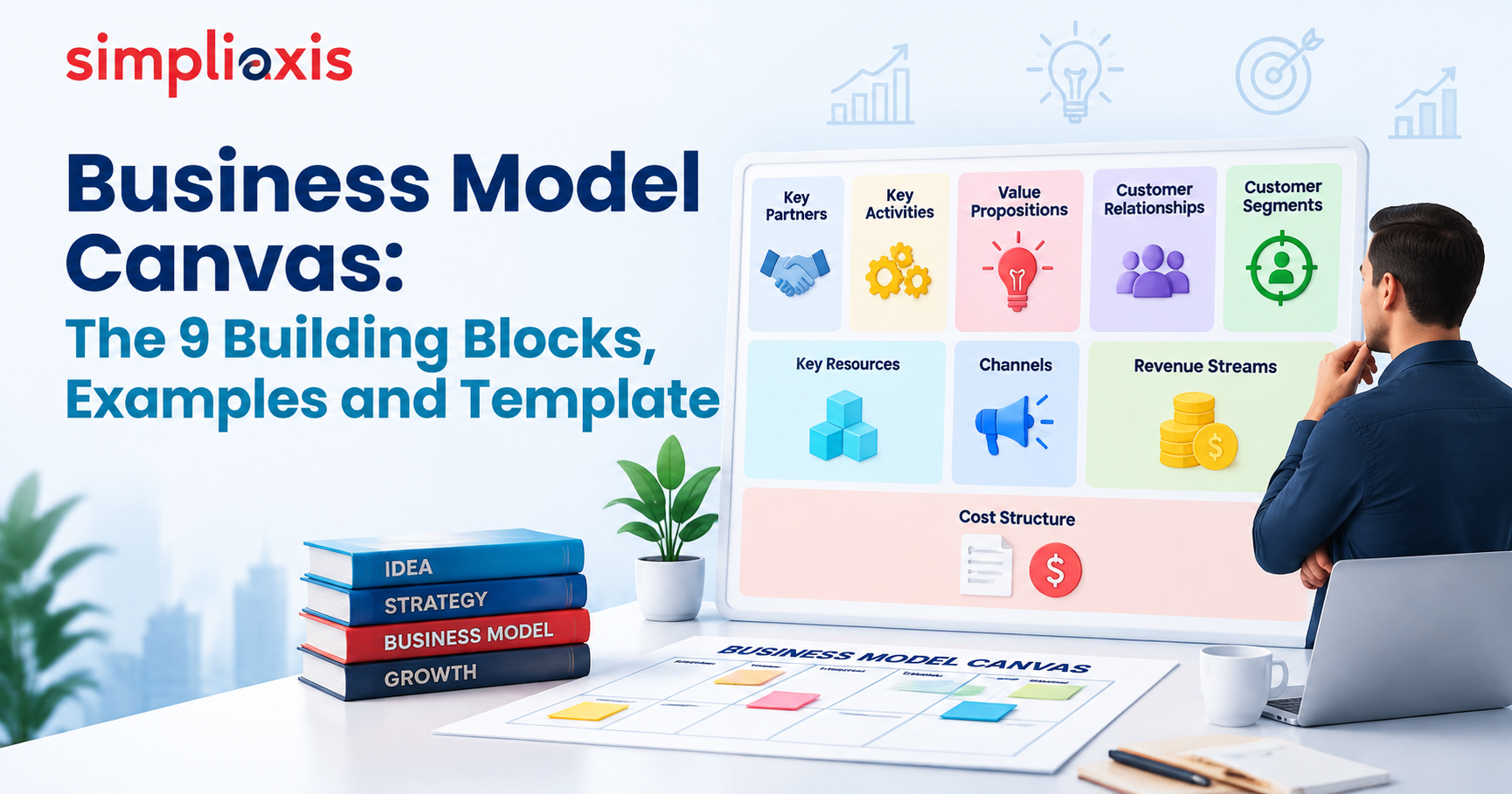
The Business Model Canvas (BMC) is a visual template for structuring how a business creates, delivers and captures value. It was created by Alexander Osterwalder with Yves Pigneur and other contributors and it breaks a business model down into nine building blocks, which are Customer Segments, Value Propositions, Channels, Customer Relationships, Streams of Revenue, Key Resources, Key Activities, Key Partnerships, and Cost Structure.
The canvas is used by entrepreneurs to evaluate new business ideas before committing serious resources. Established organizations use it to analyze existing operations to explore new revenue opportunities and to identify gaps between customer expectations and business capabilities. Product teams can also leverage it to link product decisions to commercial objectives.
The canvas provides a high-level view of how a business works, as opposed to a traditional business plan. It does not replace financial forecasts, market research, or an execution plan, but it provides a useful starting point for all three.
Key Highlights of Business Model Canvas
- The Business Model Canvas brings nine essential business decisions together in one visual framework.
- Alexander Osterwalder and Yves Pigneur popularized the approach through Business Model Generation, published in 2010.
- The canvas works for startups, established companies, nonprofits, and product teams.
- The Business Model Canvas focuses on the overall business model, while the Lean Canvas emphasizes startup problems, solutions, and early-stage risks.
- Customer research, financial analysis, and experiments are necessary to validate the assumptions recorded in a canvas.
Introduction
A business idea might look great on paper, but it has to be tested against a few things. Who will pay for it? How will customers know about it? Can this business create value profitably? The business model canvas pulls all of these decisions into one place, helping teams find gaps and see how different parts of a business affect each other.
Consider an online tutoring startup that matches students with qualified tutors and takes a percentage of each lesson. The service needs to attract students and tutors, pay them reliably, keep the quality of service high and cover its operating costs to be successful.
Mapping these relationships helps startups test ideas early in the product development process, before committing significant resources. It is equally useful for established companies looking at new markets, subscription services or changes to their existing business models.
This guide includes nine building blocks, how to fill out a canvas, real-world examples, and how product owners can use it to make better business decisions in 2026.
What Is a Business Model Canvas?
Business Model Canvas is a strategic planning tool that outlines how a business serves its customers, delivers its value, and makes money. It provides a common view of the decisions linking customer needs, daily operations and financial performance.
The nine building blocks are:
- Customer Segments
- Value Propositions
- Channels
- Customer Relationships
- Revenue Streams
- Key Resources
- Key Activities
- Key Partnerships
- Cost Structure
Each block is a different part of the business but the real value is in seeing how they fit together.
Imagine a company that sends you healthy meals through a mobile app. It may be aimed at busy working people who want simple lunches during the week. The company could provide flexible meal plans, take orders via its app and use a logistics partner to deliver the meals.
For this model to work, the business needs reliable food suppliers, kitchen capacity, ordering technology, customer support and a pricing structure that covers its costs.
The canvas helps the team to see these elements together rather than treating marketing, product development and operations as separate activities.
Origin and Purpose
The framework was created by Alexander Osterwalder, with Yves Pigneur and other collaborators. Their book, Business Model Generation, published in 2010, was instrumental in establishing the canvas as a common approach for business model design.
The main goal is to enable communication, exploration and testing of business assumptions.
For example, a company may believe that customers will pay premium prices for a personalized service. However, if each customer requires a lot of manual support, the added revenue might not be worth the expense of delivering that support.
The canvas helps teams to spot such conflicts early. It can also help decide whether to enter a new market, introduce subscriptions, change distribution channels or develop a new product.
It is not a replacement for market research or financial planning. Instead, it provides a starting point for deciding what needs to be investigated.
Canvas vs Traditional Business Plan
A business model canvas and a traditional business plan support different stages of business planning.
A business plan typically explains the opportunity, market conditions, operating arrangements, management structure, risks, and financial forecasts in considerable detail. A canvas compresses the central business logic into a visual overview.
| Aspect | Business Model Canvas | Traditional Business Plan |
| Format | One-page visual framework | Detailed written document |
| Primary purpose | Understand and evaluate a business model | Explain the business and how it will be executed |
| Main focus | Value creation, delivery, and capture | Market analysis, operations, strategy, and financial planning |
| Level of detail | High-level overview | Detailed explanations and supporting evidence |
| Flexibility | Easy to revise during workshops and experiments | Revisions may require updating several sections |
| Financial planning | Identifies major revenue streams and costs | Usually includes budgets, forecasts, cash flow, and financial assumptions |
| Best use | Exploring ideas, reviewing business models, and identifying gaps | Funding applications, formal planning, and implementation |
Suppose an entrepreneur wants to launch a specialty coffee subscription service. The canvas can help establish who the customers are, what makes the subscription attractive, how deliveries will work, and whether recurring revenue can support the business.
A business plan would go further. It might include market research, supplier quotations, inventory projections, customer acquisition estimates, staffing requirements, and a cash-flow forecast.
The two approaches are therefore complementary. A canvas can expose weaknesses before a team spends time preparing a detailed plan, while a business plan can turn the resulting decisions into a more complete operating and financial proposal.
Neither format guarantees that the business will succeed. Both depend on the quality of the underlying assumptions and evidence.
The 9 Building Blocks of the Business Model Canvas
1. Customer Segments
Customer Segments explains the different groups of people or organizations that a business wants to reach and serve.
Customer needs, budgets, buying habits and expectations are all different. A product built for freelancers may lack the security and reporting capabilities that a large enterprise requires.
Common types of customer segments include:
- Mass market: A large market with similar needs.
- Niche market: A small, specialized market with specific needs.
- Segmented market: Multiple related groups with varying needs.
- Different customers of the same business: Diverse market.
- Multi-sided market: Two or more interdependent groups, e.g. buyers and sellers on a marketplace.
For example, an online learning platform can cater to university students, working professionals, and employers. Students may want affordability. Professionals may want practical courses. Employers may want centralized billing and progress reports.
If these groups are treated as a single audience, product priorities may be unclear and marketing may be ineffective.
When defining customer segments, consider:
- Who does the product solve the problem for?
- Who purchases the product? And who utilizes it?
- Who is in most need of it?
Do different groups have different needs for features/services?
In business-to-business markets, the buyer and the user may be different people. A user of a software product could be an employee, but a manager approves the purchase and the finance team has the budget.
As the business collects evidence from interviews, sales data, consumer input, and purchasing behavior, customer segments should become more specific.
2. Value Propositions
The Value Proposition explains why customers might choose a product or service over available alternatives.
Features describe what a product does. A value proposition explains why those features matter.
For instance, a project management platform could offer automated reminders, task assignment and shared dashboards. Its value prop could be to help teams not miss deadlines and spend less time coordinating work.
A business may create value through:
- Improved performance or convenience
- Reasonable Prices
- Customization”
- Lower risk
- Easier to reach
- Enhanced customer experience
A local grocery delivery service might compete with other similar services on reliable delivery times, local products, or responsive customer service.
To identify a value proposition, ask three questions:
- What problem does the customer need to fix?
- What will the product bring to the table?
- What would make the customer choose it over another option or stick to the status quo?
That last question is important because customers may not see enough upside to justify switching products or changing their habits.
Customer interviews, prototype testing, competitor research and sales conversations can help you determine whether a proposed value proposition addresses a real need. To map benefits against customer pains in more detail, use a value proposition canvas.
3. Channels
Channels describe how customers discover, evaluate, purchase, and receive a product or service. They also include the ways customers access assistance when needed.
Common channels include:
- Company websites and mobile applications
- Physical stores and sales teams
- Search engines, social media, and email
- Distributors and resellers
- Online marketplaces and app stores
- Partner referrals and professional networks
Consider a skin care brand selling directly to consumers. Social media can introduce its products to customers, the company website can process the purchases and the logistics provider can deliver the orders. Email can drive repeat purchases and share product information.
Each channel has its own costs and limitations. A marketplace provides access to customers, but at the cost of fees. A sales team can be more personal, but it costs more to run.
Where are your customers looking for solutions? Which channels do they trust? What does it cost to convert that interest into a completed purchase?
The process for complex products may involve several channels. An enterprise software buyer may discover a company through an industry article, attend a product demo, sign a contract with a sales rep, and get onboarding from a customer success team.
A customer journey map can identify the friction points in these interactions.
4. Customer Relationships
Customer Relationships explains how a business attracts, supports, and retains customers.
The right approach depends on customer expectations, product complexity, and operating costs.
Common relationship models include:
- Personal assistance: Support from sales representatives or service agents.
- Dedicated assistance: A specific representative manages an important account.
- Self-service: Customers use the product independently.
- Automated service: Software provides reminders, recommendations, or guidance.
- Communities: Customers exchange information and help each other.
- Co-creation: Customers contribute feedback or ideas that shape the offering.
A cloud software provider could deliver self-service onboarding and documentation online to individual users, but provide implementation support to enterprise clients.
It doesn't end after that first sale. Companies need to think about onboarding, troubleshooting, renewals, and engagement.
Customer retention is essential for subscription companies. Frequent cancellations may suggest that the product isn't providing sufficient continued value or that your customers aren't able to use it.
Important metrics to watch are retention rate, churn, repeat purchases, support response time, customer satisfaction, etc. These should all be viewed in conjunction with customer feedback to get to know what is going on and why.
5. Revenue Streams
Revenue Streams describe how a business earns money from its customers.
Common revenue models include:
- One-time purchases
- Monthly or annual subscriptions
- Usage-based pricing
- Licensing fees
- Transaction commissions
- Advertising
- Consulting and service fees
- Freemium upgrades and paid add-ons
An online accounting app could have a free version, an affordable subscription aimed at small businesses, and a more expensive enterprise version that includes reports and permissions.
Every level has its own requirements, and each one generates different revenue streams. That said, even free users require infrastructure and support, while paid customers need to get their money's worth. The marketplace may also be able to generate income via commissions on transactions, sellers' subscription fees, or advertisements.
When defining revenue streams, ask:
- What are customers paying for?
- Who pays, and who receives the benefit?
- Will customers pay once or regularly?
- How predictable is the revenue?
- How will changes in price, usage, or retention affect income?
For example, a subscription business with 300 paying customers at ₹800 per month generates ₹2,40,000 in gross monthly subscription revenue before discounts, refunds, taxes, and other adjustments.
That is not profit. Salaries, technology, marketing, payment fees, and customer support still need to be paid.
A separate financial model is necessary to determine whether the revenue structure is sustainable.
6. Key Resources
Key Resources are the assets a business needs to deliver its value proposition and operate effectively.
They generally fall into four categories:
- Physical: Equipment, inventory, offices, warehouses, and manufacturing facilities.
- Intellectual: Software, patents, proprietary processes, content, data, and brand reputation.
- Human: Employees and specialists whose knowledge keeps the business running.
- Financial: Working capital, investment funding, credit, and cash reserves.
Important resources for a software company may be its platform, its development team, its cloud infrastructure and its customer data. For a retailer, inventory, supplier relationships, store locations and distribution facilities may be more important.
The aim is to identify the resources that are key to the business model, not to create a list of all the assets the company has.
You don't have to have all the resources. A business might rent equipment, license technology or bring in outside specialists when it is more practical.
Resource planning should also take dependencies into account. Operational risks can arise where a critical function depends on a single supplier or a single specialist.
7. Key Activities
Key Activities are the tasks a business must perform to make its model work.
Examples include:
- Product development and maintenance
- Manufacturing and quality control
- Marketing and sales
- Order fulfillment and distribution
- Customer support
- Research and experimentation
- Platform operations, security, and data management
For instance, an online tutoring marketplace needs to maintain the platform, hire tutors, attract students, deal with payments, settle complaints and help users find the right matches.
These activities directly influence the quality of the service.
One good way to identify key activities is to ask: If this activity were not performed, would the business struggle to deliver its value proposition or make money?
This could be product development and security for a software company; it could be production and quality control for a manufacturer.
By identifying the essential activities, teams know where to invest, what to automate and what tasks can be outsourced. Outsourcing can reduce cost, but the business is still responsible for the quality of service and results to the customer.
8. Key Partnerships
Key Partnerships identifies the external organizations that help a business operate or deliver value.
Partners may provide expertise, technology, distribution, resources, or access to customers.
Examples include:
- Suppliers and manufacturers
- Logistics providers
- Cloud hosting and software vendors
- Payment processors
- Marketing agencies
- Research institutions
- Integration partners and distributors
An online retailer may need manufacturers for its products, a logistics company for delivery, a payment provider for transactions and a cloud service for its website.
These relationships let the retailer concentrate on product selection, marketing and the customer experience instead of building all capabilities internally.
Partnerships, however, can carry risks. A delivery provider may raise prices, a supplier may have shortages or a third-party service may become unreliable.
As you complete this block, consider what each partner brings, what the relationship costs and if there is an option if the partnership doesn’t last.
9. Cost Structure
Cost Structure identifies the major expenses involved in operating the business.
Common costs include:
- Salaries and contractor payments
- Technology infrastructure and software licenses
- Manufacturing and raw materials
- Marketing and sales
- Rent and administration
- Logistics and customer support
- Compliance, insurance, and security
Costs can be broadly divided into fixed and variable expenses.
Fixed costs remain fairly constant over a certain period of time, like rent. Variable costs change with the level of activity, like shipping costs or the cost to produce a product.
A software company can shell out a huge amount in development before it launches, but each new user adds very little in costs. As the number of orders increases, the meal delivery business incurs costs in ingredients, packaging, preparation and delivery.
Let’s say the meal service costs ₹250 per meal. The cost of ingredients and packaging is Rs. 110, delivery charges Rs. 45, and payment and other variable charges Rs. 15. The remaining ₹80 per meal goes toward fixed costs and profit.
That amount is not pure profit because salaries, kitchen rent, marketing, equipment and other overheads still have to be covered.
Understanding the cost structure helps a business determine if its pricing and revenue model can support its operations.
How to Fill Out a Business Model Canvas Step by Step
Filling out a business model canvas is best treated as a structured working session rather than a writing exercise. The goal is to understand how the business is expected to operate, identify weak assumptions, and decide what evidence is needed before making significant commitments.
A first version does not need to be perfect. In fact, a canvas that makes uncertainty visible can be more useful than one filled with confident statements that nobody has tested.
Start With Customers and Value
Begin by identifying the customer group you intend to serve and the problem you want to solve.
Avoid starting with a list of features. A team may be enthusiastic about building a mobile application, introducing artificial intelligence, or adding a new dashboard, but those ideas do not establish that customers need the product.
Start with the people who experience the problem.
For example, a startup might initially write “people who want to eat healthier” as its customer segment. That description is too broad to guide many business decisions. It could be narrowed to “office workers in large cities who need convenient weekday lunches and have limited time to prepare meals.”
The narrower segment suggests questions worth investigating. Do these customers purchase lunch every working day? Are they dissatisfied with existing delivery services? Are they more interested in nutritional information, delivery reliability or price? Do they want individual meals or a weekly subscription?
You can answer these questions using product discovery techniques such as interviews and observation.
If the segment is reasonably well defined, articulate the value proposition. Describe the problem, the benefit, and why the solution may be better than current alternatives.
Then complete the remaining blocks in a sequence that helps the team explore the business logic:
- Customer Segments: Identify the intended audience and distinguish users from buyers where necessary.
- Value Propositions: Describe the benefit that matters to those customers.
- Channels: Determine how customers will discover, evaluate, purchase, and receive the offering.
- Customer Relationships: Decide what support and engagement the business must provide.
- Revenue Streams: Establish how customers will pay and what they will pay for.
- Key Resources: Identify the assets needed to deliver the offering.
- Key Activities: List the activities that make the business model work.
- Key Partnerships: Identify external organizations that provide essential capabilities.
- Cost Structure: Estimate the major expenses and how they change with demand.
The order is a useful starting point, not a hard and fast rule. If the team already has strong evidence on costs or supplier limitations, those factors might inform the model from the start.
The recommended customer segment might be for the meal subscription startup that could enjoy easy weekday lunches. The team could offer pre-selected meal plans, sell subscriptions on a website, and use a kitchen partner to cook the food.
That model gives rise to other questions. Will customers agree to pay weekly? How many meals have to be sold to cover the cost of preparation and delivery? What happens if customers pause their subscriptions? Will the service be able to keep up its quality as demand grows?
The canvas makes these dependencies easier to discuss.
A product strategy guide can provide additional context on connecting customer needs with business goals and product decisions.
Test Assumptions Block by Block
A completed canvas is a set of hypotheses about how the business will work. Some may be supported by customer data, existing sales, or operating experience. Others may remain uncertain.
The next step is to determine which assumptions are most important and how to test them.
Imagine a startup that plans to charge ₹999 per month for a productivity application. Its founders believe that small businesses will pay this price because the application saves time.
That assumption can be investigated through interviews, a prototype, a pricing experiment, or a pilot with a small group of prospective customers. The team should look for evidence of actual purchasing intent rather than relying entirely on positive comments.
Different blocks require different tests.
| Canvas Block | Example Assumption | Possible Test |
| Customer Segments | Small retailers experience a significant inventory problem | Interview retailers and observe their current processes |
| Value Propositions | Automated alerts will reduce stock-related errors | Test a prototype with representative users |
| Channels | Search marketing can attract qualified customers | Run a limited campaign and track relevant conversions |
| Customer Relationships | Self-service onboarding will be sufficient | Observe trial users and measure where they need assistance |
| Revenue Streams | Customers will pay a monthly subscription | Test pricing with qualified prospects and seek paid commitments |
| Key Resources | Existing cloud services can support expected demand | Conduct a technical assessment and performance tests |
| Key Activities | Product updates can be delivered by a small team | Estimate workload and test the development process |
| Key Partnerships | A logistics provider can meet delivery requirements | Run a pilot and measure service reliability |
| Cost Structure | Unit costs will decline as order volume grows | Compare supplier quotations and model different demand levels |
These are possible experiments, not guarantees that a particular outcome will follow.
A practical testing process has five parts:
- State the assumption clearly. Avoid vague statements such as “customers will like the product.” Write a testable claim.
- Assess the risk. Consider the consequences if the assumption proves wrong.
- Select an experiment. Use the smallest practical test that can produce useful evidence.
- Define the evidence needed. Decide what results would support, challenge, or leave the assumption unresolved.
- Update the canvas. Record the findings and revise the relevant blocks.
Teams should prioritize assumptions that are both uncertain and consequential. A minor design preference may not justify immediate research, while uncertainty about customer willingness to pay could undermine the entire business model.
This approach is consistent with the experimentation principles discussed in Harvard Business Review's Why the Lean Start-Up Changes Everything.
The work does not end after the first round of testing. Customer behavior, competition, technology, and operating costs change. A useful canvas evolves as the team learns more about the market and its own capabilities.
Business Model Canvas Examples
A business model canvas becomes easier to understand when its blocks are applied to a concrete scenario. The examples below show how the same framework can describe businesses with very different revenue models and operational requirements.
These are illustrative scenarios created to explain the framework. The figures are examples for calculation, not reported financial results from specific companies.
Subscription Software Example
Imagine a startup developing a cloud-based project management platform for small consulting firms. Its customers currently coordinate client work through spreadsheets, email, and separate messaging tools.
The startup wants to provide a single place to assign tasks, monitor deadlines, share project updates, and communicate with clients.
Its initial business model might look like this:
| Building Block | Illustrative Business Model |
| Customer Segments | Small consulting firms and independent project teams |
| Value Propositions | An affordable, straightforward way to coordinate tasks, deadlines, and client work |
| Channels | Company website, content marketing, product trials, and referrals |
| Customer Relationships | Self-service onboarding, online documentation, and email support |
| Revenue Streams | Monthly and annual subscriptions, with different plans for different team sizes |
| Key Resources | Software platform, development team, customer data, and brand |
| Key Activities | Product development, maintenance, customer acquisition, and support |
| Key Partnerships | Cloud hosting provider, payment processor, and integration partners |
| Cost Structure | Salaries, infrastructure, software tools, marketing, and support |
At first glance, the model looks straightforward. The business develops software, sells subscriptions, and improves the product over time.
The challenge is making the nine blocks work together.
Customer Segments and Value Propositions
The company initially targets small consulting firms because their teams need to coordinate several client projects without the administrative overhead of a large enterprise platform.
However, the team must establish whether this segment experiences the problem frequently enough to pay for a dedicated tool. Some firms may already have a satisfactory system. Others may need features that are too expensive for a small startup to provide.
Interviews with prospective customers can help identify the most important unmet needs.
Channels and Customer Relationships
The startup is offering a free trial on its website. Potential customers will be brought in by content marketing and referrals, and automated onboarding will enable users to get a chance to explore the product without a sales call appointment.
This approach maintains a relatively simple initial service model. Larger companies may need data migration, security audits or training and this might not be enough.
If research shows enterprise customers are willing to pay for more help, the team could later offer paid onboarding or a higher-priced plan.
Revenue Streams and Cost Structure
Suppose the startup has 200 paying customers, each paying a subscription fee of ₹1,000 a month in revenue. Its monthly recurring revenue would be ₹2,00,000, assuming all 200 customers are paying the full amount and excluding discounts, taxes, refunds and other adjustments.
The figure is a starting point for financial analysis and not a measure of profitability.
The business still has to pay for development salaries, hosting, customer support, payment fees and marketing. It also has to factor in customers who cancel, delay payment or need more help than anticipated.
Even if a company has many subscribers, it can get in trouble if it costs a lot to get customers or if customers leave before the company makes back the money it spent to get them.
Key Resources and Key Activities
The software platform and development team are central to the model. So are the activities required to maintain reliability, fix defects, protect customer data, and improve the product.
If the team spends most of its time building features that customers rarely use, it may be creating cost without strengthening the value proposition.
The canvas helps the founders return to a basic question: Which product improvements are most likely to help the target customer solve a meaningful problem?
As customer behavior becomes more apparent, the startup should continue to review its business model. If annual subscriptions improve cash-flow predictability, the pricing model may change. If customer support is expensive, then the team will need to improve onboarding or redesign confusing workflows.
The example demonstrates why the business model canvas is useful beyond the initial planning stage. It connects product decisions to the commercial model that supports them.
Marketplace Example
Now consider a platform that connects independent tutors with students who want online lessons.
Unlike the subscription software company, this business depends on two interdependent customer groups. Students need access to suitable tutors, while tutors need enough relevant students to justify spending time on the platform.
Its initial canvas could look like this:
| Building Block | Illustrative Business Model |
| Customer Segments | Students and independent tutors |
| Value Propositions | Convenient tutor discovery, scheduling, and online learning |
| Channels | Website, mobile application, search marketing, and referrals |
| Customer Relationships | Reviews, booking notifications, customer support, and community features |
| Revenue Streams | Commission on completed lessons and optional tutor subscriptions |
| Key Resources | Marketplace platform, tutor profiles, payment systems, and trust mechanisms |
| Key Activities | User acquisition, tutor verification, platform maintenance, and dispute resolution |
| Key Partnerships | Payment providers, video-conferencing services, and educational organizations |
| Cost Structure | Development, marketing, payment processing, verification, and support |
The most important challenge is balancing supply and demand.
If the platform attracts many students but has too few qualified tutors, students may leave without booking. If it recruits many tutors but generates few student inquiries, tutors may stop using the service.
The company cannot evaluate its customer acquisition strategy by looking at only one side of the marketplace.
Customer Segments and Value Propositions
The site could first target students studying for a particular exam and tutors who teach that subject. Starting with a narrow market makes it simpler to determine the supply/demand balance within the same category.
Students might appreciate tutor credentials, flexible hours, flat pricing, and honest reviews. Tutors might care more about the quality of student questions, consistent pay, and the percentage of commission.
Thus, the value proposition for the platform differs according to customer segments.
It hinges on balancing advantages between the two sets of people, without high costs or deterioration of service.
Channels and Customer Relationships
Search marketing and educational communities may help attract students, while professional networks and tutor referrals may help recruit instructors.
Once users join, the platform needs to support profile creation, discovery, booking, payments, and follow-up. Reviews and clear cancellation policies can help build trust, although the business must ensure that its review system is fair and useful.
Customer relationships also include dispute resolution. If a student pays for a lesson that does not take place, the platform needs a process for handling the issue.
Revenue Streams and Key Partnerships
A service fee on completed lessons synchronizes the platform revenue stream with transactions. The more customers book and complete lessons, the more money the business makes.
Nevertheless, it should be possible for a tutor to accept. If the price were high, this would give tutors an incentive to either try to avoid the platform and complete the transaction separately, or lower the transaction value.
Offsite centers and payment providers and video-conferencing vendors may also be crucial partners, since users may judge their value based on their offerings and prices, respectively.
Key Activities, Resources, and Cost Structure
The platform needs software, payments, information about tutors and a way to maintain trust between users.
Its activities go beyond product development. The service it promises to deliver includes tutor verification, customer acquisition, scheduling, fraud prevention and dispute resolution.
The company needs to know how much it costs to get students and tutors. If a campaign attracts lots of tutors, it looks good, but it’s only as good as the amount of relevant bookings those tutors receive.
And the same goes for student recruitment. The number of registrations themselves are not a sign that the marketplace is doing useful business.
This example illustrates how the canvas helps to identify dependencies that would be overlooked if a team only thinks about the product. The platform needs a working operating model, a balanced marketplace and a revenue structure that supports both.
Business Model Canvas vs Lean Canvas: Comparison Table
The Business Model Canvas and Lean Canvas are both one-page formats with similarities, but they focus on different questions.
The Business Model Canvas, developed by Alexander Osterwalder and Yves Pigneur, offers a high-level view of how an organization creates, delivers, and captures value.
The Lean Canvas, developed by Ash Maurya, is a variation of the original canvas for the startup environment where uncertainty about the problem, solution and market may be the biggest issue.
| Aspect | Business Model Canvas | Lean Canvas |
| Primary focus | Overall business model | Early-stage startup assumptions |
| Customer understanding | Customer Segments | Customer Segments |
| Customer value | Value Propositions | Unique Value Proposition |
| Customer problem | Considered through customer research and value propositions | Explicit Problem block |
| Solution | Addressed through the value proposition and operational model | Explicit Solution block |
| Operational model | Key Activities, Key Resources, and Key Partnerships | Key Metrics and Unfair Advantage replace several original blocks |
| Financial model | Revenue Streams and Cost Structure | Revenue Streams and Cost Structure |
| Best suited for | Established businesses, business model design, and strategic reviews | Early-stage startups testing a problem and proposed solution |
The difference becomes clearer if you consider a new startup.
Say you’re an entrepreneur who wants to build an app that helps freelancers manage fluctuating income. First, the founder must understand whether freelancers have a big problem, how they currently manage cash flow, and whether they would actually use a new solution before investing in development.
The Lean Canvas makes those uncertainties salient by adding explicit blocks for problem and solution.
Alternatively, the Business Model Canvas with its broader operational perspective might be more useful for a business that already has a working product and is trying to add a subscription offering. The company needs to examine not only customer demand but also delivery costs, support requirements, partnerships, and recurring revenue.
Neither framework is automatically superior.
A startup can use the Lean Canvas to explore an initial idea and later use the Business Model Canvas to examine how the business should operate as it develops. An established organization can also use the Lean Canvas when exploring a completely new product whose customer problem remains uncertain.
The choice depends on the questions the team needs to answer. Both tools are most useful when their contents are treated as hypotheses that must be examined against evidence.
How Product Owners Use the Canvas
Product owners sit at the intersection of customer needs, product priorities and business objectives, as their roles and responsibilities show. The business model canvas gives them a bigger picture of how the product contributes to the goals of the organization.
Without that context, a product backlog can turn into a list of requests from customers, sales teams and internal stakeholders. Some requests may be valuable, while others may require significant development effort but not address an important customer problem or enable a meaningful business outcome.
The canvas helps product owners ask better questions before determining what to build.
Let’s say we have a software company and its customers requested advanced reporting. The feature seems reasonable, but the business value of the feature depends on the context.
Will reporting help the company win enterprise customers? Will it increase retention of your current customers? Need to support a more expensive subscription tier? What will it cost to build and maintain? Is it a feature that customers need, or are they asking for it because the current workflow is confusing?
The answers will help determine whether the team builds the feature right away, delves further into the need, or takes a different approach.Models such as the Kano model help judge whether a requested feature is a basic expectation or a genuine differentiator.
The canvas can also be a useful tool for product owners to communicate with people outside of the product team, such as stakeholders. Marketing may be focused on acquisition, customer support on recurring complaints, and engineering on technical reliability. A shared view of the business model helps explain why these concerns can affect the same customer outcome.
Product owners should understand how their responsibilities relate to a product management career. This product owner vs product manager guide provides further context on how the roles differ across organizations.
Professionals who want to develop their product ownership capabilities can explore CSPO certification training or A-CSPO certification training.
Linking the Canvas to the Product Backlog
The canvas becomes more useful when its assumptions shape the Product Backlog.
A practical approach is to connect a business model question with a customer problem, an experiment, or a potential backlog item.
| Business Model Question | Possible Product Backlog Item | Intended Learning or Outcome |
| Do customers struggle during onboarding? | Test a guided onboarding flow | Determine whether customers can reach the product's core value more easily |
| Could the product improve retention? | Investigate and address a recurring usability issue | Understand whether the issue contributes to cancellations |
| Will enterprise customers pay for advanced reporting? | Prototype the feature and interview qualified buyers | Validate demand before committing to full development |
| Can support costs be reduced? | Improve help documentation or automate common questions | Evaluate whether customers can resolve routine issues independently |
| Could an integration attract new customers? | Interview target users and test a limited integration | Establish whether the integration addresses a meaningful need |
| Are customers abandoning the checkout process? | Examine the checkout journey and test a simplified flow | Identify friction that may prevent completed purchases |
These items are examples rather than automatic priorities. Score them with a method such as RICE prioritization before committing the work.The team should consider customer evidence, business impact, technical effort, delivery risk, and strategic alignment before committing to the work.
Suppose you’ve done research and found that users are dropping off onboarding because they don’t know how to import their existing project data. The team could respond with a clearer import flow, better instructions or a walkthrough setup process.
Depends on what the research says. Building more features would not necessarily fix the problem.
That’s where product discovery and the canvas feed off each other. The canvas delineates the business hypotheses that are important; discovery lets the team investigate customer needs and possible solutions.
A product roadmap can illustrate how validated initiatives will contribute to longer-term product outcomes. If you’d like to learn more about product discovery, prioritization, and delivery, check out the Atlassian product management guide.
Product owners should also remember that a canvas does not replace the backlog, roadmap or product strategy. Each one serves a different purpose. The canvas provides context to the business, the roadmap shows the direction and expected results and the backlog structures the work to be done to deliver and learn.
When these tools are connected, product decisions become easier to explain and evaluate.
Common Mistakes When Using the Canvas
The business model canvas is relatively easy to complete, but a finished page does not automatically mean the business model is sound. Several common mistakes can make the exercise less useful.
1. Defining customer segments too broadly
Writing “everyone” or “all businesses” leaves the team with little guidance about customer needs, pricing, or channels.
A more focused segment provides a clearer starting point. A company can expand later when it has evidence that its product serves additional audiences.
2. Confusing product features with value propositions
A list of features does not explain why customers should care.
Instead of writing “dashboards, alerts, and reports,” describe the customer benefit those capabilities are intended to provide. This makes it easier to evaluate whether the product is solving a meaningful problem.
3. Treating assumptions as established facts
A team might assume that customers will pay a certain price or like a certain distribution channel. We should retain those beliefs as assumptions because we have evidence for them.
Customer interviews, prototype testing, sales data, and limited experiments can help separate promising ideas from unsupported expectations.
4. Ignoring the relationship between revenue and costs
A business with high revenue is not necessarily a profit-making business.
A company can have a lot of sales but spend too much on acquisition, delivery or support. Look at revenue, margins, operating costs and retention, and how they all move together instead of looking at every number in isolation.
5. Overlooking customer relationships
Acquiring customers is just one aspect of a sustainable business model. Customers may require onboarding, training, continual support, or a reason to renew their subscriptions.
But if those needs are ignored, a business may find it difficult to retain its customers even with good initial marketing.
6. Filling every block with excessive detail
The canvas's design is meant to communicate the core business logic at a glance. When the paragraphs are long the relationships between blocks are not so obvious.
Be short and sweet. Save all the detailed market research, budgets, customer interview notes and financial models in supporting documents.
7. Creating the canvas once and never revisiting it
A business model changes as the company learns about customers, competition, and operating costs.
Review the canvas after important experiments, pricing changes, market shifts, or the introduction of a new product. A change in one block may require adjustments elsewhere.
8. Confusing the canvas with an execution plan
The canvas explains how the business is expected to work, but it does not assign every task, set a delivery schedule, or establish a detailed budget.
Teams still need appropriate planning, financial analysis, ownership, and performance measures to turn the model into action.
9. Assuming all nine blocks are equally important
Certain blocks might be more susceptible than others.
The first problem for a two-sided marketplace might be how to get enough buyers and sellers. Compliance and trust can be at the heart of a regulated financial service. The team should focus on those assumptions that could have the most serious effect on the business.
10. Treating the first version as a commitment
The first canvas is a starting hypothesis. If customer research challenges the original value proposition, the business should reconsider it rather than preserve the initial plan simply because it has already been documented.
A willingness to revise the canvas is a sign that the framework is being used as intended.
Business Model Canvas Template and Workshop Tips
A business model canvas workshop should leave participants with more than nine completed boxes. Ideally, the team should understand how the business is expected to work, where its most significant uncertainties lie, and which actions will help resolve them.
Teams can begin with the official Strategyzer Business Model Canvas template. You can use it as a worksheet for printing or as a collaborative digital canvas.
Decide what the team needs to look at before the session. Are you creating a new startup business model, looking at an existing offering or investigating a change like subscription pricing or a new distribution channel?
A clear objective keeps the discussion focused.
Choose participants carefully: Include people who understand customers and product development, sales, operations and finance. A canvas developed in isolation by a department may miss important dependencies. Customer-facing teams can provide insight into buyer behavior, and Finance and Operations can help assess the commercial and practical implications.
Start with what the team knows: Existing customer feedback, sales records, support requests, and financial information provide a useful foundation. Where evidence is missing, record the assumption rather than presenting it as a fact.
Use short, specific notes: A statement such as “small retailers need an easier way to monitor stock” is easier to discuss than a long paragraph about inventory management. If the team cannot explain a block clearly, it may need to investigate the underlying idea further.
Discuss the connections between blocks: Ask what happens to costs if the business changes its customer relationship model. Consider whether a new customer segment requires additional channels or capabilities. Examine whether the current revenue model can support the promised level of service.
Prioritize uncertainties: Not every unanswered question needs immediate research. Focus on assumptions that could materially change the business decision. A startup should usually investigate whether customers have a meaningful problem before spending heavily on building a sophisticated solution.
Assign follow-up actions: Each important experiment should have a responsible owner, a clear objective, and a way to evaluate the result. Without follow-up, a workshop can generate interesting discussion without improving the business model.
Schedule a review: The canvas should be revisited when new evidence becomes available. Teams may review it after a customer pilot, a pricing experiment, a major product release, or a significant change in market conditions.
The workshop itself can be relatively short, but the learning process should continue beyond the session.
For an early-stage startup, the first canvas may contain many untested assumptions. That is normal. The next step is to determine the most consequential unknowns and plan experiments to probe them.
An established company may have historical data and operating experience but it should still challenge assumptions that no longer reflect customer behavior or current market conditions.
The canvas can also support a broader lean startup approach, encouraging teams to learn before investing significant resources. Teams using agile practices can explore the lean startup in SAFe to learn more about experimentation and innovation.
Teams can also look at the Y Combinator Startup Library for help with fundamentals of startups and early-stage business decisions.
Ultimately, a canvas is only as good as the conversations and decisions it drives. The end result is not completing all nine blocks but the beginning of the work.
Conclusion
Business Model Canvas is a practical way of understanding how a business creates, delivers and captures value through nine interconnected building blocks. It helps startups assess new ideas, established companies evaluate growth opportunities, and product teams align customer needs with business goals.
Its real value is uncovering business assumptions and how decisions around customers, pricing, operations, and resources affect one another. For example, a subscription business has to think about how to get paying customers, but also how to keep them, whilst managing the costs of delivery and support.
But completing a canvas does not mean success. You will need customer research, financial analysis and hands-on experiments to test assumptions and surface possible risks.
Define your customer segments and value proposition, and then map out the other blocks. Test assumptions with real evidence and refresh the canvas as your business changes. The business model canvas is a useful tool for making informed choices, stronger business strategy and continuous business model innovation when used consistently.








 Lowest-Price Challenge












 Personalized Path



.webp)


 USA
 Canada
 India
 UK
 Australia
 Singapore


