


 Call Us




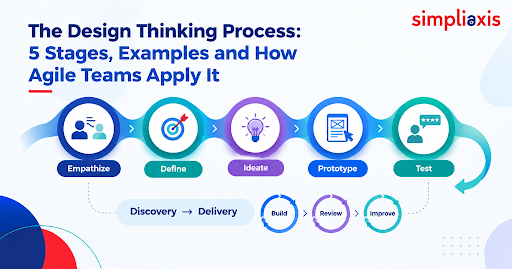
The design thinking process falls under 5 stages: Empathise, Define, Ideate, Prototype, and Test. It is a human-centered methodology, helping teams generate ideas, understand needs, test solutions, and drive innovation.
Key Highlights of Design Thinking Process
- Design thinking is a human-focused and iterative process of understanding users, challenging assumptions, and coming up with innovative solutions for users.
- The design thinking process includes five stages: Empathize, Define, Ideate, Prototype, and Test. The team may iterate any of these steps whenever it gets new information.
- User research, problem definition, idea generation, prototyping, and user testing allow the team to validate their solutions before committing to development efforts.
- Design thinking can complement Agile and Scrum methods because of the ability to determine what problems need to be solved, while Agile team builds, tests, and improves those validated solutions iteratively.
- Among the other design thinking frameworks are the Double Diamond model, IDEO's Human-Centered Design, IBM's Enterprise Design Thinking, and Google's Design Sprint. Double Diamond framework has the following stages: Discover, Define, Develop, Deliver.
- For effective implementation of design thinking there should be active user involvement, cross-functional collaboration, measurable results, rapid experimentation, and embracing mistakes.
Introduction
On a day-to-day basis, we come across many problems. What matters is how we find solutions that put people's needs first.
This is where the design thinking process comes into play.Developed at Stanford d.school, design thinking process steps are made to solve open-ended problems. Teams that want hands-on practice can build these skills through design thinking training. In this article, we will be covering the 5 stages of design thinking, its examples, common mistakes, design thinking vs agile, and look at some interesting design thinking process examples.
What Does Design Thinking Mean in Plain Terms?
Design thinking follows a methodological approach to solving problems, helping in putting people at the center.
According to John E. Arnold, who coined the term design thinking in this book, “Creative Engineering”, defines design thinking as an approach to creative problem solving that combines judicial, analytical, and synthetic thinking to drive human-centered innovation
Some of the key characteristics of design thinking are
(a) Human centered: Here, the solutions are not designed based on assumptions; they are created around real-user needs.
(b) Iterative: Teams refine and revisit ideas based on feedback.
© Collaborative: Outcomes are driven by cross-functional perspectives.

Five Stages of the Designing Thinking Process
What are the 5 Stages of the Design Thinking Process?
The five stages of design thinking process are:
1. Empathize: Understand Real Users
In this stage, we will use different qualitative user research methods to gather a rich understanding of your users. Example: interviews, diary studies, direct observation, and contextual enquiry. The goal is to deeply understand who our user is, so much so that we can mirror their emotions and motivations.
While empathy maps are the most common deliverable of the empathy stage of design thinking, they aren’t your only choice. Remember, the goal of the stage isn’t to create the perfect artifacts, but rather help your team develop empathy and understanding of your users.
User insight can be successfully synthesized and communicated in other artifacts like a pain/gain map. This map identifies what your user has to lose or gain from a situation or from a current-state customer journey map.
2. Define: Frame the Right Problem
As we move forward to the design phase, the goal is to clearly align and articulate the need of the user that’s based on insight gained from research. Many teams do this through user need statements, summarizing the need you’re going to satisfy for the user.
You can find other UX methods like problem statements which are used in discovery stages and prioritization of pain points from a current-state journey map.
3. Ideate: Generate Multiple Solution
In this stage of the design thinking process, we come up with a wide range of potential ideas that help solve your user’s needs. There are several traditional UX methods that may be useful at this point: brainstorming, mind mapping, written ideation, bodystorming, and design charrettes.
While traditional design thinking practices promote team members who are capturing their individual ideas on sticky notes, don’t feel limited to this structure. Pair people off, introduce different tools or materials, and ideate remotely. If you have created a customer journey map, you can ideate directly on top of the pain points you have identified.
4. Prototype: Build Cheap, Testable Versions
When you begin to prototype, it should depend on what you’re trying to learn. For example: Imagine you’re designing a process, consider a future-state service blueprint - a prototype for future processes you plan on implementing. Interactive wireframes or a paper prototype can also be used.
The goal of the prototype phase is to understand what components of your ideas work and which do not. Here, you begin to weigh the impact versus feasibility of those ideas through feedback on your prototype.
5. Test: Learn From Real Users and Iterate
In this stage, you need to be asking yourself the following questions,
- “Does this solution meet our user’s needs?”
- “Has the solution improved how the user feels, think, or do their tasks?”
Get started with conducting traditional usability tests and watch real users using your new designs and iterate on those designs until you are ready to implement.
Design Thinking Process at a Glance: Outputs, Tools and Time
Design Thinking Process Example: Redesigning a Fintech App Onboarding Flow
Imagine a fintech app that lets its users open savings accounts and invest in mutual funds. The product had a good download rate but only 38% of the new users completed their onboarding. The team decided to address the issue using the five stages of design thinking to improve their UX. The figures below are fictional and provided for demonstration.
1. Empathize
The team starts their design thinking journey by analyzing the problems the users face while using their application. They look into the app’s user base by conducting 15 individual interviews with recent sign-ups, 6 of whom abandoned the onboarding process. The team also analyzes session replay videos, feedback, and support tickets.
2. Define
Next, the team synthesizes the information they gathered and formulate a statement to reflect their understanding of the problem.They also create benchmarks and define metrics to measure the success of their redesign efforts in the future.
- Increase onboarding completion rate from 38% to 60%.
- Decrease average onboarding time from 11 minutes to 6 minutes.
- Decrease the number of KYC-related support tickets by 30%.
- Having defined the problem, the team starts working on the solution.
3. Ideate
The team brainstorms possible solutions in a cross-functional workshop. They ask “How might we…” questions, for instance:
- How might we make the identification process simple and trustworthy?
- How might we shorten the time spent onboarding without sacrificing compliance?
- How might we assure the users that their information will be used responsibly?
Below are some of the ideas the team considered.
- Progressive onboarding with a progress bar and an estimate of time spent.
- KYC document submission with explanations as to why the information is necessary.
- Security badges and mentions of regulatory bodies the company works with.
- Automated fill and smartphone scanning of documents.
- A chat feature or the ability to ask for a call during the KYC process.
The team then prioritizes the ideas based on impact and effort and proceeds to prototyping.
4. Prototype
The team builds a clickable prototype in a tool called Figma. It follows the three-step structure mentioned above. It also includes security badges, progressive onboarding, and smartphone scanning. A clickable prototype is a rapidly produced mock up of the final product that allows one to simulate the UX.
Some iterations the team makes include asking for the phone number first and letting the users browse investment funds before completing KYC. The legal and engineering teams review the prototypes to ensure that they meet regulatory requirements before they proceed to the next step.
5. Test and Iterate
The team conducts a series of tests with 8-10 representative users. They observe the test subjects as they perform a few tasks and make note of points of friction.
Below are some of the test results.
- The testers responded positively to the progress bar and the estimated time.
- They also preferred the version where they could browse the investment funds first.
However, they were confused by the language used in the address proof step.
The team then went ahead and redesigned the language used in the prototype and tested it again. Once the redesign was implemented, the team performed an A/B testing and made iterations to improve the completion rate and drop-off rate.
This resulted in an increase in onboarding completion rate from 38% to 61% and also led to a decrease in the time taken for onboarding from 11 minutes to 5.5 minutes.

Who participates in the design thinking process?
The key stakeholders who participate in the design thinking process are:
1. End users:
These people are the focus of the process; their needs, frustrations, and feedback help determine every step of design thinking. IBM’s guide presents them as partners, not objects of study. Engaging them as participants helps the team avoid designing in a vacuum.
2. Facilitator:
This person oversees the process; he/she thinks about ways to manage the team, keep discussions flowing, and ensure productive use of time. A good facilitator will invest in processes, engagement, and equal participation rather than ideas, and will steer the team towards next steps after a session.
3. Researchers:
This group focuses on the subject of the design thinking process, studying users’ attitudes and behaviors. Their work provides the basis for all later stages.
4. Designers:
UX, UI, and product designers create ideas and mock-ups based on the information provided by researchers.
5. Subject matter experts:
This group provides an in-depth understanding of the challenges the project faces; they have real-world insight into the topic the designers are working on. Their involvement ensures that the design thinking process does not include any irrelevant suggestions, and allows the team to avoid obvious mistakes.
6. Business, IT, marketing, legal, and operations representatives:
These people have to define what they will be required to do, and what support they will have to provide, once the project launches. Their involvement from the beginning ensures that the final product will be realistic and viable.
7. Testers:
They test the hypotheses and ideas generated by the designers, ensuring that they are realistic and useful.
8. Stakeholders and sponsors:
They provide the support, context, and guidance the team needs, and their involvement from the beginning removes many potential obstacles deriving from the mismatch between the project and the company’s goals. Collaborating with them during the co-creation phase removes many barriers that would otherwise arise during later stages of development.
9. Project manager:
A project manager is responsible for budgets and timelines and for ensuring that the team meets its goals. They are also involved in building empathy with stakeholders, and defining when the team should shift its focus from researching and ideating to building and testing a prototype.
10. Employees:
Their involvement in the ideation phase helps gain their buy-in, which in turn is critical for the product’s subsequent launch and adoption.
What is a design thinking workshop?
A design thinking workshop is a facilitated gathering of a cross-functional team that works through the five steps of the design thinking process (empathize, define, ideate, prototype, and test) to resolve a particular issue. It is an interactive and engaging session rather than a lecture or a presentation.
Typical format and duration of a design thinking workshop
| Format | Duration | What is realistic |
| Half day | 3 to 4 hours | Introduction and ideation only, with no complete cycle |
| Full day | 7 to 8 hours | One complete cycle with simplified prototyping |
| 2 to 3 days | 16 to 24 hours | Recommended for real product development with user research |
Most workshops are one or two days long. Two to three days is common if the group will also conduct interviews and build prototypes at the workshop. A full-day session works well for six to 15 participants.

How to run a design thinking workshop?
We have structured the design thinking workshop into three steps: Prepare, Facilitate, and Document. Let’s look at them in detail
Step 1: Prepare a designing thinking workshop:
When you are running a successful design thinking workshop, you need to ensure that your team has all the resources needed to make informed decisions. The duration can be anywhere between 2 to 6 weeks or longer.
Check out the following workshop preparation checklist for your review
- Select your team, location, and time.
- Compile the current landscape.
- Develop a proper workshop agenda.
- Create the workshop facilitation deck.
- Send the pre-workshop email.
Step 2: Facilitate the design thinking workshop
Once the agenda is ready, you can begin with facilitating a production workshop. Let’s look at a 1-day workshop format that’s aligned with the strategic requirements for a good experience.
- 9:00 am - Introduction
- 9:30 am - Design thinking warm-up
- 9:45 am - Draft statement of opportunity
- 10:30 am - Coffee-break
- 10:45 am - Review current landscape
- 11:30 am - Validate user personas
- 12:30 am - lunch
- 1:00 pm - Share design inspiration
- 1:30 am - Generate user stories
- 2:45 am - Prioritize experience goals
- 3:30 am - Break
- 3:45 am - Define minimum viable solution
- 4:30 pm - Recap with next steps
Step 3: Document design thinking outcomes
Here, the goal will be to ensure the complete insights and alignments that’s generated during the workshop can be reviewed and used by others. The document detailing should be according to the scale of your project. You can begin by creating short design thinking sessions.
Three sources of workshop documentation
(a) Write about what was discussed in the workshop
- Compile notes that you or your co-facilitators would have taken during the session.
- Collect additional information from participants on key topics.
- Identify the areas of interest.
(b) Write about what was produced
- Take pictures of shared outputs - this can be your whiteboards.
- Make scans of individual outputs.
© Write about what was decided
- Describe all the requirements, alignments, and rankings in detail.
- Outline the necessary steps, responsibilities, and roles.
In your post-workshop documentation, add the workshop details, executive summary, decisions, discussions, inspirations, or any reference data.
Design thinking process in UI UX
Design thinking in UI/UX refers to a human-centered approach to design that is iterative in nature and consists of five stages: empathize, define, ideate, prototype and test; these stages are not strictly linear.
The design thinking process steps help UX teams to tackle confusing or difficult design problems by focusing on the user and questioning assumptions. It is used to redefine the problem statement and produce a solution that can be tested by the user.
Whereas, UX refers to research, information architecture, wireframes and usability testing while UI refers to visual design, interaction design and screen layout. Design thinking informs both concepts.
Design thinking process example: A Food Delivery App
A design team can conduct interviews and find out that users leave their orders at the checkout stage (Empathize). Then the team would define the problem as "Users need a faster and more reliable way to make a payment" (Define).
Afterward, the team can sketch multiple checkout flows (Ideate), create a clickable prototype (Prototype) and test it on five users (Test). If users get confused about delivery fees during testing, then the team will go back to previous steps.
Practical steps to incorporate the design thinking process into your team
Measuring design thinking success comes into incorporating key processes into your team. Let’s look at the steps in detail
1. Start Small
Pick one project design, one feature or one ongoing issue to test the framework on rather than implementing it across the whole company. A two-week long experiment of improving one onboarding screen will allow the team to go through each step of the framework one by one with significantly reduced risk.
Make sure to present the results and improvements to stakeholders and demonstrate how the framework has been applied.
2. Include Cross-Functional Team Members
Design thinking is most efficient when it uses the collective effort and expertise of a group of people. Whenever possible, invite designers, developers, product managers, marketers, customer support and even sales representatives to contribute to the project.
In particular, customer support often has an insider perspective on what issues users may encounter. Additionally, most engineers will be able to veto unrealistic technological suggestions, saving the project time and effort.
3. Use Collaborative Project Management Software
The whole team, including stakeholders, should be able to see what’s been achieved, what decisions have been made and what tasks are left. Organize whiteboarding sessions and affinity mapping with your team in FigJam or Miro.
Consider the use of a project management application like Jira, Asana, and Trello to track progress and foster cooperation. Consider the use of a design tool like Figma to create prototypes and collaborate on ideas. Consider storing documents, research findings, and personas in a shared online storage folder.
4. Create a Design Proposal Template for Customer-oriented Project Work
Create a design proposal template for every project that you work on to set a common ground with your client.
The design proposal should detail project deliverables, target audience, research plan, schedule, objectives, and metrics of performance. This way, you will set clear expectations for your clients and let them know the benefits of using your services.
5. Conduct User Research Regularly
Consider regular user research sessions every month or quarter. The idea is to conduct regular user research as opposed to conducting intensive research every few months. In this way, you will always stay updated with insights and update your personas.
6. Set Key Performance Indicators for Each Project
Establish what key performance indicators (KPIs) will help you measure the success of a completed project.
Define attainable goals, such as a task completion rate, time spent on a website or an application, a drop-off rate, customer satisfaction score or the number of support tickets, among others. Use the metric to determine whether a proposed solution has been successful or not.
7. Conduct Structured Design Thinking Workshops
Organize design sprints, product discovery workshops, ideation sessions or even problem-framing workshops. They are a great way to introduce structure into the sometimes chaotic design thinking process.
Set a deadline for each workshop and invite everyone to contribute to the general idea, mock-up prototypes or discuss potential solutions.
8. Encourage Rapid Prototyping and Early Feedback
Make your team aware that presenting early and often is an important part of the design thinking process.
Sketching ideas on paper or developing a series of mock-ups in Figma will help identify deal-breakers long before the final product is presented to the target audience. Rapid prototyping is crucial for determining what does and does not work.
9. Create an Iterative Culture
Make sure your team knows that their research, prototypes, presentations and suggested solutions may fail. Iteration is at the core of the design thinking framework. Encourage your team to iterate on their own and with each other.
Host regular retrospective meetings to discuss what has worked and what should be improved. Iterative design-thinking will only work if team members are not afraid of public failures.
10. Maintain a Knowledge Base
Store your research results, user journey maps, test results and other crucial documents in an organized manner. This will help new team members learn the fundamentals of your design thinking framework.
Having a reliable reference point will also reduce the possibility of repeated errors and omissions.
Design Thinking vs Agile: What's the Difference?
How Design Thinking Fits Into Agile and Scrum?
Design Thinking allows one to define users’ needs and prioritize the problems that need solving. One should employ Agile and Scrum to transform ideas into reality via iterative development cycles. When used together, these methodologies enable a feedback loop between discovering users’ needs and developing a product.
Dual-Track Agile: Discovery and Delivery
Dual-track Agile is an approach that involves simultaneous but sequential processes. It integrates ‘discovery’ and ‘delivery’ tracks that address different but interconnected activities.
Discovery track
Discovery track is where one conducts product discovery: interviews, problem definition, ideation, prototyping, and testing solutions.
It is the responsibility of product managers, UX designers, and a few developers to ensure that ideas addressed are technically feasible. Therefore, the track’s outputs are tangible and validated ideas, not working products.
Delivery track
The delivery track is where sprints and iterations take place. It employs standard Scrum practices to plan, develop, review, test, and refine a product incrementally.
Developers are responsible for constructing necessary products after validating ideas in the discovery track. Besides building and testing products, they also meet to review and adapt what has been built.
How do the tracks link together?
The discovery track stays one or two sprints ahead of the delivery track to ensure that there are always defined requirements in the delivery backlog. Besides informing what gets built, the delivery results also inform the next steps based on what has been learned about the users. This way, the feedback loop prevents the wastes associated with building unviable products and waiting for directions from stakeholders.
Turning Design Thinking Insights Into User Stories and Backlog Items
Design Thinking produces lots of data including interview transcriptions, personas and empathy maps, journey maps, and problems statements. But the difficulty is to transform all this information into user stories and priority product backlog items for a Scrum team to estimate, build and test them.
Step 1: Synthesize the research findings
Firstly, the researcher needs to synthesize the information into the topics, problems and prioritize them.
Step 2: Write user stories
Based on the frequency and the impact of each of the problems found, user stories can be written. The format for writing user stories is “As a [persona], I want [goal], so that [benefit].”
The persona will give a background and the benefit will serve as a basis for evaluating the user story. For example, the researcher may use the data received from personas and empathy maps to create a user story based on pain points.
For example, if the persona ‘shopper’ faces problems related to the unknown delivery fees, the following user story can be created: “As a shopper, I want to know the cost of delivery before checkout so that I can make an informed decision.”
Step 3: Add acceptance criteria
After developing user stories, one can then define acceptance criteria to help estimation and testing.
Step 4: Break down large items
The fourth step is to break down large stories, especially those identified during the user journey mapping, into smaller ones.
One should also ensure that the epics and stories are traceable back to the research results, and where appropriate, add links to the documents with the themes and patterns.
Step 5: Prioritize and refine
Once synthesis and storyboarding are complete, the product owner can prioritize and refine the user stories.
In backlog refinement, the Scrum team goes through the user stories to ask clarifying questions and make assumptions visible before estimating the effort.
Using Prototypes and User Feedback Before Development
After creating user stories, one may need to build prototypes and solicit feedback from users. This step is important because it ensures that one can test ideas before committing to development. At this point, the aim should be to invest minimal resources but get sufficient feedback to either reject or validate an idea.
1. Choosing fidelity
When developing prototypes, it is important to choose the most appropriate fidelity. For instance, one can use storyboards and paper-based prototypes to test concepts and message boarding. However, one can also use higher fidelity click-through prototypes to simulate the final product. The key is to match the prototype’s detail to the requirements.
2. Testing with real users.
One can obtain feedback from the intended users and stakeholders after prototyping. In order to receive valuable feedback, it is necessary to conduct usability tests that are either moderated or unmoderated. In moderated usability tests, there are guides who help the users attain their objectives; however, in unmoderated usability tests, users are not guided and are allowed to interact freely with the prototypes.
3. Capturing and acting on feedback.
One needs to analyze the feedback and update user stories. It is advisable to report bugs and issues using objective language. One should also sort the feedback into themes, focusing on showstopers first, then usability issues, and finally, subjective feedback. One can report the results of prototype testing to the stakeholders and update the user stories, criteria, and backlog accordingly.
4. Linking to Scrum
Research-informed user stories can guide story refinement and help developers ask clarifying questions in sprint planning. Alternatively, one could decide to conduct prototype testing during a sprint to inform the next development steps.
Other design thinking models worth knowing:
The Stanford d.school five-stage model is the best-known approach, but it is not the only useful one. Other models differ, offering varied speed, size, or team dynamics, but all are based on the same principles, such as human-centeredness, iteration, and prototyping.
The models are similar in most aspects, but the choice of the design thinking framework depends on the project’s size and complexity.
1. Double Diamond:
Double Diamond was created by the Design Council (The Double Diamond – Design Council).. It consists of four phases, namely, Discover, Define, Develop, and Deliver. The first two phases are collectively called the first diamond, and the last two are the second diamond. Each diamond consists of two steps: divergent and convergent. The former is about finding an idea, and the latter is about selecting it.
First Diamond and Second Diamond
The first diamond focuses on finding a problem and narrowing the focus, while the second is about developing multiple possible solutions and narrowing them down to actualizing the chosen one.
In the discovery phase, you need to conduct user research, define the problem statement or brief, develop a solution, and deliver it by narrowing the scope, building the prototype, and testing it.
This approach was good for strategic design, tackling challenging organizational issues, and working with agile teams. In the latter case, the first diamond is Discovery, and the second is Delivery.
2. IDEO Human-Centered Design
IDEO treats human-centered design as the mindset and the process of using design thinking that solves problems. The three lenses through which one can examine the process are desirability, feasibility, and viability. The former is a desirable product or service to the user, something reasonable and possible to implement, and the latter is cost-effective.
The process goes through three overlapping spaces: Inspiration, Ideation, and Implementation. The first is about gathering insights, the second is about sketching ideas, and the third is about prototyping and testing in the actual environment.
This approach is suitable for teams that have to balance desirability and feasibility and work within the constraints of a given product. It also works well when one has to manage product teams in an iterative, nonlinear manner.
3. IBM Enterprise Design Thinking
IBM enterprise design thinking is tailored for enterprises, where there are many stakeholders. It works with the same set of principles as other methodologies but introduces some adjustments to make design thinking work for larger teams.
The three key components of IBM E.D.T. are to focus on outcomes, work through prototyping and iterations, and converge to business objectives.
The practice requires project managers to organize hills, where the project’s progress is presented to stakeholders, playbacks, where teams receive feedback, and to sponsor users to ensure that users’ voices are heard.
This approach is ideal for enterprises and their stakeholders, where design-thinking practitioners work alongside business leaders. Therefore, it converges with scaling frameworks such as Scrum of Scrums and the Scaled Agile Framework.
4. Google Design Sprint
The Google design sprint is a five-day process meant to help teams answer essential business questions through the creation of prototypes and testing them with customers. The process is inspired by the design thinking methodology but hastened to fit within five days.
According to the Google sprint model, the first day is about understanding the problem and identifying a long-term goal. The second day is sketching, and one has to choose the best sketch and build a storyboard by the end of the day. The third day is about building a prototype, and the fourth one is user testing, which usually uses five users.
Thus, the final day is about analyzing the results and making conclusions. Google Design Sprints help teams get rapid answers through design thinking. The output can be used for sprint notes or integrated into the backlog items and user stories.
Choosing the Right Model
Common Mistakes Teams Make When Adopting Design Thinking
Design thinking promises to enable organizations to create more desirable products and improve customer satisfaction but many companies that try to embrace it with a zeal fail to get any substantial benefit from the approach, and the reasons are usually not in the methods themselves but in how the teams try to apply them.
1. Wrong approach to workshops
Most commonly, organisations that want to adopt design thinking launch a two-day brainstorming session, whiteboard a bunch of ideas, stick some sticky notes on the wall, declare themselves design-led and then forget about design thinking during the following six months. Any serious adoption of the approach requires the organisations’ long-term commitment through continuous customer interaction and iterations.
2. Lack of empathy
Usually, teams skip extensive user research and tend to rely on their biases, opinions or a superficial analysis of a couple of users’ comments instead. Empathy is all about understanding the needs and problems of the people; it involves observing real users and analysing their behaviours and decision-making processes. Instead of creating user personas, the teams often rationalize their ideas and advocate for a particular course of action.
3. Jumping to solutions
Urged by the need to accomplish something tangible as soon as possible, teams rush to develop a solution without spending enough time on analysing the problems and defining it clearly, and the outcome is usually a prototype that addresses an issue that nobody asked for. It is essential to invest time and effort into the definition of the problem to be solved. For example, instead of ‘checkout process’, specify ‘help first-time buyers’.
4. Fears of failure
Some teams try to perfect their prototypes several times before any testing, believing that the design has to be failure-proof, but such approach often leads to an overinvestment in a concept that ultimately will fail. Prototypes are meant to be tested and disposed of upon the identification of flaws; instead of spending weeks on a detailed prototype, one may use sketches, clickable mock-ups, role-playing or even simple dummy versions of the intended product.
5. Incomplete stakeholder engagement
If the process is constricted within one department, there is a high chance that promising ideas will fail during the handover to other teams due to a poor understanding of the ultimate goal. All stakeholders should be actively engaged during the process to ensure that the unified vision is correctly interpreted and that proposed solutions are realistic and would actually work.
6. Wrong sequence
The process is usually depicted as a process that follows a particular order but in practice, it is much more iterative. If the teams move from one stage to another in a linear fashion, skipping the necessary iterations, they miss opportunities to incorporate insights from the later stages into their earlier work, thus, defeating the key principles of the approach.
7. No metrics
Without a reference to specific goals, the outcomes of using a design thinking approach are hard to evaluate. It is essential to tie the project to a set of easily measurable outcomes, for example, a conversion rate, ticket resolution time, retention, or task duration.
Conclusion
Design thinking can be applied to a range of solution-focused problems and scenarios by taking human-centred approaches. The five stages of design thinking, namely, empathize, define, ideate, prototype and test, when completed in an iterative manner, allow teams to replace assumptions with insights.
Design thinking can be combined with other frameworks, such as the Agile and Scrum approaches, to rapidly develop products and services. Whereas discovery-focused sprints help in developing an initial idea, the scrum technique focuses on continuous improvement and perfection of a product or a service.
If you’re looking to attain new skills in design thinking in UI/UX, enroll in the UX for design and Agile teams course by Simpliaxis. Here, you will learn the AI tools to boost UX agility, integrate UX into sprints, and develop faster feedback loops.






 Lowest-Price Challenge












 Personalized Path



.webp)


 USA
 Canada
 India
 UK
 Australia
 Singapore


