


 Call Us




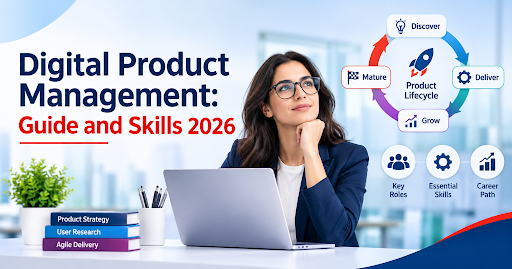
Digital product managers are responsible for taking a software product from concept to launch and more. This role requires a mixture of customer research, strategy and agile delivery.
The product manager will have the authority to decide what to build, why and how to measure success.
Key skills required will include data analysis, experimentation, user research and technical knowledge. In 2026, this role has expanded to include managing AI features, product led growth and continuous delivery on SaaS and mobile.
Key Highlights of Digital Product Management:
- Digital product management guides software products from idea to launch and beyond, blending customer research, business strategy, and agile delivery.
- The digital product lifecycle has four stages: discovery, delivery, growth, and maturity or sunset, and each stage demands different decisions and metrics.
- Core roles include the digital product manager (strategy and outcomes), the digital product owner (backlog and sprint execution), and product designers and analysts.
- The most important skills fall into two clusters: data and experimentation (metrics, A/B testing, prioritization) and technical literacy (APIs, databases, architecture basics).
- Continuous delivery has changed the job, replacing big annual releases with small, frequent bets and fast feedback loops.
- The comparison table breaks down the digital product manager vs product owner differences in focus, time horizon, artifacts, and stakeholders.
- Common tools include Jira, Productboard, and Aha! for roadmapping and backlogs, plus Amplitude, Optimizely, and Hotjar for analytics and experimentation.
- Career entry routes include associate product manager programs, internal transfers, side projects, and adjacent roles, supported by certifications like CSPO, ICP-PDM, SAFe APM, and PSPO.
Introduction
All of the different apps that you use, all of the websites that you visit, and all of the purchases that you make online are made up of thousands of decisions. Someone had to decide what problem to solve, what features to build first, and what defines success for that product. Digital product managers (or product managers for short) are the people responsible for making those decisions.
Product management is one of the fastest growing occupations. With SaaS, fintech, eCommerce, and other forms of online and digital business proliferating, the demand for product managers is greater than ever. The role is considered a product-centered enabler of digital transformation and many product management programs are being offered by non-tech businesses.
Many product managers find the role fulfilling because there is a large amount of variety in the work. Each day can bring a new and different type of work. In addition to being strategic and creative, the work can be emotionally taxing. Oftentimes, product managers must explain and defend their decisions and work to upper management.
This guide is meant to provide an insider perspective on the field. It includes information about the role, the work, the path, and the future. After reading this guide, you should have a better understanding of product management and determine if this is the career for you.
What is Digital Product Management?
Digital product management is the process of creating and optimizing digital products. These products can include websites, mobile apps, SaaS, and other software and electronic products. Product managers are responsible for the product vision, goals, and results.
The nature of product management for physical products and for digital products is quite different. For digital products, continuous delivery and rapid evolution of the product require frequent changes to how the product management teams operate.
Scope of a Digital Product
A digital product extends beyond the scope of a user interface. It encompasses the entire system and the user experience.
- Interface: The user interface, user experience and journey, and notifications.
- Infrastructure: Application Programming Interfaces (APIs), integrations, and back-end systems.
- Monetization: Logic and models for monetization, prices, and trials.
- Support: Help and documentation; and feedback.
A digital product manager operates at all the above-mentioned layers. True understanding of scope helps make appropriate and realistic decisions with respect to the product, releases and features.
An example of scope is the incorporation of referral features in a product. This involves product changes at the user interface and experience layer, in addition to changes to the product features and support infrastructure to name a few.
Scenario planning with respect to product changes becomes the responsibility of a product manager.
Why Continuous Delivery Changes the Job?
The need for continuous delivery of digital products changes how product management is done. Old product management practices, where product updates were released once a year, are no longer applicable.
Agile development encourages frequent product releases. Some SaaS companies are now doing dozens or more code releases in a day. With the shift to continuous delivery, changes get sent to customers with each release. This shifts the responsibilities of a manager in at least the following two ways:
- Distributing and integrating feedback becomes quicker and more important.
- Anticipating and planning for what might happen next
A manager must be comfortable with uncertainty.
Handling and responding to changing priorities becomes an integral part of managing a product. Agility itself becomes an integral part of the product development process and of the delivery process.
The modern manager spends less time making large, up-front plans. Managers must continually keep their teams focused on the end goal while eliminating obstacles and distractions that get in the way.
The Digital Product Lifecycle
Like any other product, digital products progress through a lifecycle. Intentional management of a digital product through its lifecycle is known as digital product lifecycle management. Traditional product life cycle models still hold true in this context, but the process has to be iterative in nature and retractable if needed.
Speed and iterative nature of software construction gives product teams leeway to try different products quickly, test them, and if the results are not favorable, stop the rollout and switch back to the previous version. Alternatively, companies can completely retract the digital product from the market.
1. Discovery
One of the foundational building blocks of a digital product is the discovery process. During discovery, product teams identify real world problems that warrant building a product or software. Strong teams use effective product discovery practices.
Once discovered, the problem should be validated and verified through User Interviews, Surveys, Usage analysis, or a host of other product evaluation techniques.
After business and product needs are validated and verified, a product backlog is formed. Product discovery techniques help teams recognize and validate product ideas worth building and focus the organization on real business needs.
Through Discovery and Product Validation, teams are able to align and generate a Backlog of ideas that are ripe for Product Development. In effect, a team should be able to execute Dual-track Agile, a process that enables Product development and idea validation to be performed concurrently.
2. Delivery
The goal of delivery is to transform product ideas into a tangible and usable product. This requires an understanding of the product backlog and how to successfully complete sprints. Delivery also requires agile meetings and ceremonies.
In this stage, management requires less focus on the day to day activities of the employees and more on helping them refine outcomes. Writing user stories is not difficult; the hard part is prioritizing product backlog items.
Some of the activities included in delivery are:
- Defining product features and releasing them in an incremental manner.
- Developing a product’s requirements by answering related product questions.
- Discussing and explaining product tradeoffs with IT.
- Preparing to communicate the release of the product to the target audience and helping create a plan for post launch product support.
Regular product backlog refinement keeps user stories, supporting items and acceptance criteria clear. A well- groomed backlog includes important information such as the user story, the backlog items that support the story, and acceptance criteria. This information helps clarify the backlog items and aids in writing user stories.
A product management’s goal is to help a company achieve and sustain value. While doing this, he/she has to manage tradeoff and prioritization pressures to help the company shift focus to product development and enhancements. He/she also has to manage and absorb other pressures to aid in achieving value for the company.
3. Growth
After product development and value achievement, product management focuses on the impact and adoption of the released product. This stage is particularly important for management of SaaS products.
This stage is also focused on product development and improvement. However, at this stage, growth and improvement are product focused and geared toward improving key product metrics.
An example of a mental model is to consider whether the product achieves product market fit. If a product scales before achieving fit, capital is wasted. Measuring fit creates focus and compounds effort.
4. Maturity
Product market fit allows for steady growth, but the pressure becomes how to protect core offerings while conservatively optimizing and reducing cost. At this stage, management decisions become more difficult. Trade-offs between investment and maintenance of product offerings increase.
Products pass on the sunset cycle, and good product management means phasing out offerings and features while also thoughtfully migrating customers and employees and clearing company resources.
A product offering's longevity may lend itself to the Digital Twin. For example, if a company creates a Digital Twin of a product, management of the Twin allows the company to capture value beyond the product's lifecycle.
Roles in Digital Product Management
Several distinct roles power product teams. Understanding how they differ helps you pick the right path.
1. Digital product manager:
The digital product manager owns a product's success from end to end. They develop the product's strategy, set and communicate priorities, and collaborate with all staff and partners.
Typical tasks include:
- Preparing and maintaining roadmaps.
- Identifying and analyzing market and competitor information.
- Defining and implementing product requirements.
- Serving as the primary point of contact for partnering functions (i.e. engineering, design, marketing, sales) for the product.
- Communicating outcomes to management.
Because of the responsibilities and authority vested in the product manager position, it has been compared to being a CEO of a product. Most of the challenge of the job stems from managing and motivating partners to achieve the product vision.
The job requires deep and broad analyses of the market and the product itself. A week's worth of activities include customer visits and reviews of product data and metrics.
2. Digital Product Owner
As defined by the Scrum Guide, a product owner focuses on the execution of a product by an agile team. The product owner is responsible for establishing and managing the product backlog. The product owner reviews and accepts user stories. In smaller and less complex companies, these two responsibilities are sometimes consolidated into a single position.
The difference becomes clearer when you look at the product owner roles and responsibilities in detail.
Two additional product team members, the product designer and product analyst, also work closely with the product manager. They are integral to the product's success. Product designers, in particular, influence and shape the user experience and usability of a product.
Product analysts work with data. From metrics analysis and dashboard development to architecting experiments to observe data in motion, product analysts contribute pivotal work in a product team’s arsenal.
Product management, design, and analysis functions combine to form the product triad. Healthy product teams learn to embrace disagreement, and work to establish intergroup communication to resolve differences.
The scope of responsibilities for each of the product functions is fluid in relation to a company’s size.
Smaller companies may require the same individual to fulfill all the functions of the product triad, whereas large companies, including Fortune 500 companies, may segment the product functions and break it down to smaller sub-functions. An adroit job seeker treads through the product management function and its sub-functions with job titles in mind.
Digital Product Management Skills
There are two broad sets of skills that you need to work on to develop a career in product management: working with data and working with technology.
Data and Experimentation
Managers make decisions using data. Product managers need the ability to interpret data, create and implement experiments to validate or refute management’s hypotheses about products.
With respect to data and experimentation, some key skills are:
- Metric understanding: Knowing which product metrics matter, such as activation, retention, churn and LTV, and how to analyze them.
- Experimentation: Knowing how to design and run a valid A/B test.
- Segmentation: Defining user segments and drawing conclusions based on segment-level data.
- Statistics: Understanding what level of evidence is required to come to a conclusion.
Prioritization is another critical skill within the data cluster. Frameworks such as the Kano model, RICE prioritization, and value vs. effort matrices are designed to help teams compare and prioritize opposing product ideas and trade-offs.
Two supporting skills are also critical. Managers must be able to tell a data story to engage and acquire internal sponsorship for their product roadmap. Understanding trade-offs and customer segments, as well as product and business economics is critical for product managers to make the right build/no build and prioritization decisions.
Technical Literacy
You need not be able to code to be a successful product manager. You need to be able to speak the language of coders. In addition, you should have a basic understanding of product constraints, and the integrations and APIs product managers are using.
The reason this is important is because feasibility discussions happen frequently. Understanding development trade-offs helps build credibility with your development team. If you don't understand these concepts, it's easy to lead your team to make decisions that negatively impact the business.
Topics that are valuable to understand include:
- Concepts around integrations and APIs.
- Various database concepts, and the costs associated with schema changes.
- Differences between client and server side code.
- Various architectural patterns and designs in SaaS products.
Understanding these concepts doesn't protect you from making mistakes, and that's ok. Being able to have a general discussion around topics helps. For example, understanding when an engineering change is considered a migration helps you understand the time and business impact of the change.
Incorporating AI features in your product increases the importance of technical literacy. The rise of the AI product manager shows where this skill set is heading.
Digital Product Management Process and Tools
The tool and process overlap. The product management process is broken into product management strategy, discovery, and delivery. Tools help, but good judgment is still required. A detailed product management workflow typically runs from problem validation through prioritization, execution, launch, and feedback.
Roadmapping and Backlog Tools
Roadmapping tools help teams visualize direction without over-promising dates. A good roadmap communicates outcomes and themes rather than rigid feature lists.
Popular tools in this category include:
- Jira is a popular tool for agile teams to manage their backlog and track sprints.
- Productboard is used to gather feedback and align it to a roadmap.
- Aha!: Ideal for higher-level strategy and planning. Helps outline and track goals.
- Notion and Confluence: Project specs, decisions and documentation. Flexibility at its best.
- Figma: Design and product management from start to finish.
Every product management tool and stack is different, but the focus is always the same: Alignment, transparency and clear access to the process, details and rationale supporting the product management strategy. When product management stakeholders can see the process, details and rationale supporting the strategy, alignment and acceptance improve. Surprise product launches diminish.
Analytics and Experimentation Tools
Product improvements are best measured via experimentation.
- Amplitude and Mixpanel provide product analytics and are a great starting point for understanding product funnels and retention.
- For learning about website and customer acquisition behavior and navigation, Google Analytics is a great resource.
- If you are looking to see if improvements to your product are providing value, consider Feature Flag and A/B testing tools such as Optimizely and VWO.
- For user session analysis and understanding friction, consider session and screen recording tools such as FullStory and HotJar.
Looker and Power BI integrate product data with company revenue data and provide business intelligence. When should you consider a business intelligence tool? Real business questions warrant real data.
Digital Product Manager vs Product Owner: Comparison Table
| Aspect | Digital Product Manager | Digital Product Owner |
| Primary focus | Product strategy and outcomes | Backlog and sprint execution |
| Origin | Business and marketing tradition | Scrum framework |
| Time horizon | Quarters to years | Sprint to quarter |
| Key artifact | Roadmap and strategy docs | Product backlog and user stories |
| Core question | Are we building the right product? | Are we building the product right? |
| Stakeholders | Executives, customers, market | Development team, Scrum master |
| Typical employer | Larger companies with multiple products | Agile teams in any organization |
| Success measure | Business and product outcomes | Delivered value per sprint |
Building a Career in Digital Product Management
How folks enter the product field is rarely a straight line. People come from engineering, design, marketing, customer support, and analysis. A range of backgrounds and skills is vital to the product field.
To decide if a product is the field for you, look at resources like “Is Product Management a Good Career?” which explores ownership, highs and lows, and realistic expectations of the field.
How do you enter the field?
There are multiple pathways into a product field. Common pathways include:
- Rotational Product Management Programs: Larger organizations may offer 2-year rotational product management programs.
- Product Management Roles: Shorter, lower-level product management roles may also teach product management.
- Product role Transitions: Product thinking may lead to role transitions to product from support, quality assurance, and analysis roles, in the same organization.
- Entrepreneurship: Product thinking may help you create a product or service. Sens. Zuckerberg, Dorsey, or Monica created apps to ‘test’ product thinking.
- Related occupations: Customer insight combined with outcome focus is key for advances in project management, business analysis and marketing.
The use of product thinking is valuable in various ways and is transferable across multiple industries.
Hiring teams are inspired by the documentation of teardowns, feature critiques and behavioral data. Provide hypotheses and insights on optimal product journey design. No one enjoys an unproductive Product Manager.
A traditional career path is a ladder. The path includes advancement from an Associate Product Manager position, to Product Manager, Senior Product Manager, Principal Product Manager, and Head/Director of Product.
With the promotion, the focus is less on product management and more on product leadership. While this is the case for many, there is always the exception to the rule.
Salaries in the product management field are competitive and rewarding. Product management is a unique career path in which product management professionals are compensated well and salaries are reviewed frequently.
Certifications That Help
Certifications and learning opportunities are great complements to your professional journey. You can strategically learn and grow while also demonstrating your motivation and commitment. From a hiring perspective, they showcase your passion and can help you gain employment.
Some useful certifications for this career path:
- CSPO: The Certified Scrum Product Owner is owned and offered by the Scrum Alliance. It is the entry-level credential for Scrum Product Ownership. The course covers backlog management, stakeholder engagement, and product vision
- ICP-PDM: The ICAgile Certified Professional in Product Management and Product Development covers advanced discovery and roadmapping. The workshop is a crash course in Product Management, agility and work under a variety of specified constraints.
- SAFe-APM: If working on large and/or complex programs, SAFe can help. It focuses on large program management. The SAFe APM certification covers design thinking and value streams at enterprise scale.
- PSPO: This credential is offered by Scrum.org and is similar to CSPO. The PSPO certification training validates deep Scrum knowledge.
Consider your target role and environment when making your choice.
Conclusion
Digital Product Management is one of the more exciting and fast paced career paths in modern business. In today’s economy, almost every company is a software company and someone has to make decisions on what software to develop. That person is the Digital Product Manager.
To better understand this field, start with an interest and initiative to gain the knowledge and skills needed. Identify opportunities to improve the products you use, research the customer journey, and develop a rationale to support your ideas. This not only builds your product sense, but also teaches you the lifecycle of a product and helps with prioritization.
Now that you understand the basics, decide on the goals you want to achieve, find the credential that matches those goals, and pursue it.
Thousands of learners around the world have benefitted from the ICAgile product management course and CSPO certification training from Simpliaxis. You get flexible schedules, certified trainers, and practical exercises that mirror real product work.
Explore the certification that fits your career stage, and take the first real step toward your product management career.








 Lowest-Price Challenge













 Personalized Path



.webp)


 USA
 Canada
 India
 UK
 Australia
 Singapore


