


 Call Us




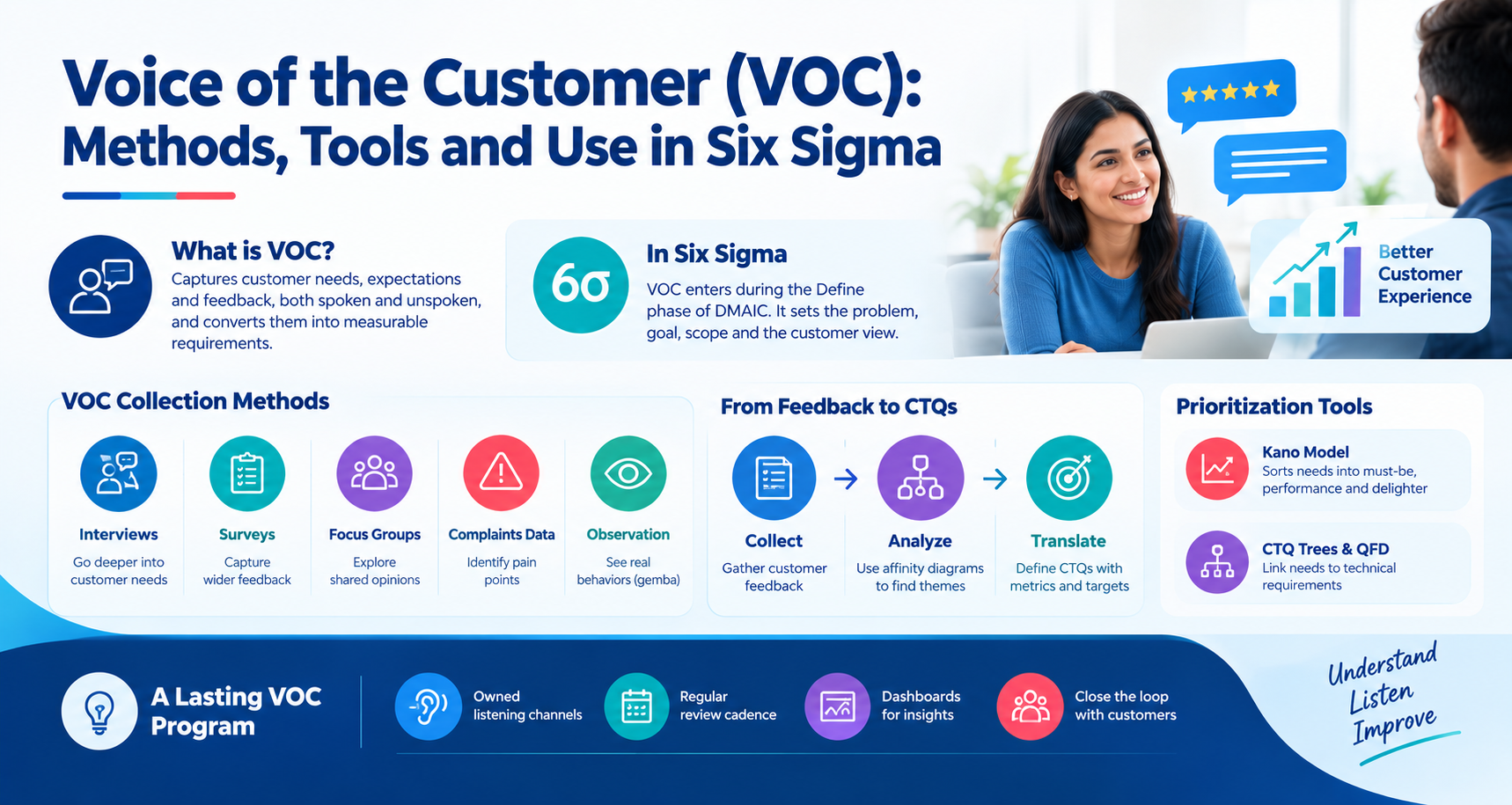
VOC is a process that systematically captures what is said by customers and defines it in a way that it can be quantitatively assessed. In the context of Six Sigma, VOC is done during the Define Phase. It involves the collection and review of several stakeholder feedback methods and data (e.g., surveys, interviews, focus groups, complaints data, and observation).
Typically, the feedback is organized using affinity diagrams to identify the CTQs. Additional tools and frameworks, e.g., the Kano model and CTQ trees, are used to prioritize the CTQs. Ultimately, the focus of a VOC exercise is to define customer requirements and improve customer experience.
Key Highlights of Voice of the Customer (VOC):
- What VOC is: Voice of customer is the structured practice of capturing customer needs, expectations and feedback, both spoken and unspoken. Teams then turn that feedback into measurable requirements.
- Role in Six Sigma: VOC enters during the Define phase of DMAIC. It sets the problem, goal, scope and customer view, because a defect is defined from the customer's side.
- Collection methods: Strong VOC work combines interviews, surveys, focus groups, complaints and support data, and observation such as gemba visits. Using several methods (triangulation) offsets the blind spots of each one.
- Collect, analyze, translate: Teams gather feedback, group comments into themes with affinity diagrams, then convert those themes into Critical to Quality (CTQ) requirements. Each CTQ has a metric, a unit and a target.
- Prioritization tools: The Kano model sorts needs into must-be, performance and delighter attributes. CTQ trees and Quality Function Deployment with the House of Quality link customer needs to technical requirements.
- Lasting program: The hotel example turned "check-in is slow" into a CTQ with a target of 5 minutes or less. Average check-in time fell from 11 minutes to 4. A lasting VOC program needs owned listening channels, a regular review cadence, dashboards and closing the loop with customers.
Introduction
All businesses strive to be customer-centric. The differentiator is in the process and framework used to capture customer feedback and translate the feedback into a quantifiable format that facilitates prioritization by management.
In VOC, customer feedback is prioritized based on the customer needs that are defined through improvement work. As a result, the work is aligned with customer value and does not consume company resources.
This resource explains the connection between VOC and Six Sigma. It gives examples of the methods and tools used in conjunction with VOC. This resource shows you how to establish a VOC system and explains a worked example.
What Is VOC?
VOC is the articulation of requirements, wishes, and aversions of a customer. Some requirements are overt and may be communicated by a customer. Others are implied or surrogate requirements.
Improving the customer experience requires that a business understands a customer’s needs and wants in order to meet them and set processes to fulfill them.
VOC is considered a customer requirement and is employed to set and improve business processes.
Voice of the customer in Six Sigma
From a Six Sigma perspective, all work starts with the customer. Therefore, any Six Sigma effort must consider VOC. For further context on the process, read about what Six Sigma is.
Within the DMAIC methodology, the function and purpose of VOC is to state the customer's needs in the context of the process in question. It articulates the problem from the perspective of the customer. If VOC is not used to describe the context and parameters of a project, it is possible that a process improvement project will meet all process criteria.
VOC in Six Sigma is a survey that is repeated over a product’s development and throughout its lifecycle. VOC surveys provide critical information that impacts the type of requirements and measurement systems that will be implemented for a product or service.
Customer Satisfaction vs. VOC Surveys
Customer Satisfaction (CSAT) surveys and VOC surveys are related, but differ from each other.
CSAT surveys: assess level of satisfaction:
- CSAT surveys are done to assess the level of customer satisfaction for a service or product that has already been offered. CSAT surveys are done to assess customer satisfaction for a service or product that has already been offered.
VOC surveys: broader than customer satisfaction surveys:
- The focus for VOC is broader than customer satisfaction surveys.
Product and service teams implement different surveys to assess customer satisfaction for the services and products offered. While service teams implement CSAT surveys, product teams use VOC surveys to help derive a product roadmap. Though surveys for both CSAT and VOC are implemented to assess customer satisfaction for a service or product that has already been offered, both surveys have a complementary function in an integrated product and service offering.
VOC Methods
The strongest VOC work uses multiple collection methods. Each method contains unique blind spots, and using multiple methods helps fill those blind spots. It is best to base conclusions on several pieces of evidence.
1. Interviews
Interviews are used to learn more about the needs and frustrations of a customer. It is best to conduct face-to-face interviews that last for 30-60 minutes. To learn more about a particular sentiment, the interviewer should be prepared to ask questions in a way that prompts the customer to provide more context.
An interview should not be conducted with a series of closed-ended questions. Closed-ended questions often prompt a customer to answer with very little context. It is best to ask questions that help the customer interpret and answer with as little editing as possible.
The general rule of thumb is that to understand a customer segment and to develop a solution to their problem, a total of 8 to 15 interviews should be conducted.Research by Griffin and Hauser. It is best to record the interviews to capture the context as it is spoken.
2. Voice of the Customer Surveys
The most common VOC method is to use a survey. Oftentimes, a large volume of survey responses is required in order to evaluate customer sentiment. To interpret survey responses, it is best to include rating scales and other closed-ended questions, and allow the respondent to explain their answer.
There are best practices for survey design. One best practice is to keep the survey as short as possible. One approach to survey design is to start with the most general question.
When designing a survey, consider the wording to eliminate questions that direct or assume a response. When working with a rating scale, make sure the response options are neither very broad nor very narrow.
A pattern in survey design is to include a request for a receipt. An example of this is the McDonald’s guest satisfaction survey. This survey, using the code found on the customer's receipt, captures customers’ feedback regarding their experience with McDonald’s. This includes the cleanliness of the restaurant, staff behavior, the food, and the speed of service. This type of customer satisfaction survey provides an example of how feedback can be captured in a timely and efficient manner.
3. Focus Groups
Focus groups are structured activities that bring together 6-10 customers. They are beneficial in capturing perceptual and attitudinal feedback and also helpful in research and product testing.
However, focus groups have limitations. It is possible for participants to influence other participants. Here, the opinions expressed in a focus group may not represent the true beliefs of participants. Focus group feedback should be used as a general direction of concern and should be verified using other feedback techniques.
4. Complaints and Support Data
Feedback already exists in your complaints and support data. Customer feedback should be captured and integrated into your process. It should be actively sought, particularly when it identifies process failures. You will find customer feedback in numerous formats, including comments and suggestions made by customers, returns, and support tickets.
This data is low-cost, high-yield. Analyzing Tag complaints can shed light on pertinent issues. Order is vital. Support conversations occur at the frontline. Analyzing support conversations provides insights, and not analyzing them is unwise.
The restriction is passive negative feedback. A significant portion of dissatisfied customers don’t voice complaints, and unfeatured, unrecoverable customers don’t show up in complaints data. Use this method in conjunction with unstructured (or structured if necessary) customer feedback surveys to better reach this customer segment.
5. Observation and Gemba Visits
Observable data is available through “in the wild” usage of the product or service. Sometimes customers don’t know or can’t express their workarounds, but workarounds are clear when you observe.
The actual location of work is where friction occurs and where the work truly adds value. The goal is to observe the work and process, including the areas and steps that add no value to the customer.
After observation, needs often go unspoken. Observation is a good complement to customer interviews, during which you can discuss what you’ve observed.
The Voice of the Customer Process
1. Collecting feedback:
The first step to transforming feedback into usable product or project requirements is collecting the feedback. There are two additional steps: analysis and interpretation.
Your understanding of the customer base determines how effective your collection methodologies will be. The customer base includes all the end users and the buyers who deal with your organization. Using a SIPOC diagram helps identify every customer of the process.
Mapping touchpoints is important, as it identifies locations within the customer’s journey where feedback will be valuable. Using a customer journey map with collection methods attached to the most relevant step ensures that feedback is collected in an effective and efficient manner.
Setting a sample size and time limit for how long you collect feedback gives you a representative sample of your customer base. This ensures that your resources and time are allocated for the collection of the most relevant feedback.
Prioritizing the collection of feedback will allow you to gain the most critical and relevant feedback for your organization from your customer base. Testing your survey questions for face validity with a small sample size of your employees will ensure the relevance of the questions.
2. Analyze With Affinity Diagrams
Raw VOC data comes in a wide variety of statements and comments which, if taken at face value, indicate the feelings and opinions of the customer. Using affinity diagrams, group similar ideas and state them in broad terms to identify the main theme of the data.
The affinity diagram makes themes automatically, so grouping statements becomes easier. Groups that statements fall into might include speed, accuracy, communication, and staff behavior/ease of use. Quantity does not indicate importance.
This step takes customer feedback and creates a smaller set of focused themes. These themes will be used in the next step of the process.
3. Translate into CTQs
CTQs are defined qualities of a product or service that meet the needs and requirements of the customer. Not all customer requirements can be measured, and thus, may need to be adjusted.
The pattern of adjusting the customer requirement varies. For example, the customer may require a process to have a check-in time of 3 minutes or less. Thus, a CTQ to measure check-in time of less than or equal to 3 minutes has been defined. To meet this CTQ, the check-in process must be measured or targeted to ensure the time meets the requirement and to set an upper limit.
In order to meet a CTQ, a process would be designed and measured in order to determine improvement.
VOC Tools
Several tools facilitate VOC analysis. Choosing the right voice of customer tools enables the team to transform unstructured commentary into defined requirements. Affinity diagrams are extremely helpful, and so is the Kano model. The House of Quality is essentially a large, advanced affinity diagram and is extremely helpful in writing requirements.
1. The affinity diagram and House of Quality
The affinity diagram organizes customer input, and Quality Function Deployment (QFD) transforms requirements into specifications.
The House of Quality is the central focus of QFD. The leftmost part of the House of Quality is customer requirements, and the rightmost part of the House of Quality represents competitors' requirements.
Prior to completing the House of Quality, an affinity diagram is usually constructed to organize customer input. Teams can use the House of Quality to defend and justify each requirement.
2. Kano model
According to the Kano model, the quality of a product or service is evaluated by three characteristics:
Must-be quality attributes are expected and, in their absence, create dissatisfaction. A hotel room, for example, must have a working lock on the door for customer satisfaction.
One-dimensional attributes are attributes that you can view in a performance frame and consequently improve performance and satisfaction. The more you improve these attributes, the higher customer satisfaction becomes. Some attributes in this dimension may include speed, price, and battery life.
This model identified that over time some attributes may shift dimensions. For example, what was previously a competitive edge attribute may shift to become an expected attribute. Therefore, management needs to assess the dimension within which an attribute exists from time to time.
This model also states that prioritized needs and expectations can be transformed into operational needs and used to construct CTQs.
Voice of the Customer Example
This model incorporates many tools and techniques to facilitate its implementation. To better illustrate the use of this model, let us consider the example of a hotel.
Hotel Example
To demonstrate how the tools work, let us consider an example where a hotel management wants to assess the customer experience during check-in to improve service.
Each theme is expressed in terms of customer wants and CTQs. The theme of waiting is expressed in the customer want “I want to go to my room quickly.” A CTQ is defined as the time between checking in and receiving the room key. The target is set to 5 minutes or less.
The average is 11 minutes. Data shows that it can take between 4 and 25 minutes to give a guest their room key. The variation is high, and the process needs improvement. The average by itself does not show all the information, and the process may be hiding a lot of slow and time-consuming outliers.
In the Measure phase, the team set an operational definition: the clock starts when the guest joins the queue and stops when the key card is handed over.The operational definition gives meaningful information to all observers of the process. The team measures the process to see what percentage of the cases take 5 minutes or less to process.
Using the DMAIC method, the focus is to measure and analyze the cause of the high variation. High variation is defined as unpredictable and inconsistent results and can be caused by several factors, such as a high volume of guests and limited staff members during peak hours. After changes to the process are implemented, the average time is reduced to 4 minutes.
In general, the complaint “check-in is slow” is converted to a measurable, baseline, and target statement. This is the main focus of VOC in Six Sigma.
Building a VOC Program
What are listening posts? These are the consistent means through which the company gathers feedback. Some examples are: post-transaction surveys, support staff analytics, review summaries, and quarterly interviews. For each of these, identify an owner. Generally, feedback will not be used if an owner is not assigned to it.
Establish the pace at which you will carry out the synthesis. Once per month, a team should identify the most relevant feedback and update Customer Critical To Quality (CTQs) statements. Once per quarter, the team should update CTQs based on changes in business and/or service priorities and using the Kano model.
The program should be integrated with other activities, including marketing research. Marketing research informs the company on future trends and how they compare with the competition. On the other hand,VOC tells a company where process improvement will matter most to customers.
The company should also measure VOC based on other business metrics. Establishing and maintaining a dashboard showing the most relevant feedback to the company, CTQs performance, and recently taken actions would keep the program and its funding secure.
Most organizations are at level two of the listening programs maturity path. Level two focuses on both ad hoc listening (level one) and periodic VOC (level three) listens. It takes commitment and sponsorship of executive management for a company to be at level three, where there is constant improvement of the service and process of the company based on feedback.
Closing The Loop With Customers
"Closing the loop" with customers means notifying them how their feedback was acted upon. This practice builds trust with your customers and encourages them to provide feedback in the future.
Closing the loop can be accomplished in many ways and often requires very little effort. This includes communicating feedback to your customers by posting an update or by notifying them of a change that was made. This information can be communicated in many ways, including by email, over the phone, or by note.
The goal of closing the loop is to show customers how the feedback they provided impacted your business. This in turn creates an opportunity for your business to improve your processes and gather more customer feedback.
VOC During The Define Phase of DMAIC
The define phase of DMAIC defines the target and the customer. VOC helps the define phase by maintaining focus on the customers.
To fully understand this phase of the DMAIC model, please refer to the define phase guide.
Skipping VOC causes a misalignment between the customer and the business. The end result of this type of project is that the business improves some internal metric and the customer remains unaware and unimpressed. This can be prevented by having at least one verified customer requirement in a project charter.
VOC to CTQ Tree
The CTQ tree is used during the Define phase of the project. It begins with a customer requirement and partitions it into drivers and finally Ends with measurable output.
Depending on customer requirements, needs and expectations for a food delivery system, the requirement “I want my food to be fresh” can be broken down into a number of drivers which may include type and condition of the food delivery packaging and the food delivery time.
Further breakdown of food delivery time may include the time it takes for the food to be prepared to the time it takes for the food to be delivered to the customer, with the time being measured in 25 minutes or less. Package integrity may be evaluated by the seal of the package and the integrity of the seal may be required to be 99.5% or greater.
To ensure the tree represents customer needs completely, the branches are evaluated during the review process to ensure the branches end in something that can be measured. If a branch ends in a word that describes a need or a requirement, i.e. a vague requirement, the tree is not complete.
Conclusion
Through the application of tools and techniques of VOC, improvement work is anchored to customer requirements. VOC enables teams to transform customer observations and needs to requirements and ultimately drivers of an improvement process. The tools of VOC are not very elaborate, however it is the application of the tools that differentiates high performing teams from low performing teams.
Building these skills is made possible by Simpliaxis with their training program for Lean Six Sigma Green Belt certification. Train yourself to lead such projects using the Lean Six Sigma Green Belt Practice Test. This training will help you identify customer needs, lead projects and execute changes that customers will definitely feel.





 Lowest-Price Challenge












 Personalized Path



.webp)


 USA
 Canada
 India
 UK
 Australia
 Singapore


