


 Call Us




Lean Canvas: How to Fill It Out, With a Template and Example

A lean canvas is a one-page business planning tool that helps startups and product teams map out a business idea, identify customer problems, define a solution, and test assumptions before investing heavily in development. Created by Ash Maurya, it adapts the Business Model Canvas for early-stage ventures by emphasizing problems, solutions, key metrics, and competitive advantages.
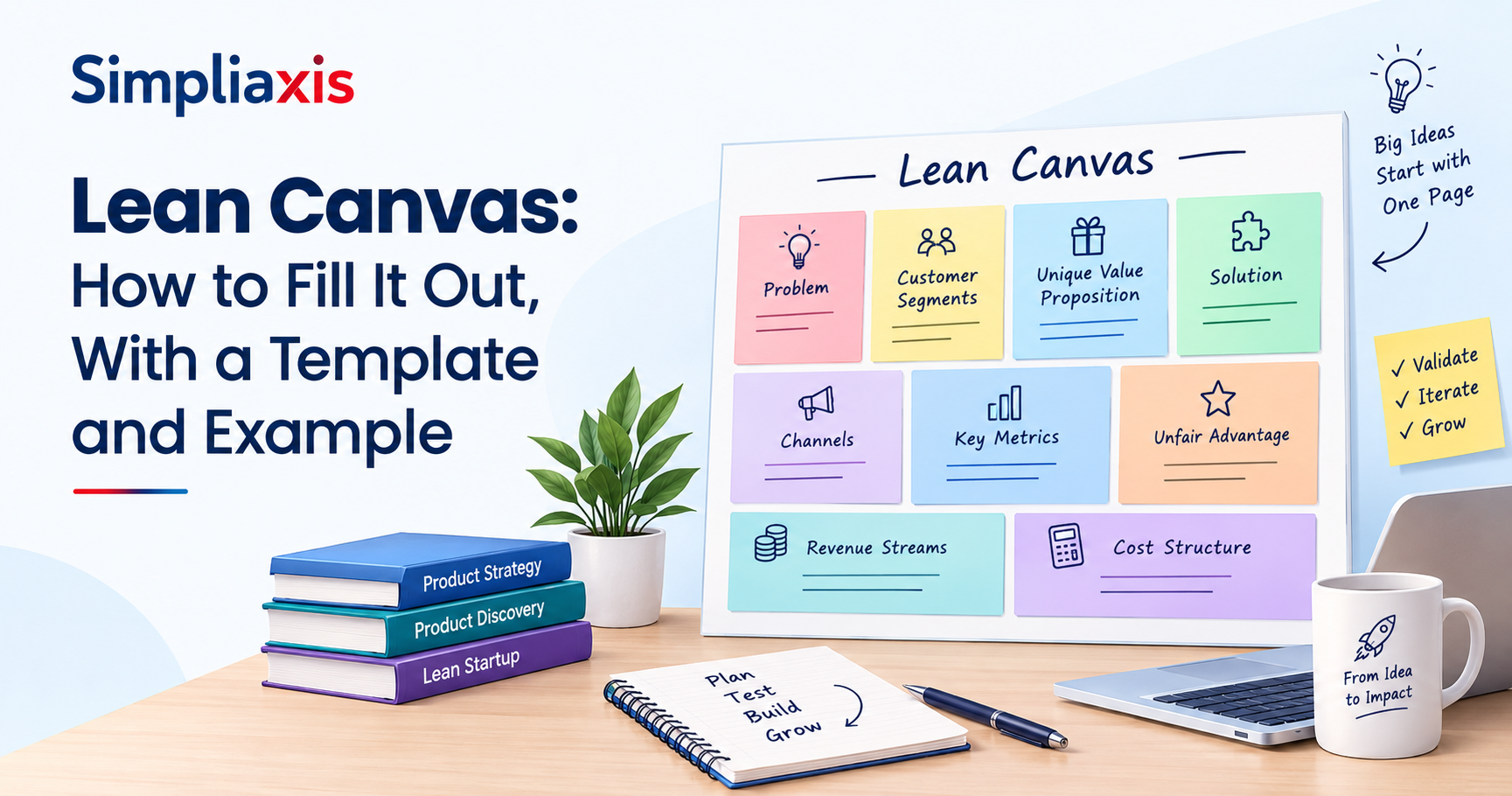
The lean canvas model contains nine boxes: Problem, Customer Segments, Unique Value Proposition, Solution, Channels, Revenue Streams, Cost Structure, Key Metrics, and Unfair Advantage. You can draft an initial version in about 30 minutes, then refine it using customer interviews, experiments, and real-world evidence.
Key Highlights of Lean Canvas
- A lean canvas summarizes a startup's business model on a single page.
- Its nine boxes connect customer problems with solutions, distribution, revenue, costs, and measurable outcomes.
- Ash Maurya developed the framework to help entrepreneurs test business assumptions before committing substantial resources.
- A lean canvas template is a starting point for discussion and validation, not a substitute for customer research or a detailed financial plan.
- Product owners can use the canvas to align stakeholders, prioritize experiments, and connect product decisions to customer value.
- The best results come from updating the canvas as new evidence emerges.
Introduction
Every startup begins with an idea. Perhaps customers struggle to manage their finances, small businesses spend too much time handling routine tasks, or professionals want a simpler way to learn new skills. The challenge is not generating an idea; it is determining whether the idea solves a meaningful problem for a clearly defined group of customers.
This is where a lean canvas becomes useful.
Instead of spending weeks preparing a lengthy startup business plan, founders can use a single-page framework to organize what they know, identify what they are assuming, and decide what to test next. The approach is particularly helpful when customer needs, pricing, and market demand remain uncertain.
For example, someone planning a habit-tracking app might initially assume that users want more reminders. Customer interviews could reveal that the real problem is losing motivation after missing a few days. That discovery would change the product's proposed solution, messaging, and success metrics.
The lean canvas makes these relationships visible before a team spends significant time or money building the wrong product.
Whether you are launching a startup, exploring a new product opportunity, or improving an existing service, this guide explains the lean canvas definition, all nine boxes, a practical lean canvas example, and a repeatable process for testing your assumptions in 2026.
What Is a Lean Canvas?
A lean canvas is a one-page business model framework that helps entrepreneurs describe how a business idea creates, delivers, and captures value. It organizes nine interconnected elements, from customer problems and target segments to revenue, costs, and competitive advantage.
Unlike a conventional business plan, which may contain extensive market research, operational details, and financial projections, the lean canvas model focuses on the assumptions that matter most at an early stage.
The framework supports three practical questions:
- Is the problem worth solving? Identify a genuine customer need and understand who experiences it.
- Can the proposed solution work? Outline a focused offering and determine how customers will discover and adopt it.
- Can the business become viable? Examine potential revenue streams, cost structure, and the factors that could make the model sustainable.
A lean business canvas is not a guarantee of success. It is a structured way to make uncertainty visible and guide startup validation.
You can start with a printable or digital LEANSTACK lean canvas template. Fill in concise statements rather than lengthy explanations, and treat each entry as a hypothesis until evidence supports it.
Who Created the Lean Canvas?
Ash Maurya created the Lean Canvas as an adaptation of the Business Model Canvas developed by Alexander Osterwalder and Yves Pigneur.
Maurya wanted a framework better suited to the uncertainty faced by entrepreneurs building new ventures. His approach draws on lean startup principles, including rapid experimentation, customer feedback, and learning before making major investments.
His book, Running Lean, expands on these principles and explains how entrepreneurs can move from an initial idea toward a business model supported by evidence.
The framework also reflects a central idea popularized by the lean startup movement: businesses should test their assumptions rather than treat an initial plan as a fixed prediction of the future. Harvard Business Review's article, Why the Lean Start-Up Changes Everything, provides useful background on this approach.
Maurya's work through LEANSTACK offers additional resources for applying the framework.
Why It Suits Early-Stage Products
Early-stage products rarely have complete information about customer behavior, willingness to pay, or the best route to market. A traditional business plan can document a strategy, but its projections may rest on assumptions that have not yet been tested.
The lean canvas helps teams focus on those uncertainties.
For example, a founder developing an online learning platform might assume that busy professionals want short video lessons. However, interviews could reveal that learners value structured practice and feedback more than shorter videos. Testing this assumption early could prevent months of unnecessary development.
The framework is especially useful when:
- You are evaluating several startup or product ideas.
- You need to identify early adopters before launching.
- You want to test problem-solution fit before building a complete product.
- You need to explain a business idea to investors, partners, or internal stakeholders.
- Your team needs a shared understanding of the customer, value proposition, and business model.
For teams working with product discovery, the canvas can connect research findings with potential solutions. It also supports product strategywhat is the lean process by making the target customer, desired outcome, and major business assumptions explicit.
The important distinction is that the canvas helps you decide what to investigate. Customer research and experiments determine whether your assumptions hold up.
The 9 Boxes of the Lean Canvas
The lean canvas contains nine boxes, each representing an important part of the proposed business model. Together, they show how a business intends to solve a problem, reach customers, generate revenue, and remain viable.
1. Problem
The Problem box identifies the most important issues experienced by your target customers.
List up to three significant problems rather than describing every inconvenience your product might address. Focus on problems that are frequent, costly, frustrating, or important enough to motivate a change in behavior.
For example, a habit-tracking app might identify these problems:
- Users struggle to maintain routines consistently.
- Missing a day makes users feel that they have failed.
- Existing trackers provide limited support for rebuilding motivation.
These statements describe customer difficulties rather than product features.
To complete this box, review customer interviews, support conversations, online discussions, and existing workarounds. Ask people how they currently handle the problem and what happens when they cannot solve it.
A problem supported by real customer behavior is a stronger starting point than an idea based only on personal opinion.
2. Customer Segments
Customer Segments define the people or organizations most likely to experience the problem and benefit from your solution.
Avoid targeting everyone who could theoretically use the product. A broad audience makes it difficult to determine which needs to prioritize, which messages will resonate, and where to find potential customers.
For a habit-tracking app, an initial segment might be working professionals who want to establish exercise, reading, or learning routines but struggle to remain consistent.
You should also identify early adopters: customers who experience the problem acutely, actively seek solutions, and are willing to try an imperfect early product.
Useful questions include:
- Who experiences the problem most frequently?
- What are they trying to accomplish?
- How do they solve the problem today?
- What would motivate them to switch?
- Where can you reach them?
A customer journey map can help you understand the steps customers take before, during, and after encountering the problem.
Start with a narrow segment, validate its needs, and expand only when the evidence justifies doing so.
3. Unique Value Proposition
The Unique Value Proposition (UVP) explains why a customer should choose your product instead of an existing alternative.
It should communicate the primary benefit clearly, using language that customers understand. Avoid generic statements such as "the best platform" or "an innovative solution" unless you can explain what makes the claim meaningful.
For the habit-tracking app, a possible UVP is:
"Build lasting habits without losing momentum when life gets busy."
This statement emphasizes a specific customer outcome rather than a list of features.
A useful UVP usually communicates three things:
- The intended audience.
- The main problem or desired outcome.
- The meaningful difference in the proposed approach.
Do not confuse a UVP with an unfair advantage. The UVP explains why the offering is valuable to customers; the unfair advantage explains what competitors cannot easily copy or reproduce.
Test your message with target customers. If they cannot explain what your product does or why it matters after reading the statement, simplify it.To map benefits against customer pains in more detail, try a value proposition canvas.
4. Solution
The Solution box describes the main capabilities that address the problems identified earlier.
At this stage, resist the temptation to design a complete product. Instead, identify the smallest set of capabilities needed to test whether the proposed solution addresses the customer's most important need.
For the habit-tracking app, the initial solution might include:
- A simple daily habit checklist.
- Flexible recovery after a missed day.
- A weekly progress summary.
These capabilities directly address consistency, motivation, and visibility into progress.
The objective is not to produce a comprehensive feature list. It is to identify the minimum viable solution that can generate meaningful feedback.
Before development, consider a clickable prototype, a manual service, or a landing page that explains the proposed benefit. Such experiments can help determine whether customers understand the solution and show interest.
This is where the lean canvas connects with the stages of product development: define a hypothesis, test a small intervention, then decide what to build.
5. Channels
Channels explain how your business will reach customers, communicate its value, and deliver the product.
Potential channels include search engines, social media, content marketing, partnerships, referrals, email, app marketplaces, and direct sales. The right choice depends on customer behavior, acquisition costs, and the type of product.
For example, a habit-tracking app might test:
- Educational articles about building consistent routines.
- Short demonstrations on relevant social platforms.
- Referrals from existing users.
- Partnerships with online learning or wellness communities.
Do not assume that a popular channel will automatically reach your intended audience. Test where potential customers actually discover information and which channels generate meaningful engagement.
Early experiments should track not only visits or impressions but also actions such as sign-ups, activation, and continued usage.
A channel that produces substantial traffic but few active users may be less valuable than a smaller channel that attracts people who genuinely need the product.
6. Revenue Streams
Revenue Streams describe how the business expects to earn money from the value it provides.
Possible models include subscriptions, one-time purchases, usage-based pricing, transaction fees, licensing, and advertising. A business may eventually use several models, but an early-stage team should test the most plausible option first.
For the habit-tracking app, possible revenue streams include:
- A free version with essential tracking features.
- A paid monthly subscription for advanced reports and customization.
- An annual plan offered at a discounted effective monthly price.
The team must test whether customers are willing to pay, which benefits justify payment, and whether the expected revenue can support the product's costs.
For example, assume the app charges ₹199 per month. If 100 customers pay for a month, gross subscription revenue is ₹19,900 before payment processing, taxes, refunds, and other expenses.
This is an illustrative calculation, not a market benchmark or revenue forecast. Actual performance depends on conversion rates, retention, pricing, and operating costs.
A compelling product idea is not automatically a viable business. Validate willingness to pay before relying on projected revenue streams.
7. Cost Structure
The Cost Structure box captures the major expenses involved in building, delivering, selling, and supporting the product.
Typical startup costs include product development, employee salaries, cloud hosting, software subscriptions, marketing, customer support, payment processing, and compliance.
For the habit-tracking app, costs might include:
- Design and software development.
- Hosting and data storage.
- Customer acquisition.
- Support and maintenance.
- Third-party integrations.
Separate fixed costs from variable costs where practical. Fixed costs generally remain relatively stable within a given operating range, while variable costs change with usage, sales, or customers.
For example, a monthly software subscription may be a fixed operating expense, whereas certain infrastructure and payment fees may increase as usage or transactions grow.
The purpose is to understand the economics of the business, not to create a detailed accounting statement. Use realistic estimates and revise them when supplier quotes, usage data, or operating experience become available.
You can also apply principles from what is the lean process to identify avoidable effort and improve the way resources are used.
8. Key Metrics
Key Metrics are the measurable indicators that show whether the business is making progress toward its objectives.
Choose metrics that connect directly to customer behavior and business viability. Avoid tracking every available number simply because a dashboard makes it easy.
For the habit-tracking app, useful measures could include:
- Activation rate: The percentage of new users who complete a meaningful first action.
- Weekly active users: The number of distinct users who engage during a week.
- Habit completion rate: The proportion of scheduled habits completed over a defined period.
- Retention rate: The percentage of users who return after a specified interval.
- Paid conversion rate: The percentage of eligible users who become paying customers.
Define each metric precisely. For instance, "active user" should refer to a meaningful behavior rather than simply opening the app.
Suppose 200 people sign up during an experiment and 80 complete their first habit. The activation rate is 40% (80 divided by 200).
That figure is useful only when the team defines activation consistently and examines what happens afterward. A high activation rate with poor retention may indicate that the initial experience is appealing but fails to deliver lasting value.
Metrics should help the team make decisions, not merely demonstrate activity.
9. Unfair Advantage
An Unfair Advantage is a meaningful asset, capability, or position that competitors cannot easily copy, buy, or reproduce.
It is often the most difficult box to complete because early-stage businesses may not yet possess a defensible advantage.
Potential examples include proprietary data, exclusive partnerships, trusted community relationships, specialized expertise, strong network effects, or distribution access that competitors cannot readily replicate.
For the habit-tracking app, an initial team might write "personalized insights." However, this is not automatically an unfair advantage because competing products could offer similar features.
A stronger advantage might develop if the product builds a unique dataset with appropriate user consent, creates a trusted community that attracts and retains members, or establishes exclusive partnerships that are difficult to replicate.
Be honest about the distinction between an existing advantage and a future possibility. If you do not have a defensible advantage yet, write "not established" and identify what evidence or capability could change that.
An unfair advantage should emerge from a real strategic asset, not simply a claim that the product is better.
How to Fill Out a Lean Canvas in 30 Minutes
You can create a useful first draft of a lean canvas in approximately 30 minutes if you already have a reasonably clear idea and access to basic customer insights.
Treat the time limit as a practical starting point, not a rule. Complex markets or unfamiliar customer segments may require more research.
Use a lean canvas template and write short, specific statements in each box. The objective is to create a testable picture of your business, not a polished presentation.
Recommended Order of Boxes
Although the canvas contains nine boxes, you do not need to complete them from left to right.
A practical sequence is:
- Customer Segments: Identify the people most likely to experience the problem.
- Problem: List the three most important difficulties they face.
- Unique Value Proposition: Describe the main outcome your product promises.
- Solution: Outline the minimum capabilities required to address the problem.
- Channels: Determine how you will reach and serve the target segment.
- Revenue Streams: Identify how the business could generate income.
- Cost Structure: Estimate the major costs of delivering the solution.
- Key Metrics: Select measures that indicate customer value and business progress.
- Unfair Advantage: Identify existing strengths that competitors cannot easily reproduce.
This sequence is a practical recommendation rather than a mandatory method. Some founders begin with a problem they have observed directly; others start with a customer segment or an existing business opportunity.
After completing the first draft, revisit the boxes to check whether they tell a consistent story. Your solution should address the listed problems, your channels should reach the chosen customers, and your revenue model should fit the value being delivered.
Marking Riskiest Assumptions
A completed canvas can look convincing even when its underlying assumptions are weak. Identify the beliefs that could invalidate the business if they prove false.
For example, the habit-tracking app may depend on three assumptions:
- Users consider inconsistent routines a significant problem.
- They will return to the app regularly.
- A sufficient number will pay for advanced features.
Rank assumptions by two factors: how uncertain they are and how damaging they would be if they were wrong.
A useful experiment should test a critical assumption with as little time and money as reasonably possible. Customer interviews may help investigate the problem, while a landing page or prototype can test interest in a proposed solution.
Mark assumptions as untested, partially supported, or supported by evidence. Avoid treating a few positive comments as proof of demand.
This process connects the lean startup canvas to the broader discipline of startup validation: learn which parts of the business model deserve investment before scaling them.
Lean Canvas Example
A worked lean canvas example makes the relationship between the nine boxes easier to understand.
Consider a fictional startup building a habit-tracking app for busy professionals. The following model is hypothetical and illustrates how a team might structure its initial assumptions.
Example: A Habit-Tracking App
| Lean canvas box | Example entry |
| Problem | Users struggle to maintain routines, feel discouraged after missing a day, and cannot easily see long-term progress. |
| Customer Segments | Busy professionals who want to maintain exercise, reading, or learning habits. |
| Unique Value Proposition | Build lasting habits without losing momentum when life gets busy. |
| Solution | Daily checklists, flexible recovery after missed days, and weekly progress summaries. |
| Channels | Search content, social media demonstrations, referrals, and relevant community partnerships. |
| Revenue Streams | Free basic plan and a proposed ₹199 monthly premium subscription. |
| Cost Structure | Development, hosting, maintenance, customer support, and marketing. |
| Key Metrics | Activation, weekly active users, retention, habit completion, and paid conversion. |
| Unfair Advantage | Not yet established; the team will investigate whether community trust or specialized behavioral insights can create a defensible position. |
The entries are starting hypotheses, not validated business facts.
The first experiment could test the problem before any substantial development begins. The founders might interview 15 to 20 people who fit the target segment, asking how they currently track habits, what causes them to stop, and which alternatives they have tried.
The team should look for recurring behaviors and concrete examples rather than asking only whether people like the idea.
Next, it could create a clickable prototype showing the daily checklist and missed-day recovery flow. A small group of target users could try the prototype and explain what they expect each feature to do.
If participants consistently value recovery after missed days, the team has an early reason to investigate that feature further. If they care more about accountability or reminders, the canvas should change.
Pricing can be tested separately through a transparent offer, interviews about existing spending, or a small paid pilot where appropriate. Stated willingness to pay is useful evidence, but actual purchasing behavior is stronger.
The team should also define success criteria before each experiment. For instance, it might set a target for how many participants complete a key prototype task or how many eligible users accept a paid offer. These thresholds are internal decision rules, not universal industry benchmarks.
After the experiments, the founders update the canvas and decide whether to continue, revise the solution, target a different segment, or reconsider the idea.
The central lesson is that a lean canvas is not a document to complete once. It is a working model that becomes more reliable as assumptions are tested.
Lean Canvas vs Business Model Canvas: Comparison Table
The Lean Canvas and Business Model Canvas both help teams describe how a business creates and captures value. However, they emphasize different questions.
The Business Model Canvas provides a broader view of the business, while the lean canvas places greater emphasis on uncertainty, customer problems, and validation in early-stage ventures.
| Comparison point | Lean Canvas | Business Model Canvas |
| Primary purpose | Test a business idea and its critical assumptions | Describe the overall business model |
| Main emphasis | Problems, solutions, customer segments, and validation | Customers, value delivery, partnerships, and business operations |
| Problem and solution | Separate, dedicated boxes | Addressed primarily through the Value Propositions block |
| Customer relationships | Not a separate box | Dedicated block |
| Key metrics | Dedicated box | Not a dedicated block |
| Key partnerships | Not a separate box | Dedicated block |
| Unfair advantage | Dedicated box | Not a dedicated block |
| Typical use | Early-stage startups and uncertain product ideas | New or established business models and strategic analysis |
The Business Model Canvas includes nine blocks: Customer Segments, Value Propositions, Channels, Customer Relationships, Revenue Streams, Key Resources, Key Activities, Key Partnerships, and Cost Structure.
See Strategyzer's Business Model Canvas guide for the original framework and related resources.
Neither canvas is universally better. Choose the lean canvas when your immediate challenge is determining whether a customer problem and business opportunity are worth pursuing. Choose the Business Model Canvas when you need to map a broader operating model, including partners, activities, and resources.
Some teams use both. A startup may begin with the lean canvas to test demand and later use the Business Model Canvas to explore partnerships, operational capabilities, and the wider business structure.
Testing Your Lean Canvas With Experiments
A lean canvas is only as useful as the evidence behind it. Once you have documented the business model, test its most important assumptions using small, focused experiments.
This reflects the build-measure-learn cycle associated with lean startup methods: build something small enough to test an idea, measure the response, and learn whether to continue or change direction.
Here are practical ways to test the nine boxes.
1. Customer interviews:Customer interviews are one of several product discovery techniques for testing the Problem and Customer Segments boxes.Ask about recent experiences, existing workarounds, and the consequences of the problem. This helps test the Problem and Customer Segments boxes.
2. Landing-page tests: Explain the proposed benefit and invite visitors to register interest. Measure qualified sign-ups rather than relying on page views alone. This can help assess the UVP and acquisition channels.
3. Prototype usability tests: Give participants a simple prototype and ask them to complete realistic tasks. Observe where they struggle and whether the proposed solution addresses the intended problem.
4. Pricing experiments: Test a clear, honest pricing offer with eligible customers. Examine purchase behavior, objections, and conversion rather than treating positive feedback as proof of willingness to pay.
5. Retention experiments: Track whether users return and experience the intended benefit over time. Early interest is not enough if users quickly abandon the product.
6. Cost and delivery tests: Estimate the resources needed to deliver the service and compare those estimates with actual operating data from a pilot.
Before each experiment, document four things: the assumption, the test, the success criterion, and the decision you will make based on the result.
For example, a habit-tracking team could hypothesize that users are more likely to return when the app offers a simple way to resume after missing a day. It could compare user behavior with and without that experience, while accounting for differences between the groups.
A single experiment may be inconclusive, so avoid making major strategic decisions from weak or unrepresentative samples. Repeat tests when necessary and record what changed.
Teams adopting lean startup in SAFe can apply similar thinking to larger organizational settings, where assumptions may need to be tested across multiple teams and stakeholders.
Lean Canvas for Product Owners in Scrum
Product owners can use a lean canvas to connect product decisions with customer problems and business outcomes.
In Scrum, the Product Owner is accountable for maximizing the value of the product resulting from the work of the Scrum Team and for effective Product Backlog management. The lean canvas can provide strategic context for those responsibilities, although it does not replace the Scrum Guide or the team's normal product management practices.
A product owner can apply the framework in several ways.
Align stakeholders around the problem. Use the Problem and Customer Segments boxes to explain who the product serves and which needs deserve attention. This helps prevent discussions from becoming a collection of disconnected feature requests.
Connect features to customer outcomes. The UVP and Solution boxes help the team explain why proposed capabilities matter. When reviewing backlog items, ask which customer problem each item addresses and how its impact will be evaluated.
Define measurable outcomes. Use Key Metrics to connect development work to activation, retention, task completion, customer satisfaction, or other relevant indicators. Select metrics appropriate to the product rather than adopting a generic list.
Prioritize experiments before major commitments. When an assumption is uncertain, the team may test it through discovery interviews, a prototype, or a small release before investing in a larger solution. MoSCoW prioritization can help organize competing requirements, while the canvas explains the business rationale behind those choices.
Review the model as evidence changes. The canvas should evolve when customer research, usage data, or market conditions challenge earlier beliefs.
The framework is also useful for understanding the difference between strategic direction and day-to-day execution. A canvas describes the proposed business logic; the Product Backlog organizes the work needed to pursue product goals
For a related explanation, see product roadmap vs product backlog.
The lean canvas is most valuable to a Scrum team when it helps everyone understand not just what they are building, but why the work matters and what evidence would indicate success.
Professionals learning product ownership can explore this product owner certification beginners guide. Those responsible for broader product decisions may also benefit from understanding who is a product manager.
Similarly, CSPO certification training and A-CSPO certification training can support continued learning in Scrum product ownership, depending on a professional's experience and goals.
Common Lean Canvas Mistakes
Even a simple framework can produce misleading results if teams use it without sufficient thought. Avoid these common mistakes.
1. Targeting everyone. A broad customer segment makes it difficult to identify meaningful problems and choose effective channels. Begin with a specific group and expand as evidence supports it.
2. Describing features instead of problems. "We need an AI dashboard" describes a proposed solution, not a customer need. Investigate the underlying difficulty before committing to a feature.
3. Writing a generic value proposition. Statements such as "easy to use" or "all-in-one platform" rarely explain why customers should choose the product. Focus on a concrete outcome and test whether customers understand it.
4. Assuming demand without evidence. Friends may praise an idea without becoming customers. Look for demonstrated behavior, repeated pain points, engagement, and willingness to pay.
5. Treating guesses as facts. Estimated pricing, acquisition costs, retention, and market demand should be labeled as assumptions until supported by evidence. Do not present hypothetical calculations as actual results.
6. Ignoring the economics. Strong customer interest does not automatically make a business viable. Examine acquisition costs, delivery expenses, pricing, and the possibility of repeat revenue.
7. Claiming an unfair advantage too early. A good feature or an enthusiastic founding team may not be difficult for competitors to copy. Identify genuine assets and acknowledge when a defensible advantage has not yet emerged.
8. Treating the canvas as a one-time exercise. Customer needs, competitors, and product usage can change. Review the canvas after meaningful experiments, major discoveries, or shifts in the business environment.
9. Confusing activity with progress. More features, more meetings, and more website traffic do not necessarily indicate that the business model is improving. Prioritize evidence that reduces uncertainty and demonstrates customer value.
A useful lean canvas is concise, honest, and open to revision. Its purpose is not to make an idea look impressive; it is to help the team make better decisions.
Conclusion
The lean canvas offers startups and product teams a practical way to turn an initial idea into a set of explicit, testable business assumptions. Its nine boxes connect customer problems, target segments, value propositions, solutions, distribution, revenue, costs, metrics, and competitive advantage.
You do not need perfect information to begin. Start with a specific customer segment, describe its most important problems, and outline a focused solution. Then identify the assumptions that could make or break the business and design small experiments to test them.
Use the lean canvas template as a living document rather than a fixed business plan. Update it when interviews, prototypes, usage data, or pricing tests challenge your original thinking.
Ultimately, the goal is not simply to complete a lean startup canvas in 30 minutes. It is to learn faster, reduce avoidable investment, and build a lean business model around real customer needs.







 Lowest-Price Challenge












 Personalized Path



.webp)


 USA
 Canada
 India
 UK
 Australia
 Singapore


