


 Call Us



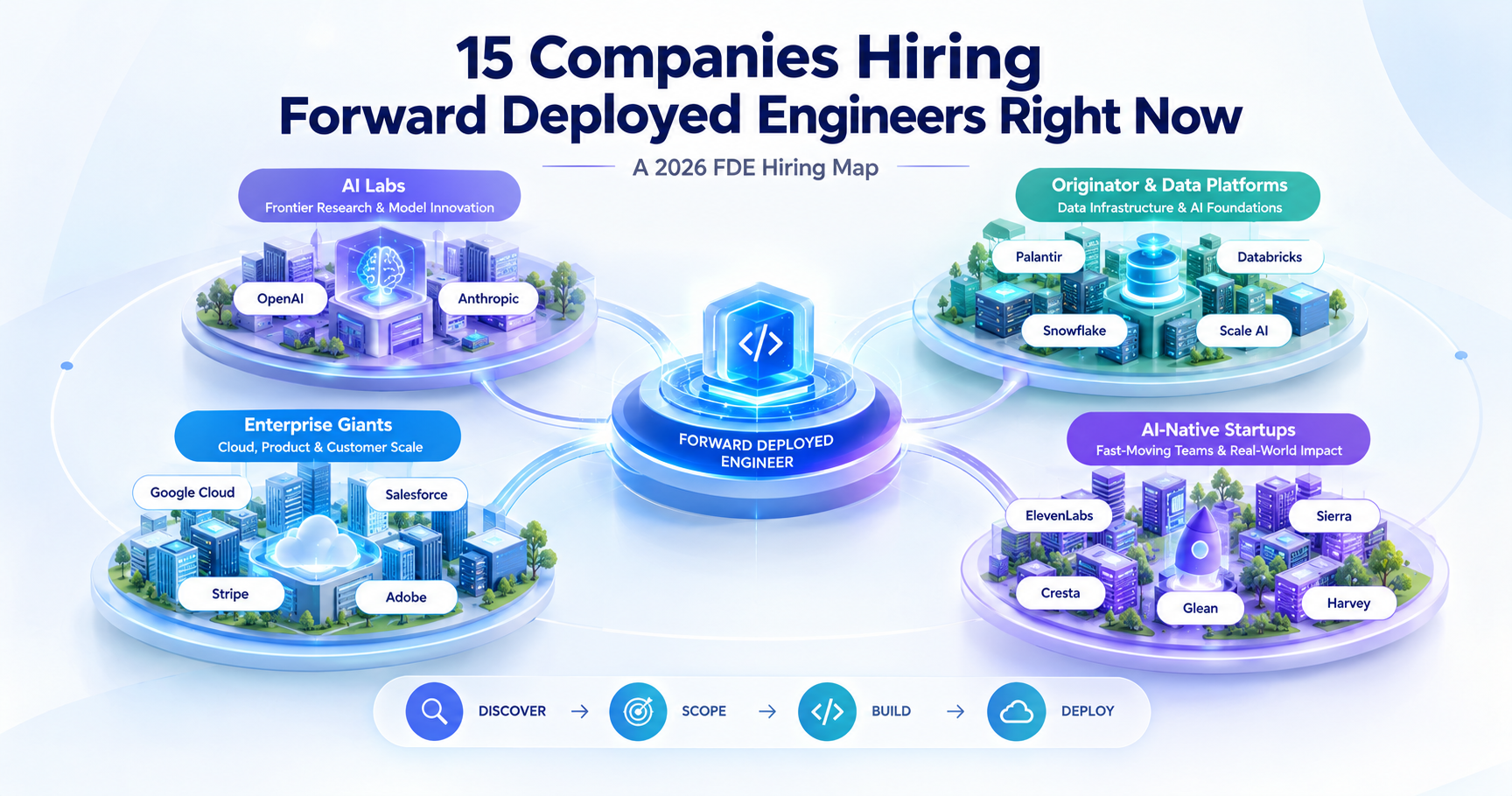
If you want a forward deployed engineering job, the useful question is not whether the role is in demand but which specific companies are hiring for it, because that is where a job search actually starts. The answer spans the AI labs that made the role famous, the data platforms that industrialised it, the enterprise giants adopting it at scale, and a wave of AI-native startups that depend on it to survive. This piece names fifteen companies actively hiring forward deployed engineers in 2026, explains what the role looks like at each, and gives you a way to target your search rather than firing applications blindly.
Knowing who hires is only half the battle, because these are demanding roles with rigorous interviews, and standing out requires genuine capability. Building the skills the role actually needs, through the Forward Deployed Engineering Program, is what turns a list of employers into a list of realistic targets rather than a wish list.
Key Highlights
- Forward deployed engineers are hired across four groups: AI labs, data platforms, enterprise giants, and AI-native startups, each offering a different flavour of the role.
- The AI labs, led by OpenAI and Anthropic, hire heavily and set the tone for the modern, AI-focused version of the role.
- Palantir, which originated the model, remains one of the largest hirers, alongside data platforms like Databricks and Snowflake.
- A wave of AI-native startups, including ElevenLabs, Sierra, Cresta, Glean, and Harvey, depend on forward deployed engineers to get their products into customers.
- The flavour of the role varies by company, so knowing what each offers lets you target the fit rather than chasing a title.
The AI labs setting the pace
The frontier AI labs are the most visible hirers of forward deployed engineers, and they define the modern, AI-heavy version of the role. OpenAI established a dedicated Forward Deployed Engineering team in early 2025, and it reportedly acquired a specialist forward deployed firm to accelerate the effort. At OpenAI, forward deployed engineers work inside customer environments, customise models against the organisation's data and workflows, and build the feedback loops that turn a capable model into a system that actually delivers, while also contributing back to the product.
Anthropic runs a substantial forward deployed effort, which it frames under the title Applied AI Engineer, backed by significant investment. The work centres on production LLM systems, retrieval, evaluation, agents, and fine-tuning trade-offs, applied inside customers to make Anthropic's models deliver real value. For engineers drawn to the frontier of applied AI, these two labs offer the most cutting-edge version of the role, working with the latest models on the hardest deployment problems. They also set the highest bar, so the capability you bring has to match the ambition of the work.
Palantir and the data platforms
The companies that industrialised the forward deployed model remain among its biggest employers. Palantir, which originated the role, still runs one of the largest forward deployed organisations anywhere, and its engineers work across government, finance, and healthcare, building against a defined outcome and a customer-specific ontology rather than a specification. Palantir remains the reference implementation of the role, and its loops are famously rigorous, weighting data engineering, ontology modelling, and the ability to decompose an ambiguous problem.
Databricks and Snowflake, the two dominant data platforms, both hire forward deployed engineers to help customers turn their data into working AI and analytics solutions, embedding to make the platform deliver real value inside complex enterprise data environments. Scale AI similarly hires forward deployed talent to help customers build and deploy AI on top of its data and model infrastructure. For engineers who like working close to data and infrastructure at scale, these companies offer a version of the role grounded in the data platforms that so much enterprise AI is built on, which is a different and valuable flavour from the pure model labs.
The enterprise giants adopting the role
Large established technology companies have adopted the forward deployed model as they race to get AI into their customers' hands. Google Cloud has been hiring for the role at significant scale, with its leadership publicly citing growing client and partner demand for help deploying its AI products. The work involves embedding with Google Cloud's enterprise customers to make its AI and cloud capabilities deliver in real environments.
Salesforce hires forward deployed engineers to help its vast customer base deploy AI within the Salesforce ecosystem, a role grounded in a specific and widely used platform. Stripe brings forward deployed engineers to its largest and most complex customers, helping them build sophisticated solutions on Stripe's infrastructure. And Adobe has joined the group, hiring for the role to help customers deploy its AI capabilities. These enterprise giants offer a version of the role with the stability of an established company and the scale of a huge customer base, a different proposition from the intensity of a frontier lab or an early startup, and a good fit for engineers who want the role without the volatility of a young company.
The AI-native startups that depend on it
Perhaps the most telling group is the wave of AI-native startups whose business models depend on forward deployed engineers, because for them the role is not a nice-to-have but a survival requirement. ElevenLabs, the voice AI company, has been hiring for a large number of forward deployed roles across multiple regions, reflecting how central deployment is to getting its technology into real use. Sierra, the customer-service AI company founded by prominent industry figures, hires forward deployed engineers to embed its agents into customers' operations.
Cresta, focused on AI for contact centres, hires forward deployed engineers across multiple countries to make its systems work in real customer environments. Glean, the enterprise search and work-assistant company, has hired for founding forward deployed roles as it scales into large organisations. Harvey, the legal AI company, hires forward deployed engineers to deploy its technology inside law firms and legal teams, a domain where the gap between a capable model and a usable system is especially wide. And Ramp, the finance platform, brings forward deployed talent to embed its AI into customers' financial operations. For engineers who want the intensity, ownership, and upside of an early-stage company, these startups offer a version of the role where forward deployed work is at the very centre of the business.
The companies at a glance
To help you target, here is how the fifteen companies group by the flavour of the role they offer.
| Company | Group | Flavour of the role |
| OpenAI | AI lab | Frontier models, customer deployment plus product |
| Anthropic | AI lab | Applied AI, production LLM systems |
| Palantir | Originator | Rigorous, ontology-driven, high-stakes domains |
| Databricks | Data platform | AI and analytics on complex enterprise data |
| Snowflake | Data platform | Deployment on the data cloud |
| Scale AI | Data platform | AI on data and model infrastructure |
| Google Cloud | Enterprise giant | Cloud and AI at enterprise scale |
| Salesforce | Enterprise giant | AI within a huge platform ecosystem |
| Stripe | Enterprise giant | Complex solutions for large customers |
| Adobe | Enterprise giant | Deploying creative and enterprise AI |
| ElevenLabs | AI-native startup | Voice AI, high hiring volume |
| Sierra | AI-native startup | Customer-service agents |
| Cresta | AI-native startup | Contact-centre AI |
| Glean | AI-native startup | Enterprise search and assistants |
| Harvey | AI-native startup | Legal AI deployment |
Read the table as a targeting tool. If you want the frontier, aim at the labs. If you want scale and stability, aim at the enterprise giants. If you want data-heavy work, aim at the platforms. If you want intensity and ownership, aim at the startups. Matching your preference to the group is a far better strategy than applying everywhere.
What these companies pay, in broad strokes
Compensation is naturally a big part of why these roles attract so much interest, and while the precise figures deserve their own detailed treatment, the broad picture is worth understanding as you target companies. Forward deployed roles at these companies are among the best-paid engineering positions available, reflecting the scarcity of people who can do the work and the value they create by getting AI into production. The frontier labs and the most competitive startups sit at the top of the range, offering total compensation that rivals or exceeds elite software engineering roles, because the demand for the specific skill set is so intense.
The pattern across the groups is roughly that the frontier AI labs and the hottest AI-native startups pay the most, driven by fierce competition for a small pool of qualified engineers, while the established enterprise giants pay strongly but often with more structure and less of the equity upside that a startup offers. The trade at a startup is higher potential upside against more risk, while the established companies offer more predictable, still-substantial compensation. Because the numbers move quickly and vary enormously by level, location, and company, the sensible approach is to research current figures for the specific roles you target rather than relying on any single quoted number, and to weigh total compensation, including equity, rather than just base salary. What is consistent across all these companies is that the role is well compensated, reflecting its genuine scarcity and value, which is part of what makes building the capability worthwhile.
How to choose which group to target
With four distinct groups hiring, a common mistake is applying everywhere rather than targeting the group that fits, so it is worth thinking deliberately about which suits you. If you want to work at the absolute frontier of AI capability, on the latest models and the hardest problems, and you can meet a very high bar, the AI labs like OpenAI and Anthropic are the target, at the cost of intense competition and demanding work. If you value the intellectual rigour of the original model and are drawn to high-stakes domains, Palantir is the reference, though its standards are famously exacting.
If you want the scale, stability, and resources of an established company, and prefer a more structured environment, the enterprise giants like Google Cloud, Salesforce, and Adobe offer the role with less of the volatility of a young company. And if you want intensity, ownership, meaningful equity, and the experience of the role being central to a company's survival, the AI-native startups like Sierra, Cresta, Glean, and Harvey offer that, at the cost of startup risk. Matching your preferences, on risk, stage, domain, and intensity, to the right group is far more effective than a scattershot approach, and it also lets you prepare more specifically, since the interview loops differ by company and group. Targeting deliberately is the mark of a candidate who understands the landscape rather than one firing applications blindly.
Reading a forward deployed job posting critically
A practical skill worth developing as you approach these companies is reading their job postings critically, because the forward deployed title is applied to a range of roles and the posting reveals which version you are looking at. A genuine forward deployed posting describes building and deploying real software inside customer environments, mentions the technical stack, and speaks to the delivery arc from discovery through production. A diluted posting, even at a reputable company, may describe something closer to pre-sales, support, or configuration under the fashionable title, which is a different job than the one you may want.
Look for what the posting says about what you would actually build and deploy, how much of the role is hands-on engineering versus customer coordination, and who owns production after go-live. Look too for signals about travel, domain, and seniority, which tell you whether the role fits your life and level. A posting that is vague about the actual building and heavy on stakeholder language may be a diluted role, while one that is concrete about the technical work and the deployment reality is more likely to be the genuine article. This critical reading is the same screening discipline that protects you across the range of roles the forward deployed title covers, and it ensures you target roles that are genuinely what you want rather than being drawn in by an appealing title over less appealing substance.
How to actually land one of these roles
Knowing who hires is the start, but these are competitive roles with demanding interviews, so the real question is how to become a strong candidate. The forward deployed interview process at these companies is rigorous and unusual, weighting customer-facing judgement and reasoning through ambiguity as heavily as coding, so preparation has to go beyond the standard software interview. The single most important thing you can do is build genuine capability across the full span of the role, discovery, scoping, building, and deployment, because that is what these companies actually test for.
It also helps to target deliberately rather than broadly. Pick the group and the companies that match what you want, tailor your approach to the flavour of the role there, and prepare specifically for their loops, which differ, with the labs weighting production LLM systems and Palantir weighting data engineering and decomposition. Genuine preparation matters more here than in most job searches, because the role is demanding and the interviews are designed to surface real capability. Building that capability through the Forward Deployed Engineering Program, grounded in agentic AI foundations, is how you turn this list of employers into offers rather than rejections.
Building toward these companies
What unites every company on this list is that they hire for genuine capability rather than credentials, which means the surest way toward any of them is to build real skill across the full span of the role. Developing that capability through the agentic AI practitioner path and applied engineering with agents prepares you for the demanding interviews these companies run, which test whether you can actually do the work rather than whether you have the right background. The market is wide open to anyone who can genuinely bridge capable AI and real deployment, regardless of pedigree, which is why building the capability matters more than any single credential when you approach this list.
A final practical note: because these companies span such different stages and cultures, from frontier labs to early startups to established giants, the same candidate can be a strong fit at one and a poor fit at another, independent of raw ability. Weighing the character of the work at the top three alongside the industry you would be serving, and the honest trade-offs of the role itself, is what turns a list of employers into a shortlist that genuinely fits you rather than a scattergun of applications.
The bottom line
Forward deployed engineers are being hired across fifteen notable companies in four groups: the AI labs like OpenAI and Anthropic setting the frontier pace, the originator Palantir alongside data platforms like Databricks, Snowflake, and Scale AI, the enterprise giants like Google Cloud, Salesforce, Stripe, and Adobe adopting the role at scale, and AI-native startups like ElevenLabs, Sierra, Cresta, Glean, and Harvey that depend on it to survive. Each group offers a different flavour of the role, so the smart move is to target the fit rather than chase the title everywhere.
Landing one of these roles takes more than knowing who is hiring, because the interviews are rigorous and unusual, weighting customer judgement and ambiguity as heavily as code. Building genuine capability across the full span of the role, and preparing specifically for the loops that differ by company, is what makes you a real candidate. Developing that capability through the Forward Deployed Engineering Program is how you turn this list into a realistic set of targets and, eventually, offers.
Whichever companies you target, treat the list as a starting map rather than a fixed universe, because new entrants join the hiring pool constantly as more organisations discover they need forward deployed talent, and the smartest search stays alert to the companies that will be hiring next as much as those hiring now.




inProjectManagement_1785128300.png)



 Lowest-Price Challenge











 Personalized Path


.webp)


 USA
USA  Canada
 India
India UK
UK Australia
 Singapore


