


 Call Us



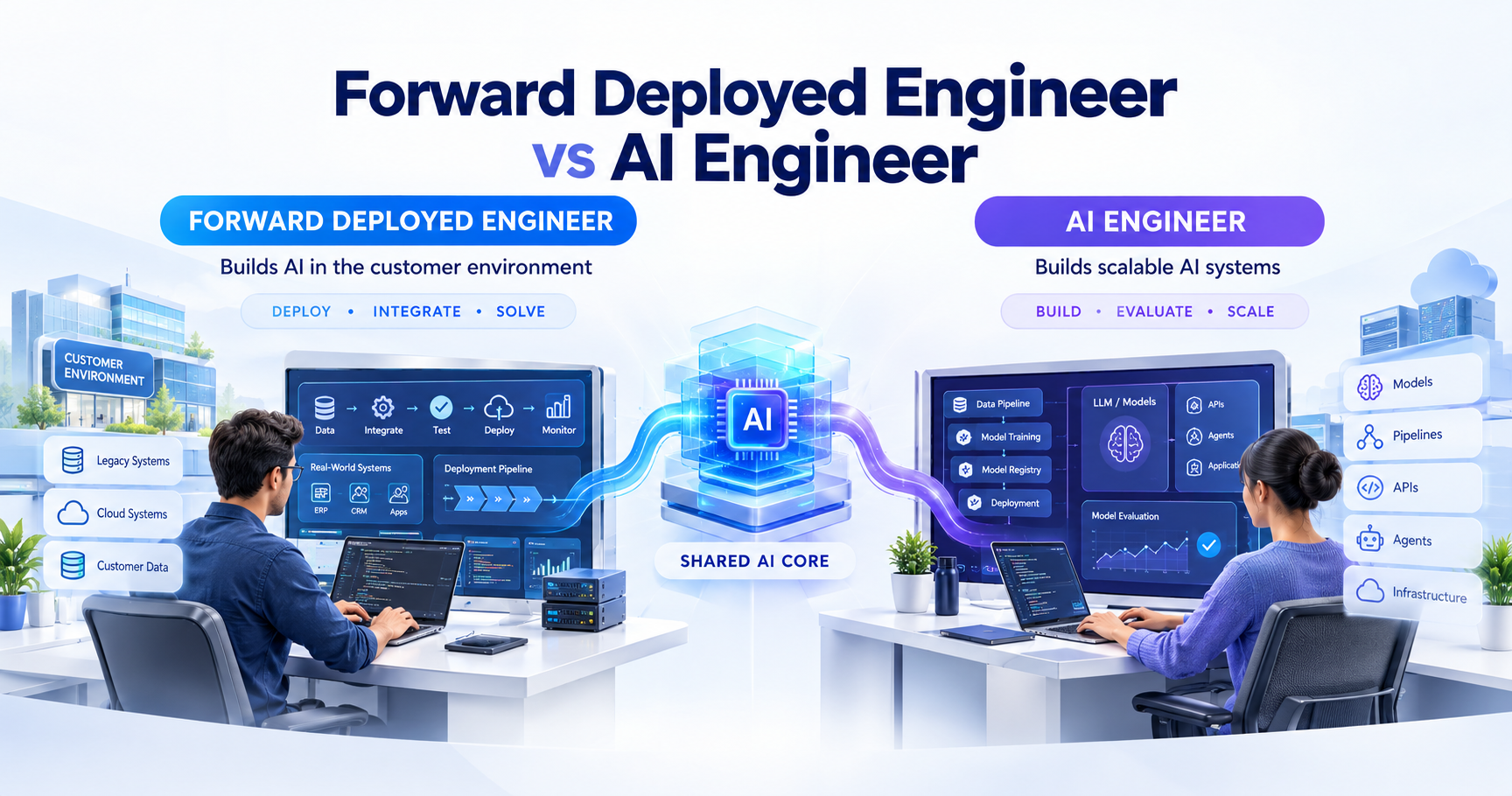
As AI has become the centre of gravity for so much of technology, two roles have risen together and now get compared constantly: the forward deployed engineer and the AI engineer. They overlap heavily, because the modern forward deployed engineer works largely on AI, and both build with the same tools. But they are aimed at different things. The AI engineer builds AI systems and capabilities, often working on the product itself, while the forward deployed engineer takes AI capability and makes it work inside a specific customer's messy reality. This piece draws the distinction for anyone deciding which of these two AI careers to pursue, and for anyone trying to tell the roles apart.
The comparison matters because both are excellent, in-demand AI careers, and the choice between them is about where you want to apply your skills rather than which is better. If the customer-facing, make-it-work-in-the-real-world version appeals, the Forward Deployed Engineering Program is built for exactly that, while the path into general AI engineering is covered thoroughly in the guide onhow to become an AI engineer.
Key Highlights
- The AI engineer builds AI systems and capabilities, often on the product, while the forward deployed engineer makes AI work inside a specific customer's environment.
- Both build with the same AI tools, which is why they overlap, but they differ in where and for whom they build.
- The AI engineer's context is often the product and its general capability, while the forward deployed engineer's context is the individual customer and their messy reality.
- The forward deployed engineer needs the AI engineer's technical skills plus the customer-facing and delivery skills that general AI engineering does not require.
- Both are strong AI careers, and the choice is about whether you want to build capability or deploy it into real organisations.
Build the capability versus deploy it into reality
The clearest way to separate these roles is by what they are ultimately building toward. The AI engineer builds AI capability: models, systems, features, and the technical machinery that makes AI work. They often work on a product, improving what the AI can do in general, or building AI systems that will be used broadly. Their focus is the capability itself and making it better, more reliable, more powerful.
The forward deployed engineer takes AI capability, which may already exist, and makes it deliver value inside a specific customer's environment. Their focus is not building the capability in the abstract but bridging the gap between a capable AI system and a particular organisation's messy, specific reality. Where the AI engineer asks how do we make the AI more capable, the forward deployed engineer asks how do we make this capable AI actually work for this customer. This distinction, building capability versus deploying it into a specific reality, is the heart of the difference, and it explains why the forward deployed role is so tied to the problem of AI pilots stalling: the capability often already works, and the forward deployed engineer is the one who makes it work in a real enterprise.
What an AI engineer actually does
To understand the contrast, it helps to see the AI engineer role on its own terms, without repeating the full path into it, which the dedicated guide on becoming an AI engineer already covers. An AI engineer builds systems that use AI to do useful things. They work with models, design the systems around them, handle the data, build the pipelines, and produce AI capabilities that solve problems, often as part of a product or platform used by many.
The AI engineer's work is centred on the technical construction of AI systems. They understand models and how to work with them, they build the retrieval systems, agents, and pipelines that turn raw model capability into working features, and they handle the evaluation and deployment that make those features reliable. Much of this happens in the context of building a product or a general capability, refining what the AI can do and making it work well at scale. It is deeply technical work focused on the AI systems themselves, and for people who love building AI capability, it is a superb career. What it does not centre on is the specific customer, because the AI engineer often builds for a product or a broad user base rather than embedding with one organisation to make the AI work in their particular reality.
What the forward deployed engineer adds
The forward deployed engineer takes the AI engineer's technical foundation and adds the customer-specific, make-it-work-in-reality dimension. They have to be able to do much of what an AI engineer does, build retrieval systems, work with agents, handle evaluation and deployment, because the modern forward deployed role is heavily AI-focused. But they apply those skills in service of a specific customer, inside that customer's environment, against their real constraints, rather than to a product in general.
This changes the nature of the work in important ways. The forward deployed engineer's AI work is grounded in a particular customer's messy data, awkward systems, and specific needs, which is a different challenge from building general capability. They also need the customer-facing and delivery skills, discovery, embedding, scoping, handoff, that general AI engineering does not require, because their job is not just to build AI but to build it inside an organisation and make it stick. The forward deployed engineer is, in a sense, an AI engineer who also embeds with customers and delivers into their reality, which is why the role needs the AI technical skills plus a whole additional layer of customer-facing capability. This is the layer that turns capable AI into deployed value, and it is exactly the full stack of skills applied inside a real customer rather than to a product in the abstract.
Where the two roles overlap
The heavy overlap between these roles is real, and being honest about it clarifies the distinction rather than blurring it. Both work with the same AI tools and techniques. Both build retrieval systems, both work with agents, both handle evaluation and deployment, both need to understand models and how to get useful behaviour from them. The technical core of building AI systems is largely shared, which is why the roles are so often compared and sometimes confused.
The overlap means that the two roles are not distant cousins but close relatives, and movement between them is very possible. An AI engineer has most of the technical foundation a forward deployed engineer needs, and a forward deployed engineer has strong general AI engineering skills. The difference is not in the technical toolkit, which is largely common, but in where and for whom the toolkit is applied, and in the additional customer-facing skills the forward deployed role demands. Recognising the shared core is useful because it means neither role requires abandoning the other's skills, and someone strong in one is well positioned to move to the other. It also means that the technical AI engineering skills are valuable in both directions, which is reassuring for anyone deciding between them.
How the context differs, and why it matters
The most consequential difference between the roles is the context in which the same technical work happens, and this difference shapes the daily experience and the required skills. The AI engineer often works in the context of a product, with a team, on systems used by many, in an environment the company controls. The forward deployed engineer works in the context of a specific customer, embedded, on a solution for that one organisation, in an environment the company does not control.
This contextual difference has large consequences. The forward deployed engineer builds against a customer's messy, unfamiliar, restricted reality rather than a controlled internal environment, which is harder in specific ways and requires the ability to work under constraints the AI engineer rarely faces. They deal with the customer's real data rather than curated datasets, their awkward systems rather than clean internal ones, their specific needs rather than general requirements. And they carry the customer relationship, which the AI engineer often does not. So even though the technical work overlaps heavily, the context transforms it, adding the customer-facing and constrained-environment challenges that define forward deployed work. This is why the forward deployed engineer needs everything the AI engineer needs plus more, and why the role sits at the demanding intersection of AI capability and real-world deployment.
A side-by-side comparison
To fix the distinction, here is how the two roles compare across the dimensions that decide the choice.
| Dimension | Forward deployed engineer | AI engineer |
| Primary focus | Making AI work for a specific customer | Building AI capability, often on a product |
| Context | Embedded in the customer's environment | Often internal, on a product or platform |
| Data worked with | The customer's real, messy data | Often curated or product data |
| Customer relationship | Central to the role | Often not part of the role |
| Technical toolkit | Largely shared with the AI engineer | Largely shared with the forward deployed engineer |
| Extra skills required | Discovery, embedding, delivery, handoff | Deeper focus on capability and scale |
| Best fit for | People who want to deploy AI into real orgs | People who want to build AI capability |
Read the table to see both the shared core and the divergence. The technical toolkit row shows why the roles overlap so much. The focus, context, and extra-skills rows show where they part ways. Your own preference across these dimensions, especially whether you want the customer relationship and the real-world deployment challenge, points to which role fits.
The customer relationship is the real dividing line
If you had to name the single factor that most distinguishes the two roles day to day, it would be the customer relationship, because that is what transforms otherwise similar technical work into two different jobs. The AI engineer often works without a direct customer relationship, building capability for a product or a broad user base, mediated by product managers and designers, with the actual users at a distance. Their satisfaction comes from building something capable and seeing it used, but usually not from a direct relationship with the people using it.
The forward deployed engineer carries the customer relationship as a central part of the role, embedding with a specific organisation, understanding their people, and being accountable to them directly. This changes the texture of the work profoundly. The forward deployed engineer has to manage a relationship, navigate an organisation's politics, communicate with non-technical stakeholders, and be present for the customer in a way the AI engineer rarely is. For some engineers, this direct relationship is energising and meaningful, the human connection to real impact that makes the work satisfying. For others, it is a burden they would rather not carry, preferring to focus on the technical building without the relationship overhead. Which of these you are is perhaps the clearest signal of which role fits you, more even than the technical preferences, because the relationship is the part of forward deployed work that the AI engineer role largely lacks, and it defines the daily experience as much as the technical stack does.
Why the roles are converging in some ways
An interesting dynamic worth understanding is that these two roles, while distinct, are in some ways converging, which affects how you should think about the choice for the long term. As AI capability becomes more accessible and the tools mature, the technical barrier to building AI systems is falling, which means the differentiator increasingly shifts toward the harder-to-automate skills, understanding a specific customer, deploying into their messy reality, and building for real adoption. These are exactly the forward deployed skills, which suggests the customer-facing, deployment-focused dimension is becoming more valuable relative to pure capability-building over time.
At the same time, AI engineers are increasingly expected to think about deployment and real-world use, not just capability, because building capability that nobody can deploy is of limited value, a lesson the whole industry is absorbing. So the two roles are converging in the sense that both are being pulled toward caring about real-world deployment, even as they retain their distinct centres. For someone choosing between them, this convergence is reassuring, because the deployment-focused skills at the heart of forward deployed work are appreciating in value across the board, and building them is a sound investment whichever role you ultimately hold. It also means that the gap between capable AI and real deployment, which the forward deployed engineer specialises in closing, is becoming recognised as the central challenge of the field rather than a niche concern.
Which one should you choose
The choice between these two strong AI careers comes down to where you want to apply your AI skills, and both answers are good. If you are drawn to building AI capability itself, to working on the product, improving what the AI can do, and building systems used broadly, the AI engineer path fits, and the route into it is well covered in the guide on how to become an AI engineer. If you are drawn to taking AI capability and making it actually work inside real organisations, to embedding with customers and deploying into their messy reality, the forward deployed path fits.
Neither is more technical or more prestigious in the abstract, they are different applications of largely shared AI skills, and the deciding factor is whether you want the customer-facing, real-world deployment dimension or prefer to focus on building capability. Because the technical core overlaps so heavily, you are not locked in, and skills built in one transfer substantially to the other. For those drawn to the deployment challenge and the customer relationship, the forward deployed role is in exceptional demand precisely because so many organisations struggle to get capable AI into production, and developing the specific capability through theForward Deployed Engineering Program equips you for exactly that work.
A useful way to hold the distinction is that the AI engineer makes AI capable, and the forward deployed engineer makes capable AI useful to a specific organisation. Both are essential, and the field increasingly needs people who can do both, which is why theagentic AI practitioner skill set that spans building and deploying is so valuable. Whichever role you lean toward, the deployment-focused half of the work is appreciating fastest, because capability without deployment generates no value, and closing that gap is where the enduring demand sits.
If you want a low-cost way to sense which of the two roles fits before committing, hearing how practitioners describe the deployment work firsthand, for instance through the forward deployed engineer webinar, tells you more about the daily texture than any comparison table can.
The bottom line
The forward deployed engineer and the AI engineer overlap heavily, because both build with the same AI tools, but they aim at different things: the AI engineer builds AI capability, often on a product, while the forward deployed engineer makes AI capability work inside a specific customer's messy reality. The distinction is not in the technical toolkit, which is largely shared, but in where and for whom it is applied, and in the customer-facing and delivery skills the forward deployed role adds on top of the AI engineering foundation.
Both are excellent, in-demand AI careers, and the choice is about where you want to apply your skills. If you want to build capability, the AI engineer path fits and is covered in the dedicated guide. If you want to deploy AI into real organisations and carry the customer relationship, the forward deployed path fits and is in exceptional demand. Because the technical core is shared, the roles are close relatives with real movement between them, and for those drawn to the deployment challenge, building the capability through the Forward Deployed Engineering Program is the way in.
Building for the deployment challenge
If the deployment-focused, customer-facing version of AI work appeals, the way in is to build genuine capability across both the AI engineering foundation and the forward deployed skills that sit on top of it. Developing that combination, through hands-on agentic AI engineering and the applied work that takes a developer into shipping AI features, is what equips you for the role that so many organisations are desperate to fill. Because the technical core is shared with general AI engineering, the skills transfer readily, and adding the customer-facing, real-world deployment layer is what turns a capable AI engineer into a forward deployed one.








 Lowest-Price Challenge











 Personalized Path


.webp)


 USA
USA  Canada
 India
India UK
UK Australia
 Singapore


