


 Call Us


Key Highlights: What Is Impact Mapping
- Impact mapping connects business goals with the work a product team plans to do.
- It has 4 levels: Why, Who, How, and What.
- This way, teams can concentrate on outcomes rather than just adding features.
- An impact map can help with product strategy, product discovery, and roadmap planning.
- Impact mapping is good for Agile teams and can help with backlog discussions.
- A simple impact mapping template can make planning easier.
- Product Owners can use impact mapping to question whether a feature is actually needed.
Introduction
Product teams often have a long list of features, requests, user stories, and ideas. The difficult part is not always deciding what can be built. It is understanding why it should be built.
This is where impact mapping can help.
Impact mapping is a visual planning method that connects a business goal to the people who can influence it, the behavior you want to change, and the work that could support that change. The method is commonly associated with Gojko Adzic and his 2012 book “Impact Mapping: Making a Big Impact with Software Products and Projects.”
Instead of starting with a feature, impact mapping starts with a goal. This changes the conversation from "What should we build?" to "What are we trying to achieve?"
That simple change can be useful when working on product strategy, product discovery, backlog planning, and a product roadmap.
For example, a team may think that building a new notification feature is the answer to low customer engagement. With impact mapping, the team first asks what business goal it wants to reach and what customer behavior needs to change. The notification feature then becomes one possible solution rather than the starting point.
You can also read more aboutProduct strategy when looking at how goals and product decisions fit together.
What Is Impact Mapping?
Impact Mapping Definition
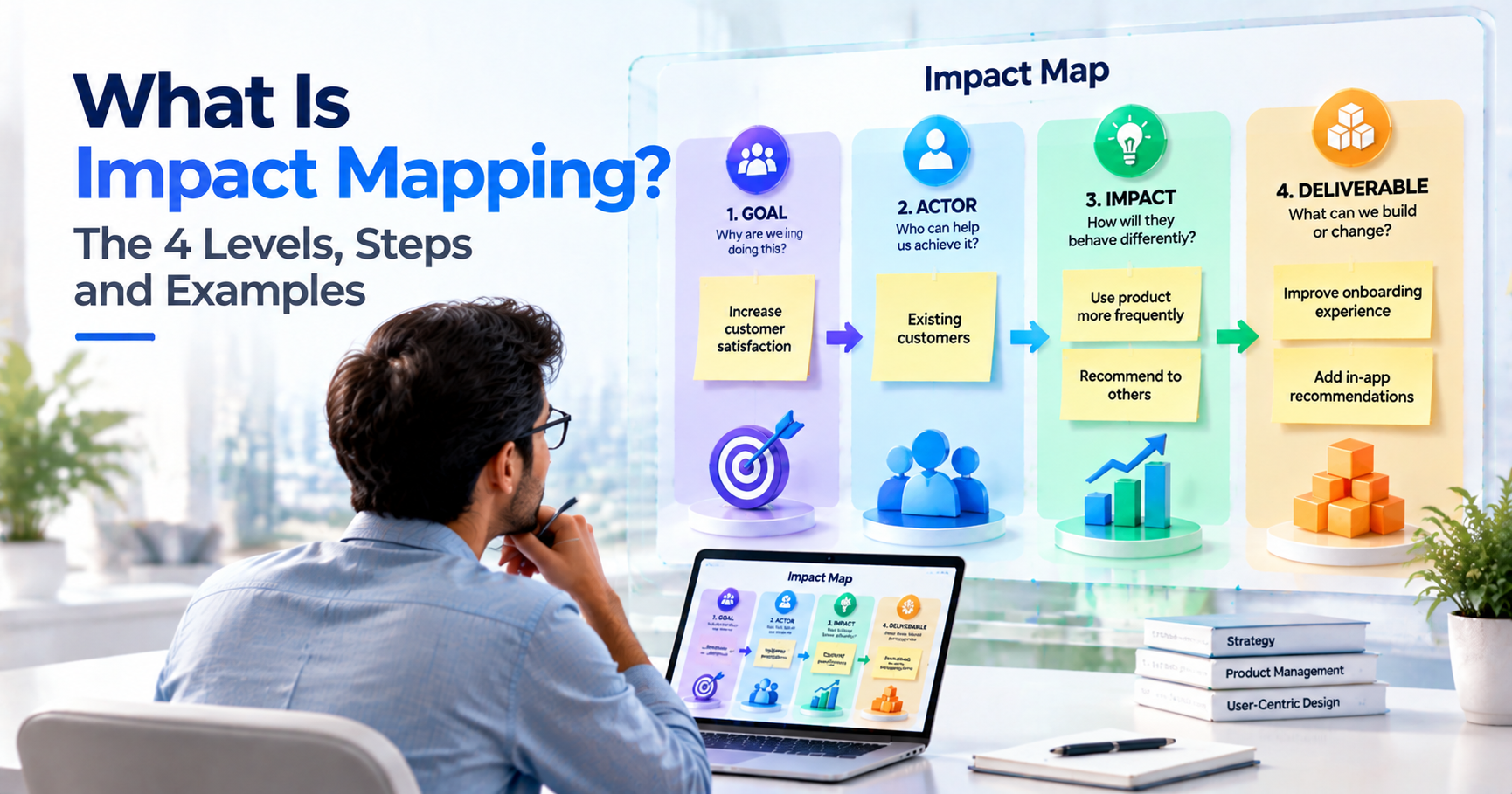
Impact mapping is a visual and collaborative planning technique that connects four things:
- Why: The goal you want to achieve
- Who: The people or groups that can affect the goal
- How: The behavior or impact you want from them
- What: The deliverables that may help create that impact
The structure creates a clear connection between a business goal and the work a team may deliver.
This is important because a feature can be delivered successfully but still fail to create the expected business result.
An impact map makes the assumptions behind the work visible. It also gives the team something to discuss when priorities change.
Where It Came From (Gojko Adzic)
Impact mapping is strongly associated with software development expert and author Gojko Adzic. His 2012 book describes impact mapping as a visual planning method for connecting business goals with software delivery.
The approach is based around four simple questions: Why, Who, How, and What.
The simplicity is one of the main reasons the impact mapping framework can be used by people across product, business, design, and engineering teams.
Why Impact Mapping Matters
A common problem in product development is focusing too much on output.
A team may say:
"We need a mobile app."
"We need a new dashboard."
"We need more user stories."
"We need this feature before the next release."
But these statements do not explain the result the team wants.
Impact mapping brings the focus back to outcomes. It helps teams connect deliverables to a goal and the behavior that is expected to support that goal.
It can also help with:
- Product prioritization
- Backlog discussions
- Product discovery
- Product strategy
- Roadmap planning
- Scope discussions
- Stakeholder alignment
- Testing assumptions
For teams working onProduct roadmap planning, an impact map can provide the reasoning behind potential roadmap items.
The Four Levels of an Impact Map
The impact mapping framework has four main levels. Each one answers a different question.
Why: The Goal
The first level is “Why”.
This is the business goal the team wants to achieve. It should be clear enough that the team can tell whether progress has been made.
For example:
Goal: Increase repeat purchases by 15% within six months.
This is more useful than:
Goal: Improve the shopping experience.
The second statement is too broad. The first gives the team something it can measure.
The goal should not simply be a feature. "Build a loyalty app" is not a goal. It is a possible deliverable.
Starting with the goal is one of the most important impact mapping steps because it gives the rest of the map a clear direction.
Who: The Actors
The second level asks “Who”.
Actors are the people or groups that can influence the goal.
Depending on the product, actors could include:
- Existing customers
- New customers
- Sales teams
- Support teams
- Partners
- Administrators
- Internal users
Try to be specific. "Users" can be too broad because different user groups may behave differently.
For the repeat purchase example, actors could include:
- Existing customers
- Customers who have not purchased in six months
- Customer support teams
The point is to understand who needs to do something differently for the goal to move.
How: The Impacts
The third level asks “How”.
This is about the behavior you want to change.
For example, if the actor is an existing customer, the desired impact could be:
- Buy from the store more often
- Return to the website regularly
- Use personalized offers
- Complete another purchase within 30 days
These are impacts, not features.
This distinction matters in impact mapping. A "loyalty dashboard" is a deliverable. "Customers return more often" is an impact.
The impact describes what needs to change in the real world.
What: The Deliverables
The final level asks “What”.
Now the team can discuss possible solutions.
For example:
- Loyalty points feature
- Personalized offers
- Reminder emails
- Mobile notifications
- Customer rewards page
These are possible deliverables.
They should not automatically become commitments. Impact mapping allows teams to consider different ways to reach the same impact.
This makes the impact mapping technique useful when a team has several possible solutions and needs to understand which ones are connected to the goal.
How to Create an Impact Map Step by Step?
If you are wondering how to create an impact map, start with a simple workshop involving the people who understand the business goal, customers, and delivery work.
Step 1: Define a Measurable Goal
Write down one clear goal.
Ask:
- What are we trying to achieve?
- How will we know that we achieved it?
- When should we see the result?
Avoid starting with a feature.
A goal such as "increase trial-to-paid conversion from 10% to 15% in three months" gives the team a much clearer starting point. If your organization already uses objectives and key results, this guide onOKR vs KPI shows how a goal like this can sit alongside them.
Step 2: Identify the Actors
Next, list the people who can influence the goal.
Think about customers, employees, partners, and other groups that can affect the result.
Do not assume that every user matters in the same way. Different actors may need different changes in behavior.
Step 3: Agree on the Impacts You Want
For each actor, ask what needs to change.
Think about actions rather than software.
For example:
Actor: Trial users
Impact: Start using the product regularly during the first week.
This gives the team a behavior to focus on.
Step 4: Choose the Deliverables
Only after discussing the goal, actors, and impacts should the team consider solutions.
This is where features, content, campaigns, process changes, or other deliverables can be added.
A useful impact mapping process does not assume that every deliverable will be built. The team can compare different options and test assumptions before making a large commitment.
These four impact mapping steps can be repeated as the team gets new information.
Impact Mapping Example
Here is a simple impact mapping example for an online learning platform.
Why:
Increase course completion from 50% to 65% over six months.
Who:
Learners who have enrolled in a course.
How:
Learners complete lessons more regularly and return to the course each week.
What:
- Progress reminders
- Weekly learning goals
- Course progress dashboard
- Resume-learning option
- Completion notifications
The important point is that the team does not start with the dashboard.
The dashboard is only one possible answer to the larger problem.
If research shows that learners already know their progress but struggle to find time for lessons, the team may choose a different solution.
This is where product discovery becomes useful. Research and customer feedback can help the team check whether the expected impact is realistic before spending too much time building a solution.
You can read more aboutProduct discovery to understand how research can support product decisions.
The same impact mapping example can also show why a roadmap item should be questioned. If a proposed feature does not connect to an actor, an impact, and the main goal, the team has a reason to discuss whether it belongs.
Impact Mapping Template and Tools
An impact mapping template does not need to be complicated.
A simple format can look like this:
Why: Goal
What business result do we want?
Who: Actors
Who can influence the result?
How: Impacts
What behavior needs to change?
What: Deliverables
What could we provide to support that change?
You can create this on a whiteboard, paper, presentation slide, or digital workspace.
An impact mapping tool can be useful when several people need to work on the same map. The important thing is not the software itself. The value comes from the discussion and the connection between the four levels.
A good impact mapping template should make it easy to see the full path from the goal to the proposed work.
You can also keep the map simple. Adding too many details can make it harder to see the main idea.
Impact Mapping vs Story Mapping vs Opportunity Solution Tree
All of these approaches can seem similar in that they all help product teams frame ideas and decisions.
Impact mapping starts with a goal and links it to actors, impacts, and deliverables.
Story mappingis more about the user journey, including the activities and stories that make it up.
Opportunity Solution Treelinks desired outcomes to opportunities, possible solutions, and experiments.
So impact mapping vs story mapping is not really about choosing one method for every situation.
A team may use impact mapping to understand why a piece of work matters and story mapping to understand what the user needs to do across a product experience. Agile Release Planning training covers how story mapping turns that work into multi-sprint releases.
This also means that impact mapping can work with product discovery and roadmap planning, not in place of them.
Using Impact Mapping in Agile and SAFe
Impact mapping in Agile can help teams connect backlog work to a larger outcome.
Agile teams often work in short cycles and adjust their plans based on feedback. An impact map can support this way of working because the team can revisit its assumptions when new information appears.
Linking Deliverables to Outcomes and the Backlog
The map can help Product Owners and Product Managers discuss why a backlog item exists.
For example:
- Goal
- Actor
- Impact
- Feature
If the feature can’t be related to the goal, the team can question whether it is needed at all. This helps with backlog refinement and prioritization. MoSCoW prioritization is a simple way to sort the items that survive this check
It can also help Product Owners communicate with stakeholders. Instead of saying a feature is important, they can talk about the business result and expected behavior change behind it.
SAFe POPM Certification Trainingcovers product ownership and product management activities, including backlog prioritization, product objectives, and alignment with business strategy for professionals in scaled Agile environments.
Also, you can see SAFe POPM roles and responsibilitieswhen considering the responsibilities involved with product ownership and product management.
Avoiding the Feature Factory
A feature factory is a situation where a team keeps producing features without enough focus on whether those features create meaningful results.
Impact mapping can help challenge this pattern.
Before adding another item to the backlog, ask:
What goal does this support?
Then ask:
Who needs to behave differently?
And:
What impact are we expecting?
This does not mean every feature is bad. It means the team has a clear reason for building it.
The approach can also help make a product roadmap more outcome-focused. Instead of treating the roadmap as only a list of features and dates, teams can connect planned work to the results they want to create.ICAgile Product Management (ICP-PDM) training explores how product managers decide which products and features are worth building.
For more context on roadmap planning, seeProduct roadmap.
Common Impact Mapping Mistakes
Starting With Features
One of the biggest mistakes is putting features at the center of the discussion.
Start with the goal instead.
Using Vague Goals
"Improve the product" is difficult to measure.
A clear goal gives the team something it can track.
Treating Impacts as Features
An impact is about a behavior change.
A feature is something the team delivers.
Keep these two ideas separate.
Adding Too Many Actors
Do not add every possible stakeholder just to make the map bigger.
Focus on people who can actually influence the goal.
Assuming Every Deliverable Must Be Built
An impact map is not a final delivery list.
The deliverables are possible ways to create the desired impact. New evidence may show that another solution is better.
Forgetting to Revisit the Map
An impact map should change when assumptions change.
Customer research, product data, experiments, and delivery feedback can all provide new information.
That makes impact mapping useful beyond the first planning meeting.
Conclusion
Impact mapping gives product teams a simple way to connect goals with real work.
The four levels are easy to remember: Why, Who, How, and What.
Start with the business goal. Identify the actors who can influence it. Decide what behavior needs to change. Then consider the deliverables that could support that change.
It can clarify product strategy discussions and help teams build a better connection between product discovery, backlog decisions, and the product road map.
It also provides teams with an easy way to challenge their assumptions before they spend time and money on a solution.
Whether you use a basic impact mapping template, an impact mapping tool, or a simple board, the main idea stays the same: do not start with what you want to build. Start with the result you want to create.









 Lowest-Price Challenge











 Personalized Path


.webp)


 USA
USA  Canada
 India
India UK
UK Australia
 Singapore


