


 Call Us




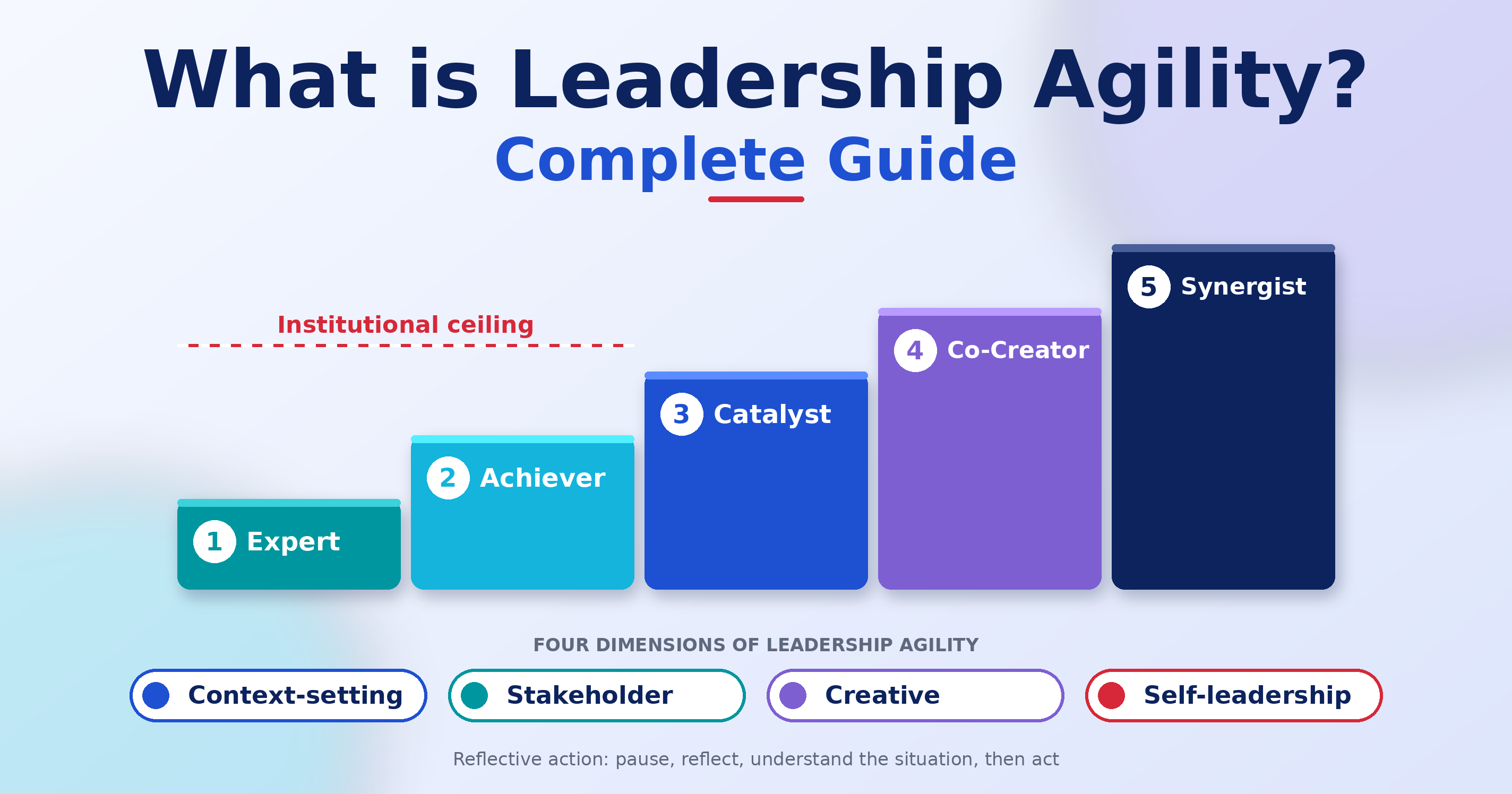
Leadership agility is the ability to pause, reflect, and understand a changing situation, and take the appropriate action. Leadership agility helps leaders move beyond habitual responses, stakeholder alignment, complex problem solving, and navigating team members through the unknown.
The framework consists of four behavioral dimensions and five levels of development. The dimensions help leaders understand their approach and the level at which they can effectively lead and drive change.
Key Highlights: What is Leadership Agility?
- Leadership agility is based on reflective action. This means stepping back and gaining perspective, and responding with intention.
- The four dimensions of leadership agility are context-setting, stakeholder, creative and self leadership.
- The five levels of leadership are: expert, achiever, catalyst, co-creator and synergist.
- Expert-level leaders have deep functional knowledge and understanding. Achiever-level leaders are more concerned with results and less on how things are done.
- Catalyst-level leaders can manage cultural change and deal with complexity and ambiguity, better. Leadership agility is different from agile leadership in that it can be applied to any field, not just the Agile and technology field.
- The key to leadership agility is to develop emotional intelligence, receive 360 feedback, practice mindfulness, reflective practice and coaching.
Introduction:
Leadership is less about identifying solutions to known problems and more about identifying a path to achieve outcomes in complexity. This is largely due to constant changes in the world, including evolving customer preferences and requirements, technological disruptions, shifting environment, and uncertainty in the market.
This is where leadership agility comes in. It allows a leader to take a step back and effectively interpret ambiguous situations in order to determine the most appropriate course of action.
This guide covers the Leadership Agility framework developed by Bill Joiner and Stephen Josephs. It explains the framework’s behavioral dimensions, developmental levels, and methods for assessing it. Further, it provides examples of activities and strategies to enhance agility at work.
What is leadership agility?
Leadership agility allows leaders to gain a deeper and broader understanding of contexts they operate in and make thoughtful and mindful decisions based on that.
Leadership agility encourages leaders to interpret the context in which they operate and break from established mental models that constrain their thinking. Instead of deliberating on how to achieve a goal, leadership agility encourages leaders to break from the status quo and question what goals should be pursued in the first place.
What Are the Four Dimensions of Leadership Agility?
Reflective action is a cycle made up of steps. The steps are:
- Identify the current situation.
- Leave behind habitual ways of thinking.
- Revise and expand your definition of the current situation.
- Take appropriate actions based on your revision.
- Analyze your actions and plan for the future.Agile teams build this same habit into the Sprint Retrospective.
An agile project manager will recognize a project is past its due date. Rather than pushing the project team to work longer hours to make up the time (a reactive approach), the manager should take steps to evaluate the situational constraints on the project team.
What Are the Four Dimensions of Leadership Agility?
The four dimensions of leadership agility are context-setting, stakeholder, creative, and self-leadership.
1. Context-Setting Leadership Agility
Context-setting leadership agility focuses on change rather than status quo. Leaders with this agility create strategies rather than simply adjusting the way they handle day-to-day business activities.
A leader who focuses on the right activities may have the everyday team activities aim to expand the business’s target market, for instance.
From the big picture perspective, the leader explains why the business should make the change and describes what the change will look like if it is successful.Context-setting agility pairs naturally with a structured change management process.
Listening to stakeholders and being open to learning implies recognizing and acknowledging the interests of various stakeholder groups, identifying commonalities and possible areas of agreement.
A stakeholder-agile leader understands there is always a reason for a stakeholder’s behavior and position, and therefore always legitimate interests that are worth exploring. Resistance should not be perceived as irrational. Therefore, identifying stakeholder concerns and interests should be of primary importance to a stakeholder-agile leader.
2. Creative Agility
Creative agility is thinking and acting in different ways to shape new solutions when existing ways of thinking and acting prove ineffective. The use of rapid feedback to inform thinking and steer actions plays an important role in this capability. This is also known as ‘creative leadership’.
For example, when a leader notices a decline in customer retention, they may use creative leadership and initiate a series of new interventions based on their understanding of the customer journey, rather than immediately offering bigger discounts.
3. Self-leadership Agility
When a leader demonstrates willingness to seek feedback and reflect on their behavior and habits, in order to address limitations, they enhance self-leadership agility. This is also imperative, as limits on a leader’s agility may restrict the agility of the team.
For example, a leader may self-reflect and recognize they have a propensity to become defensive towards feedback, as a result of which they may adopt new behaviors. This may facilitate the improvement of how the leader engages with their team.
How These Four Types Work Together?
Each dimension of the framework is meant to be integrated. As an example, imagine a leader who is able to set a strong strategic direction. What happens if this leader does not develop stakeholder alignment? Additionally, imagine a leader who is able to positively influence stakeholders. Will that be sufficient if the leader does not reflect on and modify his or her behaviors?
Let’s look at the example of a company that is introducing a new operating model.
- What does context-setting agility look like? Here, the leader or change agent posits the rationale for the need for change and defines what success will look like.
- In this case, stakeholder agility looks like building understanding and support for the change across the leadership and the team.
- Creative agility looks like identifying and solving implementation challenges.
- Lastly, self-leadership agility looks like reflecting on and modifying his or her behaviors based on feedback in order to meet the needs of the change.
What Are the Levels of Leadership Agility?
The framework also describes leadership agility using a developmental approach, and identifies it at the following levels: Expert, Achiever, Catalyst, Co-Creator, and Synergist.
Of the five levels, Expert, Achiever and Catalyst levels are the most relevant for our purposes.
1. Expert level leadership
Being at the Expert level of leadership means primarily relying on technical and functional skills, as well as, his or her position and title to effect change. People at this level of leadership are great at defining and solving problems, especially in predictable situations.
Some common habits of Expert level leaders include: “Here’s what we need to do to solve X; let me show you.”
This level of leadership is effective in solving problems where the inputs, machinery and tools of the change are clearly defined.
2. Achiever Leadership
Leaders like this appreciate the contributions of all employees and have an eye for detail. As such, they have an ability to meld different elements such as expertise, goals, and outcomes. They tend to ask, “How can I inspire my team to achieve outcome (x)?” Achiever leaders are good at garnering support and commitment for a specific cause, but may not always be great at dealing with complicated situations and organizing systems.
3. Catalyst Leadership
Leaders like this understand the relationship between a company’s “human system” and “business system” and how both impact organizational success. They are adept at understanding employees’ collective perspectives, meaning and purpose and fostering positive relationships. These leaders tend to be good at developing their employees’ relational and collaborative skills, and are champion change agents.
Catalysts are comfortable with uncertainty and are skilled at meaningful conversation. They are able to simultaneously comprehend several different points of view and promote productive dialogue to help resolve complex issues and challenges.
4. Co-Creator Leadership
Co-Creator leaders foster and deepen our collective sense of purpose and contribute to the development and refinement of collaborative leadership.
They are able to move beyond traditional notions of leadership as an individual endeavor and are more adept at and comfortable with leadership which they view as collective.
They work more effectively and are comfortable operating in larger and more varied systems.
5. Synergist Leadership
At the highest level, Synergist leadership, leaders are adept and at ease integrating and responding appropriately to the most diverse and confusing situations, and helping others do the same. They are comfortable with ambiguity and are able to effect change.
How Leaders Progress Through the Levels?
Leadership development is not just about adding skills to your resume. It’s about developing the ways in which you make sense of yourself and others and organizational systems. It’s about leading at increasingly more complex levels.
When a leader starts to improve their management of tasks and/or communication, they are typically moving toward becoming a more effective Catalyst. Yet, to move beyond Achiever, they also need to address their deeply held assumptions about what it means to lead and achieve.
Personal reflection is at the core of this transformative developmental journey. ChangeWise describes this journey as a constant cycle of determining objectives, planning, acting, and reflecting on one’s experiences.
What Percentage of Leaders Are at Each Level?
Distributions vary from one ChangeWise publication to another. In one source, it was estimated that managers are approximately 45% Expert, 35% Achiever, 5% Catalyst, 4% Co-Creator, and 1% Synergist, with the rest at earlier levels of development.
Another ChangeWise publication suggested that approximately 55% of managers are at the Expert level, 35% at Achiever, and 10% at Catalyst.
The focus of this research is not on the exact percentages. The focus is on the fact that the capacity to lead complex and transformative organizational change is relatively less, and many organizations have what Peter Senge calls, “an institutional ceiling” around Expert and Achiever levels.
How Do Leaders Behave at Different Levels?
| Leadership level | Pivotal conversations | Leading teams | Leading organizational change |
| Expert | Gives advice, solves the immediate issue, and relies on expertise or authority. | Directs work and monitors execution. | Focuses on implementing defined tasks and solving operational problems. |
| Achiever | Seeks agreement on goals, roles, and actions. | Sets targets, delegates, and drives accountability. | Uses plans, milestones, and performance measures to deliver results. |
| Catalyst | Explores assumptions, emotions, and competing perspectives. | Builds trust, shared ownership, and collective learning. | Addresses culture, relationships, and system-wide patterns that shape change. |
| Co-Creator | Builds dialogue around shared purpose and mutual learning. | Encourages leadership across boundaries and networks. | Engages diverse stakeholders in shaping the future together. |
| Synergist | Responds with deep presence and adapts to what the moment needs. | Enables highly integrated collaboration in uncertain conditions. | Works fluidly with interdependent systems and emerging opportunities. |
How Does Leadership Agility Change With Organizational Complexity?
1. Expert: Stable, Low-Complexity Environments
Expert leadership suits situations where work is consistent, where technical skills are paramount, and where cause-and-effect relationships are clear.
For instance, an experienced operations manager may rapidly detect and remedy a production issue that occurs repeatedly. In such a case, quick expertise is extremely valuable.
2. Achiever: Moderate Complexity and Episodic Change
Achiever leadership is useful when a leader is required to coordinate a larger number of employees, functions, and/or priorities.
A major Initiative (e.g. a transformational campaign, product launch, or enhancement of a department) usually requires coordination by a leader who creates and implements a plan, assigns responsibility, and monitors progress.This is classic project leader territory: plans, milestones and accountability.
3. Catalyst and Beyond: Rapid Change, High Complexity
Catalyst level leadership is necessary when planners cannot fully control outcomes due to lack of agreement among the stakeholders and/or ambiguity with the nature of the problems.
Mergers, transformational changes of a culture, digitizing a business, or changing a business strategy to a new market require inordinate levels of change to systems, relationships and mindsets.
In these types of environments, planners must enable and sustain learning through a series of rapid changes. This is true of systems, relationships and mindsets. This is particularly true when a large number of employees must be constantly engaged, aligned and supportive of these rapid changes.
How Is Leadership Agility Different From Other Leadership Concepts?
1. Leadership Agility and Leadership Styles
There are various ways of leading, including autocratic, democratic, servant leadership principles, and situational styles.
Leadership agility is a broader concept. It is the flexibility to choose different behaviors to suit different situations rather than rely on one style.
A servant leader is supportive and accessible to his/her team. Agile leadership encompasses the ability to set direction, challenge, and facilitate, as well as, make a decision at the right time.
2. Leadership Agility vs. Emotional Intelligence
Emotional intelligence is having the understanding of emotions in one-self and others and being able to work with them.
It is essential for effective leadership and helps in becoming more flexible towards stakeholders and self. However, leadership agility is more expansive and includes other skills and abilities like strategic framing, systems thinking and creative problem solving.
3. Leadership Agility vs. Agile Leadership
Agile leadership is a style of management which embraces the Agile values and ways of working. In scaled environments, this often takes the form of Lean-Agile leadership.In scaled environments, this often takes the form of Lean-Agile leadership.It focuses on flexibility, collaboration, autonomy of employees, and distributed decision-making.
Leadership agility is a more expansive developmental framework, and can be adopted by leadership regardless if an organization adopts any of the agile frameworks (Scrum, Kanban, SAFe, etc.) Leadership agility helps individuals move beyond command and control, a shift that sits at the heart of Agile leadership principles.
Why Do Many Leaders Plateau as Expert or Achiever?
Many leaders are able to successfully lead teams because they are technically competent, dependable and focused on delivering results early on in their career. The organization typically rewards these strengths through promotions.
However, the same strengths that fuel early career success can become constraints in leadership as one is required to effectively collaborate and work with greater system thinking and adaptability with uncertainty.
The framework calls this an "institutional ceiling." Organizational structures based on assumptions of Expert and Achiever roles typically reward the same strengths in similar ways.
Common reasons why leadership plateaus include:
- Receiving promotions for their expertise rather than their capacity for leadership development.
- Not receiving constructive feedback on their leadership impact.
- Working in a culture that rewards certainty and control.
- Avoiding direct and difficult conversations.
- Focusing on skill development rather than behavior change.
- Not having time or means for self-reflection.
Deliberate practice is required for leaders to get beyond their plateau, and an environment in which leaders are supported to take risks to self-direct and be guided in learning from feedback and mistakes is critical for growth.
How Can You Assess Your Leadership Agility?
Self-Assessment Questions
You already know how to evaluate yourself, but a self-assessment can reveal a pattern you might be unaware of. Look over these questions and see if you can add anything:
- In the case of a high-stakes problem, do I take the solution-focused route and offer up the first solution I think of, or do I look for the bigger picture first?
- Do I take the time to consult my stakeholders and understand their requirements before coming to a conclusion?
- Am I able to identify an assumption that is limiting my approach?
- Do I request feedback on my behaviors, specifically from people who are not in agreement with me?
- When a plan fails do I look at the system and my part in that system, or do I look at the people who executed the plan?
- Am I allowing my team to do the same?
- The point of self-assessment is to locate your default leadership pattern. When does it work for you? When does it work against you?
360 Feedback and Formal Assessments
A 360-degree feedback process aims to get feedback from the people who experience your leadership directly. Typically, this means your manager, your peers, your direct reports, and other stakeholders.
The ChangeWise Leadership Agility 360 assessment evaluates leadership agility across the four types of agility and three action arenas: pivotal conversations, leading teams, and leading organizational change.
In general, self-perception is incomplete. A leader can believe they are collaborative for example, while others perceive them to be controlling or dismissive.
The most effective feedback processes are designed to turn feedback into behavior changes.
How Can You Develop Greater Leadership Agility?
Building Self-Awareness
Begin by reflecting on your automatic reactions to situations. Do you, for example, become more controlling? Avoid conflict? Focus only on how to execute the task? Withdraw and not have the difficult conversation?
After important leadership situations, keep a short reflection. Reflect on:
- What happened?
- What did I assume?
- How did I respond?
- What impact did my behavior have?
- What might I do differently next time?
- Self-awareness gives us the pause to make a different choice.
Practicing Reflective Action
Reflective action is about learning to lead yourself throughout your everyday work and not about once a year reviews and retreats.
Prepare for an important meeting by writing down your desired outcome, what you think the important stakeholders may be concerned with, and any assumptions you may be bringing into the meeting.
Post-meeting, consider what you learn? Was your understanding different?
And what will you do differently next time?
This simple repetitive cycle over time builds your contextual and self-leadership agility.
Coaching and Structured Development Paths
Leadership coaching can help individuals see the blind-spots they have. A coach can challenge your assumptions and support self-reflective practice and maintain accountability for the changes you want to make.
Other structured developmental programs can help facilitate the change as well.A good starting point is this free change management course, which covers how people respond to change. For example, programs may include using case studies, role play and peer feedback. ChangeWise teaches leadership agility as a developmental and learnable concept as opposed to being born with it.
For leaders working within Agile environments, learning leadership principles of Agile can facilitate change as well. Agile leadership is focused on empowering the team to identify and remove blockers to progress and continuous improvement, as opposed to using traditional command and control techniques.
Conclusion: Key Takeaways
One definition of leadership agility is the capacity to act and respond adequately when the environment is uncertain, complex, and changing. It’s built by “reflective action” or stepping back and widening your view and then acting with greater awareness.
The framework provides two helpful ways to look at things. The four dimensions describe how leaders act, including context-setting, stakeholder, creative, and self leadership agility. The five developmental levels look at the increasing complexity in how leaders make sense of themselves, others, and the organization.







 Lowest-Price Challenge












 Personalized Path



.webp)


 USA
 Canada
 India
 UK
 Australia
 Singapore


