


 Call Us




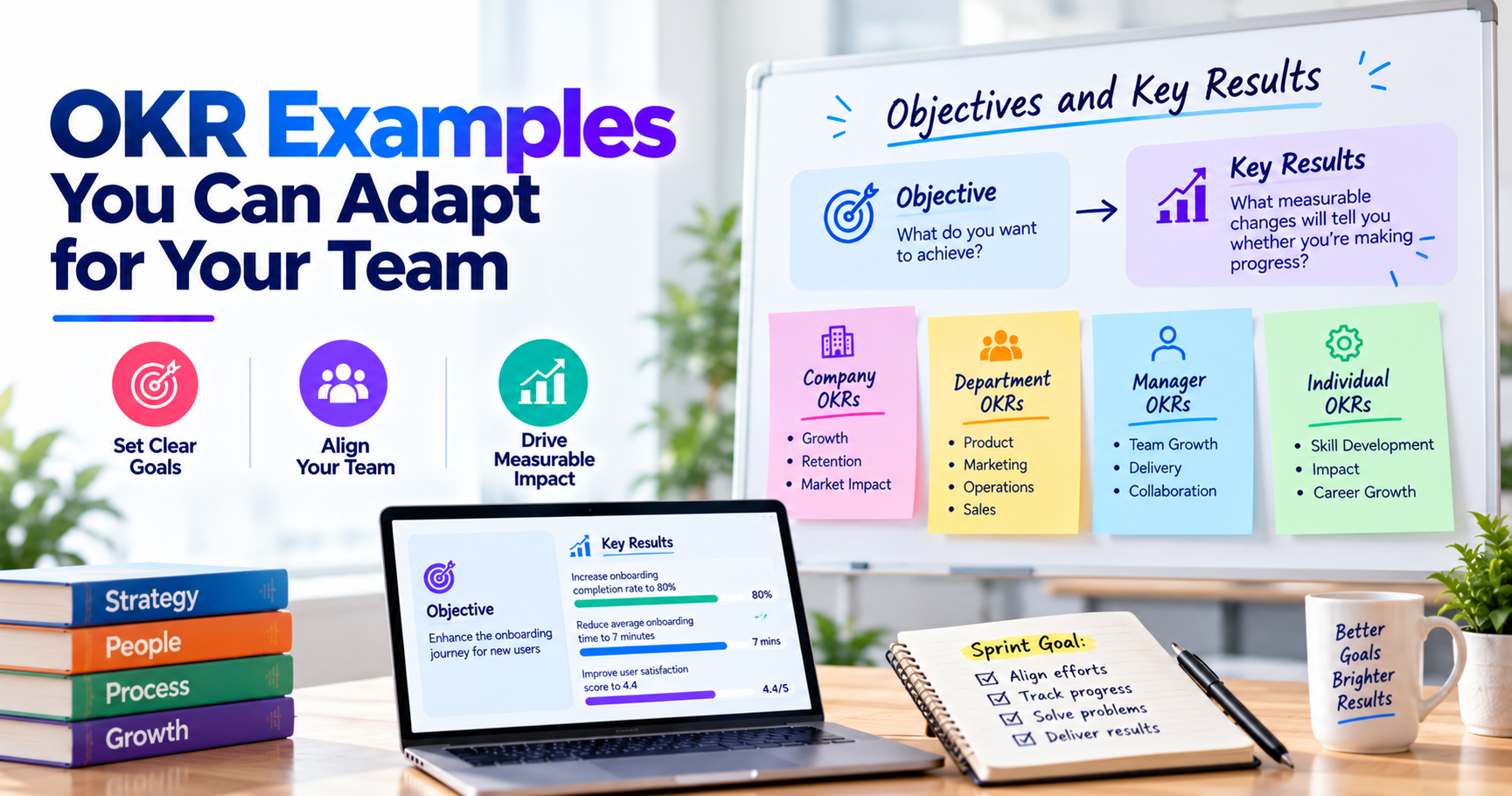
OKRs (Objectives and Key Results) help teams set clear goals and know whether or not the work they are doing is driving results. What the team is trying to do is the goal, and the key results are what progress looks like in real life.
For example, a product team could want to improve their onboarding experience, and they might want to make it easier for new users to begin using the product. We can measure progress by increasing the onboarding completion rate from 60% to 80% and reducing the average time to complete it from 12 minutes to 7 minutes.
The basic concept is straightforward: measure the impact your work has in terms of the difference it makes, not the number of boxes you tick off a list.
Looking for OKR examples for employees, managers, product teams, operations, and individual contributors? Here are some examples that can help you get started with specific, measurable, work-relevant goals.
Key Highlights of OKR Examples
- OKRs connect everyday work with larger business priorities, helping teams understand what deserves their attention.
- Objectives describe what you want to achieve, while key results measure progress toward that outcome.
- Most teams can start with two to four objectives per quarter to avoid spreading themselves too thin.
- Effective OKRs measure meaningful changes rather than simply counting completed tasks.
- OKR examples should be adapted to your team's responsibilities, resources, and current performance.
- Regular check-ins help teams identify problems early, learn from results, and adjust their approach when necessary.
Introduction
A team can work flat out for an entire quarter and still struggle to explain what changed as a result.
Projects get completed, meetings fill the calendar, and reports are submitted on time. But when someone asks what improved because of all that work, the answer isn't always clear.
Did customer satisfaction improve? Are more people using the product? Has the team found a more efficient way of working?
When you are busy doing things, it’s easy to forget what those things were supposed to be doing.
Objectives and Key Results, or OKRs, help teams shift the conversation from activity to impact. They help to get agreement on what is important, to define what success looks like and to see if the work is delivering the results we want.
It takes practice to write useful OKRs. “Improve team performance” is a good goal but too vague to guide everyday decisions. And just because a project is done doesn’t mean the problem is solved.
That’s where practical OKR examples come in handy. They show how broad goals can be turned into specific objectives and measurable key results that guide day-to-day decisions.
In this guide, you'll find 30 OKR examples for companies, departments, managers, and individual contributors. We'll also look at how to improve weak OKRs, write your own, and review progress during the quarter.
Use these examples as starting points, not targets to copy word for word. Good OKRs are based on the actual challenges, priorities, and capacity of your team.
What an OKR Looks Like
An OKR has two parts: an objective and its key results.
- Objective: What do you want to achieve?
- Key Results: What measurable changes will tell you whether you're making progress?
The objective gives the team a direction to work toward; the key results show whether it's getting there.
For example, let’s say a product team has identified a problem with its onboarding. People commit to the product, but a lot of them drop out before the initial setup.
The team might develop an OKR like:
Objective: Enhance the onboarding journey for new users of our product.
- Key Result 1: Boost onboarding completion rate from 60% to 80% by end of quarter.
- Key Result 2: Bring down the average onboarding time from 12 minutes to 7 minutes.
- Key Result 3: Boost new user satisfaction score from 3.6 to 4.4 (out of 5).
All the key results revolve around one thing about onboarding: completion, time, and user experience.
These measures give the team more visibility into whether the onboarding experience is improving.
As you can see, the OKR does not tell you how to solve it. The team could redesign the interface, simplify registration, or add a guided tutorial. These are possible initiatives; the key results measure whether the changes actually work.
That distinction matters. A team could launch a redesigned page on time and still find that users are abandoning the process at the same point.
Good OKRs make the intended outcome clear while leaving the team room to test different approaches.
If you're comparing goal-setting and performance measurement frameworks, this guide to OKR vs KPI explains how the two approaches differ.
Company-Level OKR Examples
Company-level OKRs establish a shared direction for the organization. They help departments understand which business priorities matter most and how their work contributes to them.
Here are three company-level examples you can tailor to your organization's goals and current challenges.
1. Improve Customer Retention
Objective: Give customers more reasons to stay with us.
- KR 1: Increase the customer retention rate from 78% to 88% by the end of the quarter.
- KR 2: Reduce customer-reported product issues by 25%.
- KR 3: Improve the customer satisfaction score from 4.0 to 4.5 out of 5.
Winning new customers matters, but growth is harder to sustain if existing customers keep leaving. The first step is understanding what's driving them away.
This OKR encourages the company to look at the experience customers have after signing up and identify where improvements could make a difference.
2. Lasting Growth Revenues
Objective: Create a more diversified and sustainable revenue stream.
- KR1. Grow quarterly recurring revenue by 15%.
- KR2: Raise the lead-to-customer conversion rate from 8% to 12%.
- KR3. Increase revenue from existing customers by 10%.
There are many ways to increase revenue. You can find new customers, convert a greater share of your qualified prospects, or help your current customers get more value from a product or service.
3. Improve Employee Engagement
Objective: Create a workplace where employees feel supported and have room to grow.
- KR 1: Improve the employee engagement score from 68% to 80%.
- KR 2: Increase the percentage of employees with documented development plans from 55% to 90%.
- KR 3: Reduce voluntary employee turnover from 14% to 10%.
Employee engagement is about more than team outings and survey scores. People also need supportive managers, room to develop, and a sense that they can grow in their careers.
Together, these measures help the organization see whether its efforts are making day-to-day work better for employees.
OKR Examples by Team
Every department has a different way of contributing to business success. Product teams are concerned with customer needs, sales teams with revenue, and HR teams with employees and organizational development.
These examples demonstrate how teams can link their daily work to outcomes that they can measure.
Product and Engineering
Product and engineering teams are balancing customer needs with technical quality and delivery deadlines. These OKR examples for product teams look at whether the product is getting more useful and reliable, rather than just counting released features.
4. Product Team: Improve Product Adoption
Objective: Help more users discover the value of our product.
- KR 1: Increase monthly active users from 20,000 to 26,000.
- KR 2: Make the new-user activation rate go from 45% to 65%.
- KR 3: Boost adoption of the core feature from 30% to 50% of active users.
A product can have several features but can still struggle to keep users engaged. This OKR helps the team see which features people value and makes them want to return back to the product.
5. Engineering Team: Improve Application Reliability
Objective: Make the product more dependable for customers.
- KR 1: Increase application uptime from 99.5% to 99.9%.
- KR2: 40% reduction in critical production incidents.
- KR3: Cut the common service restoration time from 90 minutes down to 45 minutes.
Technical improvements may not always be obvious to the customer, but they will certainly notice when an application crashes or is unavailable.
6. Engineeering Team: Increasing Development Efficiency
Objective: Help engineers make valuable changes with less delay and rework.
- KR1. Cut average lead time for changes from five days to three.
- KR2: Decrease change failure rate from 15% to 8%.
- KR3. Improve automated test run success to 95%.
Going faster is good, but only if you don’t sacrifice quality. When they track speed using delivery metrics such as lead time and cycle time, the team can improve their workflow with failures and test results without creating new problems. Lead time for changes and change failure rate are two of the DORA metrics.
Sales & Marketing
Sales and marketing are important for business growth, but each has a separate role. Marketing generates and nurtures prospects. Sales turns opportunities into customers. So, their OKRs should reflect those traits.
7. Sales Team: Convert More Qualified Leads into Customers
Objective: Turn more potential sales prospects into paying customers.
- KR1: Boost qualified-lead-to-customer conversion rate from 12% to 18%.
- KR2. Cut average sales cycle from 45 days to 35 days.
- KR3. Increase new customer revenue growth by 20% quarterly.
More calls doesn’t mean more sales. Conversion rates and sales-cycle length can show where prospects are dropping off and where the process needs attention.
8. Marketing Team: Enhanced Lead Generation
Objective: Bring in prospects who have better chances of becoming customers.
- KR1. Increase marketing leads from 500 to 700 per month.
- KR2: Increase MQL to SQL conversion from 25% to 35%.
- KR3. Reduce Customer Acquisition Cost by 15%
A campaign can generate hundreds of leads and still not reach the people who are most likely to buy. If few leads convert, the team may need to look at what its targeting, messaging, or conversion process is.
9. Content Marketing: Make Organic Performance Better
Objective: Make content a stronger source of qualified traffic and leads.
- KR1. Grow organic site sessions 30% during the quarter.
- KR2: Grow content-generated organic leads from 100 to 150 per month.
- KR3: Improve conversion rate of key landing pages from 2% to 3.5%.
Publishing consistently is part of the job for a content team. Content also needs to reach the right audience, answer real questions, and help readers take the next step.
By looking at traffic on top of leads and conversions, the team can see if its content is helping with business goals.
HR and L&D
HR and Learning and Development teams influence employee experience, retention, and professional growth. Their OKRs should help answer a practical question: Are our initiatives making work better for employees and helping the organization build the capabilities it needs? HR teams applying agile goal-setting can explore Agile for HR.
10. HR Team: Improve Employee Retention
Objective: Make the workplace a place where employees want to grow and stay.
- KR 1: Reduce voluntary employee turnover from 16% to 11%.
- KR 2: Increase favorable responses to manager-support questions from 65% to 80%.
- KR 3: Increase the percentage of employees completing meaningful quarterly development conversations from 60% to 90%.
People leave organizations for different reasons. Manager support, career opportunities, recognition, and workload can all influence their decision.
Together, these key results help HR examine the employee experience and identify areas where changes may have the greatest impact.
11. L&D Team: Help Employees Use What They Learn
Objective: Build the skills employees need to confidently execute in their roles.
- KR1: Increase proficiency assessment scores 20% in three priority skills.
- KR2: Increase the percentage of trained employees using new skills on the job from 40% to 70%.
- KR3. Reduce skill-related performance gaps by 25% in two priority departments.
You can get good feedback on a training session, and it still can have very little impact on someone’s work. The L&D team can see how effective the training is by tracking how people are developing skills and using them on the job.
.
12. Recruitment Team: Make Hiring More Effective
Objective: Help the organization find and hire the right people without unnecessary delays.
- KR1: Reduce median time-to-fill from 45 days to 32 days.
- KR2: Improve the rate from 3.8 to 4.4 of 5 for hiring manager satisfaction.
- KR3: Improve offer acceptance rate from 70% to 85%.
Speed of hire is important, but so is candidate experience and quality of hire. These key results balance all three.
Operations and Customer Success
Operations teams help keep processes running smoothly and customer success, and support teams help customers get value from a product or service. These OKR examples for operations look at removing avoidable delays and making everyday work more dependable.
13. Operations Team: Reducing Process Delays
Objective: Make important business processes faster and more predictable.
- KR1. Cut the average time to process an internal request, in-house, from four days to two days.
- KR2: 30% reduction in errors in completed transactions
- KR3. Improve operational task on-time completion rate from 82% to 95%.
A delayed approval can delay several people or projects. This OKR helps the team find bottlenecks and speed up the process while not losing accuracy.
14. Customer Success Team: Help Customers Get Started Faster
Objective: Help new customers experience the value of our product sooner.
- KR 1: Reduce average time-to-first-value from 21 days to 14 days.
- KR 2: Increase onboarding completion within 30 days from 70% to 90%.
- KR 3: Reduce onboarding-related support tickets by 25%.
Customers are more likely to get value from a product when they can start using it confidently. A smoother onboarding process can reduce confusion, answer common questions, and help customers reach their first meaningful result sooner. Mapping the customer journey helps pinpoint where new customers get stuck.
15. Customer Support: Resolve Problems Better
Objective: Help customers get useful answers without unnecessary waiting or continuous follow-ups.
- KR1. Cut median first-response time from six to two hours.
- KR2. Increase first contact resolution from 65% to 80%
- KR3. Improve customer satisfaction post support interaction from 82% to 90%.
A quick response is not enough if the customer problem is still not solved. Measures resolution and satisfaction with response time so the team can focus on support that actually solves problems.
Agile Delivery Teams and PMO
Agile delivery teams and Project Management Office (PMOs) often juggle competing priorities, tight deadlines, and dependencies across teams.
Their OKRs should be easy to track progress without compromising outcomes.
16. Agile Team: Make Delivery Predictability Better
Objective: Deliver more reliably, but with visible priorities.
- KR1. Percentage of planned outcomes achieved in sprints to go from 65% to 85%
- KR2: Decrease Unplanned Work Percentage to 15% of Total Team Capacity from 30%.
- KR3. Decrease unresolved cross-team dependencies older than two weeks by 50%.
Even the best teams can lose momentum if priorities keep changing or another team doesn’t deliver what they need on time. This OKR helps to better plan, better communicate & take action on dependencies sooner.
Sprint goals can be used by teams to set a common purpose for each sprint. Sprint goals guide immediate work, while OKRs connect that work to broader business priorities.
17. PMO: Better Project Results
Objective: To help strategic projects realize the value they were meant to create.
- KR1: Increase the proportion of strategic projects achieving agreed outcome targets from 60% to 85%.
- KR2: Reduce unresolved high-priority project risks over 30 days old by 50%.
- KR3. Improve stakeholder satisfaction through project visibility and reporting (3.5 to 4.3 out of 5).
A project can be on time and on budget and still not deliver the value that stakeholders expected. These crucial findings prompt the PMO to move beyond milestones, a core part of project governance, and evaluate the true impact of the project.
18. Agile Leadership: Strengthen Team Alignment
Objective: Help teams understand shared priorities and respond to changing needs.
- KR 1: Increase the percentage of team members who can identify their team's top three priorities from 60% to 90%.
- KR 2: Reduce the average time required to resolve priority conflicts from five days to two days.
- KR 3: Increase stakeholder agreement on quarterly priorities from 70% to 90%.
When priorities aren't clear, people can end up pulling in different directions and decisions tend to drag. Leaders can help by spelling out what matters, making space for honest conversations, and resolving clashes early.
This is one reason agile OKRs can be valuable. They give teams a shared direction without requiring them to stick rigidly to a plan when circumstances change.
OKR Examples for Managers and Individuals
OKRs don’t have to be departmental. They can be used by managers and individual contributors to set clear expectations, build skills, and connect their work to the goals of the team.
These OKR examples for employees and individuals must be aligned with the person's role and responsibilities. You can't blame people for outcomes that they don't really control.
19. Manager: Enhance Team Performance
Objective: To help the team in achieving better results without taking upon excessive workloads.
- KR1: Improve team engagement from 72% to 82%.
- KR2: 30% reduction in the number of priority tasks carried over from one reporting period to the next.
- KR3: Ensure that at least 90% of team members have clear quarterly priorities and development goals.
20. Project Manager: Improve Project Execution
Objective: Make project delivery more predictable and transparent.
- KR 1: Increase milestone completion on schedule from 75% to 90%.
- KR 2: Reduce overdue high-priority actions by 40%.
- KR 3: Improve stakeholder satisfaction with project communication from 3.7 to 4.4 out of 5.For more measures, see these project management KPI examples.
21. Individual Contributor: Manage Time More Effectively
Objective: Make more room for focused, high-impact work.
- KR 1: Increase the percentage of weekly priorities completed on time from 70% to 90%.
- KR 2: Reduce avoidable task switching during focus periods by 30%.
- KR 3: Complete at least 90% of committed deadlines over the quarter.
22. Individual Contributor: Build Professional Skills
Objective: To develop skills that will increase the level of responsibility at work.
- KR1. Increase the assessment scores of a priority professional skill from 70% to 90%.
- KR2. Do 3 real-world projects to prove new skills.
- KR3.4. Out of a 5-point scale, the reviewer's average relevant feedback of at least 4.
23. Content Writer: Improve Content Performance
Objective: Create content that attracts the right audience and grows the business.
- KR1: Increase organic traffic to assigned content pages by 25%.
- KR2: Increase the conversion rate of priority articles from 2% to 3%
- KR3. Increase qualified content leads per month from 20 to 30
24. Individual Contributor: Make cross-functional teamwork better.
Objective: Make working with other teams easier and more productive.
- KR1: Decrease cross-functional approval turnaround time by 25% on average.
- KR2: Increase stakeholder satisfaction with shared deliverables from 3.6 to 4.3 on a 5 point scale.
- KR3: Achieve 90% of documented project dependencies on committed due dates.
25. Team Leader: Make Coaching and Feedback Better
Objective: Create a work environment where people receive useful feedback and have the space to grow.
- KR1. Increase the percent of employees that receive one-on-one feedback conversations monthly from 60% to 95%.
- KR2: Increase employee ratings of feedback usefulness from 3.5 to 4.3 out of 5.
- KR3. Increase the percentage of agreed development actions completed each quarter from 50% to 80%.Useful feedback depends on psychological safety.
26. Individual Contributor: Enhance Client Communication
Objective: To improve clarity, helpfulness, and responsiveness of customer communication.
- KR1. Reduce follow-up requests due to ambiguous communication by 30%.
- KR2: Attain 90%+ customer communication satisfaction score.
- KR3: Meet 90% of assigned customer requests within the agreed service level.
27. Individual Contributor: Develop Strategic Thinking
Objective: To enable better informed choices to drive team and business priorities.
- KR1: To produce and present three data-driven recommendations in the quarter.
- KR2: Test/implement at least two recommendations
- KR3: Track and log the results of each recommendation you implement.
28. Employee: Improve Work Quality
Objective: Deliver consistently high-quality work that meets team and stakeholder expectations.
- KR 1: Reduce rework caused by avoidable errors by 25%.
- KR 2: Achieve a quality review score of at least 90% across assigned deliverables.
- KR 3: Complete 95% of agreed deliverables by their deadlines.
This example can help employees focus on the quality and reliability of their contributions, rather than simply counting completed tasks.
29. Operations Analyst: Improve Process Visibility
Objective: Give teams clearer information to make operational decisions.
- KR 1: Reduce the time required to prepare the monthly operations report from five days to two days.
- KR 2: Improve the accuracy of key operational data to at least 98%.
- KR 3: Ensure 90% of recurring operational reports are delivered by the agreed deadline.
For an operations analyst, better reporting is valuable when it helps others make informed decisions. These key results balance efficiency, accuracy, and reliability.
30. New Manager: Build a Stronger Team Foundation
Objective: Establish the clarity and support the team needs to work effectively together.
- KR 1: Ensure 100% of team members have documented quarterly priorities.
- KR 2: Complete monthly one-to-one conversations with at least 90% of direct reports.
- KR 3: Improve the team's clarity-of-expectations score from 65% to 85%.
This OKR can be used by new managers to focus on practical foundations: clear expectations, regular communication, and a better understanding of what the team needs to succeed.
These OKR examples for employees and individuals are not ready-made goals, just starting points. A junior in a role may be trying to master a critical skill, while a more senior colleague may be trying to take ownership of complex projects or shape strategic choices.
Pick a significant goal for your role and then identify the evidence that will show you are making progress.
Fixing Weak OKRs: Before and After Rewrites
Sometimes an OKR sounds good until you try to measure it. Phrases such as “improve performance” or “be more productive” describe worthwhile ambitions, but they don't tell a team what success should look like.
The table below shows three common weak OKRs and how to rewrite them to focus on measurable outcomes.
| Example | Before: Weak OKR | After: Improved OKR |
| Website Launch | Objective: Launch a new website. Key Results: Finalize the design, publish all web pages, and complete website testing. | Objective: Make the website a more effective channel for customer acquisition. Key Results: Improve qualified website leads by 25%; improve conversion rate of priority landing pages from 2% to 3%; improve bounce rate on key service pages by 15% . |
| Sales Productivity | Objective: Improve sales productivity. Key Results: 100 sales calls/week; send more emails to prospects; attend all sales meetings | Objective: Improve the efficiency of the sales pipeline. Key Results: Increase each sales rep’s qualified opportunities generated by 20%; increase the opportunity-to-customer conversion rate from 15% to 22%; decrease the median sales cycle by 10%. . |
| Professional Development | Objective: Improve my professional skills Key Results: Read more books, attend workshops, learn a new tool . | Objective: Acquire skills to be able to independently manage more complex projects. Key Results: Complete two practical projects using the target skill; achieve a proficiency assessment score of at least 85%; receive a reviewer rating of at least 4 out of 5 on the quality of completed work . |
How to Write Your Own OKRs in 5 Steps
You don't need a complicated planning exercise to write useful OKRs. Start with a real priority, decide how you'll measure progress, and be prepared to adjust if the approach isn't working.
Step 1: Decide What Matters Most
Start by asking what would make the biggest difference to your team over the next quarter.
Maybe customers are leaving because onboarding is confusing. Maybe projects keep getting delayed because teams depend on one another. Or your organization might need to build skills that are currently missing.
Choose a priority that addresses a real problem or opportunity. If everything becomes an objective, nothing gets the attention it deserves.
Step 2: Write an Objective People Can Understand
Your objective should explain the change you want to create.
Instead of writing "Improve customer service metrics," try "Make it easier for customers to get their problems resolved."
The second version gives people a clearer idea of what they're working toward without telling them exactly how they must do it.
Step 3: Choose Two to Four Measurable Key Results
Now decide what evidence would show that you're making progress.
Where possible, include a starting point, a target, and a deadline.
For example, if customer satisfaction currently stands at 65%, the team might aim to increase it to 85% by the end of the quarter.
It's also worth looking at more than one measure. Customer satisfaction, resolution time, and repeat support requests together can tell you more than any single metric.
Step 4: Decide What Work Could Help You Get There
Once the objective and key results are clear, identify the initiatives that could help move the numbers.
For a customer onboarding objective, these might include simplifying the setup process, creating short tutorials, or introducing guided onboarding calls.
Assign owners and agree on next steps. Just remember that these initiatives are the work you plan to do, while the key results measure what that work is meant to achieve.
Step 5: Check Alignment and Review Progress
Before finalizing your OKRs, discuss them with relevant stakeholders.
Make sure the objectives support wider business priorities, the targets are realistic, and the team has the resources to make progress.
Then decide how often you'll review the results and what you'll do when priorities change.
If you're looking to build your understanding of goal-setting in Agile environments, the Agile OKRs microcredential can help you explore how OKRs support alignment, measurement, and continuous improvement.
Tracking and Reviewing OKRs Each Quarter
Writing your OKRs is only the first step. Their real value comes from using them to guide decisions throughout the quarter.
Without regular reviews, even a well-written OKR can end up forgotten in a planning document.
Here's how to keep yours useful.
Begin With a Baseline
Before the quarter begins, record where each key result stands.
If you want to improve customer retention, establish the current retention rate. If you're trying to reduce delivery delays, find out how long the process currently takes.
A baseline gives you something concrete to work toward and helps you avoid setting targets based on guesswork.
Check Progress Regularly
Weekly or biweekly check-ins give teams a chance to discuss what's working and where they're getting stuck.
Use these conversations to review progress, identify blockers, discuss dependencies, and agree on any changes needed.
These check-ins aren't about defending every number. They're a chance to understand what's behind the results and agree on the next move.
Score Your Key Results Consistently
Many OKR systems use a score between 0 and 1, where 0 means no progress and 1 means the target has been achieved.
For a straightforward numerical target, you can calculate progress by comparing the improvement achieved with the improvement required.
Suppose your team wants to increase monthly active users from 20,000 to 26,000 but reaches 24,800 by the end of the quarter.
- Starting value: 20,000 users.
- Target value: 26,000 users.
- Actual value: 24,800 users.
- Target improvement: 6,000 users.
- Actual improvement: 4,800 users.
- Progress toward the target: 80%.
The calculation is based on the proportion of the intended improvement achieved, rather than the actual user count divided by the target user count.
This method works for a straightforward increase metric. Other key results may need different scoring methods, particularly when lower values are better or success depends on meeting a specific threshold.
Look Back and Learn
At the end of the quarter, don't stop at the final score.
Ask what worked, what didn't, and what the team would do differently next time. Were the targets realistic? Did the chosen metrics reflect the right outcomes? Were there obstacles that could have been addressed earlier?
The answers should shape your next planning cycle.
Falling short of an ambitious target doesn't automatically mean the quarter was a failure. The useful question is why it happened and what the team can learn before setting its next goals.
Conclusion
OKRs allow teams to turn priorities into measurable outcomes. They clarify what people are working toward, why it matters, and how they’ll know they’re making progress.
This guide contains 30 OKR examples across different teams, job roles, and business objectives. Use these as inspiration, then adapt the targets to your team’s baseline, responsibilities, and resources.
Your first OKRs don’t need to be perfect. Set a meaningful goal, choose a few useful key results, and review progress regularly. Over time, the process becomes less about filling in a template and more about making better decisions.
If you’re looking to build your understanding of goal-setting in Agile environments, the Agile OKRs microcredential can help you explore how OKRs support alignment, measurement, and continuous improvement.
Anukriti Soy
Anukriti Soy holds a Master’s degree in English from Mount Carmel College and is a content writer specialising in project management, Scrum, and Agile frameworks. She has experience creating technical articles, course content, reports, internal blogs, and social media content, with a versatile writing style that adapts to diverse topics and audiences.
Author Image : Anukriti Soy.jpg









 Lowest-Price Challenge












 Personalized Path



.webp)


 USA
 Canada
 India
 UK
 Australia
 Singapore


