


 Call Us



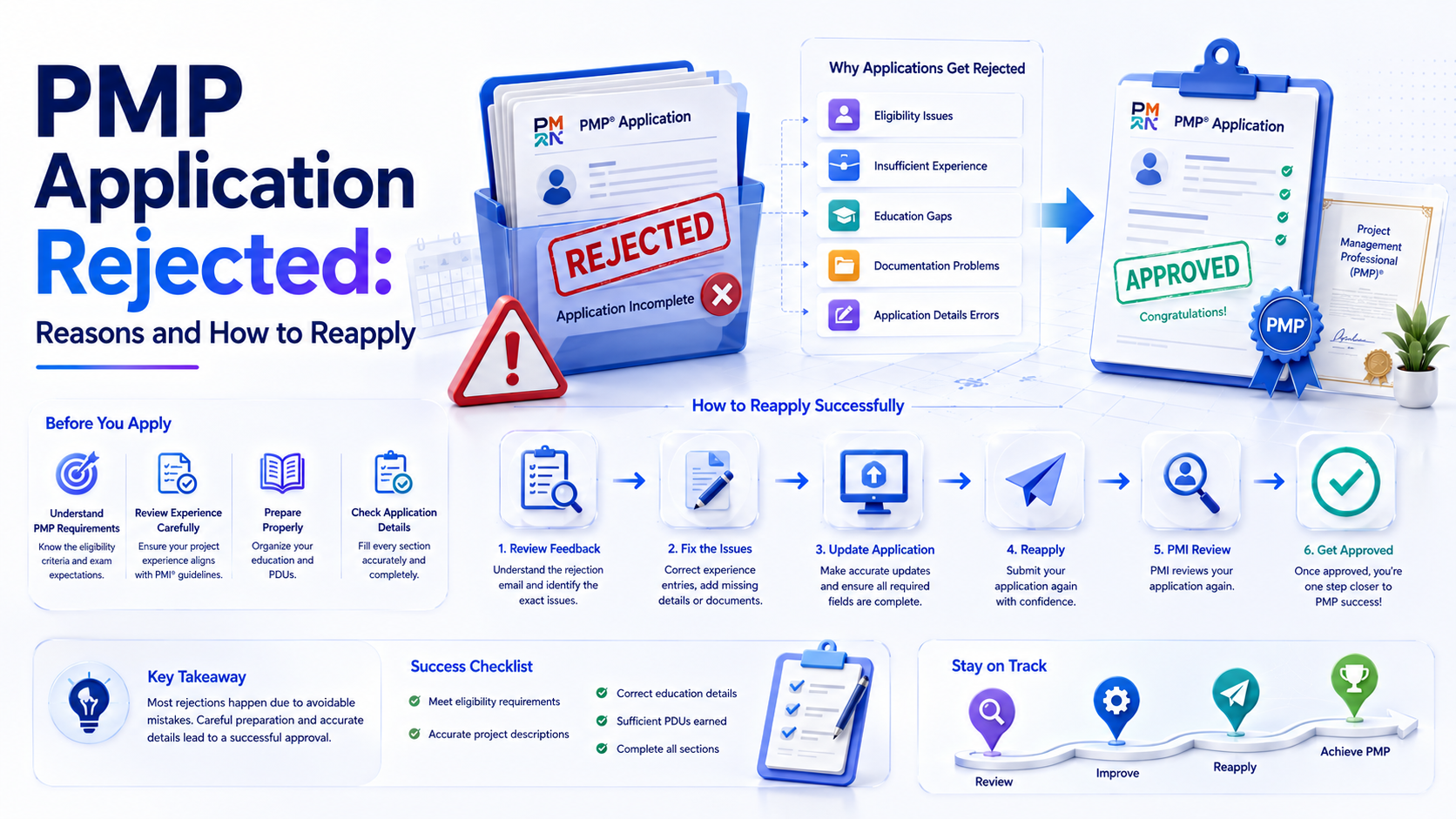
Was your PMP application rejected? Wondering why and what you should do now? If PMI rejects your application, begin by reading the decision email carefully and identifying the specific issue mentioned in the feedback. Common rejection issues include unclear project descriptions, experience that appears operational rather than project-based, insufficient explanation of your role in leading and directing project work, overlapping experience, or information that is difficult to verify.
Do not immediately create an entirely new application. First, compare the feedback with the project experience you submitted. Correct inaccurate dates, clarify your actual responsibilities, remove non-qualifying work, and make sure each project description accurately explains your role and contributions.
A rejected application is different from an unsuccessful PMP audit. PMI's current certification handbook demonstrates that candidates who do not fulfill audit requirements or choose not to comply with an audit can face a one-year suspension before reapplying.
If you need to reapply, use your original application as a diagnostic tool. Keep information that remains accurate, correct the sections that caused concern, and ensure your new submission clearly and honestly reflects your actual project experience and responsibilities.
Key Highlights of PMP Application Rejected
- A PMP application rejection notice does not mean you have failed the PMP exam.
- PMI evaluates whether your application demonstrates qualifying professional project management experience and meets the current eligibility requirements.
- Your job title does not have to be “Project Manager.” PMI's current guidance focuses on whether you actually led and directed project work.
- Do not present operational duties, routine administration, personal projects, academic projects, and other non-qualifying activities as PMP project experience.
- Overlapping projects should not be counted twice when calculating qualifying experience months.
- A failed audit is different from an ordinary application rejection and can result in a one-year suspension.
- Strong applications describe the candidate's actual role and responsibilities, rather than simply describing the project.
- Reapplying successfully means addressing the reason for the original decision rather than copying another applicant's experience description.
- Candidates should never exaggerate responsibilities or change facts merely to make an application appear stronger.
Introduction
You have spent time documenting your project experience, checking your eligibility, and putting together your PMP application. Then, instead of moving forward, you receive a rejection from PMI. Naturally, questions may come to mind:
- Why was my PMP application rejected?
- What did I get wrong?
- Do I have to start the application process all over again?
A PMP application rejection does not mean you can never take the PMP exam. PMI reviews your application before you can move on to the examination. So, the information you provide needs to show that your experience meets the certification requirements. Here, your project descriptions matter because they show PMI what projects you worked on, what you were responsible for, and how you contributed.
It is not necessary to have a “Project Manager” designation to sit for the PMP exam. PMI's current guidance focuses on whether your experience demonstrates that you led and directed project work. At the same time, routine operational work should not be presented as project experience merely to meet the application requirements. So, if your PMP application is rejected, adding more impressive-sounding project management terms is not the solution. Instead, try to:
- Analyze PMI's feedback deeply,
- Check whether your dates and project details are accurate,
- Make sure your descriptions clearly reflect the work you actually performed.
In this guide, we will break down the most common PMP application rejection reasons, explain what PMI's feedback can mean, share PMP application experience description examples, and walk through how to reapply after rejection. You will also learn what to check before submitting your application again, including issues that can arise during a PMP audit.
Why PMP Applications Get Rejected by PMI
A PMP application can be rejected when the information submitted does not clearly demonstrate that your experience meets PMI's requirements. PMI's updated guidance focuses on professional experience where you lead and direct project work. The project work should also be temporary, carried out in a unique context, and intended to create value. Routine operational or administrative activities should not be presented as project experience.
This creates an important point: having years of work experience does not automatically mean you have qualifying project management experience.
For example, imagine you have worked in software support for eight years. You may have gained valuable professional experience during that time, but that does not mean all eight years count as project management experience. However, if you led a specific system implementation, coordinated a migration project, worked with stakeholders, and managed delivery activities, that project may provide relevant experience if it meets PMI's requirements.
You may also come across articles that mention unclear leadership, operational work, weak project descriptions, or overlapping experience as common reasons for application problems. However, PMI does not publish an official “top eight rejection reasons” list. The eight issues discussed below are therefore common application problems to watch for, rather than an official PMI ranking.
PMP Application Rejected vs Returned vs Audit Failed: Which One Did You Get?
Before you start rewriting your application, first make sure you know what actually happened. A PMP application rejection, a request for additional information, and a failed audit are not the same thing, so the next step can be different in each situation.
| Situation | What it generally means | What you should do |
| Application is not approved | PMI did not approve the submitted application based on its review | Read the feedback and determine which information needs correction or clarification |
| Application returned/request for clarification | PMI needs additional or corrected information, depending on the communication you received | Follow the instructions in the PMI communication |
| Selected for audit | PMI has selected the application for verification | Prepare the requested documentation within the stated deadline |
| Audit failed | PMI could not verify the application, or the candidate did not comply with the audit | Follow PMI's instructions before attempting another application |
| Application approved | Eligibility requirements have been accepted | Proceed with the next certification steps |
PMI's current handbook says that applications selected for audit require supporting documentation such as education records, experience verification, and training documentation. Candidates have 90 days to submit the requested audit package. PMI states that an audit normally takes about five to seven business days after the necessary information has been received.
A failed audit has a separate consequence. PMI states that if a candidate does not fulfil the audit requirements or chooses not to comply, the audit is failed and a one-year suspension applies before the candidate can reapply. So, if your email says that the application itself was not approved, do not automatically assume that the one-year audit suspension applies.
What Happens Inside PMI's Application Review Process?
When PMI reviews a candidate’s application, it focuses on whether the information provided supports the candidate’s eligibility for the PMP certification. Its current application guidance asks candidates to provide details about their work, roles and responsibilities, project duration, and project management experience. PMI also advises applicants to focus on their roles and responsibilities, rather than explaining what the project was about. This distinction is very important. The reviewer needs to understand not just what the project was, but also what the candidate actually did on that project.
Here’s how the same project description can look different from a reviewer’s perspective:
| Description Type | Experience Descriptions | What the reviewer can understand |
| Project-Focused Description | “The project involved implementing a new CRM system for the sales department.” | This explains what the project was about but gives little information about the applicant's involvement. |
| Role-Focused Description | “I coordinated stakeholder requirements, managed the implementation schedule, tracked project risks, facilitated issue resolution, and coordinated the transition to the new CRM system.” | This provides a clearer picture of the applicant's responsibilities and involvement in the project. |
For a detailed explanation of PMP eligibility and application requirements, see thePMP certification requirements.
How to Read Your PMP Rejection Email From PMI
Received a PMP application rejection? Don’t focus only on the final line saying, “your application was not approved”. Before you start rewriting your application, go back to the feedback in the email and read it carefully. Pay attention to what PMI says is missing, unclear, or difficult to verify, because it will help you understand what you need to address before you apply again. For example, feedback may include:
- Your role or responsibilities were not clear enough.
- Your experience did not appear to meet the definition of a project.
- Your description did not clearly demonstrate your involvement in the work.
- The experience could not be verified.
- The information provided did not establish that you met an eligibility requirement.
Let’s understand the feedback first, because the right fix depends on the issue PMI identified. Once you know what PMI flagged, you can work out what needs to be corrected or clarified:
| PMI Feedback | What it means | What you can improve |
| Roles or responsibilities are not sufficiently clear. | Your description may not show what you personally handled. | Rewrite the description around your actual responsibilities and contributions. |
| Experience does not appear to meet the project definition. | The work may sound like routine, ongoing, or operational activity. | Review whether the work was a temporary project with a defined objective and outcome. |
| Your involvement is not clearly demonstrated. | The description may explain the project but not what you personally did. | Add factual details about your responsibilities, decisions, and contributions. |
| Experience could not be verified. | Some dates, contacts, or supporting information may be unclear or inconsistent. | Check your project dates, contact details, and other verification information carefully. |
| Eligibility requirement is not established. | The information provided may not clearly demonstrate that you meet a specific requirement. | Review the relevant eligibility requirement and provide accurate information that supports your eligibility. |
The goal is not to make your application sound more impressive. It is to make your actual project experience easier to understand and verify.
“Insufficient Detail Regarding Your Role”: What PMI Is Looking For
Insufficient detail does not necessarily mean your project experience is invalid. Sometimes the problem is simply that the application does not communicate your contribution clearly enough. For instance,
Statement 1: “I worked with the team to implement an ERP system.”
Statement 2: “I coordinated requirements with finance, procurement, and IT stakeholders, maintained the implementation schedule, tracked risks and issues, coordinated testing activities, and supported stakeholders' readiness for the ERP rollout”
The first statement does not explain what the applicant actually did. However, the second one gives the reviewer a clearer picture of the candidate’s responsibilities. It does not claim that the applicant personally performed every activity, but rather it remains grounded in the person’s actual contributions.
“Experience Does Not Meet the Definition of a Project”: What It Means
PMI defines a project as temporary work, done in a unique context, built to create value. Routine operational or administrative tasks don't fit that definition, no matter how demanding they were.
This is genuinely tricky for experienced professionals, because most jobs blend operational work with project work. Look at the difference:
Operations: "Managed daily application support and resolved customer tickets."
Project: "Led the migration of the customer support platform to a new system, coordinating requirements, migration activities, testing, stakeholder communication, and transition to the new operating environment."
The second statement (Project) has a clear start, a clear finish, and a clear result.
“Unable to Verify You Led and Directed”: What to Change
PMI's language here is specific: "led and directed." But that doesn't require a formal project manager title. PMI's current guidance points out that candidates with titles like project coordinator, program analyst, operations lead, implementation manager, or team lead can still qualify, as long as their actual work shows real project leadership.
So, elaborate your responsibilities instead of inflating your job title. If you,
- Coordinated several stakeholders? Say exactly what you coordinated.
- Controlled project risks? Explain how, in specific terms.
- Managed schedules, resources, scope, or communication? Describe those actions directly.
- Supported another project manager? Keep it honest and don't rewrite yourself as the lead.
8 Common Reasons for PMP Application Rejection
These eight issues are not an official PMI ranking, but they cover most of the PMP application mistakes candidates actually run into.
Reason 1: Operational Work Described Instead of Project Work
Treating operational work or routine work as project experience is probably the single most common PMP application mistake. The “operational work” runs continuously, but the “project work” has a defined start and end. Let’s see the distinction,
Operational work: "Managed daily production incidents and monitored system performance."
Project work: "Led a six-month infrastructure migration, coordinating technical teams, migration schedules, risk responses, stakeholder communications, and cutover activities."
Here, the second statement, “project work,” gives a reviewer real project context.
Before you log an experience entry, try to ask yourself:
- Did this work have a clear beginning and end?
- Was there a distinct objective?
- Did it produce a unique outcome or value?
- Did I lead or direct the work myself?
- Can I actually explain what I personally did?
If you answer "no" to most of these, reconsider whether it belongs in your application at all.
Reason 2: No Evidence of Leading and Directing the Project
It is another frequent problem: describing participation instead of leadership. Let’s see the distinction,
Statement 1: "I assisted the project manager with stakeholder meetings."
Statement 2: "I coordinated stakeholder meetings, consolidated requirements, tracked decisions, and escalated unresolved issues to maintain alignment across business and technical teams."
The second statement shows real responsibility. But be careful: do not swap “assisted” for “led” unless you genuinely led that work. The goal should not be inserting stronger language; it’s to make the applicant’s real leadership visible.
Reason 3: Unclear Project Objectives in Your Description
A good reviewer should understand your project's purpose instantly. For instance,
Statement 1: "Worked on a digital transformation initiative"
Statement 2: "The project aimed to replace the company's legacy customer portal with a cloud-based platform to improve customer access, reduce manual processing, and support new digital services."
In the above two statements, the first statement does not explain much. But the second statement gives context for everything that follows. A strong description usually follows this shape:
Objective → Your role → Key actions → Outcome
Reason 4: Experience Not Mapped Clearly to Project Management Work
Some candidates list technical tasks without showing any project management angle. For example:
Statement 1: "Configured servers, created APIs, performed testing and fixed defects."
Statement 2: "I coordinated technical dependencies, maintained delivery milestones, managed risks and issues, facilitated stakeholder decisions, and coordinated testing activities across the implementation team."
Whatever is mentioned in Statement 1, those are real, valuable activities. But they do not prove project management experience. Whereas, in Statement 2, technical work is demonstrated in a storytelling way. Therefore, as per PMI’s guidance, focus on what you led, how you contributed, and what value it created.
Reason 5: Overlapping Project Dates Inflating Your Experience
Overlapping projects need extra care. PMI counts experience in months, and it never counts overlapping months twice. Here's a simple example:
Project A: January–June
Project B: April–September
You can not just add six months and six months to claim twelve. The April–June overlap only counts once.
So before you submit, build a timeline. List:
- Project name
- Start date
- End date
- Your role
- Whether it overlaps another entry
Reason 6: Too Many Small Projects Without Clear Project Outcomes
More projects do not automatically make a stronger application. List too many small, near-identical entries, and reviewers can lose track of what you actually led. Focus instead on the projects that genuinely show project management skill. For each one, spell out:
- The objective
- The project period
- Your role
- Your major responsibilities
- The stakeholders or teams involved
- Key decisions or coordination work
- The outcome
Reason 7: Language and Clarity Problems Make the Experience Difficult to Verify
The application doesn't need to sound academic. For instance,
Statement 1: "Spearheaded synergistic cross-functional optimisation of strategic operational paradigms to facilitate transformative enterprise enablement."
Statement 2: "I coordinated the finance, IT, and operations teams to implement the new reporting system and managed requirements, risks, testing, and stakeholder communication."
Avoid sentences like Statement 1, and write instead Statement 2. Because it is instantly clearer, use company-specific acronyms sparingly.
Reason 8: Supervisor or Contact Details Cannot Be Verified
If PMI selects your application for audit, your experience details need to hold up. PMI's handbook notes that audit documentation can include signatures from supervisors or managers tied to your reported experience. So before you submit, ask whether the people linked to your experience entries can realistically verify it. This gets tricky if:
- Your former manager has changed companies
- Your organisation was acquired
- The project sponsor left the company
- Your company runs a matrix reporting structure
- You worked through a consulting or contracting arrangement
How PMI Reviewers Assess Your PMP Application
Here's a simple test: could someone who wasn't involved in your project understand exactly what you did? PMI's guidance says candidates should document their role, their responsibilities, and their project management experience in plain terms.
The 30-Second Scan Test Your Project Description Should Pass
This isn't an official PMI test; think of it as an editorial gut check. Read one project description quickly. Within 30 seconds, can you identify:
- What the project was
- Why it happened
- When it happened
- What you personally did
- How you led or directed the work
- What the project actually delivered
If you can't, you have to rework the descriptions. For a better understanding, see the distinction,
Statement 1: "Worked on an application modernization initiative and coordinated with multiple teams to ensure successful delivery." A reviewer still has no idea what you coordinated.
Statement 2: "I coordinated requirements between business and engineering teams, maintained the delivery schedule, tracked risks and dependencies, facilitated issue resolution, and coordinated user acceptance testing before the application was released." Now the contribution is obvious.
Here, understand the difference: Statement 1 is hard to evaluate, while Statement 2 is clearer and easy to evaluate.
PMP Application Experience Description Examples: Rejected vs Stronger Versions
Some illustrative examples are listed below. They are not real PMI decisions, and do not copy them for your application.
Example 1: An IT Delivery Project
Rejected version: "I worked on a mobile application development project. I coordinated with developers and testers and helped deliver the application."
Why it's weak: It says almost nothing about your actual authority or responsibilities.
Stronger version: "I coordinated requirements between business stakeholders, developers, and testers for the mobile application project. I maintained the delivery schedule, tracked risks and dependencies, facilitated requirement reviews, coordinated testing activities, and communicated progress and issues to stakeholders. I supported resolution of scope and delivery issues and coordinated the transition of the completed application to the business."
Why it’s stronger: This version explains real contribution, without claiming work that wasn't actually yours.
Example 2: A Process Improvement Project
Version 1: "I worked on improving the company's invoice approval process and helped the team reduce delays."
Why it's weak: A reviewer reading that has no idea what the project's objective was or what this person actually owned. It could describe almost anyone on the finance team.
Version 2: "I led a process improvement initiative to reduce delays in invoice approval. I gathered requirements from finance and procurement stakeholders, analysed the existing workflow, coordinated the redesign activities, tracked implementation risks, and facilitated user validation. After implementation, I coordinated the transition to the revised workflow and monitored the agreed performance measures."
Why it’s stronger: The rewrite has a clear start and end. It reads like a project, not an ongoing job function.
Example 3: An Infrastructure Project
Version 1: "I was responsible for infrastructure activities during a data centre migration."
Why it's weak: This is a weak version as it does not separate technical tasks from the project leadership.
Version 2: "I coordinated infrastructure activities for the data centre migration, including schedule dependencies, resource coordination, risk tracking, and stakeholder communication. I facilitated migration planning with infrastructure and application teams, coordinated readiness reviews, tracked issues during the migration window, and supported the transition to the new environment."
Why it’s stronger: This version demonstrates the responsibilities in a transparent way.
For more guidance, browsePMP application examples.
The PMP Project Description Formula for a Stronger Application
Here is a structure that works: Objective → Role → Actions → Outcome
Objective: Why did the project exist? "The project aimed to migrate the organisation's customer database to a cloud platform."
Role: Where did you fit in? "I coordinated the project delivery activities between business, infrastructure, and application teams."
Actions: What did you actually do? "I managed requirements, coordinated the schedule, tracked risks and dependencies, facilitated stakeholder reviews, and coordinated testing."
Outcome: What did the project deliver? "The migration was completed, and the business transitioned to the new platform with the agreed data and application functionality."
How to Reapply for PMP After Rejection
Got a "PMP application not approved" message? Treat your original application like a diagnostic report, not a failure. Here's how to reapply for PMP after rejection, step by step:
- Save the PMI communication. Keep the original email and every piece of feedback.
- Identify the exact issue. Was it about eligibility, experience, project definition, leadership, dates, verification, or documentation?
- Recheck your project history. Pull up your employment records, project files, and personal notes. Confirm your dates, project names, and contacts.
- Separate projects from operations. Cut entries that are really just routine admin or ongoing operations.
- Rewrite unclear descriptions. Focus on your real responsibilities, not a full rewrite of your career.
- Recheck overlapping months. Make sure no period gets counted twice.
- Verify your contacts. Confirm the people tied to your experience can actually verify it if PMI asks.
What to Change and What to Leave Untouched
You do not need to rewrite everything.
Change:
- Unclear descriptions
- Inaccurate or incomplete dates
- Ambiguous responsibilities
- Operational entries that shouldn't be there
- Anything that doesn't clearly establish your project role
- Incorrect contact details
Leave unchanged:
- Accurate facts
- Genuine project dates
- Official job titles
- Responsibilities you truly performed
- Outcomes you can support with evidence
The simple rule is you have to improve the explanation, not the facts.
How Long Does PMI Take to Review a Resubmitted Application?
Do not assume every resubmission follows the same timeline. PMI's documentation gives a specific window for audits: 90 days to submit the requested documentation, and roughly five to seven business days for PMI to complete the review once it has everything.
Score Your PMP Application Before You Resubmit
Before you hit submit again, run a structured review.
12-Point Pre-Submission Self-Audit
Check whether you are getting “yes” for the following:
- Does every project have a clear objective?
- Is each project genuinely temporary?
- Are the project dates accurate?
- Have you checked for overlapping months?
- Does each entry explain your real role?
- Does it show leadership or direction where it applies?
- Have you separated operational duties from project work?
- Are your responsibilities specific, not vague?
- Are your project outcomes explained?
- Are your supervisor and contact details accurate?
- Could your experience survive an audit?
- Have you checked the current PMI eligibility requirements?
A low score does not guarantee rejection. Think of this as a quality check, not an official PMI scoring system.
How to Fix High-Risk Issues Before Submitting
Fix the issues that hit eligibility or credibility first.
- High priority: Inaccurate experience, overlapping months, non-qualifying work, wrong education details, unverifiable experience, unclear leadership.
- Medium priority: Vague objectives, too much technical detail, unclear outcomes, undefined terms.
- Low priority: Small stylistic tweaks.
Do not spend an hour polishing your word choice while an incorrect project date sits untouched.
What to Do If Your PMP Application or Audit Is Rejected
First, figure out which situation you are actually in. If your application was rejected, find the underlying problem and fix it before you resubmit. If PMI selected you for audit, prepare your documents carefully instead. PMI's audit guidance says you may need:
- Degree or diploma documentation
- Signatures from supervisors or managers who can verify your experience
- Certificates or letters verifying your project management education
You will get 90 days to submit that audit package. If you miss it, or choose not to comply, then PMI can give you a one-year suspension before you reapply.
If you are not sure why your application was rejected, contact PMI directly instead of guessing. You can also review the PMP audit process before you prepare anything.
How Many Times Can You Apply for PMP After Rejection?
There is an important line between an ordinary rejection and a failed audit. Don't assume a rejected application automatically triggers a one-year wait; it usually doesn't.
That one-year suspension only applies when a candidate fails to meet audit requirements, or chooses not to comply with one. If your application simply wasn't approved, follow PMI's instructions and confirm your specific situation directly with PMI if anything feels unclear.
Suspension Rules and When CAPM May Be a Better Alternative
PMI offers CAPM as an entry-level project management credential, and PMI's own guidance treats it as a solid alternative for professionals who aren't quite ready for PMP yet.
Your next move depends on your experience:
- Meet PMP eligibility but need to clarify your application? Improve the application itself.
- Genuinely don't have the required experience yet? Keep building it, and consider whether CAPM fits your current career stage better.
PMP Application Rejection Issues for Indian Applicants
Professionals dealing with a PMP application rejection in India often hit practical documentation and communication snags, especially inside large IT services firms, consultancies, or matrix structures.
These are not special PMI rules for Indian applicants. They are common workplace realities that make an otherwise solid application harder to document clearly.
Designation Inflation in Indian IT Services and How to Describe Your Actual Role
Job titles vary from company to company. You might be a Technical Lead, Module Lead, Delivery Lead, Associate Project Manager, Program Analyst, Consultant, Business Analyst, or Implementation Lead.
Here is the key point: your title alone does not establish PMP eligibility.
PMI's guidance is direct about this: you do not need the title "project manager." What matters is whether your actual work shows real leadership and direction.
So use your official designation honestly, and describe the responsibilities you actually carried. Do not rename "Technical Lead" to "Project Manager" just because it sounds better on paper.
Matrix Reporting: Who Should Be Listed as Your Supervisor?
Matrix organisations create a specific kind of confusion. The person you reported to administratively might not be the person who actually supervised your project work.
Stick to accurate information and follow PMI's instructions closely. If your project manager, functional manager, and reporting manager were three different people, keep a clear record of who can genuinely verify your experience. Do not pick the most senior name available, but rather pick the accurate one.
What to Do When Your Former Manager or Employer Has Moved On
This happens often in long careers, so before you submit, check:
- Are the contact's details still valid?
- Does your former organisation have a central HR or verification process?
- Is there another appropriate person who could verify the work?
- Do your own project records support the experience you're claiming?
Never fabricate contact information. If you are unsure what counts as an acceptable verification arrangement, ask PMI first, rather than guess.
How Simpliaxis Helps You Prepare a Strong PMP Application and Get Certified
Preparing a PMP application is a different challenge from preparing for the PMP exam itself. You need to understand the eligibility rules, pick the right project experience, document your responsibilities clearly, and stay ready for a possible audit.
Simpliaxis'PMP certification training can support you through that journey. Once your application pathway is clear, aPMP practice test can help you gauge your exam readiness.
Before you apply, it also helps to understand the fullPMP exam eligibility requirements and the broader process explained inhow to get PMP certification.
One thing worth remembering: training can prepare you, but it can't replace honest, accurate application documentation. Your application has to reflect what you actually did.
Conclusion
A PMP application rejection message stings. But it also hands you something useful: a clear map of what to fix.
Start by understanding why PMI didn't approve your application. Resist the urge to rewrite everything from scratch, or to copy someone else's "successful" example off the internet. Instead, go back through your own project history.
Separate real project work from routine operations. Check every date. Remove any overlapping months from your math. Explain what you actually did. Show real leadership where you genuinely led. Make sure everything can be verified. And above all, don't exaggerate.
PMI's guidance makes one thing clear: you don't need the title "project manager," but your experience does need to show genuine project leadership and direction.
If this is your first application, reading the requirements now can save you real time later. If you've already been rejected, treat PMI's feedback as your checklist for round two. You can also browse theFAQs on PMP certification for more on the certification pathway.






 Lowest-Price Challenge











 Personalized Path


.webp)


 USA
USA  Canada
  India
India  UK
UK  Australia
  Singapore


