


 Call Us



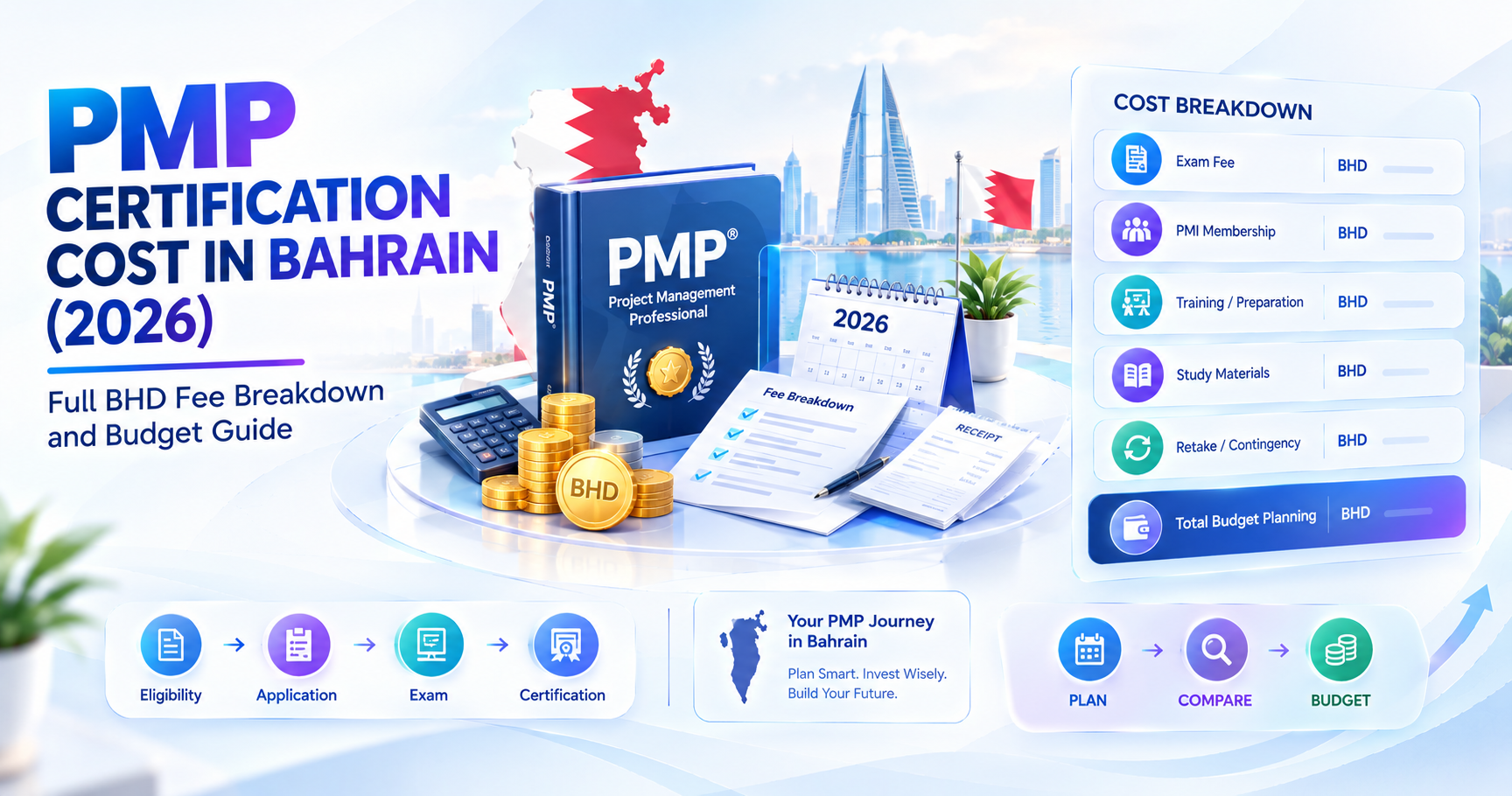
PMP certification in Bahrain typically costs between BHD 1,229 and BHD 2,129 (roughly USD 3,270 to USD 5,660) for a first-time PMI member candidate, once the PMI exam fee, PMI membership and a local instructor-led training course are all added together. The PMI exam fee itself is billed in USD everywhere in the world, so it converts to only about BHD 160 for PMI members, one of the smallest headline numbers in the GCC because the Bahraini Dinar is pegged at a very high fixed rate against the dollar. The bulk of the total spend in Bahrain comes from training, not from PMI's own fees, and in banking, finance and construction employers this training cost is frequently absorbed through corporate sponsorship rather than paid out of pocket.
Key Highlights of PMP Certification Cost in Bahrain
- PMI raised the PMP exam fee worldwide on 6 August 2026, from $405 to $425 for PMI members and from $555 to $675 for non-members, a change that applies to candidates in Bahrain exactly as it does everywhere else, because PMI bills in USD.
- Converted at Bahrain's fixed peg of 1 USD = 0.376 BHD, the new member exam fee is about BHD 160 and the non-member fee is about BHD 254, among the lowest local-currency figures in the GCC for the same exam.
- PMI individual membership costs $154 a year plus a one-time $10 application fee for new joiners (about BHD 62 in the first year), and it remains financially worthwhile for almost every Bahrain-based candidate because it cuts the exam fee by $250.
- Local PMP preparation courses in Bahrain are commonly priced between BHD 1,000 and BHD 1,900 (roughly USD 2,660 to USD 5,050), and this training line, not PMI's fees, is what actually drives most of the variation in total cost.
- Renewing a PMP credential costs $60 per three-year cycle for PMI members and $150 for non-members, on top of earning 60 PDUs, including a minimum of 35 Education PDUs, within that cycle.
- Bahrain's banking, financial services, government digital-transformation and construction sectors are the heaviest employers of PMP-certified project managers, and many of them fund some or all of the training cost through corporate learning budgets.
- Because the PMI exam fee is identical across the region, Bahrain's real cost advantage over the UAE, Saudi Arabia and Qatar shows up in the local training market and in the strength of the Bahraini Dinar, not in PMI's own pricing.
How Much Does PMP Certification Actually Cost in Bahrain?
A realistic PMP certification budget in Bahrain has three moving parts: the PMI exam fee, an optional but usually worthwhile PMI membership, and a training course, and only the last of these varies much by provider.
The exam fee is fixed globally in USD by PMI, so a candidate in Manama pays exactly the same dollar amount as a candidate in London or Toronto. What changes locally is the training market, where Bahrain's small but mature project management training sector, anchored by institutions such as the Bahrain Institute of Banking and Finance (BIBF) alongside PMI Authorised Training Partners, prices instructor-led PMP preparation broadly in the BHD 1,000 to BHD 1,900 band.
Because BHD is such a high-value currency, this training range converts to roughly USD 2,660 to USD 5,050, which sits close to what mid-range instructor-led PMP bootcamps cost elsewhere in the world. Candidates comparing quotes in Bahrain should always ask whether the quoted BHD figure includes the PMI exam fee, study materials, mock exams and PMI Authorised Training Partner (ATP) contact hours, or whether it covers tuition only, since providers bundle these differently.
What Is the PMP Exam Fee in Bahrain in 2026?
The PMP exam fee in Bahrain is $425 for PMI members and $675 for non-members, following a PMI-wide price increase that took effect on 6 August 2026. Before that date the fees were $405 and $555 respectively, so members absorbed a $20 rise and non-members a $120 rise, according to Simpliaxis's own analysis of the change in its PMP Exam Fee Increase 2026 guide. Candidates who registered and paid before 6 August 2026 kept the older, lower fee for that attempt.
Converted at Bahrain's official peg of 1 USD = 0.376 BHD, the numbers land as follows.
Exam fee status | USD (PMI, global) | BHD equivalent at peg |
| PMI member, standard exam | $425 | ≈ BHD 159.80 |
| Non-member, standard exam | $675 | ≈ BHD 253.80 |
| PMI member, exam retake | $275 | ≈ BHD 103.40 |
| Non-member, exam retake | $375 | ≈ BHD 141.00 |
Two things are worth noting about timing. The exam fee increase followed shortly after PMI refreshed the PMP Examination Content Outline on 9 July 2026, re-weighting the three exam domains to People 33%, Process 41% and Business Environment 26%, with roughly 60% of questions now drawing on agile or hybrid scenarios rather than purely predictive ones. Candidates in Bahrain preparing against outdated material risk a retake, which adds another $275 to $375 to the budget, so it is worth confirming with any training provider that materials are aligned to the current outline rather than the pre-July 2026 version.
Is PMI Membership Worth the Cost for Candidates in Bahrain?
Joining PMI before booking the PMP exam is financially rational for almost every Bahrain-based candidate, because the membership discount on the exam fee is larger than the membership fee itself. PMI individual membership costs $154 a year, plus a one-time $10 application fee for first-time joiners, for a first-year total of $164, equivalent to roughly BHD 62 at the fixed peg. Some older guides still quote a $129 or $139 membership fee; that figure predates PMI's most recent increase and no longer reflects the 2026 rate, so budgets built on it will fall short.
The maths favours membership clearly: paying $675 as a non-member versus $425 as a member plus $164 for first-year membership works out to $589 in total, still $86 cheaper than sitting the exam without joining, before counting any of the other membership perks. Those perks include free digital access to the PMBOK Guide and other PMI standards, PDU-earning templates and webinars, and access to local and regional PMI chapter events, all detailed on Simpliaxis's PMI membership benefits overview. For a Bahrain-based professional who will also need PDUs for renewal three years later, ongoing membership tends to keep paying for itself.
Full PMP Certification Cost Breakdown in Bahrain (BHD and USD)
The table below lays out every fee a Bahrain-based PMP candidate is likely to encounter, converted using the Central Bank of Bahrain's official fixed peg of 1 USD = 0.376 BHD, verified against live BHD/USD quotes retrieved via Wise on 20 September 2026, which continue to trade within a fraction of a fil of the peg.
Cost component | USD | BHD equivalent |
| PMI membership, year one (annual fee + application fee) | $164 | ≈ BHD 61.66 |
| PMI membership, subsequent years (renewal) | $154 | ≈ BHD 57.90 |
| PMP exam fee, PMI member | $425 | ≈ BHD 159.80 |
| PMP exam fee, non-member | $675 | ≈ BHD 253.80 |
| Local PMP preparation course (typical range) | ≈ $2,660 to $5,050 | BHD 1,000 to BHD 1,900 |
| PMP renewal (CCR) fee, PMI member, per 3-year cycle | $60 | ≈ BHD 22.56 |
| PMP renewal (CCR) fee, non-member, per 3-year cycle | $150 | ≈ BHD 56.40 |
Adding a first-year PMI membership, the member exam fee and a mid-market training course gives a realistic all-in first-attempt budget of roughly BHD 1,229 to BHD 2,129 (about $3,270 to $5,660). Candidates who self-study using free or low-cost resources and skip a paid course can bring the total down closer to just the membership and exam fee, around BHD 229 (about $589), though PMI's eligibility rules still require documented project experience or approved education hours regardless of how a candidate prepares.
Simpliaxis's own PMP Certification Training course is structured to cover the required contact hours, study materials and mock exams within a single fee, which is one way Bahrain-based candidates avoid the a-la-carte cost creep that comes from buying materials, question banks and coaching separately.
What Does PMP Eligibility Cost Before You Even Sit the Exam?
PMP eligibility itself carries no separate PMI fee, but the route a Bahrain-based candidate qualifies through has a real effect on the total budget. PMI offers two eligibility paths: a four-year degree plus 36 months of leading projects and 35 hours of project management education, or a secondary-level qualification plus 60 months of leading projects and the same 35 hours of education. That 35-hour education requirement is where cost enters the picture, because it is almost always satisfied by paying for a PMI-aligned training course rather than through free study, which is one reason the training line item, rather than any PMI fee, ends up being the largest single cost in a Bahrain candidate's budget.
Candidates who do not yet meet the experience threshold sometimes start with the Certified Associate in Project Management (CAPM), a lower-cost entry credential with its own separate exam fee, before working toward PMP eligibility later. This adds a few hundred dollars to the overall journey but is a legitimate way for early-career professionals in Bahrain's banking and construction sectors to begin building PMI-recognised credentials while they accumulate the project experience PMP requires.
Whichever path is used, PMI also runs a short application audit on a percentage of submissions, which does not add cost but can add several weeks to the timeline if supporting documents, such as project experience letters from a Bahrain-based employer, are not ready in advance.
What Drives PMP Training Costs Up or Down in Bahrain?
Four factors explain most of the spread between BHD 1,000 and BHD 1,900 in Bahrain's PMP training market, and understanding them helps a candidate avoid overpaying without cutting corners on quality.
- Delivery format. Self-paced online courses sit at the lower end of the range, live virtual instructor-led courses sit in the middle, and in-person classroom bootcamps in Manama typically command the highest prices because of venue and instructor travel costs.
- PMI Authorised Training Partner (ATP) status. Courses run by a genuine PMI ATP guarantee that contact hours count toward PMP eligibility and that content is aligned to the current Examination Content Outline; non-ATP providers sometimes price lower but leave candidates exposed to outdated material or hours PMI will not accept.
- What is bundled into the fee. Some Bahrain providers quote a headline price that excludes the PMI exam fee, mock exams or the PMBOK Guide, while others, such as Simpliaxis's bundled PMP course, fold study materials, practice questions and simulation exams into one fee, which makes like-for-like comparison essential.
- Group versus individual enrolment. Organisations booking several employees at once, common in Bahrain's banking and government sectors, routinely negotiate a lower per-seat rate than an individual booking a single course.
Why Do Employers in Bahrain's Banking, Finance and Construction Sectors Fund PMP Certification?
Employers in Bahrain fund PMP training because the certified project managers they produce directly reduce delivery risk on the compliance-heavy, high-value projects that dominate the local economy. Bahrain's Economic Development Board points to financial services, ICT and logistics as core pillars of the economy, and Bahrain has long operated as a training and finance hub for the wider Gulf, reinforced by the Bahrain Financial Harbour and by institutions such as BIBF, which has run banking-sector training programmes since 1981 and now runs a dedicated Project Management Academy. On top of this, the King Fahd Causeway linking Bahrain to Saudi Arabia's Eastern Province carries roughly 11.5 million passengers a year, and a meaningful share of Bahrain's finance and project professionals either commute across it daily or serve Saudi-based mandates from a Bahrain base, which keeps demand for PMP-certified talent tied to both economies at once.
In practice, this means a banking compliance project, a government digital-transformation programme or a large construction contract in Bahrain is more likely to have its PMP training paid for by the employer than by the individual, particularly where several team members need certifying together. This is exactly the scenario Simpliaxis's corporate and group training programmes are built for: organisations get a single negotiated invoice, consistent PMI-aligned content across the whole cohort, and a lower effective per-head cost than employees would get booking individually.
For a Bahrain-based professional weighing whether to ask their employer to sponsor the course, the right pitch is usually to point at that same group-training route rather than requesting reimbursement for an individually booked seat.
How Does Bahrain's PMP Cost Compare to the UAE, Saudi Arabia, Qatar and Oman?
The PMI exam fee is identical in USD terms across every GCC country, but the same $425 member fee produces a different headline number once converted into each country's pegged currency, because not every Gulf peg values its currency the same way against the dollar.
Country | Currency peg to USD | PMP member exam fee in local currency |
| Bahrain | 1 USD = 0.376 BHD | ≈ BHD 167 |
| Oman | 1 USD = 0.3845 OMR | ≈ OMR 171 |
| UAE | 1 USD = 3.6725 AED | ≈ AED 1,634 |
| Qatar | 1 USD = 3.64 QAR | ≈ QAR 1,620 |
| Saudi Arabia | 1 USD = 3.75 SAR | ≈ SAR 1,669 |
Bahrain and Oman run the two highest-valued pegged currencies in the Gulf, so the exam fee looks smallest in BHD and OMR terms even though every candidate in the region is paying the same underlying $425. Where Bahrain genuinely differs from the UAE and Saudi Arabia is in the training market itself: Simpliaxis's PMP Certification Training in the UAE and its Riyadh-based Saudi programme serve much larger candidate pools and a denser cluster of PMI Authorised Training Partners, which can push headline training prices in either direction depending on format and provider tier. Bahrain's smaller market means fewer providers to compare, but it also means group and corporate rates are easier to negotiate directly, since training providers serving Bahrain's concentrated banking and government-linked employer base are used to bundling cohorts.
PMP Renewal Cost in Bahrain: Budgeting for the Next Three Years
Passing the PMP exam is not the end of the cost story, because the credential must be renewed every three years under PMI's Continuing Certification Requirements (CCR). A Bahrain-based PMP holder needs to earn 60 Professional Development Units (PDUs) within each three-year cycle, of which at least 35 must come from Education, split across PMI's Ways of Working, Power Skills and Business Acumen areas, with the remaining PDUs available through Giving Back activity such as volunteering or knowledge-sharing. Full detail on how those PDUs are categorised is set out on Simpliaxis's PMP Certification Renewal Fee page.
The renewal fee itself is $60 for PMI members and $150 for non-members, payable once per three-year cycle at the point of renewal. Converted at the peg, that is roughly BHD 22.56 for members and BHD 56.40 for non-members, a small enough sum that it rarely changes a candidate's membership decision on its own, but it is one more reason ongoing PMI membership tends to make sense once the exam is behind a Bahrain-based professional.
Common Cost Mistakes Bahrain-Based Candidates Make
- Budgeting only for the PMI exam fee and forgetting that training, not PMI's own charges, is what actually drives most of the total cost variation in Bahrain.
- Registering for the exam as a non-member to "save time," when joining PMI first almost always costs less overall once the $250 fee gap is counted.
- Choosing a training provider on price alone without confirming PMI Authorised Training Partner status, then discovering contact hours are not accepted toward eligibility.
- Studying from material written before the 9 July 2026 Examination Content Outline update, increasing the risk of a retake and its accompanying $275 to $375 fee.
- Assuming an employer will not fund training without asking, when Bahrain's banking, government and construction employers frequently sponsor PMP certification, especially for cohorts booked through corporate and group training arrangements.
- Forgetting to budget for renewal three years out, even though the $60 to $150 renewal fee and the 60-PDU requirement are a certainty, not an option.
Conclusion
PMP certification in Bahrain is, in one sense, the cheapest-looking version of this credential anywhere in the Gulf, simply because the Bahraini Dinar's high fixed value against the dollar shrinks PMI's USD-denominated fees into some of the smallest local-currency numbers in the region. In every other sense, the cost story in Bahrain is identical to the rest of the world: PMI sets the exam and membership fees globally, and the real budgeting decisions are about training format, provider quality and renewal planning rather than about geography. What does make Bahrain distinctive is its employer base.
A market built around banking, financial services and government digital-transformation projects, reinforced by cross-border demand from Saudi Arabia via the King Fahd Causeway, has a strong commercial incentive to fund PMP training rather than leave it to individual employees, which is why the corporate and group training route deserves serious consideration before anyone in Bahrain pays for a PMP course out of pocket.






 Lowest-Price Challenge











 Personalized Path


.webp)


 USA
USA  Canada
  India
India  UK
UK  Australia
  Singapore


