


 Call Us
_1788434918.jpeg)


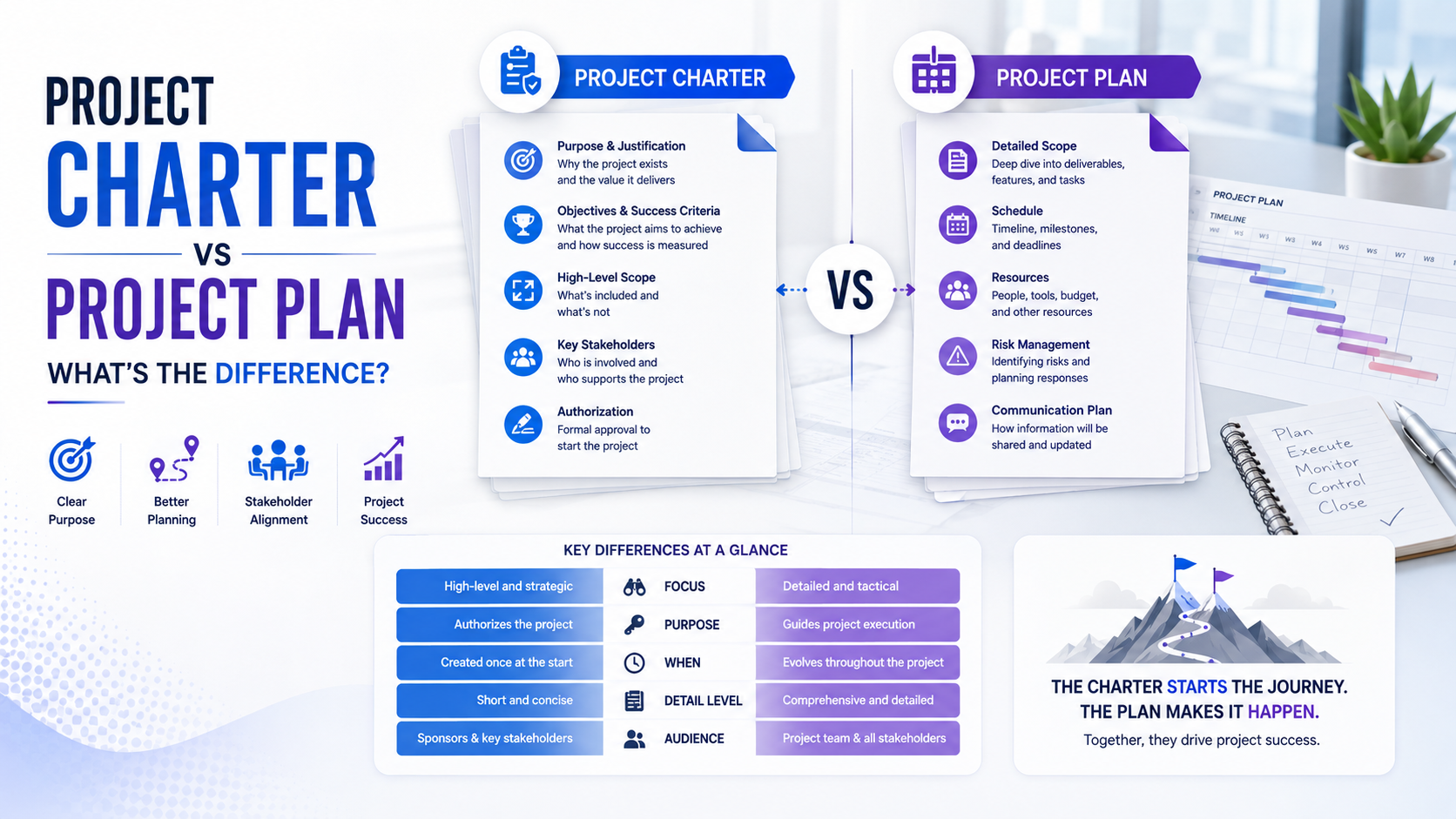
A project charter is the short, high-level document that authorizes a project and gives the project manager the authority to use organizational resources. A project management plan is the detailed, working document created after that authorization, and it explains exactly how the project will be executed, monitored, controlled, and closed.
In the project charter vs project plan comparison, the charter answers why the project exists and who has the authority to run it. The project plan answers how the work will actually get done, day by day, task by task. Take a glance at these project plan templates to get better clarity.
Key Highlights of Project Charter vs Project Plan
- A project charter is created during project initiation. A project management plan is created during project planning, right after the charter is approved.
- The project sponsor or initiator typically issues the charter. The project manager, working with the team, develops the project management plan.
- The charter is short, usually one to five pages. The project management plan is long and detailed, often running into dozens of pages once every subsidiary plan is attached.
- The charter authorizes the project's existence. The project management plan does not authorize anything. It guides execution.
- Both documents matter for the PMP and CAPM exams, and confusing their purpose is one of the most common mistakes candidates make.
- Subsidiary plans, such as the risk management plan, cost management plan, and schedule management plan, are components of the project management plan, not the charter.
- Agile and hybrid teams still need a charter equivalent, even if they call it something else, such as a project vision statement or a lean canvas.
Ask ten project managers what makes a project charter different from a project management plan, and you may get ten slightly different answers. Some will say the charter is just an early plan. Others will insist the two documents serve completely separate purposes and should never be confused. Both groups are partly right, but the second group is closer to the truth that matters for real projects and for certification exams.
This confusion is not just academic. Teams that treat the charter as a plan often skip formal authorization and start executing without a clear mandate. Teams that treat the plan as a mere formality often discover, weeks into execution, that nobody actually agreed on the budget, the scope boundaries, or who approves changes.Both mistakes cost time, money, and trust.
Looking at project plan vs project charter this way, as a sequence of authorization followed by execution detail, is the fastest way to avoid both traps. It also mirrors how thefive phases of project management are structured, with initiation and planning as distinct, sequential stages.
This guide breaks down the project charter vs project plan question in detail, along with the difference between project charter and project plan that shows up in day-to-day project work rather than just in theory. We will also learn about what is a project management plan.
You will also see how the charter feeds into the plan, where other documents like the business case and statement of work fit, and how this distinction is tested on the PMP and CAPM exams. Whether you are preparing for certification or trying to fix a governance gap on your own project, this comparison should give you a clear, working answer.
What a Project Charter is?
A project charter is a formal document that authorizes the existence of a project and gives the project manager the authority to apply organizational resources to project activities. That is the standard PMI definition, and it is worth memorizing because every important idea about the charter sits inside it.
Three things happen when a charter is signed.
- First, the project officially exists in the eyes of the organization. Before that signature, any work being done is informal, unfunded, and technically unauthorized.
- Second, a project manager is named, either by title or by name, and that person receives the authority to pull people, budget, and equipment into the project.
- Third, the high-level boundaries of the project are set, including its purpose, its measurable objectives, and the constraints it must work within.
A typical charter is short. It usually runs between one and five pages, though very large or complex programs may extend this slightly. It is meant to be read quickly by senior stakeholders, not studied like a technical manual.
The charter usually contains:
- The business need or purpose driving the project
- Measurable objectives and success criteria
- High-level requirements and a summary of scope
- A summary schedule with major milestones
- A summary budget or order-of-magnitude cost estimate
- The name of the project manager and the scope of their authority
- Key stakeholders
- High-level risks, assumptions, and constraints
- Approval requirements and the sponsor's signature
Who issues a project charter?
A project charter is issued by the project sponsor or initiator, not the project manager. The sponsor, who sits senior enough to fund and authorize the project, either writes the charter personally or delegates the drafting to the project manager. Even when the project manager drafts the document, the sponsor's signature is what makes it official.
In large, multi-stage programs, where funding is released in tranches, a charter can authorize a phase rather than an entire project. In those cases, a fresh or updated authorization is required before the next phase begins.
What a Project Management Plan Is?
A project management plan is the document that describes how the project will be executed, monitored, controlled, and closed. Unlike the charter, which is a short authorization document, the project management plan is comprehensive. It integrates and consolidates every subsidiary plan and every baseline produced during the planning process group.
Learning how to write a project plan is crucial to understand the project’s scope and goals.
Where the charter says what the project is and why it exists, the project management plan says how the team will actually deliver it. This includes the detailed work breakdown, the schedule logic, the cost estimates rolled up into a baseline, the quality standards, the communication cadence, the risk register and response strategies, and the procurement approach if outside vendors are involved.
The project management plan typically includes:
- Scope, schedule, and cost baselines
- Subsidiary management plans: scope, schedule, cost, quality, resource, communications, risk, procurement, and stakeholder engagement
- A change management plan and a configuration management plan
- The project life cycle description and the chosen development approach, whether predictive, agile, or hybrid
- Performance measurement baselines used to track progress against the plan
Building this document is not a one-person task. The project manager leads its development, but subsidiary plans are typically drafted by functional leads or subject matter experts and then integrated into the whole. Taken together, these project management plan components turn a short authorization into an operational playbook that the entire team can follow.
It is worth clarifying a common terminology mix-up here. In everyday conversation, people often say "project plan" to mean a schedule, usually shown as a Gantt chart. Technically, that schedule is only one output within the broader project management plan. The formal PMI term for the comprehensive document is "project management plan," while "project plan" is the informal, commonly used shorthand. This guide treats them as referring to the same governing document, since that is how most practitioners use the terms in daily work.
Project Charter vs Project Plan: 10 Key Differences
The project charter and project management plan differ across ten practical dimensions. Understanding these differences clears up most of the confusion that trips up new project managers and exam candidates alike.
1. Purpose. The charter authorizes the project. It answers the question, should this project exist, and who is allowed to run it. The project management plan does not authorize anything. It answers the question, given that the project has been authorized, how exactly will it be delivered.
2. Timing of creation. The charter is created during project initiation, before detailed planning begins. The project management plan is created during the planning process group, immediately after the charter has been approved. You cannot build a meaningful project management plan without an approved charter, because the plan needs the charter's boundaries as its starting input.
3. Who creates it. The sponsor or initiator issues the charter, sometimes delegating the drafting to the project manager but always retaining approval authority. The project manager owns the development of the project management plan, coordinating with team leads and subject matter experts to assemble the subsidiary plans.
4. Level of detail. The charter is intentionally high-level. It should never contain a detailed work breakdown structure, a day-by-day schedule, or line-item budget figures. The project management plan is the opposite. It is exhaustive, detailed, and operational, covering exactly how each knowledge area will be managed.
5. Length and format. Charters are short, typically one to five pages, written to be read in minutes by busy executives. Project management plans are long, often dozens of pages once every subsidiary plan and baseline is attached, because the audience needs operational detail, not just a summary.
6. Audience. The charter is written primarily for the sponsor, senior stakeholders, and sometimes the customer. It is a decision-making and authorization document. The project management plan is written for the project team, functional leads, and anyone responsible for executing or monitoring the work. It is an operational reference document.
Who approves the project charter also differs sharply from who approves the plan. A project management plan is usually approved through a combination of sponsor sign-offs and internal governance reviews, since it is the project manager's operational document rather than pure authorization.
7. Flexibility and change control. The charter is meant to be stable. Its scope, objectives, and authority statements should not change. Generally, sponsor re-approval is required for major budget increases or fundamental shifts in objectives. The project management plan is a living document. As the project progresses, it will be updated if it passes through the formal change control process.
8. Content focus. The charter focuses on the business case summary, objectives, high-level scope, milestones, budget order of magnitude, stakeholders, and the project manager's assigned authority. The project management plan focuses on the scope baseline, schedule baseline, cost baseline, and every subsidiary management plan needed to execute, monitor, and control the work.
9. Relationship to authority. The charter is the source of the project manager's authority. Without a signed charter, a project manager technically has no standing to commit resources or make binding decisions. The project management plan does not grant authority. It assumes the authority already exists and simply documents how that authority will be exercised operationally.
10. Lifecycle role. The charter is created once at the start and referenced throughout the project as the ultimate point of truth for scope and objectives, though it may occasionally be formally revised. The project management plan evolves continuously, absorbing approved changes, updated baselines, and refined subsidiary plans as the project matures from planning through closure.
How the Charter Feeds the Project Management Plan?
The charter is not a document you file away once it is signed. It is a direct input into the Develop Project Management Plan process. Everything the project manager and team produce during planning must trace back to what the charter authorized.
This traceability matters for a practical reason. If the project management plan ever expands scope, changes objectives, or assumes a budget beyond what the charter allowed, the plan is no longer aligned with its authorization. That misalignment is exactly the kind of gap that causes scope creep, funding disputes, and stakeholder conflict later in the project.
The relationship works like a funnel. The charter defines broad boundaries. The planning process then narrows those boundaries into specific, actionable detail, without ever exceeding what was originally authorized unless a formal change is approved.
What the Plan Inherits and What It Must Expand?
The project management plan inherits several elements directly from the charter, and then it must expand each one into operational detail.
- The charter states the project's purpose and measurable objectives. The plan translates those objectives into a detailed scope statement, a work breakdown structure, and acceptance criteria for each deliverable.
- The charter sets a summary budget. The plan builds a full cost baseline, broken into control accounts, along with a cost management plan describing how spending will be tracked and controlled.
- The charter provides a summary schedule with major milestones. The plan develops a full schedule baseline, sequencing every activity and identifying dependencies and the critical path.
- The charter names high-level risks. The plan builds out a complete risk register, assigning owners, probability and impact ratings, and response strategies for each identified risk.
- The charter identifies key stakeholders. The plan develops a stakeholder engagement plan and a communications management plan describing exactly how, when, and through what channel each stakeholder group will be kept informed.
- The charter grants the project manager general authority. The plan operationalizes that authority into specific approval thresholds, escalation paths, and decision rights documented in the change management plan.
This inheritance model is why experienced project managers insist on a well-written charter before planning begins. A vague or incomplete charter forces the team to guess at boundaries during planning, which almost always leads to rework later when the sponsor's actual expectations surface.
Where the Other Project Documents Fit: Business Case, SOW, Scope Statement, and Roadmap
The project charter vs business case, project charter vs statement of work, and project charter vs scope statement comparisons come up often, because these documents overlap in content but serve distinct roles in the project lifecycle.
Business case. The business case is created before the charter and answers a financial and strategic question: is this project worth doing? It weighs projected benefits against costs and risks, and it is typically one of the inputs used to develop the charter. The business case justifies the investment. The charter formally authorizes it. Understanding theimportance of a project charter alongside the business case helps clarify why organizations insist on both documents rather than treating one as a substitute for the other.
Statement of work (SOW). A statement of work describes the products, services, or results the project is expected to deliver, and it is also typically created before the charter, serving as one of its inputs. In contractual settings, a procurement SOW is the detailed, often legally binding document that a vendor must fulfill. The project charter vs statement of work distinction comes down to authorization versus description. The SOW describes what will be delivered. The charter authorizes the internal effort to deliver it.
Scope statement. A detailed project scope statement is developed later, during planning, and it expands the charter's high-level scope summary into a full description of deliverables, boundaries, exclusions, and acceptance criteria. The project charter vs scope statement difference is primarily one of detail and timing. The charter's scope summary is a paragraph or a short list. The scope statement, part of the scope baseline within the project management plan, can run several pages and becomes the authoritative reference for what is and is not included in the project.
Roadmap. A product or program roadmap sits at a different altitude altogether. It typically spans multiple projects or releases over a longer time horizon and communicates strategic direction rather than authorization or execution detail. A roadmap might reference several charters and several project management plans as it tracks how strategic themes translate into delivered work over time.
Together, these documents form a chain: the business case justifies the investment, the SOW or product vision describes what is wanted, the charter authorizes the project and names the project manager, the scope statement and full project management plan detail how the work will be executed, and the roadmap situates that single project within a broader portfolio of initiatives. Seeing the full chain laid out this way makes the project charter and project plan difference much easier to explain to stakeholders who only know these documents by name, not by function.
What to Do When the Project Plan Contradicts the Charter?
Contradictions between the plan and the charter happen more often than most teams admit. A schedule baseline might slip well past the milestone the charter promised. A cost estimate might exceed the budget ceiling the sponsor originally approved. A scope statement might quietly expand beyond what the charter's objectives described.
When this happens, the first step is to identify whether the contradiction is material or minor. A material contradiction changes the fundamental value proposition the sponsor approved, such as a significant budget overrun, a schedule slip that undermines the original business case, or a scope shift that changes what success looks like. A minor contradiction is an operational detail that does not change the project's fundamental purpose or authorized boundaries.
Material contradictions cannot be resolved by the project manager alone, no matter how reasonable the justification seems. The charter was signed by the sponsor, and only the sponsor, or a change control board acting with the sponsor's delegated authority, can approve changes that affect what was originally authorized. Proceeding without that approval puts the project manager in a position of acting outside their granted authority, which creates both governance and, in some organizations, personal accountability risk.
Minor contradictions, by contrast, are exactly what the project management plan's own change control process exists to handle. A shift in task sequencing, a resource substitution, or a small adjustment to a subsidiary plan rarely needs sponsor involvement, as long as it does not touch the baselines or the objectives the charter established.
Change Control vs Re-Authorization
This distinction between change control and re-authorization is one of the most practically important ideas in this entire comparison.
Change control is the formal process, documented within the project management plan, for evaluating and approving changes to the project's baselines, be they scope, schedule, or cost, without altering the project's fundamental charter. Most day-to-day changes during execution go through this process. A change control board, often chaired by the project manager or a designated authority, reviews the request, assesses impact, and approves or rejects it based on criteria set out in the plan.
Re-authorization is a different, heavier process. It happens when a change is so significant that it effectively alters what the sponsor originally agreed to fund and support. Examples include a budget increase beyond an agreed threshold, often cited around ten percent, a schedule slip beyond an agreed tolerance, often around 15%, a change to the project's core objectives, or a change in sponsorship itself.
In these cases, the appropriate response is not a change request buried in a project management plan revision. It is a return to the sponsor, sometimes with a revised or entirely new charter, to reconfirm authorization before continuing.
A simple test many experienced project managers use: if you would be uncomfortable explaining the change to the original sponsor without their prior knowledge, it probably needs re-authorization rather than routine change control.
Project Charter and Project Plan in Agile and Hybrid Delivery
Agile teams sometimes assume that charters and detailed project management plans are artifacts of traditional, waterfall-style project management and do not apply to them. This is a partial misunderstanding. The need for authorization and for a shared understanding of how work will proceed does not disappear in agile delivery. It simply takes a different shape.
In agile and hybrid environments, the charter equivalent is often called a project vision statement, a product vision, or sometimes a lean or agile charter. It still answers the same core questions: why does this initiative exist, who has decision-making authority, what does success look like, and what are the boundaries within which the team will operate. It is typically even shorter than a traditional charter, sometimes fitting on a single page or a lean canvas, but its authorizing function is unchanged.
The project management plan equivalent in agile is more distributed. Rather than a single, comprehensive document finished before execution begins, agile teams maintain a release plan, a product backlog with prioritization logic, sprint plans, a definition of done, and team working agreements. These artifacts collectively perform the same function as the traditional project management plan, describing how the work will actually get done, except they are created and refined continuously rather than upfront.
Hybrid delivery models often keep a fuller, more traditional charter for governance and funding purposes, especially in larger organizations where finance and portfolio management expect a formal authorization document, while using agile artifacts for the execution-level planning that would otherwise live inside a full project management plan. This hybrid approach lets the organization satisfy governance requirements at the charter level while giving delivery teams the flexibility to adapt their working plans sprint by sprint.
The underlying principle holds across all delivery approaches: authorization comes first and stays relatively stable, while execution-level planning comes second and stays adaptive. Agile does not eliminate this sequence. It simply compresses the charter and accelerates the planning cycle.
Project Charter vs Project Plan in the PMP and CAPM Exams
For anyone preparing for the PMP or CAPM exam, the project charter pmp distinction between authorization and execution is one of the highest-yield topics to master, because it appears repeatedly across scenario-based questions.
The exam consistently tests a few core facts. The charter is created in the Initiating process group, specifically through the Develop Project Charter process. The sponsor or initiator issues and signs it, never the project manager, even when the project manager helped draft the content. Without a signed charter, the project officially does not exist, and any resource commitment made before that signature is technically unauthorized.
The project management plan, by contrast, is created through the Develop Project Management Plan process within the Planning process group. It integrates every subsidiary plan produced by the other planning processes, and the project manager leads its development, though it typically requires input from the team and formal approval from the sponsor or relevant governance body before it becomes the baseline for execution.
A frequent PMP exam trap involves scenario questions where a project manager is asked what to do first, when the scenario describes a project that has not yet been formally chartered. The correct answer is almost always to obtain or complete the charter before doing anything else, even if the scenario seems to invite jumping straight into planning or execution activities. If you are actively preparing for the exam, this overview ofPMP certification training covers exactly this kind of process group sequencing and the common traps candidates fall into.
Another commonly tested nuance is project charter vs business case, project charter vs scope statement, and project charter vs statement of work. Exam questions often describe a document's content and ask which artifact it belongs to. Remembering that the business case justifies the investment, the SOW describes deliverables, the charter authorizes the project, and the scope statement details what is included and excluded will resolve most of these questions correctly.
How This Distinction Is Typically Tested?
Exam questions on this topic tend to follow a few recognizable patterns.
Situational questions describe a scenario, often involving a project manager who has started assigning tasks or spending budget, and ask what should have happened first. These questions are testing whether you know the charter must exist and be approved before planning or execution activities begin.
Matching questions present a list of document characteristics, such as "grants authority to the project manager" or "integrates subsidiary plans and baselines," and ask you to match each characteristic to the correct document. These reward memorizing the specific, distinguishing features covered in the ten key differences above.
Sequencing questions ask which process group or which specific process a described activity belongs to. Recognizing that Develop Project Charter belongs to Initiating and Develop Project Management Plan belongs to Planning resolves most of these.
Authority questions test who signs, who approves, and who can authorize changes to each document. Remembering that the sponsor signs the charter, and that project management plan changes generally go through a change control process defined within the plan itself, addresses the majority of these questions correctly.
Preparing project management plan vs project documents distinctions is also worth attention, since the exam sometimes separates "project documents" as a broader category, covering artifacts like the risk register, stakeholder register, and issue log, from the formal "project management plan," which specifically refers to the integrated management document with its baselines and subsidiary plans.
Both categories fall under the wider umbrella of project initiation documents and planning documents that a project accumulates between the Initiating and Planning process groups, and knowing which artifact belongs to which category is often the deciding factor in close exam questions.
Common Confusions That Cause Real Project Problems
Beyond exam preparation, several confusions between the charter and the project management plan create real operational problems on actual projects.
1. Confusing informal buy-in with formal authorization:
A sponsor casually agreeing in a meeting that a project should happen is not the same as a signed charter. Teams that start work based on verbal agreement often discover, months later, that no one is entirely sure who approved the budget or the scope, which becomes a serious problem the moment anything goes wrong.
2. Writing a charter that is really a mini project management plan:
Some organizations produce charters that are twenty or thirty pages long, packed with detailed schedules and line-item budgets. This defeats the purpose of the charter, which is meant to be quickly reviewable by senior stakeholders. It also creates confusion about which document is the authoritative source for detailed planning, since the charter and the project management plan end up duplicating content.
3. Treating the project management plan as static:
Some teams write the project management plan once and never revisit it, even as the project evolves significantly. Since the plan is meant to be a living document, updated through formal change control, letting it go stale means the team is executing against outdated assumptions.
4. Skipping re-authorization for material changes:
As covered earlier, a serious budget or schedule change should trigger a return to the sponsor, not a quiet update buried in a project management plan revision. Skipping this step erodes sponsor trust and can leave a project manager exposed if the change later proves controversial.
5. Confusing "who creates it" with "who owns it."
Even when a project manager drafts the charter on the sponsor's behalf, ownership and signing authority remain with the sponsor. Similarly, even though the project manager owns the project management plan, its subsidiary plans are often developed collaboratively with functional leads, and pretending the project manager works in isolation ignores how these documents are actually built in practice.
6. Ignoring subsidiary plans in project management until problems appear:
Subsidiary plans in project management, such as the risk management plan, the communications management plan, and the procurement management plan, are often treated as boilerplate sections filled in quickly to complete the project management plan template. Teams that actually use these subsidiary plans as living guides, rather than as one-time paperwork, tend to catch problems earlier and respond to them with a documented process rather than improvisation.
Project Management Training for Stronger Project Documentation
Understanding the theoretical difference between a charter and a project management plan is a useful start, but applying that understanding consistently, across real projects with real stakeholders, real budget pressure, and real schedule constraints, is a different skill. This is where structured project management training makes a measurable difference.
Formal training grounded in the PMBOK framework gives project managers a repeatable process for drafting charters that are appropriately scoped, developing project management plans that genuinely integrate every subsidiary plan rather than treating them as checkbox exercises, and recognizing early when a change requires sponsor re-authorization rather than routine change control.
It also builds the vocabulary needed to have these conversations clearly with sponsors, stakeholders, and project teams, reducing the ambiguity that causes so many of the problems described above.
For professionals aiming to formalize this knowledge, whether to strengthen day-to-day practice or to pursue a recognized credential, structured, exam-aligned training programs cover this entire document hierarchy in depth, from the business case through the charter, the full project management plan, and every subsidiary plan in between.
Conclusion
The project charter vs project plan comparison ultimately comes down to authorization versus execution. The charter is the short, high-level document that gives a project its formal existence and gives the project manager the authority to act. The project management plan is the detailed, comprehensive document that translates that authorization into an executable, monitorable, controllable path to delivery.
Getting this distinction right matters well beyond exam preparation. Projects that skip proper charter authorization often struggle with unclear authority and scope disputes later. Projects that treat the project management plan as an afterthought often struggle with misaligned expectations and uncontrolled change. Understanding when each document applies, who owns it, and how they connect gives project managers a stronger foundation for running projects that stay aligned with what stakeholders actually approved.
If you are looking to build this foundation formally, whether you are preparing for the PMP exam or simply want a more structured approach to project documentation in your current role, a good next step is exploringPMP certification training from Simpliaxis.
The program walks through the entire initiation-to-closure process, including exactly the kind of charter and project management plan distinctions covered in this guide, with practical exercises designed to help the concepts stick well beyond exam day.








 Lowest-Price Challenge











 Personalized Path


.webp)


 USA
USA  Canada
 India
India UK
UK Australia
 Singapore


