


 Call Us



Machine learning is among the most radical technologies that define the contemporary digital environment. However, what is machine learning? To define it in simple terms what machine learning is in simple terms- it is a way in which computers learn through their data and can become better at their job without necessarily being told what to do. Systems learn by analyzing patterns and therefore make decisions, rather than strictly following instructions, and also improve with time.
Machine learning has become an important aspect in the modern world where huge volumes of data are produced every second and transformed into useful information. It drives recommendation systems, chatbots, fraud detection and self-driving technologies. Machine learning is closely related to artificial intelligence (AI) and it is the driving force, which is used to automate and make smarter decisions.
Since companies adopt the idea of data-based strategies more and more, it is imperative to know what machine learning is and how it can be utilized to innovate, gain efficiency, and remain competitive in a fast-paced technological environment.
Why is Machine Learning Important?
The significance of machine learning has risen at a rapid rate as a result of the massive expansion of big data. In current times, enterprises and organizations are producing huge amounts of structured and unstructured data on a second-by-second basis. It is important to understand what machine learning is since the traditional tools are ineffective in managing this scale. Machine learning applications allow systems to handle, analyze, and derive useful data on data in real time.
Automation is one of the greatest machine learning benefits. Advanced machine learning algorithms enable companies to automate repetitive processes like data processing, fraud detection and customer support. This saves on human labor, increases speed and precision. These systems are being continually enhanced by learning and thus become more efficient with time.
The other important reason why machine learning is important is its influence on decision-making. Through predictive analytics and data trends, it is possible to make data-driven decisions in organizations. Machine learning can be used in businesses to identify risks and predict sales, keeping the business afloat.
In a world that is data led and technological, it is easy to decipher what machine learning is in simple words to bring out the essence of machine learning, a potent weapon of smarter automation, better insights and more effective strategic results.
Why Should We Learn Machine Learning?
In the modern technologically advanced world, it is necessary to comprehend why machine learninghas become even more vital. The huge scope of the career opportunities it provides is one of the prime reasons. The data scientist, machine learning engineer, AI specialist, and business analyst are some of the positions that are on demand in industries such as healthcare, finance, retail, and technology.
Another major factor is the increased industry demand for machine learning skills. Firms are also aggressively investing in machine learning applications to enhance efficiency and customer experience and competitive advantage. This has posed a high demand on those professionals who are aware of the machine learning algorithms and evidence-based decision-making.
Besides, machine learning is a future-proof skill. With the ever-growing automation and artificial intelligence, it would be advisable to know what machine learning is to remain relevant in the career in the long run. It allows a person to work with data, create intelligent systems, and keep up with the new technologies.
Understanding what machine learning is in simple words and gaining practical skills can open doors to exciting and high-growth career paths.
What Are the Benefits of Machine Learning?
Understanding the machine learning benefits helps explain why this technology is transforming modern businesses and industries.
Automation and Efficiency
Automation is one of the greatest advantages of machine learning. It is capable of doing repetitive and time consuming jobs like data analysis, customer service via chatbots and optimization of the workflow. This means that there will be less human effort and more efficiency in operations which will enable the businesses to concentrate on more strategic matters.
Improved Accuracy and Performance
The other significant advantage is an increased accuracy. Complex machine learningalgorithms are used to analyze high amounts of data and detect patterns precisely. This reduces human error and enhances performance in sensitive sectors such as healthcare diagnosis, financial forecasting and quality management.
Personalization and Customer Experience
Machine learning applications play a key role in personalization. Platforms like e-commerce websites and streaming services use data to understand user behavior and preferences. This enables them to provide tailored recommendations, improving user engagement and satisfaction.
Fraud Detection and Security
Fraud detection is one of the most important applications of machine learning. Real-time data analysis helps financial institutions to detect suspicious transactions and threats. This will aid in avoiding fraud, increasing security and safeguarding sensitive information.
Continuous Learning and Improvement
A unique aspect of machine learning is its ability to learn from new data. Systems also get better with time making them more precise and efficient hence long term value is added to organizations.
What is the History of Machine Learning?
The history of machine learning dates back to the mid-20th century when researchers first explored the idea of computers learning from data rather than following fixed instructions. This marked the beginning of what we now recognize as Machine Learning History, a field that has evolved significantly over time.
In the 1950s, pioneers such as Arthur Samuel wrote programs that were capable of learning by experience, including a checkers playing computer that got better with experience. It has been among the initial applications of machine learning in a practical way.
The 1960s and 1970s were the period of studying pattern recognition and simple algorithms. The idea of neural networks was implemented, which preconditioned the following inventions.
In the 1980s and 1990s, the increase of computing power and development of statistical algorithms prompted the increase of machine learning algorithms, which included decision trees, regression models, and clustering algorithms.
The 2000s marked a turning point with the rise of big data and the internet, enabling more complex applications of machine learning across industries.
In recent years, deep learning and artificial intelligence have driven major breakthroughs in areas like image recognition, speech processing, and automation.
How did Machine Learning evolve?
The evolution of machine learning represents a major shift in how computers solve problems and interact with data. Over time, it has transformed from simple programmed systems into intelligent models that power modern technologies.
The early years were characterized by an all-rule computer system. Instructions were required to be written manually in all the possible scenarios and this made the systems fixed and hard to scale. These deficiencies enabled the creation of data-driven models due to the necessity to find a more versatile solution.
As the concept of what machine learning became clearer, the focus moved toward systems that could learn from data rather than follow fixed rules. This change ensures machine learning algorithms to detect patterns, predict and refine with time regardless of the need to be adjusted by human hands.
The second important element of the evolution was the development of computing power. Due to the emergence of powerful processors, cloud computing, and availability of big data, machine learning applications became feasible and efficient. Intricate models were now able to be trained at a higher speed, and at an extremely larger scale.
Today, machine learning is closely connected to modern artificial intelligence. It forms the backbone of AI systems used in areas like automation, recommendation engines, and predictive analytics, making it an essential technology in the digital age.
What is the Difference Between Machine Learning, Artificial Intelligence, and Deep Learning?
Understanding the difference between AI and ML and the difference between ML and DL is essential to grasp how modern intelligent systems work.
Artificial Intelligence (AI) is the broadest concept. It refers to machines or systems designed to mimic human intelligence, such as reasoning, problem-solving, and decision-making. AI includes a wide range of technologies like robotics, expert systems, and natural language processing.
Machine learning, on the other hand, is a subset of AI. It focuses specifically on enabling systems to learn from data and improve over time without being explicitly programmed. In simple terms, if AI is the goal of creating smart machines, machine learning is one of the main methods used to achieve that goal.
Deep learning (DL) is a further subset of machine learning. It uses advanced neural networks with multiple layers (called deep neural networks) to process large amounts of data. This is especially useful for complex tasks such as image recognition, speech processing, and language translation.
The relationship can be understood as a hierarchy: AI is the umbrella, machine learning sits within AI, and deep learning exists within machine learning.
In real-world applications, AI powers virtual assistants, machine learning applications drive recommendation systems, and deep learning enables facial recognition and self-driving cars. Understanding this hierarchy helps clarify the difference between AI and ML and the difference between ML and DL effectively.
Relationship Between AI, ML, and DL
| Aspect | Artificial Intelligence (AI) | Machine Learning (ML) | Deep Learning (DL) |
Definition | Broad concept of machines mimicking human intelligence | Subset of AI that learns from data | Subset of ML using neural networks |
Scope | Very wide | Medium | Narrow |
Approach | Rule-based + learning-based | Data-driven learning | Neural network-based learning |
Human Intervention | High (can be rule-based) | Medium | Low |
Complexity | General intelligence tasks | Pattern recognition & prediction | Complex data processing |
Examples | Virtual assistants, robotics | Recommendation systems, fraud detection | Image recognition, speech recognition |
Hierarchy Structure
Artificial Intelligence (AI) → Broad concept
Machine Learning (ML) → Subset of AI
Deep Learning (DL) → Subset of ML
How Does Machine Learning Work?
To understand How Machine Learning Works?, it’s important to look at the basic process through which machines learn from data and make predictions.
In essence, machine learning has a straightforward process, namely: data, training, prediction. First, huge volumes of data are gathered on different sources. This information is then processed and streamlined in a way that it is useful to machine learning algorithms. Good quality of data is necessary since the quality of the model is wholly reliant on it.
The second step is the model training step. It is at this phase that the algorithm is trained on the training data, and it learns about the patterns, relationships, and trends. The process assists the system in developing a model that is able to make a correspondence of the inputs to anticipated outputs. To illustrate, a model can be trained to determine whether an email is spam or not by using previous examples.
After training, the model is expected to be applied to new and unknown data to make predictions. Here machine learning applications can come into play like predicting sales, identification of fraud, or product suggestions.
Another key aspect of how machine learning works is iteration and optimization. Models are repeatedly tested and refined using techniques like error correction and parameter tuning. This continuous improvement ensures better accuracy over time.
What is Deep Learning?
The question What is Deep Learning? is a popular question when examining the advanced concepts of machine learning. Deep learning is a form of machine learning that involves the application of artificial neural networks to make use of massive data volumes. These are the networks that are based on the human brain and are created to handle information in layers.
Neural networks that consist of several layers of input, hidden and output layers are at the heart of deep learning. Data is processed at each layer and it is passed on, and the system learns more and more complicated patterns. It is made deep by the presence of many hidden layers and allows the model to solve tasks that are hard to the traditional machine learning algorithms.
Deep learning particularly excels in unstructured data sets like text, audio and images. It is due to this that it is extensively applied in real-world machine learning such as facial recognition, speech assistants, recommendation systems, and autonomous vehicles. It is also an important part of natural language processing and it drives chatbots and translation applications.
As data continues to grow, deep learning is becoming a driving force behind innovation, pushing the boundaries of what intelligent systems can achieve.
What Are Machine Learning Algorithms?
Machine Learning Algorithms are the core of every smart system as it provides computers with instructions and procedures to learn about information. Simply put an algorithm is a program of instructions to solve a problem or do a task. These algorithms are applied in machine learning to process data, find patterns and create models capable of making predictions or decisions, without being explicitly programmed.
Machine Learning Algorithms have various types each with its tasks. A single type is regression algorithms, which are applied to forecast continuous values. The example of linear regression is that house prices can be approximated using such factors as location and house size. The other type is classification algorithms that are applied to classify data into pre-established groups, as in the case of spam or not spam.
Unsupervised learning algorithms are known as clustering algorithms, they are applied to cluster together similar data points without labels. An example of such a use of clustering is by businesses to segment customers (according to purchasing behavior). Another popular data is decision trees whereby the data is divided into branches depending on conditions and is therefore easy to interpret and can be used in decision-making activities.
Machine Learning Algorithms also play an important role in model building. They manipulate training data, acquire associations and produce results that could be used with new data. These algorithms are always refined using training and optimization enabling them to be more precise as time goes by.
It is necessary to be aware of various Machine Learning Algorithms in order to choose the appropriate version to address certain real-life issues.
Understanding different Machine Learning Algorithms is essential for selecting the right approach to solve specific real-world problems effectively.
What Are Seven Steps of Machine Learning?
Building effective machine learning applications involves a structured process. These seven steps help transform raw data into accurate and reliable models.
1. Data Collection
The initial process is the collection of the pertinent data using different sources like databases, APIs, sensors or user interactions. Diverse data is required to train the effective machine learning algorithms.
2. Data Preparation
Raw data is rarely ready to use. It has to be cleaned, structured, and refined through the processing of missing data, elimination of duplicate data, and data conversion to appropriate formats that can be analyzed.
3. Model Selection
At this stage, the suitable Machine Learning Algorithms are selected according to the type of problem. As an illustration, prediction is carried out with the help of regression models, whereas categorization tasks are performed with the aid of classification models.
4. Training
Prepared data is used to train the selected model. It is in this step that the algorithm acquires patterns and relationships between input and output data, which make up the model.
5. Evaluation
After it is trained, the model is checked on another set of data to test its performance. Accuracy, precision, and recall are metrics that assist in identifying the level of performance of the model.
6. Optimization
When the model is not performing well, then it is fine-tuned using tuning methods like changing the parameters or enhancing the quality of data. This measure is taken to provide enhanced accuracy and efficiency.
7. Deployment
Lastly, the model gets implemented into the real-life conditions, wherein it is able to predict and help in decision-making. Constant evaluation makes the model effective in the long run.
What Are the Applications of Machine Learning
Applications of Machine Learning are also developing at a fast rate in various industries and are changing the way businesses are run and decisions made. Machine Learning Applications are assisting organizations open up precious insights and enhance efficiency, both in the analysis of vast volumes of data and the automation of sophisticated processes.
One of the most common applications of machine learning is in healthcare, where it is used for disease diagnosis, medical image analysis, and personalized treatment plans. In finance, machine learning helps in fraud detection, risk assessment, and algorithmic trading by analyzing transaction patterns in real time.
Retail and e-commerce industries rely heavily on Machine Learning Applications for recommendation systems, customer segmentation, and demand forecasting. Similarly, in marketing, businesses use machine learning to analyze customer behaviour and deliver personalized campaigns.
In manufacturing, machine learning supports predictive maintenance and quality control, reducing downtime and improving productivity. The transportation industry uses it for route optimization and autonomous driving technologies.
Altogether, the Applications of Machine Learning increase, which indicates its aptitude to address complicated challenges, advanced decision-making, and innovation in various industries, so it is a crucial aspect of the process of modern digital transformation.
What Are Machine Learning Use Cases?
Fraud Detection
Fraud detection in fields such as banking and finance is among the most important Machine Learning Applications. Machine learning algorithms examine large amounts of transactional data to detect patterns that are abnormal or outliers. To give an example, when a transaction suddenly takes place in a new location or an unusual amount, the system can put up a flag immediately. This real-time identification assists organizations to minimize financial risks as well as enhance security.
Chatbots and Virtual Assistants
Chatbots are another powerful use case of machine learning. These systems process information and programs to interpret queries by the user and give a computerized answer. Chatbots are used by businesses in their customer support, in answering frequently asked questions, and providing 24/7 support. These systems become more effective with time as they learn through interactions with the user and are more accurate.
Recommendation Engines
Recommendation engines are widely used in platforms like e-commerce and streaming services. Machine learning analyzes user behaviour, search history, and preferences to suggest relevant products or content. This personalization enhances user experience and increases engagement, making it one of the most impactful Machine Learning Applications in today’s digital landscape.
Machine Learning Examples by Industry
Machine learning applications are transforming industries by enabling smarter decision-making, automation, and predictive insights. Here’s how different sectors are using machine learning in practical ways:
Healthcare
Machine learning finds its application in healthcare for disease diagnosis, medical imaging, and predictive analytics. X-rays, MRIs, and patient records may be analyzed by algorithms to identify such diseases as cancer at an early stage. It is also assisting doctors to make evidence-based treatment decisions and enhance patient outcomes.
Finance
Machine learning has been essential in the finance industry in fraud detection, risk assessment, and algorithmic trading. There are models that interpret the pattern of transactions in order to raise red flags against suspicious transactions and measure creditworthiness. This does not only makes it more secure, but also allows quicker and better-informed financial decisions.
Retail
Machine learning is used in retail to provide recommendation systems, demand prediction and customer segmentation. Companies examine the customer behavior to recommend their products, maximize their prices and maintain their inventory effectively, to increase sales and customer services.
Manufacturing
Manufacturing uses machine learning for predictive maintenance and quality control. By analyzing machine data, systems can predict equipment failures before they occur, reducing downtime. It also ensures product quality by detecting defects during production processes.
These machine learning examples by industry clearly show how data-driven technologies are reshaping operations and driving innovation across sectors.
Below is a table highlighting key Machine Learning Applications across industries with examples:
Industry | Application | Example |
Healthcare | Disease prediction & diagnosis | Detecting cancer using medical imaging and patient data |
Finance | Fraud detection | Identifying unusual credit card transactions |
Retail | Recommendation systems | Suggesting products based on user behavior |
Manufacturing | Predictive maintenance | Predicting machine failures before breakdown |
Marketing | Customer segmentation | Targeted advertising campaigns |
Transportation | Route optimization | Real-time traffic prediction in navigation apps |
Entertainment | Content recommendation | Suggesting movies/shows on streaming platforms |
Education | Personalized learning | Adaptive learning platforms for students |
As industries continue to generate massive amounts of data, the importance of Machine Learning Applications will only grow, making them essential for innovation and competitive advantage.
How Can You Implement Machine Learning in Your Organization?
Implementing machine learning in an organization requires a structured and goal-oriented approach. It’s not just about technology—it’s about aligning data, strategy, and execution to deliver real business value through Machine Learning Applications.
To successfully adopt machine learning, organizations should follow these key steps:
Define clear business goals: Open by determining the problem you wish to solve. It could be enhancing customer experience, lowering operations costs, or uncovering fraud but having an objective to achieve will help you create a machine learning initiative that will create quantifiable value.
Assess data readiness: Machine learning requires data that is of high quality and availability. Companies need to gather data, clean and organize them appropriately. Even the best models will not provide quality results without quality data.
Choose the right tools and algorithms: Select appropriate Machine Learning Algorithms based on your business problem. This could include regression models, decision trees, or clustering techniques depending on the use case.
Train and test the model: Use historical data to train the model and evaluate its performance using test datasets. This step ensures that the model can make accurate predictions on new data.
Deploy and monitor the model: On successful validation, implement the model into practice. Always keep an eye on its performance and revise it when new data arises to ensure that it is accurate and efficient.
What are Machine Learning Libraries?
Machine learning libraries are pre-built tools and frameworks that simplify the development of machine learning models. Instead of writing complex algorithms from scratch, developers can use these libraries to build, train, and deploy models more efficiently.
Some of the most popular Machine Learning Libraries include:
TensorFlow – It is an open-source library which is popular in the construction and deployment of deep learning models. It is extremely scaled and can be utilized in research as well as production.
Scikit-learn – Scikit-learn is a beginner-friendly library with applications in the more classic Algorithms of Machine Learning such as regression, classification, and clustering. It is best suited to analyze data and fast models.
PyTorch – PyTorch, due to its flexibility and ease of use is popular in research and is commonly used in deep learning development and neural network development.
These libraries help a great deal in enhancing growth, raising the level of precision and the developer to experiment with various models. They are invaluable to anyone in the sphere of machine learning and assist in transforming intricate data into an action plan.
What are Machine Learning Platforms?
Machine learning platforms are integrated environments that provide tools and infrastructure to build, train, deploy, and manage machine learning models at scale. These platforms simplify the entire lifecycle of Machine Learning Applications, making it easier for organizations to adopt and implement ML solutions.
A majority of the modern platforms are cloud based, which provides them with scalability, storage, and computing capabilities without the use of intensive on-premise infrastructure. The most popular cloud platforms such as those provided by AWS, Google cloud, and Microsoft Azure include end-to-end data processing, model training, and deployment solutions.
These platforms typically include features such as data preprocessing tools, built-in Machine Learning Algorithms, automated model training (AutoML), and performance monitoring. They also support collaboration between data scientists, developers, and business teams.
By using machine learning platforms, organizations can reduce development time, lower costs, and efficiently manage large-scale ML projects, making them essential for deploying real-world Machine Learning Applications in today’s data-driven environment.
What is Machine Learning Operations (MLOps)?
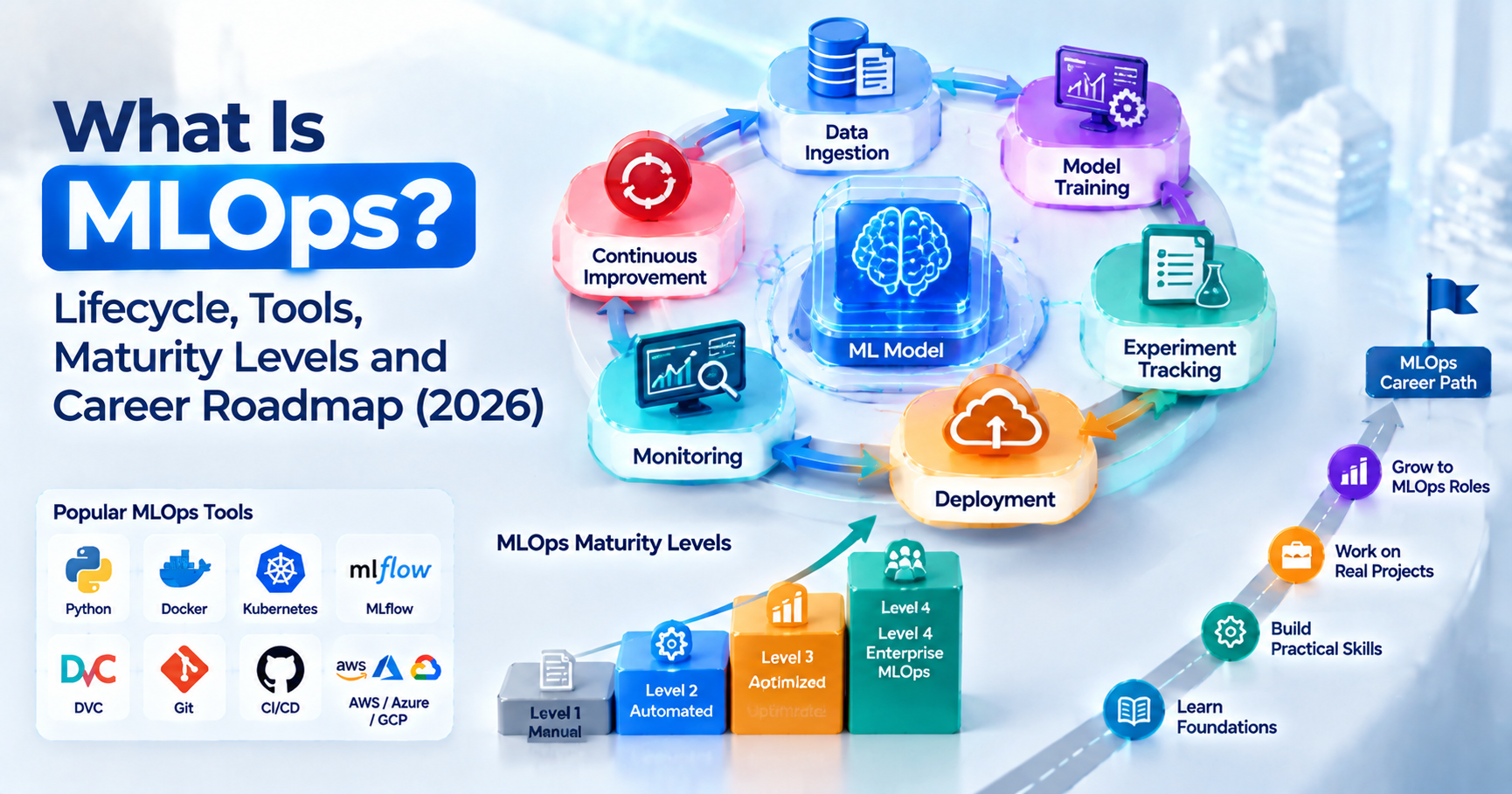
What is MLOps? It is defined as Machine Learning Operations, which is a collection of practices that integrates machine learning, DevOps, and data engineering to run the entire lifecycle of Machine Learning Applications. MLOps guarantees an efficient and effective development, deployment, monitoring, and maintenance of machine learning models in the real world.
Construction of a model is not the only part of the process in the modern organization. MLOps is associated with lifecycle management, such as data collection, model training, testing, deployment, and continuous monitoring. It assists teams to make sure that models are accurate and reliable even with the introduction of new data with time.
One of the important aspects of what is MLOps is automation. It allows machine learning to be easily integrated and deployed continuously (CI/CD) pipelines, which saves human labor and accelerates the process of updating models. Automated workflows are also useful in version control, performance tracking and scaling of Machine Learning Applications across systems.
MLOps can enhance the process of collaboration between data scientists and developers, minimize the risk of operations, and make AI-based solutions more expeditious through the implementation of the given approach. With the increasing use of machine learning, it is important that MLOps should be used to ensure efficiency, scalability, and success in the long-term.
How Can AWS Machine Learning Help?
AWS Machine Learning is a large-scale provider of cloud-based services and tools that assist companies in creating, training, and deploying machine learning models in the most efficient, time-effective way. Such platforms as Amazon SageMaker allow developers and data scientists to handle the complete lifecycle of Machine Learning Applications, including data preparation and model deployment, in a single place.
AWS also has data labeling, model training, and performance monitoring tools, so it is simpler to work with complex Machine Learning Algorithms without the need to have huge infrastructure. Experimentation, optimization, and deployment of models in organizations can be undertaken with less time and scalable computing power through built-in automation.
To businesses, the most valuable aspect of machine learning is that it saves time in development, cuts down infrastructure expenses and enhances decision making. AWS enables the companies to scale their ML solutions up to the demand without compromising security and reliability.
Using AWS, organizations can help innovate faster, simplify processes and deploy data-driven solutions to the market more effectively and is a robust platform on which to collaborate on modern machine learning applications.
Check Out for : AWS Cloud Computing Certification Course
What are the Machine Learning Teams, Roles and Workflows?
Successful machine learning applications rely on collaboration between different roles and a well-structured workflow. Each team member contributes to building, deploying, and maintaining effective machine learning models.
Data Scientists
Analyze data and identify patterns to solve business problems
Build and train machine learning models using statistical methods
Select appropriate Machine Learning Algorithms for specific use cases
Evaluate model performance and improve accuracy
Machine Learning Engineers
Deploy models into production environments
Optimize models for scalability and performance
Integrate machine learning applications with software systems
Manage pipelines using MLOps practices
Data Engineers
Collect, clean, and transform large datasets
Ensure data pipelines are reliable and efficient
Maintain data quality for accurate model training
Workflow Structure
Define business objectives and problem statements
Prepare and preprocess data for modeling
Train, test, and validate models
Deploy models and monitor performance continuously
Check out for : Data Science Certification Course
What Are the Challenges in Machine Learning Implementation?
Implementing machine learning in real-world scenarios comes with several challenges that organizations must address to ensure successful outcomes. These challenges can impact the accuracy, efficiency, and scalability of Machine Learning Applications.
One of the biggest challenges is data quality. Machine learning models rely heavily on data, and poor-quality data—such as missing values, inconsistencies, or noise—can lead to inaccurate predictions. Ensuring clean, relevant, and well-structured data is essential for building reliable models.
Another major issue is bias in data. If the training data is biased or unbalanced, the model may produce unfair or skewed results. This can lead to ethical concerns, especially in applications like hiring, lending, or healthcare, where decisions must be unbiased and fair.
Cost is also a significant factor. Developing and deploying machine learning models requires investment in infrastructure, tools, and skilled professionals. High computational power, especially for complex models, can increase operational expenses.
Lastly, complexity poses a challenge. Building, training, and maintaining Machine Learning Algorithms require technical expertise and continuous monitoring. Models must be updated regularly to adapt to new data and changing conditions.
Addressing these challenges is crucial for organizations to fully leverage the potential of machine learning.
What Are the Advantages and Disadvantages of Machine Learning?
Advantages of Machine Learning | Disadvantages of Machine Learning |
Automation: Automates repetitive tasks, reducing human effort and error. | High Cost: Requires significant investment in infrastructure, software, and skilled personnel. |
Data-Driven Insights: Identifies hidden patterns in large datasets for better decision-making. | Data Dependency: Model accuracy depends heavily on the quality and quantity of data. |
Scalability: Can handle massive amounts of data more efficiently than traditional methods. | Complexity: Models can be difficult to understand, interpret, and maintain. |
Continuous Improvement: Learns from new data and improves over time, enhancing performance. | Bias and Fairness: If data is biased, predictions can be inaccurate or unfair. |
Enhanced Accuracy: Capable of precise predictions for tasks like fraud detection, medical diagnosis, and recommendations. | Overfitting/Underfitting: Poorly designed models may fail to generalize to new data. |
Personalization: Delivers tailored experiences to users in applications like e-commerce and media streaming. | Security Risks: Sensitive data handling and model vulnerability can pose risks. |
Are Machine Learning Models Deterministic?
Machine learning models can be deterministic or probabilistic depending on their design and application.
Deterministic models produce the same output every time given the same input, offering predictability and consistency. These are typically used when exact reproducibility is critical.
Probabilistic models, on the other hand, provide outputs based on likelihoods and probabilities, reflecting uncertainty in the data or environment. This approach is more common in supervised, unsupervised, and reinforcement learning, where variability and real-world randomness are considered.
The distinction is important in order to select the appropriate method in business applications. By way of example, probabilistic models are very commonly used in fraud detection systems to process vague patterns, whereas rule-based automation can be based on deterministic results. After all, there is no universal answer to the question of determinism versus probabilism of a model based on the problem, the data, and the outcome that it must achieve.
Why & When Should We Learn Machine Learning?
Machine learning is essential due to its growing relevance across industries.
Timing: As the concept of big data and AI-driven solutions emerges, it is a good time to learn the skills of ML in order to remain competitive in the labor market.
Career relevance: Industries such as finance, healthcare, retail, and technology actively seek ML experts to build predictive models, automate processes, and improve decision-making.
Future-proof skill: ML skills will be a guarantee of future employability as companies move to more data-driven strategies.
How to Get Started with Machine Learning?
Getting started with machine learning requires a structured approach that combines learning theory with hands-on practice.
Learning path: Start by gaining some background on What is Machine Learning as well as the types of machine learning, namely, supervised, unsupervised, semi-supervised, and reinforcement learning. Understand fundamental principles in statistics, linear algebra and probability, which are important in developing models.
Courses and practice: Take online courses, tutorials, and certifications about How Machine Learning Work?Courses such as Coursera, Udemy, and edX have novice to advanced courses. Practice with data in Python or R also contributes to solid learning. Begin with small tasks such as predicting house prices, image classification, or recommendation system to become confident.
Consistent practice, participation in Kaggle competitions, and exploring Applications of Machine Learning in real-world scenarios can accelerate mastery. By following a structured path, beginners can transform foundational knowledge into practical skills, ready for machine learning applications in industry.
What is the Future of Machine Learning?
Trends: New trends are the appearance of automated machine learning (AutoML), the development of better machine learning algorithms, and the application of deep learning methods in daily life. Models are also becoming more efficient and scalable and more able to process large and unstructured data sets.
AI growth: The overlap between machine learning and AI keeps growing in such industries as healthcare, finance, manufacturing, and retail. The predictive analytics, natural language processing and computer vision will be advanced so that it will be possible to make some smarter decisions and automate them.
Automation future: Organizations will be using the benefits of machine learning more to streamline their operations, lower operational expenses, and improve customer experiences. The MLOps will be implemented and will simplify the deployment and maintenance of models, guaranteeing continuous learning and improvement.
FAQs
What’s the difference between AI and ML?
Artificial intelligence (AI) is the more general model of machine imitation of human intelligence whereas machine learning (ML) is a more specific model in which algorithms acquire patterns by analyzing data, without explicit programming.
What are the four main types of machine learning?
The key four types of machine learning include supervised learning, unsupervised learning, semi-supervised learning and reinforcement learning. Both types are used to achieve a particular purpose according to data and task.
Is it hard to learn machine learning?
Machine learning requires understanding mathematics, statistics, and programming. With structured online courses, tutorials, and practice, beginners can gradually build confidence and skill.
What is an example of machine learning?
Use of machine learning in fraud detection in banking, recommendation engines in streaming services and predictive maintenance in manufacturing with access to historical and real-time data.
What do you mean by machine learning?
Machine learning is a branch of AI where algorithms analyze historical data, identify patterns, and make predictions or decisions without explicit instructions.
How is ML different from AI?
ML focuses on data-driven learning and prediction, while AI covers a wider scope including reasoning, planning, robotics, and natural language understanding beyond mere data patterns.
What are the 4 types of ML?
There are four kinds of ML namely, supervised, unsupervised, semi-supervised and reinforcement learning. Supervised learns with labeled data and unsupervised discovers concealed patterns.
Is ChatGPT machine learning?
Yes, ChatGPT is a product of machine learning and deep learning techniques, trained on large datasets to generate human-like responses.
What is the difference between machine learning and deep learning?
Machine learning requires feature extraction manually, whereas deep learning automatically extracts features using neural networks, excelling at complex tasks like image and speech recognition.
Can I learn machine learning online?
Absolutely. Many platforms offer courses in machine learning, including tutorials, coding exercises, and projects that help beginners and professionals learn at their own pace.
Do I need to go to university to become a machine learning engineer?
Formal education helps, but self-learning, online courses, and hands-on projects can also prepare you for a machine learning engineer career. Practical skills are highly valued.
Why is Python preferred for machine learning?
Python is a favorite language when it comes to machine learning because it is simple, has a large library such as tensor flow and scikit-learn, has a community that supports it and is easy to combine machine learning workflows.
How can I become a machine learning engineer?
Begin with basic programming, mathematics, and statistics, and specialize in machine learning, work on projects, and familiarize oneself with the various frameworks, such as TensorFlow, PyTorch, and MLOps tools.
How do I prepare for a machine learning interview?
Focus on ML concepts, algorithms, coding exercises, real-world problem-solving, and understanding machine learning applications to demonstrate practical knowledge and analytical skills.
Conclusion :-
Machine learning is no longer just a buzzword—it’s a powerful technology shaping how we live, work, and make decisions. From understanding what is machine learning in simple words to exploring advanced concepts like Machine Learning Algorithms, What is Deep Learning?, and what MLops is, this blog walks you through everything you need to know.
You’ve discovered how machine learning types work, explored real Applications of Machine Learning, and understood the difference between AI and ML, as well as the difference between ML and DL. We’ve also covered practical insights like implementation, tools, challenges, and career paths.
Whether you're a beginner or the one who wishes to deepen your knowledge, machine learning benefits are significant to ignore. Now it’s your turn—start learning, experiment with data, and explore how machine learning can transform ideas into intelligent solutions.









 Lowest-Price Challenge











 Personalized Path


.webp)


 USA
USA  Canada
 India
India UK
UK Australia
 Singapore


