


 Call Us




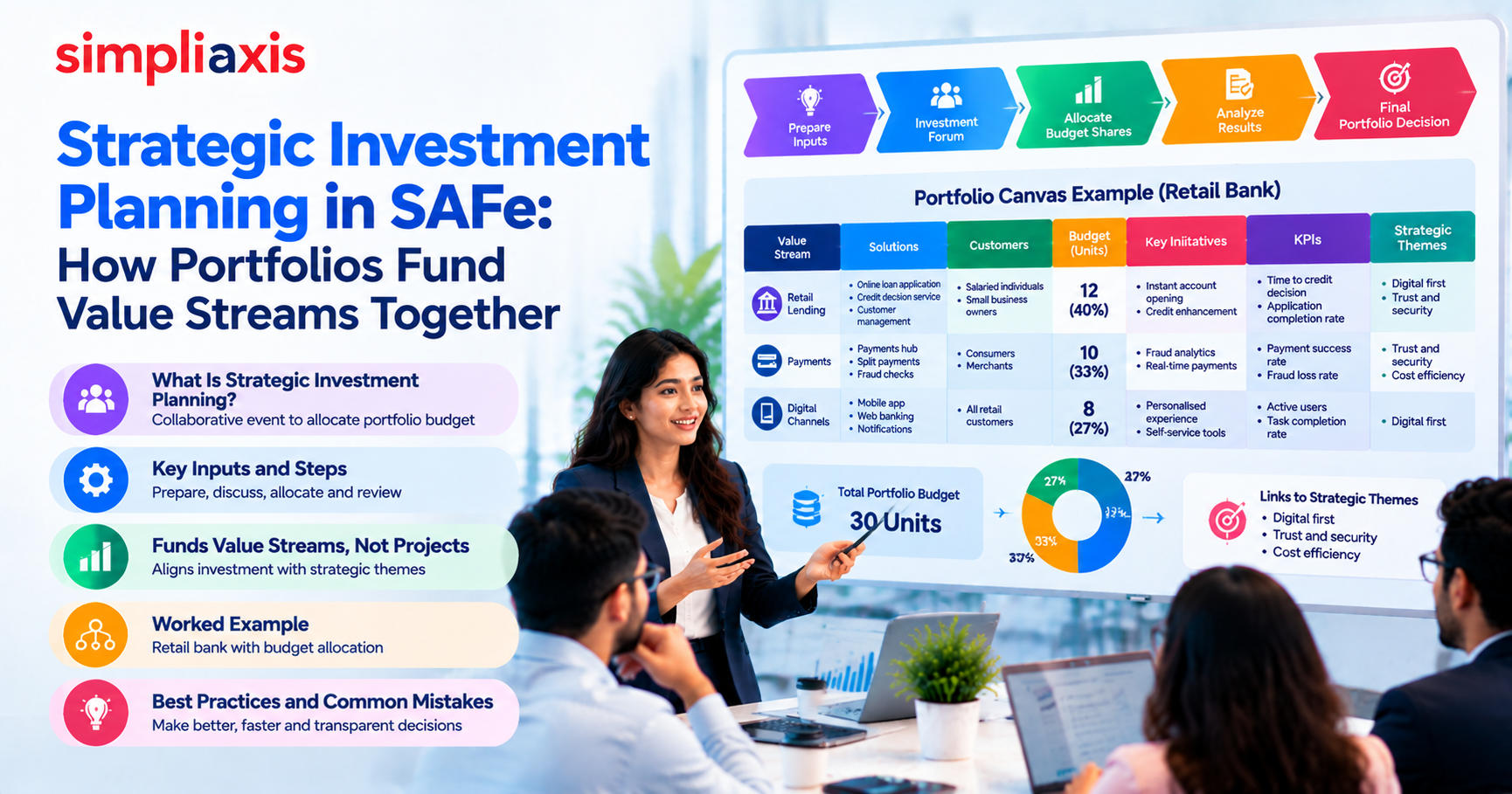
Most organisations still fund work the old way: a yearly budget cycle, a list of projects, and a long negotiation in which the loudest sponsor tends to win. SAFe offers a different answer. Instead of funding projects, Lean Portfolio Management funds value streams, and it uses a structured, collaborative event to decide how much each one should get and which large initiatives deserve investment.
That event was introduced as Participatory Budgeting. The SAFe Knowledge Base now titles the article Strategic Investment Planning, with Participatory Budgeting as the former name, so you will see both terms in courseware, blogs and exam preparation material. This guide explains what the practice is, how the inputs and steps work, who takes part, and what a worked example looks like, so you can run it or answer questions about it with confidence. If SAFe is new to you, begin with our overview of what SAFe is.
Key Highlights of Strategic Investment Planning SAFe
- Strategic Investment Planning is a collaborative event in which portfolio stakeholders decide how to allocate the portfolio budget to value streams and which initiatives to fund.
- It was previously called Participatory Budgeting, and the SAFe Knowledge Base says the name change is still in transition, so older materials use the former term.
- Participants work in small groups, pool budget shares and negotiate funding for baseline solution investments and proposed solution initiatives.
- The output informs the final budget decision made by portfolio leadership. It is input to the decision, not a vote that replaces accountability.
- The practice supports Lean budgeting by funding value streams instead of projects, and it is part of the Lean Portfolio Management competency.
What Is Strategic Investment Planning in SAFe?
Strategic Investment Planning is the SAFe practice in which portfolio leaders and stakeholders collaboratively decide how the portfolio budget is spread across value streams and which proposed initiatives, including epics, receive funding. It is described on the SAFe Knowledge Base page for Strategic Investment Planning, which also records the former name.
The practice belongs to Lean Portfolio Management, the part of SAFe that connects strategy, funding and governance. If you are new to the concept, our guide to implementing Lean Portfolio Management gives the surrounding context, and the portfolio level of the framework is explained in our overview of the four levels of the Scaled Agile Framework.
The rename from Participatory Budgeting
Participatory Budgeting was introduced in SAFe 5.0. The Knowledge Base now says the practice is transitioning to the name Strategic Investment Planning and warns that courseware and other SAFe material may still use the older name during the change. In practice, this means the two terms refer to the same practice. If you are studying for a SAFe exam, learn both names so you are not surprised by either.
Why Annual Project Budgeting Fails and How Investment Planning Helps
Traditional budgeting asks people to predict a year of work and its cost in advance. By the time the budget is approved, priorities have often changed, and money stays locked in projects that no longer matter. Moving money between initiatives needs another round of approvals, so the organisation is slow to respond.
SAFe's approach changes three things. Funding goes to long-lived value streams, so teams are not disbanded and reassembled around projects. Decisions are revisited regularly, so budgets can shift as customer and market needs change. And the decision draws on several viewpoints, so trade-offs are visible and the reasons for them are recorded. The portfolio level also fits the idea of two systems working together, a hierarchy for direction and a network for delivery, which our article on the SAFe dual operating system explains.
Inputs You Prepare Before the Forum
The SAFe Knowledge Base describes the first step as preparing the content. A forum that starts without these inputs turns into a general debate, so prepare them in advance.
| Input | What it contains |
| Business context | The current state, the Strategic Themes and the Portfolio Vision |
| Total budget and guardrails | The overall portfolio budget and the Lean budget guardrails that limit how it can be spent |
| Baseline Solution Investments | The existing solutions that need continuing funding |
| Proposed Solution Initiatives | New initiatives competing for funding, including epics |
| Time horizon and cost shares | The budget period and the share of cost each value stream carries |
Baseline Solution Investments are what it costs to keep valuable existing solutions running and evolving. Proposed Solution Initiatives are the new bets. Keeping them separate stops running costs from quietly crowding out new work, and the reverse. If you need a reminder of what an epic is, see our article on epics in Agile, and our guide to portfolio Kanban shows how epics reach the funding discussion.
Who Takes Part and How Groups Are Formed
The Knowledge Base lists participants such as portfolio leadership, Product and Solution Management, Epic Owners, architects, Business Owners and other relevant stakeholders. They are organised into groups of five to eight people, so that everyone can speak and no group is dominated by one voice. Mixing roles in each group helps, because a finance leader, an architect and a product manager see different parts of the same trade-off.
The Value Management Office, or portfolio leadership, takes the aggregate results and uses them for the final decision. The person who coordinates the event should be neutral about the outcome, and the people who bring proposals should not also decide how the votes are counted.
The Investment Forum Step by Step
The official guidance describes four steps: prepare the content, assemble the participants, conduct the forums and analyse the results. The sub-sections below add practical detail to the middle two.
Pooling budget shares
Each participant or group receives budget shares that represent a portion of the portfolio budget. The shares are pooled and used to fund items, so a group cannot fund everything. This creates a natural constraint that forces choices.
Negotiating and recording decisions
Groups discuss the baseline investments and the proposed initiatives and decide where to put their shares. The Knowledge Base stresses that groups should record the reasons for their decisions. Those reasons are often more valuable than the numbers, because they explain what the group believed about value, risk and urgency.
Analysing results
Portfolio leadership reviews the aggregated pattern of funding. A strongly funded initiative signals broad support. A split result signals disagreement that deserves more discussion. The final budget decision stays with the people accountable for it, using the forum as evidence. Our guide on LPM tips for large portfolios covers how to keep the process manageable when there are many value streams.
Worked Example: A Bank Funding Three Value Streams
This example is fictional and uses made-up numbers to show the mechanics. A bank has three value streams: Retail Lending, Payments and Digital Channels. The portfolio has 30 budget units to allocate, and the cost shares by value stream are shown below.
| Value stream | Cost share (units) |
| Retail Lending | 12 |
| Payments | 10 |
| Digital Channels | 8 |
| Total | 30 |
The baseline investments, the cost of keeping the existing solutions healthy, are agreed first.
| Baseline Solution Investment | Units |
| Lending platform | 9 |
| Payments platform | 8 |
| Digital banking app | 6 |
| Total baseline | 23 |
That leaves 7 units for new initiatives, and three proposals compete for them. Each of three forum groups receives 7 shares, so 21 shares are placed in total, and each group places its shares on the proposals it wants to fund.
| Proposed Solution Initiative | Units requested | Group 1 shares | Group 2 shares | Group 3 shares | Total shares |
| Instant account opening | 5 | 5 | 5 | 4 | 14 |
| Fraud analytics | 3 | 2 | 0 | 3 | 5 |
| New reporting platform | 4 | 0 | 2 | 0 | 2 |
| Total | 12 | 7 | 7 | 7 | 21 |
The pattern is useful. Instant account opening attracts two thirds of all shares and strong support from every group. Fraud analytics is supported by two groups and ignored by one. The reporting platform gets little interest. Requests total 12 units, but only 7 are available, so portfolio leadership has to choose. A sensible reading is to fund instant account opening in full with 5 units, give fraud analytics the remaining 2 units as a smaller first step, and defer the reporting platform, with the groups' recorded reasons to explain why. The forum has not made the decision for them, but it has shown them where the organisation stands.
Strategic Investment Planning vs Traditional Annual Budgeting
The two approaches answer different questions, and the comparison shows why Lean Portfolio Management treats funding as a continuing conversation.
| Aspect | Traditional annual project budgeting | Strategic Investment Planning |
| What is funded | Individual projects with fixed scope | Value streams and their baseline investments, plus selected new initiatives |
| Who decides | Finance and senior sponsors, often separately | Portfolio leadership using input from a mixed group of stakeholders |
| Frequency | Once a year, with slow changes mid-year | Regular cadence, so budgets can shift as needs change |
| Basis for decisions | Business cases written to win approval | Strategic Themes, evidence and recorded reasoning |
| Treatment of running costs | Often hidden inside projects | Shown as baseline solution investments |
| Response to change | Needs a new approval cycle | Rebalanced at the next planning event |
| Link to value | Projects measured against plan | Outcomes measured against the hypothesis and the business value delivered |
Seen this way, the practice is part of how an organisation turns strategy into funding decisions. Our article on business value in SAFe explains why SAFe focuses on value delivered, not on activity completed.
How the Forum Connects to Epics, WSJF and Business Cases
The initiatives competing for funding are usually epics, and each one should arrive with a Lean business case and a defined minimum viable product. That keeps the forum focused on evidence about value and risk, not on who argues best. The ideas behind this are covered in our guide to Lean Startup in SAFe, where epics are treated as hypotheses to test.
Prioritisation methods fit alongside the forum. Weighted Shortest Job First ranks epics by the cost of delay divided by job size, and the result gives participants a common reference point. Our guide to WSJF explains the calculation. Use it to inform the conversation and not to replace it, since a score cannot capture constraints such as legal deadlines or strategic bets that the portfolio has decided to make.
Facilitation Tips for Your First Event
A first event is a learning exercise, so keep it modest.
- Start small. Run it for one portfolio or a small set of value streams before scaling.
- Prepare a one-page summary of each proposal. Participants should be able to read it in five minutes.
- Use a neutral facilitator. Someone with no stake in the outcome keeps groups on track.
- Invite the right mix. Business Owners, product leaders, architects and finance should all be present. Our article on what Business Owners do in PI Planning shows how that role contributes to similar events.
- Time-box each step. Pooling and negotiating can drift if nobody keeps time.
- Record reasons as you go. Capture them at the table, not from memory afterwards.
- Close the loop. Tell participants what was decided and why, so they trust the next event.
Tools and Limits: CoFund and Budgets That Cannot Move
SAFe provides a tool called SAFe CoFund that supports the event. It links value streams, strategic themes and investment horizons, and records stakeholder input as it happens. You do not need it to start, since a spreadsheet and a facilitated workshop work for a first run, but a tool helps when there are many participants or several budget cycles.
There are limits to the practice. A SAFe article on the color of money problem notes that the approach assumes money can be moved freely, which is often untrue. Government earmarks and some restricted funding cannot be reallocated, so the forum must work within those limits and be open about them. Another practical limit is time. A large portfolio can run the event only at a sensible cadence, so keep the number of decisions on the table small and focused on the biggest ones.
Strategic Investment Planning in the SAFe LPM Exam
The topic belongs to the investment funding area of Lean Portfolio Management. The Scaled Agile study guide for the Lean Portfolio Manager 6.0 exam lists 45 questions in 90 minutes, a 77 percent pass mark and seven domains, with Establishing Investment Funding weighted at 16 to 18 percent. Check the current guide before you sit the exam, because details can change.
To see how this topic fits a study plan, read our LPM syllabus overview and the article on steps to pass the SAFe LPM exam. Our SAFe LPM practice test lets you check your understanding. Learn both names of the practice, the four steps, the two kinds of investment and the role of guardrails, because questions usually test those ideas.
Common Mistakes in Investment Planning
- Starting without prepared inputs. Without the Strategic Themes, budget and baseline costs, the forum becomes opinion.
- Mixing running costs and new bets. Baseline and proposed investments should be visible separately.
- Treating the result as a vote. The outcome informs the decision. It does not remove accountability.
- Ignoring constraints. If some money cannot move, say so at the start.
- Letting senior voices dominate. Small mixed groups and recorded reasons protect against this.
- Doing it once. A single event does not give a Lean budget. The practice works when it is repeated on a regular cadence.
- Funding projects again. If every item in the forum looks like a project with a fixed scope, the portfolio is using the new name for the old behaviour.
Conclusion
Strategic Investment Planning gives a portfolio a structured, transparent way to fund value streams and decide which large initiatives to back. Prepare the inputs, separate baseline investments from new proposals, form small mixed groups, record the reasons and use the results to support, not replace, the accountable decision. Learn both names of the practice, because courseware and exams may use either.
Learn how portfolios decide and fund work: Build your skills with the Lean Portfolio Management certification training.
Start with the foundations of scaled Agile: Explore the Leading SAFe certification training.






 Lowest-Price Challenge












 Personalized Path



.webp)


 USA
 Canada
 India
 UK
 Australia
 Singapore


