


 Call Us




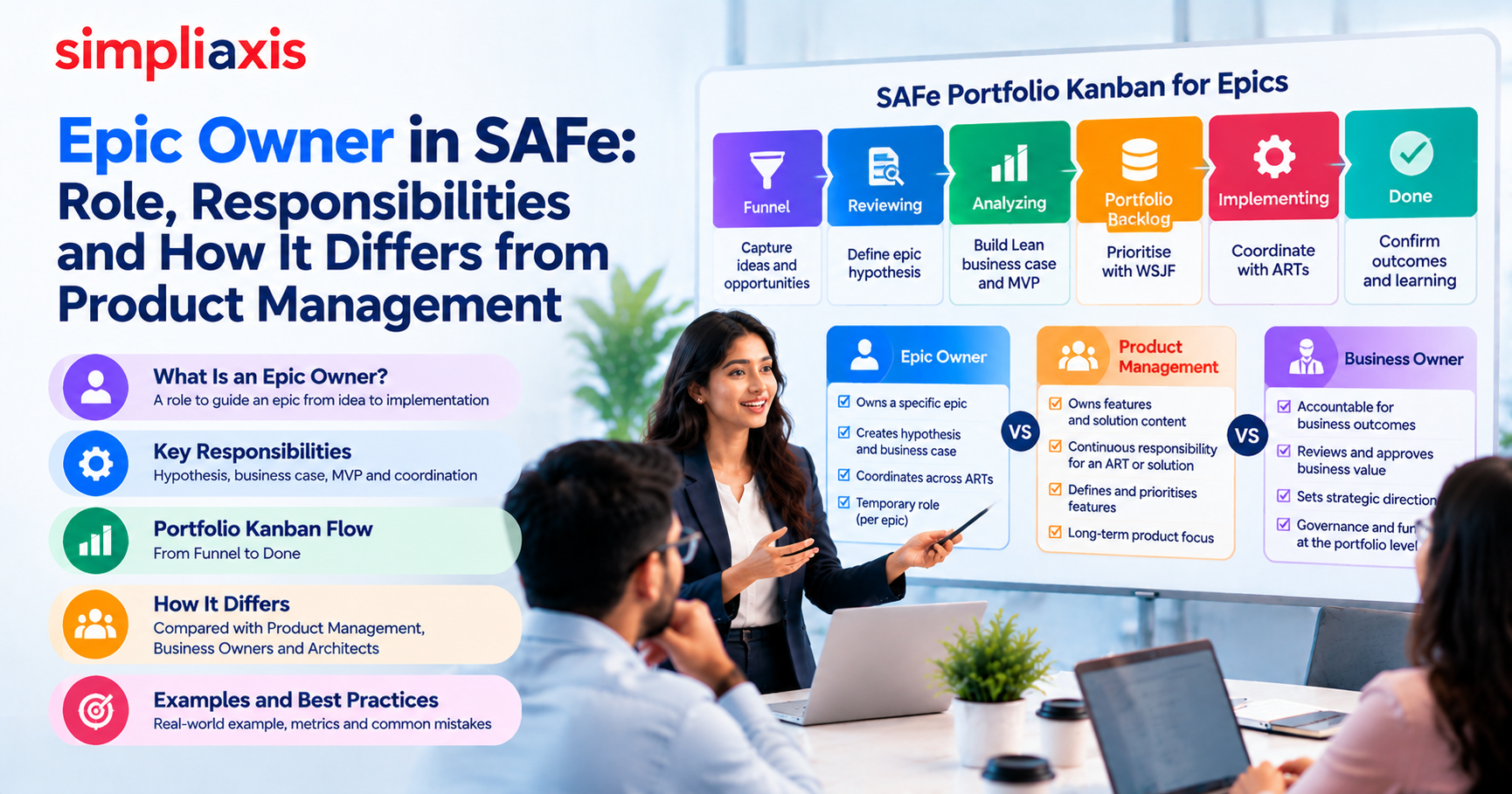
Large Agile organisations often discover that their biggest initiatives belong to nobody. Features have Product Managers, stories have Product Owners and teams have Scrum Masters, but a cross-team initiative that will take months and a large share of the budget can fall between the roles. SAFe closes that gap with the Epic Owner.
This guide explains what an Epic Owner is, what the role does at each stage of the Portfolio Kanban system, how it differs from Product Management, Business Owners and architects, and how to write the hypothesis and Lean business case that an Epic Owner is responsible for. It includes a worked example and a short list of mistakes, so you can recognise the role in your own organisation or explain it in an interview or exam.
Key Highlights of SAFe Epic Owner
- An Epic Owner is a role that someone takes on for a specific epic. It is not a job title or a permanent position.
- The Epic Owner guides an epic through the Portfolio Kanban system, defines its hypothesis, Lean business case and minimum viable product (MVP), and coordinates its start with the Agile Release Trains.
- The role is different from the Product Manager, who owns content at the ART level, and from Business Owners, who are accountable for business outcomes.
- Enterprise Architects typically act as Epic Owners for enabler epics, according to the SAFe Knowledge Base.
- A good Epic Owner brings evidence, collaboration and economics to the portfolio, and does not act as a lone decision maker.
What Is an Epic Owner in SAFe?
An Epic Owner coordinates an epic through the Portfolio Kanban system, working with stakeholders to define the epic, its Lean business case and its MVP, and then, if Lean Portfolio Management approves it, coordinating its introduction into implementation with the Agile Release Trains. That is the definition the SAFe Knowledge Base gives for the Epic Owner role, in slightly more words.
An epic, in SAFe, is a large solution development initiative that is big enough to need a business case and portfolio-level approval. If you need a refresher on the term, read our explanation of what an epic is in Agile and how an epic differs from a feature and a user story.
A role, not a job title
SAFe is explicit that Epic Owner is a role that a person assumes for an epic. Nobody is hired as an Epic Owner in the way someone is hired as a Release Train Engineer. In practice the person is often a Product Manager, a senior business stakeholder or an architect with the right knowledge. Our overview of roles in SAFe shows where this role sits among the others.
SAFe guidance has also said that an Epic Owner typically works with one or two epics at a time. That is a useful sanity check. An Epic Owner who has ten epics is not coordinating, only tracking.
Epic Owner Responsibilities Across the Portfolio Kanban System
The Portfolio Kanban system makes the flow of epics visible. SAFe describes its states as Funnel, Reviewing, Analyzing, Portfolio Backlog, Implementing and Done, and our article on portfolio Kanban explains each state in more detail. The table shows what an Epic Owner typically does at each one.
| Portfolio Kanban state | What the Epic Owner does |
| Funnel | Captures the idea and frames the problem or opportunity |
| Reviewing | Writes the epic hypothesis statement and checks it against Strategic Themes |
| Analyzing | Leads the work on the Lean business case and MVP, and collaborates on sizing for prioritisation |
| Portfolio Backlog | Provides context while Lean Portfolio Management and stakeholders prioritise |
| Implementing | Coordinates the start of work with the ARTs and supports the teams as the epic is built |
| Done | Hands the ongoing ownership of what was built to the ARTs and confirms what was learned |
The official page emphasises collaboration. An Epic Owner does not do the analysis alone. The role takes responsibility for the collaborations needed: Business Owners, Product Management, architects and teams all contribute to the epic's definition.
Two ideas that make the role easier to understand
First, the Epic Owner is responsible for the quality of the case, not for forcing approval. If the evidence shows an epic should not go ahead, a good Epic Owner says so. Second, the Epic Owner is a coordinator across ARTs. Epics often involve more than one train, and someone has to hold the thread between them, which is where the role earns its keep. The guide to implementing Lean Portfolio Management shows where this coordination fits in the wider portfolio process.
Epic Owner vs Product Manager vs Business Owner vs Architect
People confuse these roles because they overlap in conversation. They differ in scope, level and accountability.
| Role | Main focus | Typical level | How it relates to the Epic Owner |
| Epic Owner | One epic from idea to implementation | Portfolio | The role itself |
| Product Manager | Features and priorities for a solution or ART | ART or Solution | Often takes the Epic Owner role for epics inside one ART |
| Business Owner | Business outcomes and governance for an ART | ART | Reviews the business case and the value the epic should deliver |
| Enterprise or Solution Architect | Technical direction and enablers | Enterprise or Solution | Typically takes the role for enabler epics |
| Product Owner | Team backlog and stories | Team | Receives work after features are defined |
The Product Manager and the Epic Owner are the pair most often mixed up. The difference is mostly one of scope and time. A Product Manager is continuously responsible for the content of a solution or train, while an Epic Owner is responsible for a specific epic until it is handed over. Our article on SAFe Product Manager vs Product Owner clarifies the role below, and the piece on Product Management responsibilities in SAFe covers the role beside the Epic Owner.
In smaller portfolios, with only a few ARTs, one person commonly holds both roles. That is fine as long as the person is clear about which hat they are wearing in a conversation.
Writing the Epic Hypothesis and Lean Business Case
Two documents carry most of an Epic Owner's work. The first is the epic hypothesis statement, which captures the idea and the benefit you expect. The second is the Lean business case, which tests that hypothesis before large investment.
The epic hypothesis statement
SAFe's epic hypothesis statement follows a template that fits on one page: for a type of customer who has a need, the solution is a type of offering that provides a benefit, unlike an alternative, our solution does something better. It also records the business outcomes you expect, the leading indicators that will tell you early whether you are right, and any nonfunctional requirements.
A fictional example for a lending business:
| Element | Example |
| Epic name | Instant account opening for small businesses |
| For | Small business owners who need a business account quickly |
| The solution is | An online onboarding service |
| That provides | Account approval and setup in one session |
| Unlike | The current process that needs a branch visit |
| Business outcome hypothesis | More completed applications and fewer drop-offs |
| Leading indicators | Share of applications completed in one session, early customer feedback |
| Nonfunctional requirements | Identity verification and data protection rules apply |
The Lean business case
A Lean business case is deliberately light. It usually covers the epic description, the hypothesis and expected business outcomes, the MVP, an estimate of size and cost, key risks and dependencies, and how success will be measured. The aim is to give Lean Portfolio Management enough evidence to decide, not to write a long document. Our article on Lean Startup in SAFe explains how the MVP and hypothesis ideas work in the framework.
The MVP matters because it lets the organisation test the hypothesis with a small investment before committing the full budget. In the example above, the MVP might offer instant onboarding to one customer segment in one region.
Prioritisation and Flow: Where the Epic Owner Adds Evidence
Epics compete for limited capacity. SAFe uses Weighted Shortest Job First, or WSJF, to compare them: the cost of delay divided by job size. The Epic Owner does not score alone. Instead they supply the information the scoring depends on, such as the value to the business, the urgency, the risk reduced and the size of the work, and then take part in collaborative scoring with Business Owners and architects. Our guide to WSJF explains the calculation, and the SAFe Knowledge Base describes WSJF prioritisation in its own terms.
A short fictional calculation shows how the numbers work. Cost of delay is the sum of user and business value, time criticality, and risk reduction or opportunity enablement, each scored on a relative scale. WSJF is that total divided by job size.
| Epic | User and business value | Time criticality | Risk reduction or opportunity | Cost of delay | Job size | WSJF |
| Instant account opening | 13 | 8 | 5 | 26 | 13 | 2.0 |
| Document upload redesign | 5 | 3 | 3 | 11 | 3 | 3.7 |
| New reporting platform | 8 | 2 | 13 | 23 | 21 | 1.1 |
The smallest epic wins on this scoring, which is the point of WSJF: it favours work that delivers a lot of value quickly. The Epic Owner's contribution is the evidence behind each score, and the final scores come from the group, not from one person.
The table below shows a simple way to agree who does what, which most sources on the role leave out.
| Decision or task | Epic Owner | Business Owners | Product Management | Architects | Lean Portfolio Management |
| Write the epic hypothesis | Leads | Consulted | Consulted | Consulted | Informed |
| Build the Lean business case and MVP | Leads | Contributes | Contributes | Contributes | Reviews |
| Score with WSJF | Facilitates inputs | Scores | Scores | Scores | Informed |
| Approve for implementation | Recommends | Consulted | Consulted | Consulted | Decides |
| Coordinate start with the ARTs | Leads | Informed | Contributes | Contributes | Informed |
| Review the outcome | Reports | Reviews | Reviews | Informed | Reviews |
Flow limits matter too. If the analysis state is full, the sensible action is to help clear a bottleneck, not to push another epic in. Visible work in process limits stop the portfolio from starting more than it can finish, and tips for doing this at scale appear in our article on LPM in large portfolios.
Worked Example: An Epic from Idea to Implementation
This example is fictional and meant to show the sequence. The lending business above wants to offer instant account opening.
| Stage | What happens | Who is involved |
| Funnel | A product leader raises the idea after seeing drop-off in the branch process | Product leader, Epic Owner named |
| Reviewing | The Epic Owner writes the hypothesis and checks fit with the Strategic Themes | Epic Owner, portfolio leadership |
| Analyzing | The Epic Owner leads work on the Lean business case and MVP, with architects sizing the effort and Business Owners assessing value | Epic Owner, architects, Business Owners |
| Portfolio Backlog | The epic is scored with WSJF against other epics and approved for the next period | Lean Portfolio Management |
| Implementing | The Epic Owner works with the two ARTs that will build the MVP and clarifies scope as questions arise | Epic Owner, Product Managers, teams |
| Done | The MVP results are reviewed and the ARTs own the further development | ARTs, Product Management |
At the end, the Epic Owner reports on the leading indicators defined at the start. If the share of applications completed in one session did not rise, the portfolio can stop or change the epic before more money is spent.
Who Should Be Epic Owner and How Many Epics at a Time
Choose the person with the most relevant knowledge and the ability to bring people together, not necessarily the most senior person. A Product Manager is a natural choice for epics inside one ART. An architect fits enabler epics. A senior business stakeholder can fit epics that change a market offer.
The role needs three things to work: access to data, authority to convene stakeholders and enough time. If an Epic Owner cannot get Business Owners into a room, or cannot see cost and customer data, the role exists only on paper. Keep the load to a small number of epics, and agree in advance how much time the role needs in each stage.
For a deeper look at how Business Owners take part in planning, which is relevant when they review a Lean business case, see what Business Owners do in PI Planning.
How to Measure Whether the Epic Owner Role Is Working
An Epic Owner role that nobody measures tends to drift into administration. A small set of measures keeps it honest. These are practitioner suggestions rather than a mandated SAFe scorecard, so adapt them to your portfolio.
| Measure | What it shows | Where to look |
| Epic cycle time and lead time | How long epics take to move through analysis and implementation | Portfolio Kanban data |
| Throughput | How many epics finish in a period | Portfolio Kanban data |
| Time in each state | Where epics wait, such as a full analysis state | Cumulative flow view |
| Hypothesis validation rate | How often the leading indicators confirm the original idea | Epic reviews |
| First-pass approval rate | How often the Lean business case is approved without major rework | Portfolio sync records |
| Business outcome reached | Whether the expected benefit appeared | Outcome measures chosen at the start |
Flow measures such as these are explained in more detail in our article on SAFe flow metrics. The most informative signs are often the negative ones: epics that stall in analysis, business cases that were never updated after approval, and stakeholders who bypass the Epic Owner because the role has no real influence. If you see these, the fix is usually clearer decision rights and better access to data, not more meetings.
The Epic Owner in SAFe Exams and Interviews
Questions about the Epic Owner appear in Lean Portfolio Management study and in SAFe interviews, usually in one of three forms: define the role, say who typically takes it, or explain how it differs from Product Management. The short answers are in the sections above.
For exam preparation, the Scaled Agile study guide for the Lean Portfolio Manager 6.0 exam describes 45 questions in 90 minutes with a 77 percent pass mark, across seven domains that include realizing the portfolio vision through epics. Our LPM syllabus overview and the guide to passing the SAFe LPM exam show how this topic fits the wider study plan. Always confirm exam details in the current official guide before you register, because they can change.
Common Mistakes with the Epic Owner Role
- Treating it as a title. Naming a permanent Epic Owner for everything creates a bottleneck. The role belongs to an epic.
- Writing the business case after the decision. If the case is only paperwork, the portfolio is not learning.
- No measurable hypothesis. An epic without leading indicators cannot be judged later.
- Owning without authority. Epic Owners need the standing to convene stakeholders and see the data.
- Letting the case go stale. Update the Lean business case if facts change during implementation.
- Starting too many epics. Without work in process limits, epics stall in analysis.
- Mixing up levels. Product Managers, Product Owners and Epic Owners work at different levels, and blurring them causes rework.
Conclusion
The Epic Owner gives a large initiative a clear coordinator without creating a new permanent job. Treat the role as a responsibility for one epic: write a testable hypothesis, build a light but honest Lean business case, define an MVP, collaborate on prioritisation and hand over cleanly to the Agile Release Trains. Keep the number of epics small, give the person real access and authority, and review the leading indicators when the work is done.
Learn how portfolios decide and fund epics: Build your skills with the Lean Portfolio Management certification training.
Move into product leadership at scale: Explore the SAFe Product Owner/Product Manager certification.







 Lowest-Price Challenge












 Personalized Path



.webp)


 USA
 Canada
 India
 UK
 Australia
 Singapore


