


 Call Us



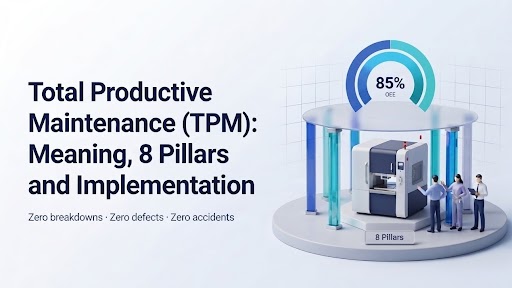
TPM is a Lean approach in which the operator, the maintenance team and the manager are all jointly responsible for the health of the equipment. The goal is zero breakdowns, zero defects and zero accidents. It is based on 8 pillars, it targets the six big losses and it is measured via OEE (Overall Equipment Effectiveness).
Key Highlights of Total Productive Maintenance (TPM):
- Total productive maintenance is a Lean-aligned system where operators, technicians, engineers and managers share ownership of equipment health. Its goals are zero breakdowns, zero defects and zero accidents.
- TPM grew out of Japanese manufacturing and was developed by Seiichi Nakajima. It is broader than preventive maintenance, which is only one technique within it.
- The 8 pillars are autonomous maintenance, planned maintenance, quality maintenance, focused improvement, early equipment management, training and education, safety, health and environment, and TPM in administration.
- The six big losses are breakdowns, setup and adjustments, small stops, reduced speed, startup rejects and production rejects. They map to availability, performance and quality.
- OEE (availability × performance × quality) is the main TPM scorecard. A commonly cited world-class benchmark is 85%.
- Implementation works best in phases. Start with 5S, pilot on one machine, then scale across the plant while tracking OEE, MTBF, MTTR and safety metrics.
- TPM supports Lean Six Sigma by stabilizing equipment so waste reduction and variation control can deliver lasting results.
Introduction
Every plant has the same tale. A machine stops in the middle of a shift. The operators just sit and wait. Maintenance comes rushing in. Output is down and the schedule is behind.
Most teams see this as a maintenance issue. TPM sees it as a shared issue. The simple question it poses is 'who knows the machine best?' The answer is invariably the operator who runs the machine every day.
TPM manufacturing programmes put that knowledge into practice. The operators clean, inspect and lubricate their own machines. The maintenance people are then left to do the more in-depth planned maintenance. The engineers are then able to design equipment which is easier to run and easier to maintain.
This guide explains what TPM is and goes through each of the 8 pillars. It covers the 6 big losses, the relationship between TPM and OEE and a practical implementation plan. It also shows where TPM sits in relation to Lean Six Sigma projects.
If you're new to Lean thinking then start with what the Lean process is. That gives you the context that TPM is built upon.
What is Total Productive Maintenance?
Total Productive Maintenance is a systematic approach to keeping equipment in good order through the involvement of everyone in the plant. The word 'total' is significant in that it encompasses all people, all equipment and the complete life of each piece of machinery.
The meaning of total productive maintenance can be broken into three ideas:
- Total means every department is involved, from the operators right up through to top management.
- Productive is all about the output and the quality, not just about the repairs.
- Maintenance is about keeping the equipment in perfect condition at all times.
In many plants, production owns the machine and maintenance owns the repair. That leads to delays and blame. TPM removes that split. Production and maintenance share ownership of uptime.
The main goals of TPM maintenance are easy to remember:
- Zero unplanned breakdowns
- Zero defects
- Zero accidents
These goals may sound very ambitious. They're not a daily scorecard in any way. They're just a direction of travel and the team will achieve them by eliminating the losses one at a time.
TPM is also a fundamental tool within Lean. The aim of Lean is to eliminate waste from every process. Breakdowns, waiting and rework are all forms of waste. You can find out more about the seven wastes of Lean in this guide. TPM is the tool that is used to deal with the equipment related waste.
The Lean Enterprise Institute has a definition of it in their lexicon (entry on TPM). It's a useful short definition for teams building a common language.
History of TPM
TPM grew out of Japanese manufacturing. Seiichi Nakajima is generally credited as the 'father' of TPM and developed the approach in Japan during the 1950s and 1970s. The concept of preventive maintenance itself came from the US. The Japanese manufacturers took up the idea and took it a lot further.
In 1971, the Japan Institute of Plant Maintenance (JIPM) established the PM Prize. The first winner was Nippon Denso (now DENSO). The programme was then extended to cover eight activities within the business.
Nakajima wrote the first English book on the subject (Introduction to TPM), which was published by Productivity Press in 1988. That book was the vehicle that took TPM out of Japan. TPM has been adopted by plants in the auto, steel, chemical, food, and pharma industries all over the world.
The original version had just 5 core principles. JIPM subsequently developed it into 8 pillars (often referred to as company wide TPM). The expanded model drew on lessons from Lean manufacturing and total quality management.
TPM vs Preventive Maintenance
Many people confuse TPM with preventive maintenance and the two are in fact quite closely linked, but they are not the same.
Preventive maintenance is a technique in that you schedule inspections, lubrication and part changes at set intervals. The maintenance staff do this.
TPM is a full management system. Preventive maintenance is just one element of it. TPM includes operator care, loss analysis, training, design feedback and safety.
| Factor | Preventive maintenance | Total productive maintenance |
| Scope | Maintenance activities | Whole organization |
| Who acts | Maintenance team | Operators, maintenance, engineers, managers |
| Main focus | Prevent failure on a schedule | Eliminate all equipment losses |
| Measure | Schedule compliance, downtime | OEE and the six big losses |
| Culture | Department task | Shared ownership |
Think of it like this: preventive maintenance is asking "did we do the machine's service on time?" TPM is asking "why is this machine losing output at all?"
The 8 Pillars of TPM
The eight pillars of TPM form the structure of the method. Each pillar addresses a different source of loss. Taken together they create a plant that runs smoothly and safely.
Some versions give the pillars in a different order. The names do vary from source to source. The substance of the ideas is the same though.
Autonomous Maintenance
Autonomous maintenance is the basis (the Japanese term is Jishu Hozen). The operator takes over with the basic maintenance of the machine (cleaning, inspection, lubrication, tightening etc).
This goes beyond just keeping the machines clean. Cleaning is in fact an inspection. The operator is looking out for leaks, loose bolts, odd noises etc. when they go and clean the machine. The small things are picked up before they become a failure.
Autonomous maintenance usually moves through steps:
- Do an initial clean and inspection of the machine.
- Fix the sources of dirt and any areas that are difficult to get to.
- Just write simple cleaning and lubrication standards.
- Train operators in general inspection skills.
- Just hand the routine checks over to the operators.
This pillar also frees the maintenance people. They spend less time on routine jobs and more time on more complex problem solving.
Planned Maintenance
Planned maintenance is the maintenance department's responsibility. They put together a structured programme to prevent failures.
A good plan is data driven. You look at the failure history, the machine criticality and the manufacturer's advice and then pick the method that is appropriate for that asset.
Planned maintenance combines several approaches:
- Preventive maintenance: time based or usage based service.
- Predictive maintenance: condition monitoring using sensors, vibration checks and thermography.
- Corrective maintenance: planned maintenance to repair a part (to restore or improve it).
- Reliability centred maintenance: a method of working out the right strategy for each failure mode.
Predictive maintenance will often use sensor data to schedule work only when it's required. That's obviously going to be cheaper than having a fixed interval on every asset.
Strong maintenance management is the key. It encompasses work orders, spare parts, schedules and records. A lot of plants will use a CMMS or some similar Total Productive Maintenance software to manage it.
Quality Maintenance
Quality maintenance (Hinshitsu Hozen) is the concept of linking equipment condition to product quality. The principle is straightforward really. If the machine is in the right condition it can't make a defect.
Teams identify which equipment settings have an effect on quality (examples would be temperature, pressure, alignment etc). They then establish the correct values and check them regularly.
This is different from end of line inspection. Inspection is finding defects after they've already occurred. Quality maintenance is preventing the defects from occurring in the first place.
The pillar is based on Six Sigma thinking. Teams use data, control limits and process capability to keep things in a state of control. A Six Sigma control plan is a good example of how you'd document such checks.
Focused Improvement
Focused improvement (or Kobetsu Kaizen) is about tackling chronic losses. A cross functional team selects a particular loss and then works on it using a structured problem solving approach.
A typical team will have an operator, a maintenance tech, an engineer and a quality person. They all have different perspectives on the same issue.
The team follows a clear path:
- Select a loss from the OEE data.
- Measure the current state.
- Find the root cause with proven tools.
- Test and apply the fix.
- Standardize the result.
Common tools are the 5 Whys, fishbone diagrams and Pareto charts. A good root cause analysis is the essence of this pillar. If you don't have that then you're just treating the symptoms and the losses will come back.
This pillar is also where TPM comes together with broader process improvement. The same mindset applies to machines as it does to workflows.
Early Equipment Management
Early equipment management takes the lessons learned from one piece of equipment and applies them to the design and improvement of a new one. It's sometimes referred to as early management.
Maintenance teams will know which designs are the ones that consistently fail. They'll know which bits are difficult to get to and which are difficult to clean. That knowledge is frequently lost when the company goes and buys a new piece of equipment.
The engineers involve maintenance and operations staff in the design and procurement stages. The end result is equipment that is easier to operate, easier to clean and easier to repair.
The pay off is apparent right from the start. The new machines start up quicker and have far fewer teething problems. The lifetime cost is also lower.
Training and Education
TPM only works when people have the right skills and this pillar is all about building those skills in a planned way.
Operators get the basic machine knowledge and inspection skills. The maintenance people get the advanced diagnosis and repair skills. The managers get the skills in how to run a TPM programme and how to interpret the data.
A common model builds skill in four levels. People first learn to know problems. Then they understand causes, prevent problems, and finally eliminate them.
Lots of organisations also invest in formal TPM training. Short workshops, on the job coaching and skill matrices are all part of the package. Some people will go on to acquire more general credentials (e.g. a Lean Six Sigma Green Belt) to give themselves the confidence to lead improvement projects.
Safety, Health and Environment
Safety, health and environment (SHE) runs through every other pillar. The target is zero accidents, zero health damage and zero environmental incidents.
Autonomous maintenance obviously improves safety. Clean floors mean fewer slips. Guards and lockout procedures protect the operator when they're doing the adjustment work. The team will also fix any oil or chemical leaks at the root cause.
Teams also do risk assessments and look at near misses. They eliminate hazards at the design stage where they can.
A safe plant is also a productive plant. Accidents lead to downtime, injuries and loss of confidence. TPM treats safety as part of reliability rather than as a separate initiative.
TPM in Administration
The final pillar takes TPM beyond the shop floor. Office and support functions also generate waste. Examples would be slow order processing, poor scheduling, missing materials and delayed information.
Administrative TPM applies the same tools to these areas.The team will map the process, often with value stream mapping, identify the losses and fix them. All of the areas can be involved in this: planning, purchasing, logistics, finance, and HR etc.
This pillar is important as production is absolutely dependent on the support functions. A machine won't run if the correct part or the correct order hasn't arrived. Efficient, clean administration is what keeps the plant running.
The Six Big Losses
The six big losses are at the heart of TPM analysis. They are the principal reasons why equipment loses productive time. Each one corresponds to a component of OEE.
Breaking losses into categories gives you a common language. It also tells you where to look first.
Loss Categories Table
| Loss | OEE factor | What it means | Typical causes |
| Equipment breakdowns | Availability | Unplanned stops from failure | Tool failure, part wear, poor lubrication |
| Setup and adjustments | Availability | Time lost during changeovers | Slow changeovers, material shortages, warm-up |
| Small stops | Performance | Short stops under a few minutes | Jams, misfeeds, blocked sensors |
| Reduced speed | Performance | Running below ideal cycle time | Wear, rough running, wrong settings |
| Startup rejects | Quality | Defects during start-up | Warm-up issues, adjustments |
| Production rejects | Quality | Defects during steady production | Process drift, poor conditions |
This mapping follows the standard OEE model, linking each loss to availability, performance, and quality.
Here is how each loss plays out in practice:
- Breakdowns are the most obvious. A motor fails and the line is stopped. They're reduced by both autonomous and planned maintenance.
- Setup and adjustment takes time on every changeover. Standard work and quick changeover methods will help with this.
- Small stops are easy to ignore. A jam clears in 30 seconds but it happens fifty times a shift. The total is significant.
- Reduced speed is right in front of you. The machine is running but at a speed less than its design speed.
- Startup rejects occur when the machine is warming up or after a stop and adjustment.
- Production rejects occur during normal runs when the conditions drift.
The six major losses map directly onto Lean's seven wastes. The equipment data show waiting, defects and over processing.
TPM and OEE
OEE is the key scorecard for TPM. It's a measure of how much of your planned production time is actually productive. The Lean Enterprise Institute defines it in its OEE lexicon entry.
OEE multiplies three factors:
- Availability: the percentage of planned time that the machine is actually running.
- Performance: how close the speed is to the ideal cycle time.
- Quality: the percentage of good parts out of all parts made.
How OEE Measures TPM Results?
OEE takes the TPM objectives and turns them into numbers. It tells you whether the programme is working and where you need to look next.
A machine is intended to run 480 minutes per shift. It loses 48 minutes to breakdowns and changeovers. Availability is 90%.
It runs at 95% of the ideal speed. Performance is 95%. 98% of the parts made are good. Quality is 98%.
OEE is at 83.8%. The team can now see which of the factors is the weakest. Availability is the biggest gap so breakdowns and setups are the priority.
A widely cited benchmark for world class OEE is 85% (Seiichi Nakajima is credited with this). Most plants are below that level. The gap is the opportunity.
OEE is not just a target. It's a diagnostic. A low score tells you that losses are present. The six major losses tell you which ones.
Teams should be looking at OEE for the same machine over time. Comparing OEE for very different machines can be very misleading. A packing line and a casting press will have very different baselines.
How to Implement TPM Step by Step?
TPM is a long journey. Plants will often take three years or more to mature. A phased approach is essential to keep the effort realistic.
Here's a practical route.
- Get leadership commitment. TPM takes time, takes training, and takes patience. Leaders have to be on board.lude production, maintenance, quality, safety, and engineering.
- Set clear goals. Set clear goals and link them to OEE, breakdown hours, defects, and safety. Capture current OEE and the six big losses.
- Start with 5S. Build a clean and orderly workplace.
- Run a pilot. Prove the method on a single machine. Train operators and set standards.
- Build planned maintenance. Use data to schedule work.
- Add the other pillars. Bring in quality, early equipment management, training, safety, and administration.
- Review and sustain. Audit often and celebrate wins.
Each step builds on the one before it. Skipping steps usually leads to weak results.
Start With 5S
5S is the starting point for most TPM programs. It creates the clean, orderly base that autonomous maintenance needs.
The five steps are sort, set in order, shine, standardize, and sustain. They remove clutter, mark locations, and set daily habits. You can learn how it fits into quality systems in this overview of 5S in Six Sigma.
Why start with this? A messy workplace is a minefield of problems. Oil on the floor is a sign of a leak. A cluttered tool crib is going to waste your time looking for tools. Cleaning the machine will also reveal any defects.
Run a red tag exercise first (flag and remove anything you don't need). Then go in and properly clean the area. Take before and after photos to demonstrate the difference.
The 'shine' step overlaps with the first step of autonomous maintenance. The two go hand in hand.
Pilot on One Machine
Don't go across the whole plant on day one. Pick one machine for a pilot.
Pick a machine that makes a real difference. It should be one that is a bottleneck, one that is a frequent source of pain. It should also have a team that is willing to work on it. A real win in that area will generate the momentum you need.
During the pilot, follow this routine:
- Record the baseline OEE and the six big losses.
- Clean and inspect the machine with the operators.
- Tag and fix abnormalities.
- Write down simple standards for cleaning and lubrication.
- Track the results weekly on a visual board.
Run the pilot for 3-6 months. Look at what worked and what didn't. Then tweak your approach prior to scaling.
Then onto the next machine. Use the pilot team as coaches. Their story is far more compelling than any slide deck.
TPM Manufacturing Examples
Real examples of how TPM manufacturing works in practice. The examples below are illustrative scenarios, not case studies of actual companies.
- Automotive parts plant. A stamping press stops several times per shift due to die misfeeds. Operators start off each shift with a clean and inspect the dies. They come across a worn guide which is the cause of the misfeeds. Maintenance replace the guide and add it to the planned maintenance checklist. The number of small stops drops dramatically and performance improves.
- Food and beverage line. A filling line is losing time during flavour change overs. A focused improvement team looks at the change over steps. They segregate the tasks that can be done whilst the line is running from those that require a stop. Setup time is reduced and availability is improved.
- Pharmaceutical packaging. A blister machine will produce seal defects if the temperature drifts. The Quality Maintenance pillar will set the correct temperature range. The operators will check it at the start of each shift. Production rejects go down.
- Steel or process plant. A pump can fail without any warning and that will stop a continuous process. The plant has vibration monitoring as part of its predictive maintenance programme and the technicians are now able to see the wear coming and can plan the repairs around the scheduled stops.
- Electronics assembly. A new line comes in with a lot of early faults. The engineers never asked maintenance for any input on the design. On the next line early equipment management gets operators and technicians into the design reviews. The new line starts up much quicker.
TPM in Lean Six Sigma Projects
TPM and Lean Six Sigma are very much complementary. Both are about eliminating waste and reducing variation. Both are data driven and both require engaged teams.
Lean provides the flow and waste perspective. Six Sigma provides the statistical tools. TPM provides the equipment reliability base. You can't get stable results from either Lean or Six Sigma without stable machines.
Here is how they connect:
- Lean removes the waste of waiting, the waste of defects and the waste of motion. TPM removes the equipment causes of that waste.
- Six Sigma reduces variation. TPM keeps the machines in a state of stability so that variation remains low.
- DMAIC projects can be aimed at reducing TPM losses. For instance a team might select breakdowns as their problem.
Take a project on freqf you’re new to Six Sigma then this overview is a good place to start. uent small stops. In Define you state the problem and the goal. In Measure you collect the stop data by cause. In Analyse you find the root causes. In Improve you test the fixes. In Control you update the standards and the check sheets.
It helps to have an understanding of the principles of Lean Six Sigma before you start. If you're new to Six Sigma then this overview is a good place to start.
Professionals who are leading the projects will typically have a certification. You can test your own readiness prior to sitting the exam with a Lean Six Sigma Green Belt practice test.
TPM Metrics to Track
Good metrics keep the TPM programme honest. Track a small number and review it frequently.
- OEE: the overall score (plus availability, performance and quality).
- MTBF: mean time between failures. The higher the better.
- MTTR (Mean Time To Repair) - lower is better.
- Breakdown hours: total unplanned downtime.
- Planned maintenance compliance: the percentage of planned work carried out on time.
- First pass yield: the percentage of good parts with no rework.
- Safety incidents: accidents and near misses.
- Autonomous maintenance audit scores: how well the operators are adhering to the standards.
Lots of these are linked to the more standard Six Sigma metrics (yield, defect rates etc). The common metrics enable the quality and maintenance teams to be speaking the same language.
Show the data on the visual boards located adjacent to the machines. Update them on a daily or weekly basis. The operators should be able to see their own results. That fosters a sense of ownership.
Conclusion
TPM changes the way a plant thinks about its equipment. Maintenance is no longer the sole owner of the machines. It's a shared responsibility with clear standards, good data and the right people.
The eight pillars provide a complete framework. Autonomous maintenance and planned maintenance will of course stabilise the machines. Quality maintenance and focused improvement will eliminate the defects and chronic losses. Early equipment management, training, safety and administration all contribute to the long term strength of the organisation.
The benefits of TPM are obvious and quantifiable. Fewer breakdowns, higher OEE, better quality and a safer working environment are all achieved. The teams involved also take a great deal of pride in their work. Costs go down over time as the number of emergency repairs drops.
Start small. Do 5S, pick one machine, measure OEE and fix one loss at a time. Then build from there.
Ready to lead this kind of change? Simpliaxis provides expert led Lean Six Sigma training that gives you the tools to run your own improvement projects with confidence. The Green Belt course is all about building the practical skills you need to reduce waste, identify root causes and control your processes. The next step in your career is to get your Green Belt and deliver real results in your plant.







 Lowest-Price Challenge













 Personalized Path



.webp)


 USA
 Canada
 India
 UK
 Australia
 Singapore


