


 Call Us




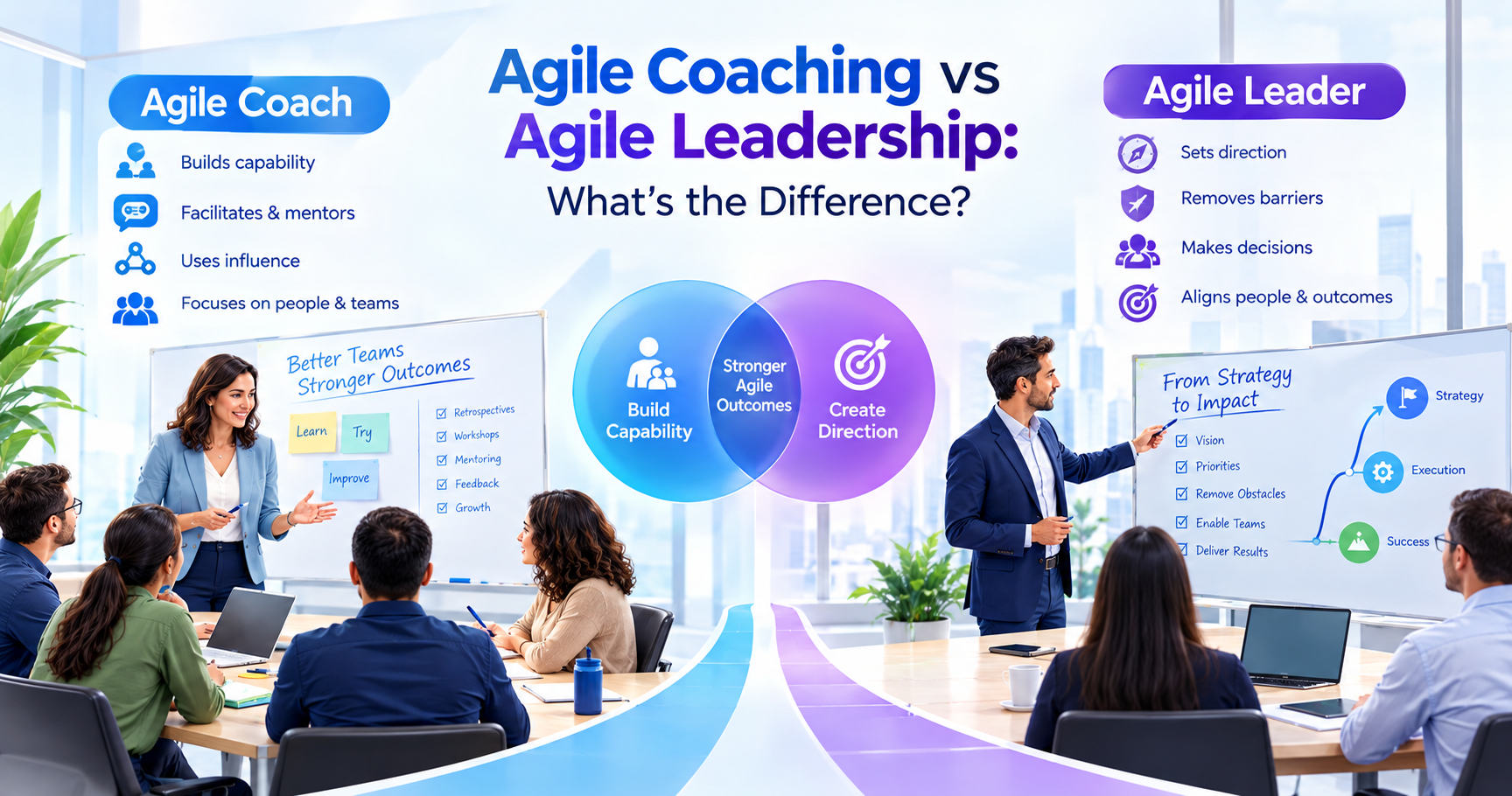
Agile coaching develops the capability of teams and leaders through facilitation, mentoring, and questioning, usually through influence. Agile leadership sets direction, removes organizational barriers, and makes decisions that align people around outcomes, usually with formal authority. The roles overlap, and strong Agile transformations need both.
Introduction: Why Agile Coach vs. Agile Leader Confusion Exists
Ask five people in the same company what an Agile coach does, and you may get five different answers. One will say the coach is a senior Scrum Master. Another will say the coach is a trainer who runs workshops. A third will say the coach is basically a manager with a friendlier title. Ask the same group about an Agile leader and the answers get even fuzzier, because "Agile leader" is rarely printed on a business card.
They are not interchangeable, and the Agile coach vs. Agile leader question matters in practice. Organizations that hire a coach when they need a leader end up with well-facilitated teams that still wait weeks for budget approvals. Organizations that appoint a leader when they need a coach end up with clear direction and teams that lack the skills or habits to act on it.
The core distinction is simple to state. Agile coaching develops capability: it helps individuals, teams, and leaders learn how to work in more adaptive ways, and it encourages them to find their own answers. Agile leadership establishes direction: it sets priorities, shapes the system people work in, removes organizational obstacles, and aligns people around outcomes. Comparing Agile coaching vs. Agile leadership is really a comparison between building the ability to change and creating the conditions and direction for change.
This guide explains both roles in plain language, compares them side by side, walks through five fundamental differences with workplace examples, and shows where they overlap. You will also learn how to tell which role your organization needs, what the career paths look like, and what current salary data says. Whether you are hiring, planning your career, or trying to untangle roles in your own organization, you will leave with a clear framework.
What Is Agile Coaching?
Agile coaching is the practice of helping individuals, teams, and organizations adopt Agile values, principles, and practices, and become more effective at them over time. Rather than telling people what to do, an Agile coach combines teaching, mentoring, facilitation, and professional coaching to build skills and self-awareness so teams can improve on their own.
Agile coaching typically happens in one of three contexts. In team coaching, the coach works with a single team on collaboration, planning, and delivery habits. In multi-team or program coaching, the coach helps several teams work together, often by improving dependencies, shared cadences, and communication. In enterprise Agile coaching, the Agile coach works with senior leaders and the wider system, including structures, incentives, and governance, that shape how the whole organization behaves.
An Agile coach works with a stance that is deliberately non-directive. The coach asks questions that surface assumptions, offers observations, holds up a mirror to team behavior, and teaches techniques when teams are ready for them. Sometimes the coach shifts into a more directive teaching mode, for example, when a team is brand new to Scrum or Kanban. The skill lies in knowing which stance fits the moment.
Core Responsibilities of an Agile Coach
The exact Agile coach responsibilities depend on the organization, but most roles include the following.
Responsibility | What the Agile coach does |
| Coaching teams and individuals | Helps team members, Product Owners, Scrum Masters, and managers reflect on how they work and try better approaches, in one-to-one conversations and in daily work |
| Facilitating key events | Facilitates or models retrospectives, planning, and workshops, then hands facilitation over |
| Teaching and mentoring | Teaches Agile and Lean concepts and mentors Scrum Masters and Product Owners on real work |
| Resolving conflict | Stays neutral, builds psychological safety, and helps people reach their own resolution |
| Driving continuous improvement | Uses data, retrospectives, and experiments, and watches the gap between stated values and actual behavior |
| Surfacing systemic impediments | Makes slow approvals, rigid funding, or conflicting priorities visible and works with leaders to address them |
| Building self-managing teams | Shifts decisions, ownership, and accountability toward the team over time |
A useful test for any coaching engagement: are the people being coached becoming more capable and independent? If not, the coaching may be drifting into consulting or dependency.
Read more: Agile Coach Skills and Competencies
Agile Coach vs. Scrum Master (Quick Clarification)
The Agile coach vs. Scrum Master question is one of the most common sources of confusion, and the two roles genuinely overlap. A Scrum Master is accountable for helping a Scrum team understand and apply Scrum, and in doing so, a Scrum Master coaches the team, facilitates events, and helps remove impediments. The Scrum Guide describes the Scrum Master as a true leader who serves the team and the wider organization. So a Scrum Master absolutely uses coaching skills.
Dimension | Scrum Master | Agile Coach |
| Typical scope | One team, sometimes two or three | Several teams, their leaders, and organizational systems |
| Framework focus | A defined framework, usually Scrum | Scrum, Kanban, Lean, product practices, team dynamics, organizational design |
| Core accountability | Helping the team understand and apply Scrum | Building agility capability across teams and leadership |
| Role of coaching | One part of the role | The core of the role |
The roles overlap but are not a strict hierarchy. An Agile coach is not simply a senior Scrum Master, because enterprise coaching requires working with executives and influencing without authority.
A quick way to remember it: a Scrum Master helps a team do Scrum well, while an Agile coach helps teams, leaders, and the organization become more agile in whatever way suits their context.
Read more: Agile Leadership vs Traditional Leadership: Key Differences
Key Skills of an Effective Agile Coach
The most valuable Agile coaching skills are people skills first and method knowledge second.
Skill | What it looks like in practice |
| Active listening and powerful questioning | Listens for what is not said and asks open questions such as "What would need to be true for this to work?" |
| Facilitation | Runs workshops and hard conversations so everyone is heard and decisions get made |
| Teaching and mentoring | Explains concepts clearly and knows when to teach and when to ask |
| Systems thinking | Looks at how structures, incentives, and handoffs produce the behavior seen |
| Conflict navigation | Separates positions from interests and makes disagreement productive |
| Change management | Understands resistance and builds momentum through small wins |
| Technical and domain awareness | Knows enough about engineering, product, and delivery flow to ask good questions |
| Self-awareness and humility | Helps others find their own answers instead of needing to be the smartest person in the room |
The benefits of Agile coaching show up in measurable and unmeasurable ways: higher team ownership, better predictability, fewer recurring problems, stronger collaboration, and leaders who understand how to support Agile teams. The caveat is that coaching changes behavior slowly and relies on the willingness of people to change. Coaching alone cannot overcome a system that punishes the behaviors being coached.
What Is Agile Leadership?
Agile leadership is a way of leading that creates the conditions for adaptability, collaboration, fast feedback, and continuous value delivery. Agile leaders set a clear direction and purpose, then empower teams to decide how to achieve it, remove barriers that get in their way, and make timely decisions when trade-offs require them.
Agile leadership is less about a methodology and more about a set of behaviors and decisions. Traditional management often relies on detailed plans, approval hierarchies, and control through oversight. Agile leadership shifts toward outcomes, transparency, experimentation, and trust. The leader still leads, and still decides, but spends more effort on context, clarity, and the health of the system than on directing task-level work.
Core Responsibilities of an Agile Leader
Agile leadership responsibilities usually include the following.
Responsibility | What the Agile leader does |
| Setting direction and purpose | Defines vision and priorities and keeps them stable enough for teams to act on |
| Empowering teams | Delegates decisions to people with the most information and sets clear boundaries |
| Removing organizational impediments | Uses authority and relationships to change approvals, dependencies, and policies that block value |
| Allocating resources and funding | Decides where people, budget, and attention go, increasingly funding long-lived teams over projects |
| Making decisions at the right level | Makes the calls only leaders can make, promptly, especially across team boundaries |
| Modeling Agile values | Shows transparency, openness to feedback, and willingness to learn from failure |
| Creating psychological safety | Makes it safe to raise problems so decision-making data reaches leaders |
The benefits of Agile leadership include faster decision-making, better alignment between teams and strategy, higher engagement, and greater organizational resilience when conditions change.
Where Agile Leadership Fits in the Org Chart
Agile leadership is a set of behaviors and responsibilities, not necessarily a formal job title. You will rarely find an "Agile Leader" box on an org chart the way you find a "VP of Engineering." Instead, Agile leadership is shown by people in many positions.
Who | How Agile leadership shows up |
| Executives | Translate strategy into outcomes and reshape governance, funding, and structure |
| Middle managers | Shift from assigning tasks to developing people and clearing obstacles. Example: a director builds a lightweight review path after three teams are blocked on the same security review |
| Product leaders | Set a quarterly outcome, such as faster customer onboarding, and let teams choose the experiments |
| Transformation and delivery leads | Carry leadership responsibilities for the Agile transformation program |
| Team members | Show leadership behaviors without formal authority, such as raising problems early |
A coach is usually an identifiable role with a job description. A leader is often someone in an existing position who is expected to lead differently, which explains why the two roles carry different levels of authority.
Key Skills of an Effective Agile Leader
The most useful Agile leadership skills tend to cluster into a few themes.
Skill | Why it matters |
| Strategic clarity and communication | Explaining the "what" and "why" so well that teams make good local decisions |
| Decision-making under uncertainty | Deciding reversible choices quickly and gathering evidence for irreversible ones |
| Empowerment and delegation | Setting guardrails and resisting the urge to take control back |
| Coaching and developing others | Growing people through questions, feedback, and stretch assignments |
| Creating psychological safety | Responding to bad news constructively so people keep bringing it |
| Systems thinking and organizational design | Changing structures, metrics, and policies that shape behavior |
| Resilience and adaptability | Changing course without losing credibility |
| Stakeholder influence | Aligning peers, executives, customers, and partners |
Note that many of these skills overlap with those of a coach. The difference is the context in which they are used. A coach uses them to build others' capability. A leader uses them to align and direct while carrying accountability for results.
Agile Coach vs. Agile Leader: Key Differences at a Glance
The quickest way to understand Agile coaching vs. Agile leadership is to compare the roles across a few dimensions. The comparison below describes typical patterns. Real roles vary by organization.
Comparison Table (Role, Focus, Scope, Authority, Outcome)
Dimension | Agile Coach | Agile Leader |
| Role | Advisor, teacher, facilitator, and mentor | Decision-maker, sponsor, and steward of the system |
| Primary focus | Capability development and continuous improvement | Direction, alignment, and business outcomes |
| Typical scope | Team, multiple teams, or organizational coaching | Team, department, business unit, or enterprise |
| Authority | Often relies on influence rather than line authority | May hold formal decision-making authority |
| Typical approach | Asks questions, facilitates, mentors, and challenges | Sets direction, empowers, aligns, and decides |
| Desired outcome | Stronger teams and improved Agile practices | Better adaptability, value delivery, and organizational performance |
These are typical patterns, not rigid definitions. An Agile coach can influence enterprise-level change, particularly when working directly with executives. An Agile leader can and should use coaching behaviors, such as asking questions before giving answers. And some organizations give coaches formal responsibilities that look a lot like leadership, such as running a transformation office.
5 Fundamental Differences Between Agile Coaching and Agile Leadership
The table gives an overview. The five differences below show how Agile coaching and Agile leadership diverge in everyday situations. For each, you will see the contrast, a realistic workplace example, and when each approach is the better fit. This section is also where the Agile coach vs. Agile leader distinction becomes practical.
Difference | Agile coaching | Agile leadership |
| 1. Handling conflict | Facilitates so the parties own the resolution | Decides when accountability, speed, or cross-team trade-offs demand it |
| 2. Shaping growth | Develops people and builds independence | Drives outcomes and points development at business priorities |
| 3. Using influence | Guides through questions and trust, often without line authority | Directs through formal authority and decision rights, ideally with an explanation |
| 4. Defining direction | Works on the "how" of improving | Owns the "what" and "why", the core Agile leadership responsibilities |
| 5. Collaborating with teams | Co-creates practices alongside teams | Inspires and enables by setting context and removing constraints |
1. Handling Conflict: Facilitating vs. Deciding
Example: Two product teams disagree about whether to build a shared component or let each team build its own version. The coach brings both teams together, helps them map the trade-offs, and facilitates a conversation that surfaces a shared concern about long-term maintenance. If the teams reach agreement, the coach's work is done. If they cannot, the engineering director steps in, weighs the cost and risk, and decides, explaining the reasoning so the teams understand it.
When each fits: Facilitation works best when the parties have the knowledge and standing to solve the problem and when buy-in matters. Deciding works best when time is short, stakes are high, the issue crosses boundaries, or the parties cannot agree. Effective leaders know that decisiveness does not require ignoring input, and effective coaches know that not every conflict resolves through conversation.
2. Shaping Growth: Developing People vs. Driving Outcomes
Example: A Scrum Master is struggling to help her team plan realistically. The coach works with her over several weeks, observing planning sessions, asking reflective questions, and suggesting experiments, with the goal of building her skill. Her manager, meanwhile, looks at the larger picture. He notes that the organization needs more experienced facilitators across its product lines in the next year, so he funds training for her and two peers and assigns her to a high-visibility program as a development opportunity.
When each fits: Coaching-led growth is ideal when the person or team is motivated, and the goal is long-term capability. Outcome-led development is needed when the organization faces a specific capability gap tied to strategy. Together they work well: leaders define which capabilities matter, and coaches help people build them. This also shows why Agile leadership skills increasingly include coaching ability.
3. Using Influence: Guiding vs. Directing
Example: A coach notices that a team's daily meeting has turned into a status report for the manager. She does not tell the manager to stop attending. She asks the team what the meeting is for, asks the manager what he hopes to learn, and helps both sides discuss alternatives. The manager decides to read the team board instead, and the meeting changes. In another scenario, a leader sees the same pattern across five teams and sets an expectation that managers will not run team events, and then explains why.
When each fits: Guiding builds ownership and works well when people have the capability to change. Directing is needed when a change must happen across the organization, when a policy blocks progress, or when a behavior is harmful. A coach who lacks authority should not pretend to have it, and a leader who relies purely on authority should not expect people to become self-managing.
4. Defining Direction: The "How" vs. the "What/Why"
Example: A leader announces that the company's top priority this year is reducing customer churn in the first 90 days, and explains the financial case. Teams now know what matters and why. A coach then works with those teams on how to organize around that goal: how to shorten feedback loops with customers, how to run discovery experiments, how to coordinate across teams working on onboarding.
When each fits: When teams are unclear on priorities, no amount of coaching on practices will fix the confusion; that is a direction problem. When teams know the goal but struggle to execute effectively, that is more of a capability problem, and Agile coaching is the better answer. Many organizations mistake one for the other and apply the wrong remedy.
5. Collaborating with Teams: Co-Creating vs. Inspiring/Enabling
Example: A coach spends a quarter embedded with a platform team, running experiments on work-in-progress limits, refining their definition of done, and adjusting based on each retrospective. The group's head of engineering is present differently: she explains why platform reliability is a strategic priority, secures headcount, and removes a long-standing approval step that was slowing the team's releases.
When each fits: Co-creation works when teams need hands-on support while they build new habits. Inspiring and enabling works when teams are capable and need clarity and unobstructed space. In the Agile coaching vs Agile leadership debate, this difference is a useful reminder that proximity and presence are different from authority and accountability.
Taken together, these five differences show a pattern. The coach works mostly through the people and the practices. The leader works mostly through the direction and the system. Each difference is also a place where the two roles hand work to each other, which the overlap section later in this guide explores.
Scope of Impact: Team-Level vs. Organization-Level
Scope is one of the clearest practical differences between the roles, and it is also where the lines blur most. Both Agile coaches and Agile leaders can work at the team level or across the organization, but they do so differently, and the work required for an Agile transformation at scale looks very different from helping one team improve.
How Agile Coaches Operate Across Teams
A coach's scope usually grows in stages. Many start with one team, then widen to a group of teams, then to leaders and the structures around them. Enterprise Agile coaching is the most senior form of this progression, and it requires skills that differ from team coaching.
When an Agile coach works across teams, the focus shifts from team habits to the relationships and flows between teams. Typical work includes:
- Improving feedback loops: Helping teams and stakeholders see results sooner, for example by aligning review cadences, sharing customer data, or reducing the time between a decision and its outcome.
- Addressing systemic impediments: Identifying patterns that repeat across teams, such as long approval chains, unclear dependencies, or tool constraints, and bringing evidence to the leaders who can act on them.
- Supporting team-of-teams collaboration: Helping several teams coordinate planning, integration, and release without recreating heavy bureaucracy.
- Developing leaders and coaches: Coaching managers and executives on how to support Agile teams, and growing Scrum Masters and team coaches within the organization.
- Supporting changes in ways of working: Helping the organization try new structures, metrics, and rhythms, and learn from the results.
Enterprise Agile coaching also involves a particular discipline: staying credible with both teams and executives. A coach who only works with teams may never get leaders to change the conditions that cause the problems. A coach who only works with executives may lose touch with reality. The best enterprise coaches move between both, and they translate the experience of each side for the other.
How Agile Leaders Operate Across the Enterprise (SAFe, LeSS, Disciplined Agile)?
At enterprise scale, Agile leadership is concerned with aligning strategy, funding, governance, and execution. Leaders decide how the organization is structured, how work is funded, which outcomes matter, and how teams coordinate. Several scaling approaches describe what leaders should do, and they differ in important ways, so it helps to treat them as distinct rather than interchangeable.
Agile leadership in SAFe: The Scaled Agile Framework (SAFe) places leadership at the center of its approach. SAFe treats Lean-Agile leadershipas a core competency of the enterprise and expects leaders to model Lean-Agile values, develop people, and lead the change. Within SAFe, Agile leadership includes sponsoring the transformation, participating in portfolio and planning activities, funding value streams instead of isolated projects, applying Lean governance, and removing organizational impediments that teams escalate. In SAFe, executives and managers are expected to learn the framework themselves, often through leadership-oriented training such as Leading SAFe, so they can lead by example. SAFe is the best-known setting for the phrase Agile leadership in SAFe, and it is also the approach with the most explicit leadership structure among the three.
Approach | Leadership emphasis | What leaders are expected to do |
| SAFe | Lean-Agile leadership as a core competency | Sponsor the transformation, fund value streams, apply Lean governance, and act on escalated impediments |
| LeSS | Minimal structure, whole-product focus | Act as teachers who improve the system, with fewer management layers |
| Disciplined Agile | A toolkit of options chosen by context | Create conditions for teams to choose and evolve practices while managing governance and risk |
All three agree on the essentials: leaders change their own behavior, fund work to support flow and learning, act on impediments teams surface, and stay visibly engaged in the Agile transformation.
The contrast with coaching at this level is clear. An enterprise coach helps leaders and teams learn and adapt, while the enterprise leader decides on structures, funding, and governance. If the leader will not change the structures, the coach can describe the problem but cannot fix it. If the coach is absent, the leader may change the structures without the capability building that makes them work.
Where Agile Coaching and Agile Leadership Overlap
For all the differences above, Agile coaching and Agile leadership share a great deal of ground. Both rely on trust, transparency, and learning. Both ask people to work differently from the way many organizations were designed to work. And both depend on the other to succeed. Understanding the overlap is as important as understanding the differences, because it prevents the mistake of treating the two as rivals.
Shared Goals: Business Agility and Team Performance
The coach and the leader pursue the same underlying goals, even though they use different tools.
Shared goal | How the coach contributes | How the leader contributes |
| Continuous improvement | Builds retrospective and experimentation habits | Acts on what improvement efforts uncover |
| Adaptability | Teaches teams to respond to change | Shapes structures and funding so change is possible |
| Collaboration | Reduces silos within and between teams | Aligns teams and removes cross-boundary barriers |
| Team effectiveness | Develops skills and ownership | Provides clarity, resources, and safety |
| Value delivery | Improves flow and feedback loops | Directs priorities toward outcomes |
These goals add up to what many people call business agility: the ability of the whole organization to sense and respond to change. In an Agile transformation, coaches and leaders contribute different parts of that ability. Coaches build the skills, habits, and mindset. Leaders set the direction, structure, and priorities. The benefits of Agile coaching, such as stronger teams and better practices, and the benefits of Agile leadership, such as alignment and faster decisions, reinforce each other when both are present.
One scenario shows how this works. A team of developers and designers uses retrospectives to raise a recurring problem: every release waits two weeks for an external compliance review. The Agile coach helps the team gather data on the delay, quantify its impact, and frame the issue clearly instead of complaining about it. The coach then helps the team bring the evidence to its department head. The Agile leader meets with the compliance group, agrees on a faster process for low-risk changes, and communicates the new policy to every team. The coach surfaced the impediment, and the leader removed the barrier. Neither could have produced the outcome alone.
Why Neither Role Works Well Without the Other
The Agile coach vs. Agile leader debate sometimes assumes an organization must choose one. In practice, each role has a typical failure mode when it works alone.
Setup | What typically goes wrong |
| Coaching without leadership support | Teams run retrospectives that change nothing, coaches burn out, and Agile starts to look like a ritual |
| Leadership without coaching support | Empowered teams lack the skills to act, and leaders conclude empowerment fails and return to control |
| Both roles at cross-purposes | A coach encourages self-organisation while a leader keeps making task-level decisions, sending contradictory signals |
This is why Agile coaching vs Agile leadership is better treated as a partnership than a competition. Neither role is automatically superior. Their value depends on the organization's needs, the authority they hold, and the skills they bring. A mature Agile transformation typically pairs leaders who sponsor and model change with coaches who build capability and surface what is really happening.
Agile Coach vs. Agile Leader: When Do You Need Each Role?
In practice, most organizations do not ask whether coaching or leadership is better in the abstract. They ask what is going wrong and who can fix it. The Agile coach vs. Agile leader decision becomes much easier when you look at observable symptoms. The signs below help you match a problem to a role, which is also a useful starting point for any Agile transformation plan.
Signs Your Organization Needs an Agile Coach
An Agile coach is likely to help when the main problem is capability, habit, or understanding. Common signs include:
Sign | What you will observe |
| Teams struggle with collaboration | Work is handed off instead of shared, silos persist, and the same arguments recur |
| Retrospectives produce no change | Problems are listed, and nothing is done differently |
| Conflict stays unresolved | Tension lingers because nobody has the skill or neutrality to work through it |
| Practices are followed mechanically | Meetings are held and boards updated, but nobody can explain why |
| New Scrum Masters or Product Owners lack support | Roles were assigned without the mentoring needed to grow into them |
| Leaders and teams misunderstand each other | Managers ask for the wrong things, such as individual utilization |
Typical Agile coaching examples that address these signs include embedding with a team for a quarter to improve its planning and retrospectives, running a facilitation workshop for Scrum Masters, coaching a Product Owner on backlog refinement, or helping a group of managers learn how to support self-managing teams. In each case, the problem is mainly one of skills and habits, and the solution is to build capability.
Signs Your Organization Needs an Agile Leader
An Agile leader, or stronger Agile leadership from existing leaders, is likely to help when the main problem is direction, structure, or authority. Common signs include:
Sign | What you will observe |
| Priorities conflict | Teams get contradictory demands, and nobody resolves them |
| Decisions are delayed | Choices wait for approvals from people far from the work |
| Teams lack autonomy | Teams are told in detail how to do their work |
| Structures block value delivery | Funding, reporting lines, or governance force slow handoffs |
| The same impediments return | Teams escalate one issue repeatedly, and nobody with authority owns it |
| There is no shared vision | Teams are busy but cannot connect their work to organizational goals |
These problems cannot be solved by coaching alone, because they sit in the domain of decisions, resources, and organizational design. The Agile leadership responsibilities of setting direction, removing barriers, and making timely decisions are the ones that need to be exercised. A coach can describe the situation and advise, but only someone with authority can resolve it.
Can One Person Do Both?
Yes, but with care. Some people do combine coaching and leadership. A head of engineering might coach her managers while also setting technical direction. An internal transformation lead might coach teams while also holding decision rights over the Agile program. The combination has real benefits and real risks.
Aspect | Detail |
| Potential benefits | Capability work and structural work connect, problems found through coaching get acted on quickly, and the person is credible with both teams and executives |
| Potential risks | Role confusion, less candor if the coach also controls performance or budget, overload, and defaulting to directing |
| How to make it work | Say which role you are playing at any moment, separate coaching from performance conversations, and give direct reports an independent coach |
This question also shows why leaders benefit from developing coaching skills and why coaches benefit from understanding leadership pressures. The goal of Agile coaching vs Agile leadership clarity is not to build walls between the two, but to ensure that people know which hat they are wearing.
Career Path: Becoming an Agile Coach vs. an Agile Leader
If you are considering a career in this space, the two paths overlap early and then diverge. Neither path is better in general. The right choice depends on what you enjoy: developing people and systems through influence, or carrying accountability for direction and outcomes.
How to become an Agile Coach
Most Agile coaches build up through hands-on experience in Agile environments. Common starting points include Scrum Master, Product Owner, project or delivery manager, business analyst, or an engineering or testing role with strong collaboration experience. From there, aspiring coaches deepen their skills in facilitation, mentoring, professional coaching, systems thinking, and change management. They practice coaching real teams, seek feedback from experienced coaches, and often join a community of practice. Many coaches also build breadth by learning Lean, Kanban, product management, and engineering practices, because credibility with teams depends on understanding their work.
Read more about how to become an Agile Coach
How to become an Agile Leader
The path to Agile leadership typically goes through people leadership and organizational responsibility. Common routes include managing teams, leading delivery or product areas, running programs, and holding responsibility for strategy and results. Aspiring Agile leaders develop experience in organizational change, budgeting and funding, stakeholder management, and decision-making under uncertainty. They also learn to lead through trust rather than control, which often means unlearning habits that earlier roles rewarded. Because Agile leadership is a set of behaviors, people can begin practicing it long before they hold a senior title.
Certifications and Training (e.g., ICAgile Agile Coaching, Leading with Agility)
Certifications can support learning, signal commitment, and help you get interviews, but they do not guarantee competence or employment. Hiring managers generally care more about evidence of impact than about a list of acronyms. Choose training that includes practice and feedback, not just lectures.
Path | Examples to explore | Focus |
| Agile coaching certification | ICAgile Agile Coaching certification track through accredited providers; Scrum Alliance team and enterprise coach programs; International Coaching Federation credentials | Coaching and facilitation stances, teaching, mentoring, and coaching craft |
| Agile leadership | Scrum Alliance agile leadership offerings; Leading SAFe; ICAgile leadership learning paths; "Leading with Agility" style programs | Leadership mindset, organizational design, and outcome-based management |
Program names, levels, prerequisites, and providers change over time, so verify the current names and requirements directly with each certifying body before you enroll or before you publish any recommendation.
Typical Career Progression for Each Path
Career titles vary widely, so treat the following as typical patterns rather than fixed ladders.
Stage | Agile coaching path | Agile leadership path |
| Early | Team member or Scrum Master | Team lead or manager |
| Mid | Senior Scrum Master, team coach, or Agile coach across several teams | Senior manager, or product or delivery head |
| Senior | Enterprise or transformation coach | Director or VP |
| Top | Principal coach, head of Agile practice, or independent consultant | Executive roles such as Chief Product Officer or COO, or business agility leader |
| Scope | Grows from one team to leaders and the wider system | Grows from a team to a department to the enterprise |
Crossovers are common. Coaches sometimes move into leadership roles when they find they want authority over the changes they have been advising on. Leaders sometimes move into coaching or consulting when they prefer working through influence. Both moves benefit from the experience gained on the other side.
Salary and Demand Comparison
Salary is one of the most searched topics about these roles, and also one of the most misleading, because figures vary enormously by source, title, location, industry, seniority, and whether the number reflects base pay or total compensation. Treat everything below as a dated snapshot, not a guarantee.
Source (2026) | Region | Agile coach figure | Note |
| Payscale | United States | About $143,000 average base | Most base salaries about $99,000 to $192,000 |
| Payscale | Canada | About C$121,000 average base | Bonus and profit sharing extra |
| Morgan McKinley | Sydney | About A$190,000 average | Recruiter salary guide |
| Morgan McKinley | Toronto | About C$120,000 average | Recruiter salary guide |
| Salary.com | United States | About $47,000 average | Filed under the title "Agile and DevOps Coach", showing how titles change the data |
Agile leadership salary
The Agile leadership salary question is harder to answer because "Agile leader" is rarely a formal job title. Pay depends on the actual position, such as engineering manager, director of delivery, head of product, VP of engineering, or transformation lead, and on seniority, industry, and region. For this reason, no single number describes Agile leadership pay, and you should research the specific title you are targeting. In general, senior leadership positions with broad organizational accountability tend to sit at higher compensation levels than individual-contributor coaching roles, while senior and principal enterprise coaches can earn comparably to many director-level leaders, particularly in consulting.
Demand
Demand for both roles tends to follow the investment organizations make in Agile transformation and business agility, and it fluctuates with economic conditions. Many organizations reassess coaching roles when budgets tighten, while leadership roles tend to be more stable because they are tied to line accountability. Demand is generally strongest for people who combine coaching skill with business, technical, or organizational depth, rather than for framework knowledge alone.
Common Misconceptions About Agile Coaches and Agile Leaders
Several persistent myths muddy the Agile coach vs. agile leader conversation. Here are the most common, each with a correction.
Misconception | Reality |
| An Agile coach is simply a senior Scrum Master | The roles overlap, but a coach works across teams, leaders, and systems with a broader toolkit |
| An Agile leader must have a formal management title | Agile leadership is a set of behaviors; formal authority helps with structures and budgets, but people at many levels show it |
| Coaches never challenge decisions, and leaders never coach | Good coaches challenge respectfully and directly, and good Agile leaders use coaching behaviors regularly |
| Agile leadership means leaving teams without direction | Empowerment depends on clear purpose, priorities, and boundaries; abdication is not agility |
| An Agile transformation can succeed through coaching or leadership alone | Coaching hits structural limits, and leadership hits capability gaps; sustainable change needs both |
| One role is more important than the other | Value depends on the organization's need: wrong structure calls for a leader, weak habits call for a coach |
Conclusion: Choosing the Right Role for Your Agile Transformation
The difference between Agile coaching and Agile leadership comes down to the kind of contribution each makes. An Agile coach develops capability, helping teams and leaders learn to work in more adaptive ways through questions, facilitation, and mentoring, usually through influence. Agile leadership provides direction and shapes the system, setting priorities, removing barriers, and making decisions, usually with formal authority.
The roles complement each other. Coaches surface what is really happening and build the skills to change it, and leaders create the conditions and make the structural changes that let those skills matter. Most successful Agile transformation efforts include both, and the best practitioners in either role borrow from the other.
A practical decision principle: ask what the main need is. If teams lack skills, habits, or shared understanding, invest in coaching. If teams are blocked by unclear priorities, slow decisions, or structures they cannot change, invest in leadership. If you see both, start with both, and make sure they work together.
If you remember one idea from the comparison of Agile coaching vs Agile leadership, let it be this: coaching builds the ability to change, leadership creates the direction and the room to change, and your organization needs to know which one it is missing.







 Lowest-Price Challenge












 Personalized Path



.webp)


 USA
 Canada
 India
 UK
 Australia
 Singapore


